
Hotel Cross-Selling Without Guest Fatigue: How to Recommend Services Without Overwhelming Guests

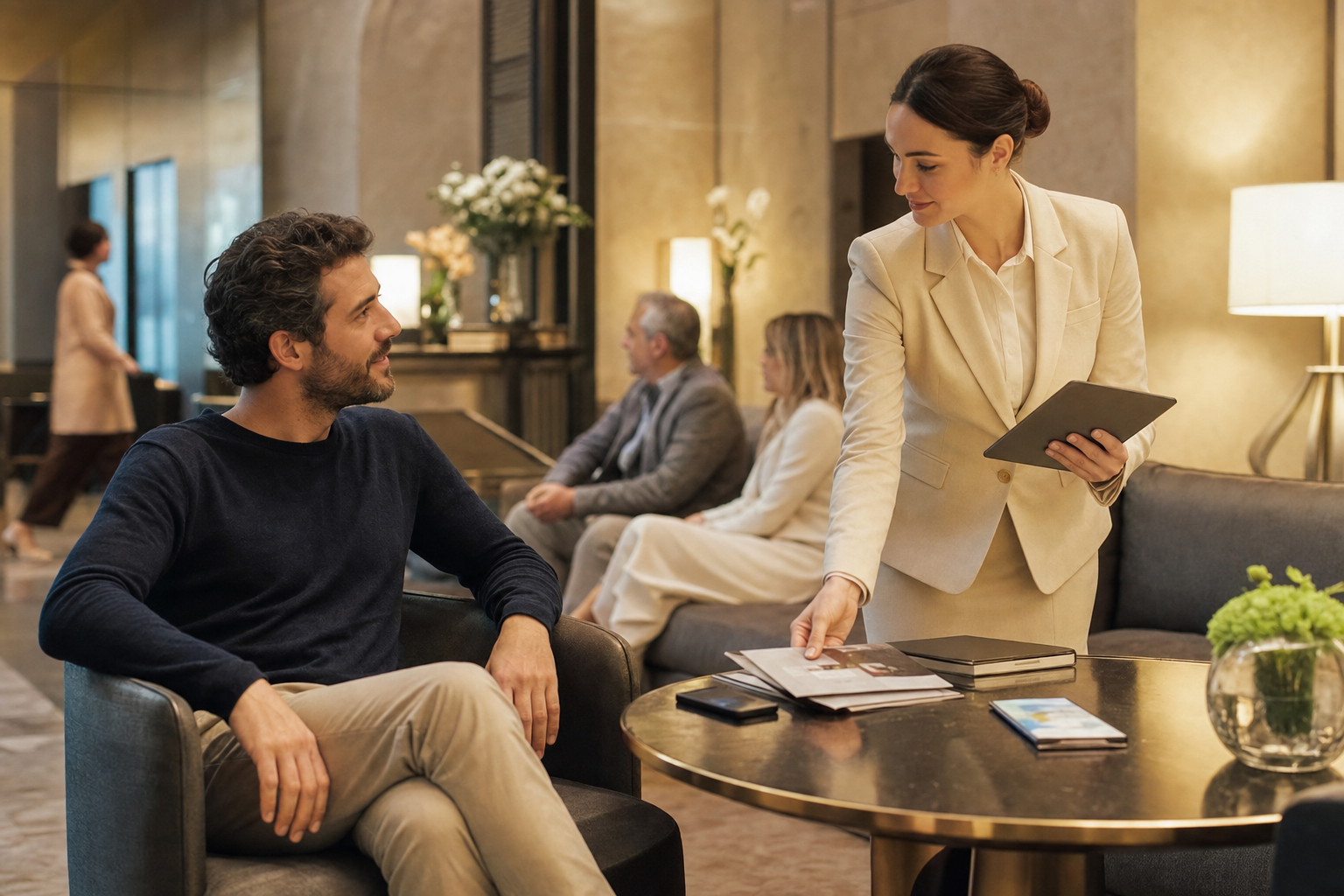

The scene repeats itself with a frequency that should concern us. A guest books a room and, before even unpacking, has already received an invitation to arrange a transfer, reserve a table, visit the spa, upgrade breakfast, join an activity, book a treatment and extend their departure time. Every message may be well written, every service may be reasonable, and every department may argue that it is simply doing its job. Yet together, they turn a stay that promised rest into an almost constant commercial conversation.
I have found that many hotel cross-selling problems stem from a seemingly minor confusion: we assume that offering more increases our chances of selling. That logic works when we look at each campaign in isolation, but it falls apart when we consider the complete experience. Marketing sees an email, Front Office sees a conversation, Food and Beverage sees an invitation, Spa sees an opportunity and Guest Relations sees a reminder. The guest, however, does not perceive departments; they perceive a hotel asking for their attention again.
Selling ancillary services is a legitimate and necessary part of the business. In many properties, the room initiates the commercial relationship, while food and beverage, wellness, activities, transfers, parking and local experiences broaden the value of the stay and support an important share of hotel profitability. Refraining from recommending them would be just as unwise as promoting them indiscriminately. The professional challenge is to determine when a proposal helps the guest enjoy their stay more fully and when it begins to treat them as a platform for a campaign.
Attention is also part of hospitality. A traveller may have the budget to dine at the hotel and still not wish to receive three reminders. They may appreciate a treatment recommendation after a long journey, yet interpret the same proposal as intrusive if it arrives while they are trying to resolve an issue. They may even be interested in several services and prefer to discover them at their own pace. In Hospitality, we should begin to regard the right to commercial silence as a component of the experience, particularly in hotels that promise rest, privacy, serenity or personalised service.
My approach begins with a discipline that is easy to explain and considerably harder to practise: every recommendation must justify the attention it consumes. To achieve this, the hotel must interpret a genuine signal, choose an appropriate moment, verify that the service can be delivered and present a specific proposal without subsequent insistence. The best cross-selling is not that which places the greatest number of offers in front of the guest, but that which makes a single recommendation feel like timely assistance and creates value for the guest, margin for the hotel and a reasonable operational workload for the team.
Guest attention is a limited inventory that hotels can also exhaust
In hotel management, we have learned to treat rooms, tables, treatment rooms, parking spaces and the available hours of certain professionals as inventory. We know that limited capacity loses value when it is allocated poorly. Curiously, we pay far less attention to another equally scarce resource: the guest's willingness to listen to us, interpret a proposal and make a decision.
Every commercial contact consumes a small amount of that resource. Reading an email takes time; closing a pop-up requires an action; answering a question at Front Desk interrupts thought; declining a proposal requires taking a position. None of these efforts appears serious in isolation. Friction emerges through accumulation, especially when the guest has to decline similar services several times or receives messages that disregard what they have already decided.

It is important to distinguish between commercial visibility and commercial pressure. Visibility allows guests to discover a service when they need it: an accessible menu, a clear explanation in the room, a natural conversation or a discreet prompt in the right place. Pressure, by contrast, pursues a response. It creates unnecessary urgency, repeats the offer, intrudes on sensitive moments or uses different channels to insist on the same opportunity.
I have seen hotels where a guest declined a restaurant reservation at check-in and received a promotional Food and Beverage message that same afternoon. The following morning, they found a card on the breakfast table and, a few hours later, someone asked again whether they had made dinner plans. Nobody was trying to bother them. The problem was more serious: the hotel lacked shared commercial memory. Each department began the conversation from scratch and turned its internal lack of knowledge into work for the guest.
I call this phenomenon offer collision. It arises when several reasonable initiatives compete for the same moment, the same channel or the same attention capacity. Its origin is usually found in independent departmental objectives. The spa needs to increase treatments, Food and Beverage wants to grow covers, Marketing seeks conversions and Front Office has a sales incentive. Everyone optimises their own metric, while no one governs the total commercial load of the stay.
Collisions create costs that rarely appear in ancillary sales reports:
- Decision fatigue: every new proposal requires the guest to compare, accept, decline or postpone. One simple offer may be useful; a succession of alternatives turns rest into a list of unresolved tasks. The more decisions we ask for, the less attention remains for recommendations that could genuinely add value.
- Loss of perceived relevance: when the hotel offers everything to everyone, the guest understands that the supposed personalisation is merely mass distribution. The proposal stops meaning “we have thought about you” and starts meaning “we need to sell this”.
- Service cannibalisation: two departments may compete for the same budget, the same time slot or the same consumption occasion. Promoting a special dinner, an outdoor experience and an afternoon treatment simultaneously does not necessarily multiply demand; it may disperse it or prevent a decision altogether.
- Positioning erosion: a hotel that promises tranquillity while maintaining insistent promotional communication introduces a contradiction into its brand. In luxury, wellness or romantic escape segments, that contradiction can be particularly costly because silence and privacy are part of the product purchased.
- Operationally toxic selling: a campaign may increase bookings for a service that is already close to its limit, concentrate demand in a difficult time slot or sell an experience that the team will deliver under pressure. Revenue appears in the commercial report; waiting times, stress and potential compensation are distributed across other departments.
- Misguided learning: if we measure only opens, clicks and sales, we will interpret as success a campaign that may have sold anyway through natural demand. We may also conclude that we need to insist more when low conversion is caused by a poor offer, incorrect timing or insufficient capacity.
The first correction is to stop counting messages alone and begin measuring the commercial load of the stay. Not all contacts carry equal weight. A verbal recommendation prompted by a guest's question creates hardly any pressure, whereas an unsolicited message, repeated through another channel and accompanied by artificial urgency, has a far greater attention cost.
I would classify contacts into four levels. The first is passive discovery: information available for the guest to consult on their own initiative. The second is commercial response: a recommendation made after the guest expresses a need. The third is the contextual proposal: the hotel identifies a sufficiently strong signal and offers a specific solution. The fourth is the promotional push: the offer originates from the hotel's need to sell, rather than from an observable guest need.
The first two levels should make up most of the system. The third requires judgement. The fourth may make sense in specific situations—for example, a genuinely exceptional opportunity compatible with the nature of the stay—but it should be used cautiously. When pushing becomes the habitual way of selling, the organisation ends up depending on frequency and stops improving the quality of its proposition.
We also need to declare protected moments. Not every point of contact is a commercial opportunity. An arrival after a long journey, the resolution of a complaint, a conversation about a medical need, a queue, a late-night call or the minutes before a transfer are not appropriate spaces to introduce a sale. Guest vulnerability should never become a commercial advantage.
This rule appears obvious until it conflicts with an incentive. If we reward the team for every service sold without considering the context, we are communicating that conversion matters more than judgement. We then ask for empathy in training sessions and are surprised when actual behaviour follows the reward system. In hospitality leadership, what we measure and recognise teaches far more powerfully than any presentation on service culture.
There is another tension that deserves attention. A guest who declines an offer is not always declining the service. They may be declining the timing, the price, the presentation, the lack of information or the obligation to decide immediately. Interpreting every “not now” as an invitation to insist later is a dangerous practice. Hospitality needs sufficient memory to distinguish between a closed decision and a deferred opportunity.
For that reason, I recommend establishing a commercial closure rule: when a guest clearly declines a proposal, that offer is no longer active unless a new signal initiated by the guest emerges. The hotel may keep the service visible, but it should not continue pursuing the conversion. At times, the best demonstration of personalisation is precisely remembering what the guest does not want.
Pressure does not depend solely on the number of messages, either. It depends on the interval between them, the variety of channels, the tone used and the emotional moment. Two communications distributed with judgement can be more respectful than a single message packed with nine offers. This is why I distrust emails that present breakfast, the spa, the restaurant, transfers, parking and half the surrounding region under the enthusiastic heading of “personalise your stay”. That is not always personalisation; it is often a catalogue with the guest's name in the header.
A well-designed catalogue remains useful, provided it is recognised as such. It allows guests to explore options, compare and decide without interaction. The difficulty arises when we confuse the availability of information with a personal recommendation. Recommending means selecting. If we present every alternative, we transfer the work of interpretation to the guest. If we choose one with sound judgement, we assume the professional responsibility of guiding them.
This distinction requires us to accept an uncomfortable concession: some services will not be promoted during certain stays. The hotel will not be wasting opportunities; it will be preserving attention for those most likely to improve the experience and generate contribution. Mature hotel strategic planning is not about filling every possible gap, but about protecting the resources that sustain future value.
One relevant recommendation: the system that turns context into value
To bring order to cross-selling, I use one central idea: a stay should have only one active recommendation at a time. This does not mean limiting the guest to a single service or concealing the rest of the offer. All products can remain accessible for consultation. What is limited is the hotel's commercial initiative: we select the opportunity with the greatest utility, observe the response and prevent other departments from launching competing proposals while that decision remains open.
The active recommendation should pass three tests before reaching the guest: signal, timing and capacity. If any one of them fails, I prefer to refrain. That restraint is not passivity; it is commercial discipline.
- Sufficient signal: there must be an observable reason to believe the service is a fit. The booking composition, declared reason for travel, a question, a known preference, arrival time, length of stay or a conversation can all offer clues. A generic guest classification is not enough. Two couples booking the same room type may be seeking entirely different experiences.
- Appropriate timing: the recommendation must appear when the guest can understand it and act on it. Offering a treatment before they know their schedule may be premature; doing so when no useful appointment times remain comes too late. The right commercial moment usually coincides with the emergence of a need, not necessarily with the customer journey stage shown in our campaign calendar.
- Confirmed capacity: the service must be available under conditions that allow the promise to be fulfilled. I do not recommend selling the last table in an overloaded time slot, a transfer with excessively tight timings or an activity whose quality depends on an uncertain forecast. Cross-selling creates value only when operations can absorb it without compromising the experience of that guest or others.
These three tests form what I call the useful recommendation triangle. Its simplicity makes it suitable for Front Office, Reservations, Food and Beverage, Spa, Guest Relations or any point at which an opportunity emerges. It also prevents cross-selling from becoming a skill reserved for particularly persuasive people. The goal is not to create aggressive salespeople, but to develop professionals able to observe, select and advise.
Consider a family arriving before the expected time, with tired children and several hours to fill before an activity they have already booked. Offering a lengthy children's experience may not fit, even if the family profile appears in the system. Recommending a simple lunch option, explaining an available quiet space or facilitating a short activity may create far more value. The commercial category of “family” provides direction, but context makes the decision.
Something similar happens with a person travelling for work who asks where they could dine late. Reciting every dining option in the hotel adds information, but does not necessarily help. A professional response would select the alternative compatible with their schedule, the time available and the level of formality they seek. If we can reserve it at that moment, the recommendation becomes a solution.
A good proposal should contain four elements: the reason, the benefit, the evidence and an easy way out. The reason explains why we mention it; the benefit connects with the need; the evidence provides confidence about availability, duration or conditions; and the easy way out allows the guest to decline without having to justify themselves.
The difference is apparent in the language. “Would you like to book our spa?” requires the guest to decide about a generic service. “As you mentioned that you are arriving after a long flight, we have a fifty-minute treatment available this afternoon designed to ease tension in the back and legs; if you would rather decide later, I can show you where to check the times” offers context, utility and freedom. The second wording may sell more, but above all, it sells better.
The easy way out is essential. When a recommendation makes refusal difficult, it creates a small emotional debt. Guests may accept out of courtesy, especially in face-to-face interactions, and end up consuming something they did not want strongly enough. That sale will be recorded as a conversion, even though it may diminish their perception of value. In Hospitality, it is worth remembering that a “yes” does not always equal satisfaction.


My published books
To decide which proposal deserves to become the active recommendation, I use a brief matrix of five questions:
- What specific need does it solve? If the answer is vague—“it improves the stay”, “it is a special experience” or “guests tend to like it”—we have not yet identified sufficient value. The recommendation should save time, reduce uncertainty, facilitate rest, enhance a celebration, solve a practical need or enrich a demonstrated interest.
- Why this offer rather than another? Choosing requires comparing opportunities. The restaurant may generate more gross revenue, but the transfer may deliver greater utility and margin. The spa may have availability, yet a local activity may better fit the purpose of the trip. The decision should consider the guest and the business, in that logical order, though not necessarily in a sentimental one.
- Can we deliver it consistently? Before promoting a service, we must review schedule, occupancy, staffing, conditions and potential bottlenecks. Selling capacity the hotel does not possess is a remarkably creative way to turn ancillary revenue into additional complaints.
- Is there a better moment? A relevant proposal can fail by arriving too early or too late. If the decision is not urgent, we can keep it visible and wait for a clearer signal. The hotel's commercial anxiety should not determine the rhythm of the stay.
- What will happen if the guest says no? The right answer should be simple: we will record the refusal, close the opportunity and continue serving with the same naturalness. If the plan is to try again through another channel, we are not respecting a decision; we are looking for a crack in it.
This model changes the role of departments. Marketing stops being merely a producer of campaigns and takes responsibility for designing a contact architecture. Revenue contributes demand, availability and economic-value criteria. Operations validates actual capacity and identifies signals during the stay. Each service defines the need it solves, the guest for whom it is particularly useful and the conditions under which it should no longer be promoted.
Coordination requires a recommendation owner. I do not mean taking ownership of the revenue, but taking responsibility for the next step. If Reservations has presented an experience and the guest is considering it, Front Office should know to avoid another incompatible proposal. If the guest declines the service, the opportunity must be closed for everyone. If they accept, the hotel moves from selling to delivering, which is where the truly important part begins.
I also recommend creating a commercial attention budget for each stay. There is no need to turn it into a complex algorithm. It can begin with very clear rules: a maximum of one proactive proposal before arrival, no repetition of declined offers, only one active recommendation, no selling during service recovery situations, and suppression of promotional messages when the guest has already booked sufficient services or has expressed a preference for privacy.
The budget should not be applied identically across all segments. A short stay has fewer useful windows and lower tolerance for interruption. A long-stay resort can facilitate more discovery, although that does not authorise turning every day into a service fair. The corporate guest may value practical, quick solutions. A couple on a getaway may welcome a carefully selected recommendation and reject any communication that disrupts intimacy. Frequency depends on context, but the principle remains: every contact must earn its right to exist.
A simple map can help teams decide:
| Observed signal | Possible recommendation | Appropriate timing | Reason to refrain |
|---|---|---|---|
| Late arrival and a question about dinner options | An available dining alternative compatible with the schedule | In the same conversation, with the option to book immediately | Kitchen close to closing, long waiting time or reduced service not explained |
| A celebration communicated in advance | A specific experience connected to the occasion | Before arrival, with a reasonable amount of time to decide | The proposal is generic, excessive or repeats something already booked |
| Explicit interest in rest and wellbeing | A treatment or access option suited to the time available | When appointment times are confirmed and there is room to organise the schedule | Capacity is full, therapist is unconfirmed or the time slot is inconvenient |
| A family asking about nearby activities | An option compatible with ages, duration and travel requirements | After clarifying what they are looking for and how much time they have | Uncertain weather, complex logistics or lack of suitability for children |
| Early departure or uncertain transport | A transfer, adapted breakfast or logistical solution | Far enough in advance to reduce uncertainty | The hotel cannot confirm punctuality, conditions or availability |
The table reveals an important point: restraint is part of the method. Teaching people how to recommend without teaching them when to remain silent creates teams that are friendly, well intentioned and commercially exhausting. Professional judgement is demonstrated both in the proposal that is made and in the one that is discarded.
Training should move beyond some of its obsession with closing phrases and focus on interpreting signals. I would work with real cases from the hotel: an early arrival, an undecided family, a returning guest, a one-night stay, a celebration, an open issue or a service close to its limit. I would ask the team to identify what to recommend, when to do it, who should do it and under what circumstances silence would be preferable.
This training offers an additional advantage: it develops economic judgement. The highest-priced service does not always produce the best contribution. We must consider variable cost, commission, team hours, consumables, compensation risk, displacement of other demand and added complexity. A well-coordinated transfer may generate less revenue than a dinner, but deliver better margin, resolve a genuine concern and strengthen trust in the hotel.
For that reason, I would avoid measuring success solely through ancillary service revenue. A useful dashboard should include several indicators:
- Net contribution per accepted recommendation: deducts direct costs, incentives, commissions and associated operational workloads. It distinguishes a sale that looks attractive in revenue terms from one that is genuinely profitable.
- Contextual acceptance rate: compares recommendations made in response to a specific signal with generic proposals. If the former do not convert better, either the signals are being misinterpreted or the offer does not solve the need we believe it does.
- Commercial contacts per stay: shows how many proactive initiatives the guest receives across every channel. This metric must be consolidated; analysing each department separately would conceal the collision.
- Post-refusal persistence rate: identifies how many closed offers reappear in another channel or conversation. A high figure reveals coordination failures and a culture that prioritises conversion over listening.
- Delivery failures for sold services: records delays, changes, unavailability, complaints and compensation associated with cross-selling. The sale does not end when payment is taken; it ends when the promised experience is delivered properly.
- Time between recommendation and decision: helps us understand whether we demand answers too quickly or present services when too little time remains to arrange consumption.
- Guest-initiated discovery: measures how much ancillary consumption arises from accessible, well-designed information without proactive intervention. Growth in this figure may allow the hotel to sell more while reducing pressure.
- Total stay value after the recommendation: considers spend, satisfaction, issues and repeat business, preventing us from celebrating an isolated sale that harms the overall outcome of the relationship.
Alongside these metrics, I would use a qualitative indicator: the Recommendation Utility Index. After reviewing a sample of interactions, the hotel can assess whether the proposal originated from a signal, solved a need, respected the timing, provided an easy way out and was delivered correctly. Its purpose is not to create false mathematical precision. It serves to sustain quality conversations between commercial and operational leaders.
Incentives must also be reviewed. Rewarding gross sales alone encourages overly frequent service offers and favours higher-priced services, even when their margin or utility is lower. A more balanced incentive should consider contribution, delivery quality and the absence of complaints. I would even reserve part of the recognition for opportunities correctly discarded when there was no capacity or fit. Knowing when to decline protects the hotel, even if it is less visible in the monthly meeting.
Implementation can begin without major projects. First, I would gather every commercial communication and conversation a guest may receive from booking through departure. Then I would simulate several real stays to identify duplications, points of overload and incompatible offers. The exercise is often revealing: each piece appears harmless on its own, yet together they can resemble a salesperson following us through the corridors with an impeccable smile and a different brochure in each hand.
I would then define the valid signals for each service, the protected moments, the closure rules and the minimum capacity required for promotion. I would also assign people responsible for opening, following up and closing each recommendation. Finally, I would review a weekly sample of stays, not to find culprits, but to learn where the system forces improvisation or encourages unnecessary pressure.
A mature cross-selling policy should fit on one page and be understandable to the entire team. It could be summarised as follows: we recommend when we understand a need; we select one proposal; we verify that we can deliver it; we explain its usefulness; we make refusal easy; we record the decision; and we stop insisting. Sophistication lies in the judgement with which we apply these rules, not in the length of the procedure.
It is also worth reviewing the design of the services themselves. If an experience requires repeated messages, permanent discounts and substantial persuasion to sell, the problem may not lie in communication. It may lack clarity, differentiation, convenience or a compelling relationship between price and value. Hotel marketing should not use frequency to compensate for a weak proposition. Before increasing the number of touchpoints, I would ask what prevents the guest from understanding why that service deserves their time and money.
Well-executed cross-selling has a quality I have always found valuable: it helps guests make a decision that would have been more difficult without our intervention. The guest does not feel that we have pushed a product on them; they feel that someone understood their situation and simplified part of their journey. That perception simultaneously strengthens the experience, trust and the business.
If you want to review your hotel's cross-selling, begin by walking through a fictional stay as though you were the guest. Open every email, listen to every proposal, observe every sign and count how many times you are asked to decide. Do this across all departments and channels. The result will be much more useful than analysing campaigns one by one, because it will reveal the accumulated pressure the guest receives and that no departmental report is seeing.
Then choose three ancillary services and require the organisation to define, for each one, a valid signal, an appropriate moment, a minimum capacity condition and a rule for restraint. If the team cannot clearly explain when it should avoid the sale, it does not yet have a strategy; it has a commercial target. That difference will shape both the hotel guest experience and the final profitability of every stay.
My final advice is simple: protect guest attention with the same rigour with which you protect rate or inventory. One relevant recommendation can enrich a journey and open a valuable revenue stream. Five undifferentiated offers can achieve precisely the opposite. In Hospitality, selling with respect requires observing more, coordinating better and accepting that, at certain moments, silence is the most valuable ancillary service we can offer.
This article ends here. The archive does not.
Lead Hospitality brings together 1200 English articles published since 2018: years of experiences, decisions and lessons you can keep exploring.
What would you like to explore next?
Choose a direction and keep reading around what you want to solve, learn or challenge.