
Operational CRM: From Guest Insights to Coordinating the Stay

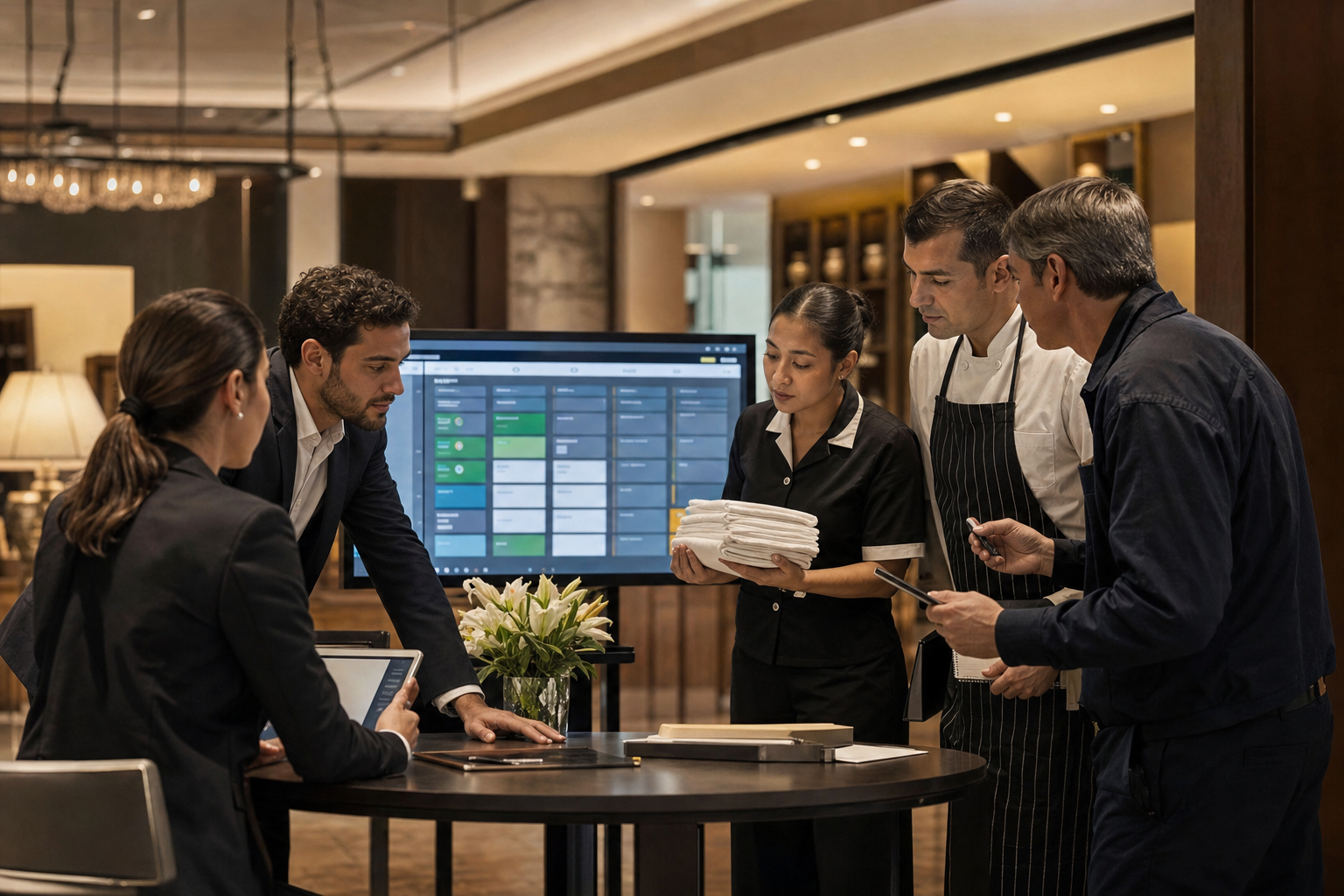

During a particularly complex arrival, the team had carefully prepared the stay of a family who had communicated several needs in advance. We knew their approximate arrival time, that one guest had reduced mobility, that there was a food intolerance, and that they required two nearby rooms. The information existed, had been recorded and read by several people. Even so, one of the rooms was assigned on another floor, the restaurant received the dietary instruction too late, and Reception had to reconstruct the situation in front of the guest. No one had deliberately ignored the request. The problem was more uncomfortable: the hotel knew what it needed to do, but had not organised who should do it, when, or how to verify it.
That stay helped me distinguish between two capabilities that we often confuse in Hospitality. The first is knowing the guest: having access to their history, preferences, reservations, communications, previous spend and past incidents. The second is far more demanding: coordinating the entire organisation so that this knowledge produces a consistent response. A hotel may have an excellent database and still force the guest to explain the same thing at Reception, repeat it in the restaurant and remind the team again when the shift changes. The data travels through the system; hospitality, meanwhile, is left waiting somewhere in the corridor.
Many hotel CRM projects have been built through a commercial lens. They identify segments, automate communications, enable campaign design and help hotel marketing maintain the relationship before and after the visit. That function remains valuable, but it is incomplete when the most relevant information does not reach the person who can change the stay. Knowing that a guest prefers a quiet room is of little use if Housekeeping does not know it is a priority, Engineering schedules work beside their door, or room allocation takes place without considering that condition. Knowledge that does not change an operational decision is stored information, not service.
This is why I see operational CRM as something broader than a technology tool. It is a working model that turns guest signals into hotel commitments. It defines which information should be activated, which department must interpret it, who takes ownership of the next action, what timeframe is reasonable, and how completion is verified. The platform can facilitate this journey, but it cannot independently invent the criteria the organisation has never agreed upon. Hotel management still requires conversations, priorities, owners and discipline; there is still no button called “coordinate the hotel properly”, although I am sure a supplier is already considering bringing one to market.
My proposal starts with a simple idea: the unit of value in an operational CRM should not be the guest data point, but the active commitment throughout the stay. This may appear to be a semantic shift, but it changes how we design processes, assign responsibilities, measure outcomes and lead teams. Instead of asking how much information we possess, we begin to analyse what should happen because of it. From that point onward, CRM ceases to be a sophisticated archive about people and becomes a system for coordinating promises, decisions and evidence of delivery.
A stay does not need another guest profile: it needs a live record of commitments
When I review how information flows through a hotel, I often find an accumulation of notes mixing facts, preferences, opinions, requests, incidents and assumptions. One note states that the guest requested a firm pillow; another says they “seem demanding”; a third recalls previous compensation; another records that they are travelling for an anniversary. All of these details appear together, but they are not of the same nature and should not generate the same response.
The first task of an operational CRM is to separate descriptive knowledge from operational obligation. A historical preference may guide a future decision, but it does not always constitute an instruction. A confirmed request, by contrast, creates a specific responsibility. An open incident requires follow-up. A commercial opportunity needs context and judgement before it becomes an offer. If we treat every signal as equivalent, the team ends up surrounded by alerts and stops distinguishing what matters from what is merely interesting.
I have learned to classify stay information into five levels, each with a different consequence:
- Contextual data. This explains who the guest is, how they are travelling or what relationship they have with the hotel, but it does not necessarily require action. It may include the purpose of travel, party composition or booking channel. Its role is to help the team interpret the situation without turning every detail into a task.
- Observed preference. This captures an expressed or verified pattern, such as a preferred location, usual timing or room set-up. It should guide personalisation where feasible, without being presented as an automatic guarantee. It also needs an expiry date, because people change and a preference from five years ago should not follow a guest indefinitely.
- Active request. This represents something the guest has requested for the current stay. At this point, there is an action that must be accepted, declined or reframed. Simply recording it is equivalent to confusing memory with execution.
- Confirmed commitment. This arises when the hotel has communicated that it will fulfil a request. From that moment, we are no longer managing a preference, but a promise. There must be an owner, a delivery date or time, and a way to verify that it has been completed.
- Incident or risk of non-delivery. This indicates that a promise is at risk, friction has arisen, or the hotel needs to intervene. These situations require priority, escalation and follow-up through to closure, particularly when they may affect the rest of the stay.
This classification prevents one of the costliest errors in hotel CRM: recording a request without defining what it means operationally. Consider a late arrival. The note “will arrive after 23:00” may seem sufficient, but it raises several questions. Should any food and beverage service remain available? Are special access instructions required? Has the room been checked and held? Is transport still pending? Does the night Reception team know the booking conditions? Are there children, reduced mobility or any other circumstance that changes the preparation? The data describes a situation; the commitment organises the response.
To work with this logic, I use the concept of a live stay file. It is not another permanent profile full of fields, but a temporary view bringing together only what can change the current guest experience. It begins before arrival, evolves with every interaction and closes once outstanding obligations have been resolved. The file should quickly answer six questions: what do we know, what has the guest requested, what have we promised, who is acting, when must it be done, and how will we know it has been resolved?
The difference from a conventional profile is profound. The profile looks towards the person; the live file looks towards execution. The profile may state that the guest is celebrating an anniversary. The operational file determines whether that information is relevant to the hotel’s proposition, whether any gesture will be made, who will prepare it, how much it may cost, and whether the action is consistent with the property’s positioning. The profile records that there was an incident on the previous visit. The live file decides whether it should be acknowledged at arrival, whether the room should be checked preventively, or whether special attention should be provided.
At this point, a familiar tension emerges between personalisation and operational capacity. The more information we collect, the more internal expectations we create. If the CRM displays twenty preferences and the hotel can consistently deliver only three, the abundance of data does not improve the experience: it creates an appearance of control that ultimately frustrates the team and, at times, the guest. Every activated data point must compete for resources, time and attention. It is worth acknowledging this honestly, because personalisation also consumes capacity.
The hotel therefore needs an operational commitment catalogue. Its function is to establish which types of requests we can accept, under what conditions, how far in advance, and who must deliver them. A cot, a special diet, connecting rooms, an airport transfer or a late check-out do not require the same workflow. Some requests can be confirmed immediately; others depend on availability; certain needs require the involvement of several departments; and a few should be declined clearly because the property does not have the means to fulfil them.
Confirming something out of courtesy that we may not be able to deliver is a dangerous practice. At the time, it appears hospitable; hours later, it becomes a perfectly justifiable complaint. One of the most useful lessons operations has taught me is that an early, well-explained refusal protects the relationship better than a kind promise that goes unfulfilled. Operational CRM must help distinguish between “requested”, “subject to availability” and “confirmed”. If these three situations are represented in the same way, the system is manufacturing confusion.
Once a commitment has been accepted, it needs to move through a visible sequence. In the models I consider most robust, every promise moves through several statuses: captured, interpreted, accepted, scheduled, in progress, verified and closed. Not all requests require this degree of formality, but those affecting safety, accessibility, food requirements, room assignment, service recovery or significant celebrations certainly deserve rigorous follow-up.
The verified status is often the major omission. We are satisfied when someone marks a task as completed, even though no one confirms that the outcome matches what was promised. Housekeeping may indicate that the extra bed has been installed, yet it may block access to the wardrobe. Engineering may close an intervention because the equipment is working again, although the noise persists. Food and Beverage may prepare a dietary alternative without confirming that the service team knows whom to deliver it to. Completing a task and fulfilling a commitment are not always the same thing.
Verification does not mean turning operations into an endless audit. It means adjusting the level of control to the risk. For a simple request, departmental confirmation may be enough. For a critical need, a physical check or discreet contact with the guest is advisable. The aim is not to create bureaucracy, but to prevent a task that is administratively closed from remaining open in the guest experience.
We must also decide what information is not worth recording. I have seen profiles containing subjective assessments, unprofessional comments and personal details with no legitimate usefulness. An operational CRM cannot become the hotel’s best-organised gossip notebook. The rule I usually propose is clear: only information that helps deliver relevant, safe, consistent and respectful service should be retained. Vague impressions, judgements about personality and unnecessary intimate data introduce bias, weaken professional judgement and can cause more harm than value.
This discipline requires distinguishing observation from interpretation. “The guest requested to speak with a manager on two occasions” describes a fact. “They are difficult” is a label. “They expressed sensitivity to noise and declined a room near the lift” provides usable information. “They are very particular” helps no one. Words shape the predisposition of the next professional serving the guest, so the quality of writing is also part of service quality.
There is another paradox worth considering. When the hotel records a preference, it raises the standard the guest will apply if they discover that the organisation knows it. Failing to remember something that was never recorded may be seen as a human limitation. Demonstrating in conversation that we know the need and then failing to fulfil it creates greater disappointment. Information creates a moral and operational obligation. This is why accumulating data without the capacity to use it is not neutral; it may widen the gap between the promise of personalisation and the real experience.
Coordinating the stay requires action owners, reliable handovers and delivery metrics
Operational CRM begins to work when it moves beyond departmental logic. Guests do not organise their experience according to our organisational chart. They are not concerned whether a request belongs to Reception, Housekeeping, Engineering, Reservations or Food and Beverage. They expect the hotel to respond as one entity. Internally, however, every request crosses different boundaries, shifts and systems. This is where the real risk emerges: the loss of accountability in the spaces between departments.
A request usually has one person who receives it, another who interprets it, someone who decides, a department that delivers it and, at times, a different professional who checks the result. If that chain is not designed, coordination depends on messages, calls, memory and goodwill. It is a fragile architecture. It works while the right people happen to coincide, occupancy allows room to breathe and not too many exceptions arise. One large arrival or shift change is enough for commitments to begin slipping through the cracks.
The decisive question is not who knows the case, but who owns the next action. This person does not have to resolve the entire commitment personally. Their responsibility is to ensure that the next step happens, mobilise the appropriate people and keep the status visible. If a room has a technical problem, Engineering may carry out the repair, but someone must retain the full view of the impact on the guest, the alternative offered and subsequent verification.
Assigning a single owner prevents diffuse accountability. When a task belongs to three departments simultaneously, it often ends up truly belonging to none of them. This does not eliminate collaboration; it makes it manageable. The owner coordinates and everyone else contributes. If circumstances change, accountability is transferred explicitly, never through the hope that “someone will have seen it”.
To design this model, I recommend starting with a limited number of high-impact situations. Trying to coordinate every hotel interaction from day one creates complexity and resistance. It is more sensible to build five solid workflows than fifty incomplete ones. The first cases should be selected by combining frequency, risk to the experience, cost of failure and coordination difficulty.
- Pre-stay requests affecting the room. These include special configurations, accessibility, proximity between rooms, cots or location requirements. They require Reservations, Reception, Housekeeping and, at times, Engineering to connect before the room is released as ready.
- Material food requirements. These must move from a note in the reservation into a workflow that confirms receipt, feasibility, preparation, correct identification and communication to service staff. A critical dietary instruction should never depend on the guest explaining it again at the buffet.
- Incidents affecting more than one department. A room fault may require technical intervention, subsequent cleaning, contact with the guest, a room move, key updates and a review of charges. Treating it as a simple maintenance work order excludes much of the guest experience.
- Recognition of repeat guests. Repeat business only gains value when it translates into proportionate and relevant actions. The aim is not to fill the room with gifts, but to prevent the guest from having to rebuild the relationship from scratch and to ensure that previous learnings are applied.
- Commercial opportunities linked to context. A late check-out, treatment, dinner or room upgrade can generate revenue and value when they respond to the real situation. CRM must prevent a need from automatically becoming an excuse to sell. Sometimes the best commercial decision is to resolve first and offer later; at other times, it is best to offer nothing at all.
Every workflow needs understandable rules. What information triggers it? Who validates the request? What timeframe exists to respond? What happens if there is no availability? Who informs the guest? When is it considered fulfilled? What level of urgency does it merit? What happens if the deadline arrives without resolution? These questions form the true design of operational CRM. Screens and automations come afterwards.
A particularly useful criterion is to establish points of no return. These are moments beyond which a commitment begins to lose feasibility or its cost rises significantly. A request for connecting rooms may be easy to accommodate several days in advance and very complicated once final room allocation has taken place. A dietary need communicated in time allows planning; received while service is under way, it requires improvisation. A fault detected in the morning may be resolved before arrival; discovered with the guest at the door, it becomes a service recovery issue.
Identifying these moments allows teams to prioritise by impact rather than simply by order of arrival. The commitment queue should not behave like an inbox where the latest item pushes earlier ones aside. Some tasks are urgent because of timing, others because of risk, others because of commercial impact, and others because of human sensitivity. An anniversary will not always be more important than a cot, an allergy or a room with non-functioning air conditioning, however appealing it may be for an internal photograph.
Books to run a hotel with judgement
Written from the general manager’s chair: technology, guest experience, leadership and management.
 Directing HotelsWhat Nobody Tells You Before You Sit in the General Manager’s Chair
 The Intelligent HotelData, Artificial Intelligence and a New Way to Run Hotels
 The Guest JourneyDesigning Customer Experience Across the Entire Hotel Journey
 Leadership and High-Performance Team ManagementPeople, Experiences and Results in Today\\\'s Hospitality
Prioritisation requires shared rules. Without them, each department will apply its own logic. Reception will protect the immediate arrival, Housekeeping will try to complete production, Engineering will group interventions, Food and Beverage will safeguard the service sequence, and Revenue will defend inventory. All of these decisions may be reasonable in isolation and, at the same time, produce a poor stay. Leadership in hospitality often consists of resolving legitimate conflicts between legitimate priorities, not of finding someone to blame.
I suggest assessing each commitment through four variables: impact on the guest, proximity of the moment of consumption, difficulty of recovery and number of areas involved. The higher the combined score, the more visible the task should be and the clearer ownership must be. This model makes it possible to distinguish between a pleasant request to fulfil and an obligation whose failure would seriously compromise the experience.
Coordination also requires handovers between shifts. A large share of the failures I have observed do not stem from a poor decision, but from an incomplete transfer. The outgoing shift knows the story; the incoming shift receives a sentence. What happened is passed on, but not what remains to be done. Or the incident is explained, while what was promised to the guest is omitted. Hours later, someone picks up the case with partial information and the conversation begins again.
A quality operational handover should communicate four elements: the current situation, the commitment made, the next action and the escalation condition. “Room 412 has a temperature issue” describes only the case. “Engineering has intervened, we have promised to check the outcome before 19:00, Reception must call at 18:45 and offer a room move if the temperature does not stabilise” allows coordination to continue. The difference between the two notes is the difference between informing and directing execution.
Operational CRM must preserve this continuity even when people change. The guest may recognise that they are speaking to different professionals, but should not feel that they are entering a different hotel each time. Consistency does not require everyone to know everything; it requires each person to find what they need in order to decide the next step.
This requires designing different views according to role. Reception needs an immediate view of arrivals, promises, risks and pending conversations. Housekeeping needs to know configurations, preparation priorities and specific verifications. Food and Beverage should see needs affecting service without accessing irrelevant information. Engineering needs to understand the impact of an intervention on the stay, not merely the technical fault code. Operational leaders need a cross-functional view of overdue commitments, bottlenecks and future workload.
Giving the same complete profile to the entire organisation may seem transparent, but it usually produces noise. Excess information distracts attention and increases the risk of using data out of context. Good coordination relies on relevant visibility: each professional accesses what they need to fulfil their responsibility, at the moment they can act.
In addition to views, brief rituals are needed. No CRM completely replaces operational conversation. A review of sensitive arrivals, commitments nearing their deadline and open incidents can prevent hours of later recovery. It should not become another ceremonial meeting or a collective reading of a screen. Its purpose is to resolve blockages, confirm owners and anticipate capacity conflicts.
In the hotels I have worked with, the quality of these conversations improves when teams avoid reviewing every reservation and focus instead on exceptions. Standard operations should flow through established processes. The meeting exists for what may break them: an unconfirmed request, a critical room, a need crossing departments, a guest affected by a previous incident or a commitment whose delivery is still not assured.
Measurement must accompany the model, although it is wise to avoid extravagant dashboards. An operational CRM does not need dozens of indicators to begin. It needs metrics that reveal where accountability is lost and which commitments are arriving late. Among those I consider most useful are:
- Time to assign an owner. This measures the time from capturing a request to someone taking ownership of the next action. A slow response at this stage often anticipates later delays, even if final delivery appears straightforward.
- Percentage of commitments with a defined deadline. A task without an expected delivery time competes poorly with daily urgencies. This indicator shows how many promises have been translated into a specific time expectation.
- Handover loss rate. This identifies commitments that are delayed, duplicated or reconstructed after a shift or departmental change. The metric makes it possible to locate particularly fragile organisational boundaries.
- Verified closure. This calculates what proportion of relevant requests are checked from the perspective of the outcome, rather than merely the administrative completion of a task.
- Information repeated by the guest. This records how many times the guest must explain again a need they have already communicated. It is one of the most honest indicators of the hotel’s true coordination.
- Operational promise failures. This measures confirmed commitments that were not delivered under the agreed conditions. Their cause should be analysed: lack of capacity, poor interpretation, late allocation, absence of follow-up or an unfeasible promise.
- Volume of alerts without action. This helps identify noise. If a large proportion of alerts produces no decision, the system is probably displaying too much information or activating signals of little relevance.
- Avoidable recovery cost. This groups compensation, room moves, additional hours and resources consumed by failures that could have been prevented through proper coordination. It connects hotel guest experience with hotel profitability without reducing it to a matter of cost savings.
These metrics should not be used to point at individuals, but to improve the system. If the same type of request is repeatedly lost at the same point, we are probably not dealing with a succession of inattentive employees. There is a design problem: ambiguous information, overlapping responsibilities, unrealistic deadlines, insufficient access or a workload incompatible with the promised standard.
Operational CRM can also improve revenue, but the sequence must be ordered properly. First, it protects delivery; then it helps identify opportunities. A guest requesting a solution to an incident should not immediately receive a paid offer related to the same problem. The system must distinguish between a commercial signal and a need for care. Monetising every interaction may increase immediate revenue while damaging the relationship in the long term.
When consistency exists, opportunities emerge naturally. A family asking about activities has an appropriate context in which to receive relevant suggestions. A guest who needs to work for a few hours after check-out may value an extension, a quiet space or an additional service. A couple celebrating a special occasion may appreciate a well-presented experience. Commercial value comes from interpreting the moment, not from launching the same offer to everyone.
In terms of hotel strategic planning, implementation should progress in layers. The first documents current workflows and identifies where information is lost. The second defines the commitment catalogue, its statuses and owners. The third configures the technology support. The fourth trains the team using real cases. The fifth measures outcomes and removes fields, alerts or tasks that add no value. Starting with the tool and expecting the operational model to emerge afterwards usually leads to new screens with old problems.
Training must go beyond explaining where to click. The team needs to learn to write facts without labelling people, distinguish a preference from a promise, assign the next action, recognise when escalation is required and close from the perspective of the outcome. They must also understand that recording a request does not mean transferring all responsibility to the system. The CRM can display the commitment; professional judgement remains what determines how to fulfil it.
Finally, this model needs governance. Someone must periodically review unfulfilled promises, workflows with the greatest friction, outdated preferences and alerts nobody uses. Operational CRM is not finished when it has been configured. It evolves with the product, segments, organisation and the hotel’s real capacity. What was an exception yesterday may become a pattern; what once added value may ultimately generate noise.
If I had to begin tomorrow, I would not ask for a new platform or try to record more information. I would select ten recent stays in which the hotel knew of a need and yet responded late, in a fragmented way or only after the guest insisted. I would reconstruct the journey of every commitment: where it began, who received it, when it lost its owner and what would have enabled better delivery. That review usually reveals more about hotel CRM than any sales demonstration.
I would then build a minimum workflow for two or three critical situations and test it for several weeks. I would define a single source of truth, an owner for every next action, understandable deadlines and a simple way of verifying the outcome. I would ask the team to identify friction points and remove any step that served only to feed the system. Hotel management improves when information reduces work and ambiguity, not when it adds another layer of administrative obligations.
A hotel that coordinates well does not impress the guest with the volume of data it possesses. It convinces them through an almost invisible continuity: the request reaches the right place, the next shift knows the commitment, departments act as one organisation, and no one forces the guest to manage their own stay. In my view, that is the most valuable destination for an operational CRM: turning what the hotel knows into something the guest can feel because it has been delivered.
This article ends here. The archive does not.
Lead Hospitality brings together 1200 English articles published since 2018: years of experiences, decisions and lessons you can keep exploring.
What would you like to explore next?
Choose a direction and keep reading around what you want to solve, learn or challenge.