
The Hotel That Thinks It Has Customers—But Really Has Channels

Albert BarraMarch 15, 2026 · 16 min read
The fundamental mistake: confusing demand with connection
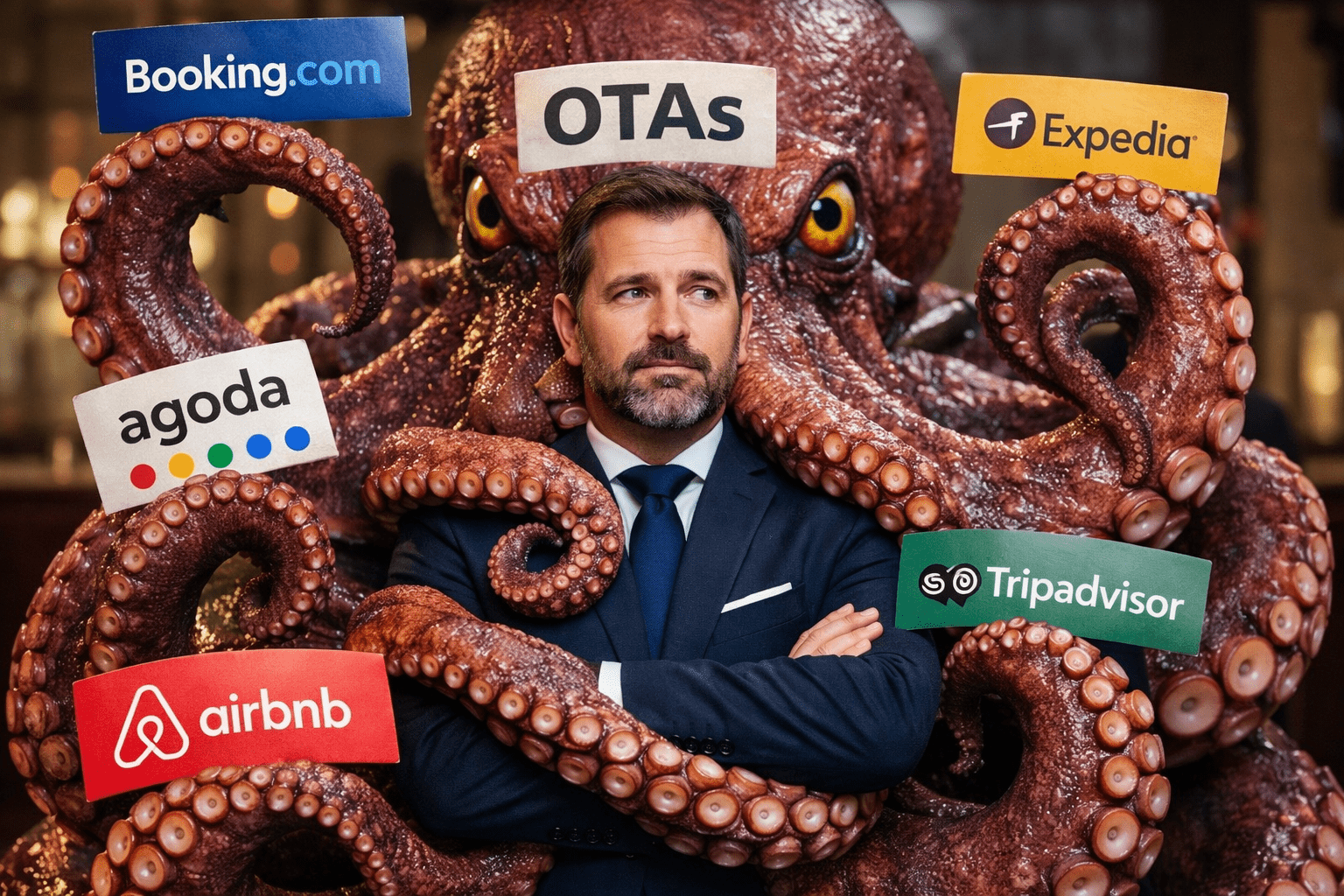
The first problem arises when a hotel assumes that every booking is equivalent to one of its own customers. It is not. A booking may represent production, but not necessarily relationship ownership. If a guest discovers your hotel on an OTA, compares it there, books there, receives pre-stay communications there, modifies their stay there, checks terms and conditions there, and returns months later to the same platform to repeat the process, the relationship asset is not yours. You have been the final provider of the service. The channel has been the functional owner of the contact. This reality hurts because it dismantles a very convenient narrative: “we are doing well because we have many repeat guests”. In quite a few cases, what exists is not repeat business with the hotel, but repeated purchasing behaviour within the same intermediated ecosystem. The guest may return to the same property, but they are still passing through the same commercial tollgate, the same decision gateway and the same infrastructure of influence. That is not strong loyalty. It is intermediated recurrence. The simplest test for identifying this confusion is brutally straightforward. Ask yourself three questions.- Can you identify the guest, communicate with them and reactivate them without relying on the channel through which they arrived?
- Is your direct value proposition strong enough to change their purchasing behaviour next time?
- If a particular platform were to reduce your visibility tomorrow, would it materially affect your profit and loss account?
What it truly means to “own the relationship”
Owning the relationship with the guest does not mean having their email address in a disorganised database. Nor does it mean sending them a generic newsletter three times a year or handing them a card with the website address at reception. Relationship ownership involves several layers of control and commercial maturity.- Data control: knowing who they are, how they book, when they travel, what they value, how much they spend, why they return or why they do not.
- Contact control: being able to communicate before, during and after the stay with your own message and a clear purpose.
- Offer control: providing genuine reasons to book direct, beyond the classic “best price guaranteed”, which so often persuades no one.
- Memory control: ensuring that, when they consider returning, they think of the hotel first—not the comparison site.
- Activation control: being able to turn a past stay into a future stay without having to buy back the same customer through third parties.
The symptoms of a hotel that thinks it has customers, but only has channels
This problem is rarely stated openly. It reveals itself through operational and commercial patterns which, viewed dispassionately, expose a structural dependency. They are worth naming without embellishment.1. Occupancy rises, but autonomy does not
Some hotels fill their rooms, but do not learn. They close strong months, but do not strengthen their ability to attract direct bookings. Production grows while dependency remains intact. In these cases, growth does not consolidate a competitive advantage; it merely increases future commercial costs.2. The CRM exists, but governs nothing
Many hotel databases are more like a dead archive than a relationship engine. They contain names, email addresses and historical stays, but no useful segmentation, no intelligent automation, no campaigns built around affinity or behaviour, and the data is almost never translated into profitable commercial action.3. The website informs, rather than persuades
The official website of far too many hotels remains a static showcase rather than a serious conversion channel. Attractive, yes. Inspiring, sometimes. But weak in its value proposition, weak in social proof, weak in urgency, weak in lead capture and weak at closing. If the website does not convince better than an intermediary, it does not compete: it merely accompanies.4. Reception operates, but does not nurture
The front desk welcomes, informs, takes payment, says goodbye and resolves incidents. All of this is important. But if it does not capture preferences, identify future opportunities, promote the direct channel or turn the stay into a future relationship, one of the most valuable points in the commercial cycle is lost.5. The post-stay journey is a void
The guest checks out, perhaps receives a survey or a review request, and that is where everything ends. There is no follow-up sequence, no relevant offer, no narrative, no emotional reminder, no well-designed incentive to book direct again. When this happens, the hotel voluntarily relinquishes the opportunity to compete for the next booking.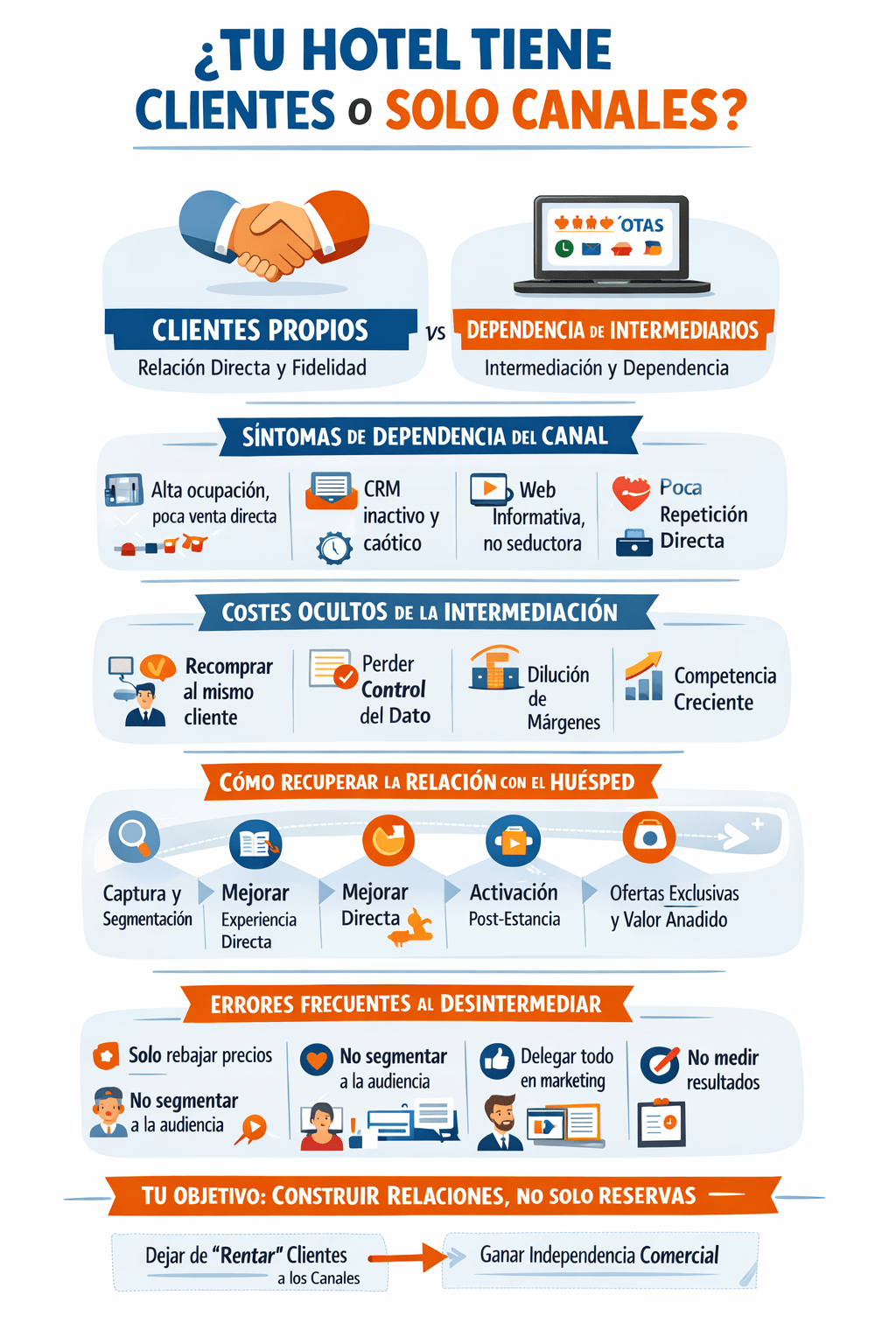
Why channels win when the hotel merely “exists”
Channels are not strong solely because of their budgets or technology. They are strong because they understand the psychology of decision-making better than many hotels do. They simplify, compare, guide, create habits and reduce friction. They become the mental place where the purchase happens. And once consumers internalise that behaviour, the hotel ceases to be the starting point and becomes an option on a digital shelf. In addition, channels tend to dominate five dimensions that many hotels underestimate.- Convenience. The guest can find, compare and book in just a few steps.
- Borrowed trust. The platform conveys security through volume, reviews and standardisation.
- Transactional memory. The customer already has an account, payment card, booking history and familiarity.
- Constant retargeting. Emails, remarketing, recommendations and reminders do the work of bringing traffic back.
- Habit-building. The customer does not search for “your hotel”; they search for “accommodation” in the place where they always search.
Intermediary dependency: the invisible cost that does not always appear in the commission
When people discuss the cost of a channel, they almost always reduce it to commission. That is an analytical mistake. The real cost of relying on intermediaries is far broader. It includes lost margin, certainly, but also the loss of knowledge, commercial power and future options. There are at least six hidden costs that every hotel should measure more rigorously.- Reacquisition cost. Paying again for a guest who has already stayed at your hotel.
- Data dispossession cost. Being unable to activate the customer commercially with freedom.
- Rate pressure cost. Competing by comparison rather than differentiation.
- Commoditisation cost. Turning the hotel into just another listing among hundreds.
- Negative elasticity cost. Having to rely on tactical stimuli to generate demand because no strong relationship base exists.
- Strategic cost. Weakening the hotel’s ability to determine its own commercial future.
Case study 1: the urban hotel that filled rooms… but did not capitalise on it
Consider an independent urban hotel in a good location, with a strong product, solid review scores and reasonable occupancy throughout much of the year. The general manager is satisfied because the production is coming in. Revenue sees that OTAs account for a highly significant part of the business, but because RevPAR is holding up, no one looks closely at the root of the problem. When the real channel mix is analysed, an uncomfortable picture emerges: more than 60% of individual demand comes through intermediaries, the database consists of thousands of unclassified records, the official website converts poorly, reception does not systematically capture preferences, and post-stay communication is limited to an automated survey. On the surface, the hotel “has a customer base”. In reality, it has production leveraged on external visibility. A change in approach could be structured as follows:- redesigning the direct-booking proposition with concrete rather than merely rhetorical benefits;
- capturing preferences and travel purpose at check-in or during the pre-stay stage;
- genuine CRM segmentation by source, frequency, purpose and value;
- a post-stay sequence with different messages for corporate guests, leisure guests, couples, short-break travellers and repeat guests;
- exclusive direct reactivation campaigns in relevant booking windows;
- training the reception team to convert a stay into a future direct booking.
Case study 2: the resort that had repeat business, but no loyalty of its own
Now imagine a leisure resort with a strong experiential component. The team argues that it has a loyal base because it sees guests returning over several summers. However, analysis reveals that a very significant share of those repeat stays still come through tour operators, OTAs or package marketplaces. What does this mean? That the positive memory of the stay has not been transformed into a robust direct relationship. The hotel has generated satisfaction, but it has not consolidated channel preference. The experience was good, certainly, but it has not been converted into an infrastructure for return. In this context, rebuilding the relationship requires something more sophisticated than sending a generic promotion in January. It requires designing an owned ecosystem.- During the stay, collect useful information on habits, family composition, preferences and service consumption.
- Before departure, clearly explain the tangible advantages of returning through the direct channel.
- After the stay, maintain an emotional narrative connected to the memory of the experience.
- In future campaigns, offer personalised propositions by profile, rather than indiscriminate discounts.
- Create a club, privilege or preferential-access logic that the channel cannot easily replicate.
The myth of “best price guaranteed” as a universal solution
For years, many hotels have tried to recover direct business with an almost singular argument: “our website always offers the best price”. The problem is that this message, on its own, has lost its pulling power. Not because price does not matter, but because guests no longer decide on price alone and, moreover, they often do not perceive a difference that is clear, credible or valuable enough to change their booking habit. When everyone says the same thing, no one differentiates. And when the only direct benefit is financial, the hotel enters a weak logic: if the customer books direct only to save a few euros, they will be just as volatile tomorrow if another channel or competitor reshapes the incentive. Direct booking needs a richer value proposition. It must answer this question: why should they book with you, rather than simply book your hotel? Some strategically stronger answers include:- genuinely greater flexibility, not rhetoric;
- better room allocation or operational priority;
- meaningful extras aligned with the guest profile;
- personalised pre-stay service;
- cumulative benefits for repeat stays;
- preferential access to experiences, time slots or limited services.
Reception as an underused commercial asset
In many hotels, reception is still treated almost exclusively as an operational function. Yet it is one of the most powerful nodes for relationship-building. It is where information can be confirmed, motivations uncovered, issues identified, preferences collected, recurrence seeded and guests educated about the value of the direct channel. But for that to happen, the team cannot limit itself to executing processes. It must understand the commercial impact of every interaction. This is not about turning reception into an aggressive sales call centre. It is about equipping it with relationship judgement. A useful operating model could be built around four functions:- Identify. Know who is arriving, why they have come and how they booked.
- Record. Turn what is learned into useful, reusable data.
- Enrich. Add value to the stay through relevant service and recommendations.
- Guide. Prepare the ground for a future direct booking.
How to rebuild a relationship monopolised by the channel
Recovering relationship ownership does not happen through an isolated action. It requires a system. And that system must redesign the guest’s commercial journey from the first interaction through to repeat business. Hotels need to stop thinking only about acquisition and start thinking about lifecycle.Phase 1. Intelligent capture
The first objective is not to sell more at any cost, but to capture better. This means collecting data with purpose, not through bureaucratic accumulation. The hotel must know what information it truly needs in order to personalise, segment and reactivate later.Phase 2. An experience consistent with the positioning
No lasting relationship can be built if the actual experience does not support the promise. Every attempt at disintermediation fails if the hotel seeks to cultivate repeat business without delivering a memorable, consistent experience aligned with its value proposition.Phase 3. Emotional post-stay activation
Departure is not the end of the process, but the beginning of the next one. This is where personalised messages, appropriate timing, relevant content and communication that combines utility with memory come into play.Phase 4. A distinctive direct proposition
The guest must find a reasonable reason to change their behaviour. If booking direct offers them nothing different, they will continue buying where it feels more convenient or familiar.Phase 5. Measurement and learning
All of this requires indicators. It is not enough to look at aggregate direct share. Hotels need to measure how many intermediated guests convert to direct, which campaigns reactivate best, which profiles migrate more easily and where the sequences break down.An applicable framework: from the dependent hotel to the relationship-led hotel
To put this transformation into practice, I propose a simple five-block framework. It can serve both as an audit guide and as a roadmap.Block 1. Dependency diagnosis
Here, the hotel must answer honestly:- what percentage of revenue depends on intermediaries;
- what share is represented by the same guests who return through third parties;
- what capacity currently exists to identify, segment and reactivate the hotel’s own customers;
- what percentage of repeat guests genuinely book direct.
Block 2. Quality of data capture
Not every database is an asset. It only becomes one if it is alive, structured and operationally connected. Here, it is worth reviewing:- the fields collected and their real usefulness;
- the level of updating;
- segmentation capability;
- integration between the PMS, CRM, booking engine, reception and marketing.
Block 3. Strength of the direct proposition
The hotel must ask itself whether its official channel truly competes or simply exists. It should assess:- clarity of the message;
- friction in the booking process;
- differentiating arguments;
- consistency between promise, price and benefits.
Block 4. An internal culture oriented towards relationships
If only marketing thinks about loyalty, the system limps. Reception, reservations, guest experience, revenue and management must be aligned around a shared vision.Block 5. Reactivation system
Finally, the hotel needs a recurring, measurable engine that turns past stays into future opportunities. Without it, everything remains merely an intention.Which indicators should hotels track if they want to stop merely “having channels”?
If hotels look only at occupancy, ADR or even gross direct share, they may develop an incomplete view. To know whether the relationship with the guest is genuinely being recovered, more refined metrics are needed.- the percentage of guests who initially arrived through an intermediary and later return through the direct channel;
- average reacquisition cost per repeat guest;
- post-stay activation rate by segment;
- volume of useful database records versus the total database;
- future revenue generated by campaigns to guests who have already stayed;
- the percentage of direct bookings attributable to known guests;
- lifetime value by initial acquisition channel.
Common mistakes when trying to disintermediate
Not every effort to recover the relationship is well conceived. In fact, many fail because of fairly predictable mistakes.- Confusing disintermediation with a price war. Cutting rates without a strategy can damage margin and positioning without creating a relationship.
- Seeking quick results without redesigning processes. Sustainable direct sales are not a campaign; they are a system.
- Delegating everything to marketing. Without operational alignment, the relationship will not be consolidated.
- Failing to segment. Treating every guest the same destroys relevance and reduces conversion.
- Failing to create a perceived advantage. If guests do not perceive additional value in booking direct, they will not change their habits.
- Failing to measure actual channel migration. Without traceability, there is much opinion and little learning.
An essential mindset shift: stop managing bookings and start managing relationships
Ultimately, this entire debate has less to do with technology than with management mindset. A hotel focused exclusively on the immediate booking tends to sacrifice strategic development for tactical production. It pursues today’s close, but does not always strengthen next year’s business. Managing relationships requires different thinking. It requires viewing every stay as a potential asset, every interaction as a point of influence and every piece of data as an element of commercial intelligence. It also requires accepting that the real value lies not only in filling rooms, but in reducing the future need to buy those rooms again and again through third parties. Put differently: the mature hotel is not the one that sells the most today, but the one that best converts today’s volume into tomorrow’s autonomy.A strong hotel is not the one that handles the most intermediation, but the one that needs it least to keep growing
Channels are not the enemy. They are a tool. The problem begins when a tool becomes a crutch, and the crutch starts to look like a leg. Many hotels have normalised intermediation to such an extent that they no longer distinguish between useful distribution and dangerous dependency. And while that confusion persists, they will continue believing they have customers when, in reality, they have rented access to demand. The big question is not whether a hotel should work with channels. Of course it should, in many cases. The strategic question is another: is it using channels to grow while building its own relationships, or is it allowing channel growth to replace the development of its own commercial asset? This is where two hotel models diverge. The first lives from the booking that comes in. The second learns from each guest who comes in, turns them into data, transforms that data into a relationship and activates it in the future. The first celebrates production. The second builds independence. The first fills rooms. The second grows stronger. And in a market that is increasingly competitive, increasingly compared and increasingly costly, that difference ceases to be theoretical and becomes decisive.Free Access+Continue with Google One Lead Hospitality account · no duplicate subscription identity
Use Google to create or recognise the same Lead Hospitality account and activate the free CRE Access+ level.