
Google Enters the Last Mile of Hotel Booking

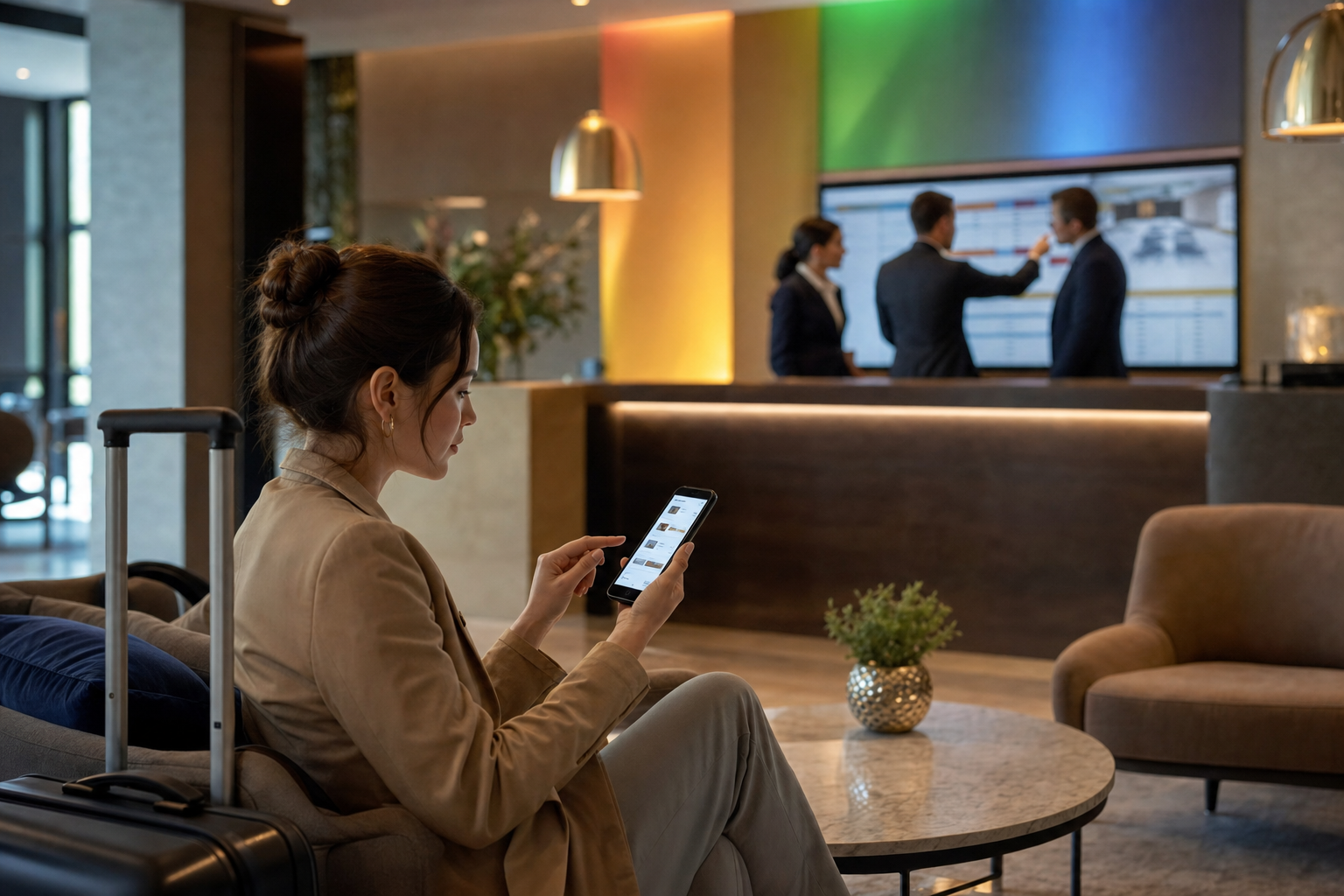

At the end of August 2026, I read a sentence that, despite its apparent simplicity, made me stop and think: Google was beginning to allow hotel bookings within AI Mode. Travellers could describe their trip, explain what type of accommodation they were looking for, compare a visual selection and continue with the purchase through Google Pay. This was not a cosmetic enhancement to search, but Google’s entry into one of the last spaces that still required customers to leave the conversation and move to another interface.
The initial rollout began in the United States, in English and for selected integrated properties and partners. Users must be signed in, of legal age, have a valid payment method and provide a US billing address. For now, there are important limitations, including the inability to select child occupancy, link certain loyalty programmes or use promotional codes during the process.
We could interpret this announcement as another development in Artificial Intelligence applied to travel, add it to a presentation on Hospitality trends and continue with our agenda. I believe that would be a mistake. Its importance lies not only in the fact that AI recommends hotels, something that was already happening, but in the fact that it can now accompany the traveller all the way to payment without requiring them to visit the property’s website or reconstruct their decision on another platform.
I have experienced enough transformations in hotel distribution to distrust both excessive enthusiasm and comfortable indifference. No announcement suddenly destroys every previous model, but some quietly change who controls demand, who presents the product, who collects payment for the booking and who retains the relationship. At first, they appear to be an additional option; a few years later, we discover that they have become the main gateway.
The useful question for us is not whether Google AI Mode will succeed, because its scale already justifies our attention. In May 2026, Google announced that AI Mode had surpassed one billion monthly users and that its queries were doubling every quarter. The truly hotel-specific question is what happens when discovery, comparison and conversion begin to take place within a single conversation, and what we must do to ensure that this convenience for the customer does not become another loss of control for the hotel.
The conversation becomes a distribution channel
Until now, many of our commercial models have represented the booking process as a relatively orderly funnel. Travellers found inspiration, searched, compared, visited several websites, consulted reviews, checked prices and finally booked. We could debate which channel intervened at each stage, but the moments were reasonably distinct and left traces that Marketing, Revenue and Distribution teams attempted to interpret.
Conversational search compresses that journey. Someone can ask for a quiet hotel near a hospital, with a gym, early breakfast, flexible cancellation and easy access from the airport. AI interprets the need, consults available information, presents options, answers follow-up questions and allows the customer to move towards purchase. What once required ten tabs, multiple filters and a degree of patience hardly compatible with a holiday can be resolved in one conversation.
This compression has a strategic consequence. Hotels no longer compete solely for a ranking position, an advert or a click; they begin to compete to be correctly understood within a response. Visibility no longer depends only on appearing, but on the platform understanding which trips, needs, constraints and expectations our property is particularly well suited to serve.
Travellers are no longer required to translate their wishes into the language of our filters, either. They can express them as they think them. Instead of selecting four stars, a pool and parking, they can ask for a comfortable hotel for travelling with an older person, away from late-night noise and with a restaurant where they can dine without having to go elsewhere. The difference may appear linguistic, but it affects positioning because AI will attempt to convert human intent into comparable criteria.
In this new environment, generic descriptions lose even more value. If we are all welcoming, exceptional, unforgettable and strategically located, the system has very little information with which to distinguish us. I have seen hotel pages capable of using five hundred words without explaining whether breakfast starts at half past six, whether the car park accommodates tall vehicles or whether a family room genuinely has two separate spaces. Commercial poetry still has its place, but it should not conceal the information that makes selling possible.
Google shows travellers visual options, reviews and key comparison factors. Then, where an integrated alternative exists, it offers the possibility of remaining within Google, selecting a room, reviewing the terms and paying with Google Pay. The hotel or booking platform participating acts as the merchant of record, processes the transaction and assumes subsequent service related to changes, cancellations and refunds. Google facilitates the interface, but does not formally become the contracting party for the booking.
That legal and operational distinction matters. From the traveller’s perspective, the experience may feel like a booking made on Google. From an economic perspective, the business continues to arrive through a hotel, a chain, an OTA or another connected partner. The visible interface and contractual responsibility may belong to different parties—a separation that tends to feel elegant when everything works, and considerably less elegant when a problem arises.
I would describe this shift through a booking sovereignty chain. Each link represents a capability that the hotel may retain, share or progressively lose:
- Being eligible to appear. Before competing for customer preference, the hotel needs its inventory, rates and content to be available to the partners powering the experience. An excellent property can be commercially absent if its connectivity, agreements or the quality of its information prevent it from being considered.
- Being understood accurately. Being present does not guarantee being interpreted correctly. Room names, services, accessibility features, policies and the property context must clearly express what is offered and for whom it is valuable.
- Being compared fairly. The visual and conversational selection will highlight certain attributes, reviews, prices and conditions. The hotel must monitor whether the comparison reflects its full proposition or reduces a complex product to a rate, a photograph and an average score.
- Participating economically in the transaction. The booking may ultimately be linked to the hotel’s direct channel or to an intermediary. Two appearances that seem identical to the traveller can generate very different acquisition costs, commercial terms and margins for the property.
- Retaining the relationship after purchase. Receiving a booking is not the same as knowing the customer or having permission to build a relationship. Data quality, guest identification, loyalty integration and the management of changes will determine how much value truly remains with the hotel.
Direct hotel sales do not necessarily disappear, but they change shape. For a long time, we have associated direct booking with a visit to our website and conversion within the booking engine. That journey will continue to exist, although it will no longer be the only way to establish a direct commercial relationship. A hotel could participate in a transaction initiated and completed in an external interface, provided that its connectivity structure and the partner acting as seller allow the business to be properly attributed to it.
This requires us to separate three concepts that we often mix together: discovery channel, conversion interface and booking merchant. The customer may discover the hotel through Google AI Mode, complete the process in a Google interface and ultimately contract with a third party. If we continue to classify that booking using only the traditional labels of direct or intermediated, we will lose information about who actually influenced the decision.
Hotel marketing attribution will change as well. A website visit was imperfect, but at least it left a signal. When the conversation answers questions, compares options and facilitates payment without generating that visit, part of the journey becomes invisible to our usual tools. We may see more bookings and fewer sessions, or attribute the sale to the final partner when the real selection took place within the conversation.
The temptation will be to celebrate volume without rebuilding the economics. I have seen that film before. Every new source of demand arrives accompanied by a narrative of reach, simplicity and conversion, while the full cost takes a little longer to appear in the P&L. Hotels need to establish who pays to participate, what commission applies, what technology or transaction costs are involved and what future value they lose when they cannot identify or retain the guest.
To assess these bookings, I would suggest calculating a net conversational booking contribution. The formula should incorporate accommodation revenue and associated services, less partner costs, payment expenses, post-booking service, cancellations, potential loyalty dilution and any operational cost caused by incomplete information. The gross production figure is once again insufficient, however seductive it may look in a commercial meeting.
Hotel revenue management will also need to adapt. In a conversation, the rate appears alongside the cancellation policy, room type, reviews, location and any other factors AI considers relevant. A lower price may lose out to a slightly more expensive option if the latter better addresses the stated intent. Competitiveness ceases to be a simple price relationship and becomes a relationship between price, fit and certainty.
This does not mean that price loses importance. It means that every commercial condition must be understandable and comparable. An apparently attractive rate may be penalised by additional fees, rigid terms or an ambiguously described room. I have repeatedly found that some hotels need a short novel to explain their supplements; perhaps it is time to admit that, if a condition requires so many footnotes, the problem is not always the customer’s reading ability.
There is also an interesting tension with loyalty. In the initial rollout, booking within AI Mode does not normally allow loyalty numbers to be added, points to be redeemed or partner promotional codes to be applied. This may facilitate a simple purchase, but it weakens recognition of repeat guests and makes it harder to transfer exclusive benefits. The traveller gains immediate convenience, while the hotel risks receiving a familiar person as though they were entirely new.
For brands and hotels with a strong loyalty strategy, this limitation may become an argument for recovering the relationship before arrival. For those whose direct sales proposition relies almost exclusively on a discount, the problem will be greater. If the only reason to book on the website was to pay a few euros less, an interface capable of comparing and taking payment without friction may further reduce the willingness to leave the conversation.
Preparing the hotel for a booking that no longer passes through our website
The first response should not be to launch another campaign, buy a tool or call an Artificial Intelligence meeting with more slides than decisions. First, we need to understand how the hotel appears, through which partners it can be booked and what happens to the information after payment. Hotel management needs to turn this development into specific business questions.
I would begin with a conversational sellability audit. This is neither a conventional SEO audit nor an isolated booking-engine review. Its purpose is to verify whether the hotel can be discovered, interpreted, compared, booked and serviced correctly when the process takes place within a conversation.
- Unambiguous commercial identity. Review whether the available information explains precisely what type of hotel you are, which demand you serve particularly well and what limitations travellers should know about. Identity cannot rely on interchangeable adjectives; it needs facts, product decisions and verifiable attributes.
- A product translatable into human intent. Analyse rooms and services through the lens of customers’ real questions. An internal name such as Deluxe DBL SV may make sense in the PMS, but it offers little to someone who wants to know whether they can sleep with two children without turning every night into a game of Tetris.
- Consistency across every source. Check that opening hours, policies, services, supplements, photographs and descriptions match across the website, public profiles, booking engines and distribution channels. Artificial Intelligence can bring together information from different places; our contradictions travel easily too.
- Commercially eligible inventory. Ask your CRS, booking engine, chain or distribution partners whether your rates can participate in this experience, under what conditions and who acts as merchant. Do not assume that being visible in Google Hotels automatically means that guests can book within AI Mode.
- An understandable total price. Review taxes, supplements, deposits and conditions so that the displayed cost does not change later. Negative surprises reduce conversion, increase cancellations and create an expectation debt before the guest has even arrived.
- Descriptive reputation. The average score helps, but specific reviews explain which travellers the hotel works well for. Comments on sleep quality, breakfast, location, cleanliness, service, accessibility or atmosphere offer more useful signals than a collection of generic praise.
- Continuity after booking. Define how the hotel will receive data, when it can communicate with the guest, who will handle a change and how the customer will be prevented from being sent from Google to the partner and from the partner to the hotel. Commercial convenience quickly loses its appeal when nobody knows who is meant to solve the problem.
- Recognition and loyalty. Design a process to identify repeat guests, recover their profile with permission and link the stay when the channel has not included their loyalty number. Recognition should feel like hospitality, not a forensic investigation conducted at Reception.
This audit should involve Distribution, Revenue, Marketing, Reservations, Front Office, Finance and Operations. If it is delegated exclusively to the digital team, we will see the interface but not understand the full business. A booking ultimately generates an arrival, a room to prepare, expectations to fulfil, possible changes and a relationship worth retaining.
The second step is to conduct conversational mystery shopping. In markets where the feature is available, it is worth asking different questions and observing when our hotel appears, how it is described and which competitors it is compared with. It is not enough to search for the property by name, because the real change occurs in unbranded queries.
I would test scenarios based on trip purpose, group composition, constraints, priorities and price sensitivity. I would ask for accommodation to rest before a medical procedure, work for a week, celebrate an anniversary without a child-focused atmosphere or stay near an event with cancellation flexibility. I would then compare the responses with the positioning we believe we have.
An uncomfortable gap may emerge between our declared identity and our platform-readable identity. We may consider ourselves ideal for families, but the absence of precise information about occupancy, cots, connecting rooms and children’s dining prevents us from proving it. We may defend a wellness proposition, while reviews speak far more about external noise than rest.
The Intelligent Hotel
Data, Artificial Intelligence and a New Way to Run Hotels
Go deeper into how AI, data and automation are transforming hotel management, commercial performance and the guest journey.
I do not recommend manipulating content in an attempt to please the algorithm. That race usually produces artificial pages and promises that operations cannot sustain. The priority should be to represent the product with such clarity that a person, an AI and the team itself arrive at a reasonably similar understanding of what the hotel offers.
We must then review the room and rate architecture. Commercial names need to express real differences, and conditions must be comparable without ambiguity. If two rooms have different names but share almost identical photographs and descriptions, the system will struggle to justify the price difference; the traveller, it should be said, will too.
Inventory sent to each partner deserves particular attention. AI may recommend the right hotel and still direct conversion to the channel with better availability, more complete information or stronger operational integration. A hotel may win the recommendation and lose the booking economics at the final step. That is why I refer to the last metre of distribution: the brief stretch in which it is decided who ultimately sells demand that others helped create.
Hotel strategies should not focus solely on appearing more often. It is important to decide which inventory to participate with, which rates to expose, which conditions to protect and which partners generate sufficient contribution. Universal presence may generate volume, but also dependency, costs and a demand mix incompatible with the positioning.
To manage this stage, I would use a specific dashboard with indicators that still do not usually appear in hotel reports:
- Conversational visibility share. Measures in how many relevant search scenarios the hotel appears across the total set of tests undertaken. It does not seek an absolute ranking, but rather an understanding of which intents consider us.
- Accurate representation rate. Assesses the percentage of attributes, conditions and features displayed without significant errors. An inaccurate appearance can be more dangerous than an absence, because it creates expectations that operations will have to pay for.
- Eligible inventory by partner. Identifies how many rooms and rates can be booked within the experience and through which seller. This indicator reveals whether potential demand is being directed to the economically preferred channel or to a more costly alternative.
- Net conversational contribution. Compares the full revenue and cost of these bookings with direct web sales, OTAs and other channels. It should include cancellations, service costs and additional spend, not merely the nominal commission.
- Post-booking identification rate. Calculates what proportion of guests can be correctly linked to an existing profile or added, with consent, to the hotel relationship. Without this metric, we may celebrate production while losing customer knowledge.
- Modification friction. Records the contacts, handovers and time required to change or cancel a booking. When several organisations are involved, every transfer increases the risk of frustration and the cost of service.
- Attribution gap. Estimates the difference between the channel that inspires or selects the booking and the channel that ultimately appears in our reports. Understanding this gap will enable hotel marketing budgets to be allocated more effectively.
The dashboard does not need to begin with scientific precision. It can initially be built using small samples, manual tests and booking reviews. I prefer an imperfect indicator that forces us to ask good questions to an impeccable dashboard measuring something that no longer explains how customers buy.
At the same time, Finance and Revenue should rebuild the P&L of the conversation-generated booking. Two transactions completed through Google Pay may appear identical to the guest and produce very different outcomes for the hotel. One may arrive through a low-cost direct connection, while another includes commission, less access to data, more cancellations and reduced ability to build loyalty.
In-stay spend will also need to be analysed. If the hotel receives limited information, communicates late or does not recognise the guest, it may lose restaurant, spa, upgrade and other service opportunities. Distribution cost does not end with commission; it includes the value we fail to develop after acquiring the booking.
The direct sales strategy will need better reasons to exist. The website will remain an important space for exploring the brand, explaining the product and building trust, but we cannot assume that every traveller will want to visit it. The conversation has reduced the effort required to purchase, and any direct alternative must offer sufficiently clear value to justify the detour.
That value may lie in flexibility, recognition, an allocation guarantee, human communication, included services, in-stay advantages or conditions designed for the right segment. I do not recommend responding with indiscriminate discounts. Reducing the price every time a more convenient interface appears is a rather effective way of financing our own irrelevance.
Loyalty programmes need to prepare for a relationship that may begin outside their forms. If the booking does not include the member number, the hotel needs a simple and respectful way to recognise the guest before arrival. Asking customers to call, forward emails and prove their identity several times contradicts the ease they have just experienced during purchase.
Front Office and Reservations will need clear criteria for explaining responsibilities. If a modification depends on the partner acting as merchant, the team must know this before promising a solution it cannot deliver. Yet hiding behind the channel is not hospitality either. Even if the contract belongs to another organisation, guests sleeping in our hotel will still judge how we helped them.
Hotel strategic planning should also include several scenarios. In one, AI Mode remains a complementary channel concentrated in certain markets. In another, it becomes a standard interface for complex travel and substantially reduces visits to websites and comparison platforms. In a third, Google expands functions, countries, languages, loyalty and booking capabilities until it becomes a dominant transactional layer.
We do not know which of those scenarios will prevail, but we can make useful decisions in all of them. Improving product clarity, organising conditions, understanding the cost of each partner, protecting guest data and strengthening the direct proposition will never be wasted work. Uncertainty does not justify passivity; it advises investment in capabilities that remain valuable across different futures.
Leadership in the hotel sector will have to avoid two extremes. The first is treating every announcement as the end of the world and approving rushed investments. The second is waiting until consumer behaviour has changed completely. The mature response combines observation, limited experimentation, economic measurement and reversible decisions while we learn.
If I had to organise the work over the next ninety days, I would begin by mapping which partners can sell the hotel within AI Mode and under what economics. I would then test real queries, correct content inconsistencies and review the rooms, rates and conditions reaching each connection. Finally, I would add the first metrics to Distribution and Revenue meetings, without creating a permanent committee whose only outcome is to convene the next meeting.
My immediate advice is simple: try to book your own hotel through this new journey when it becomes available in your market. Do it as a customer unfamiliar with the brand; state specific needs, compare the responses and document every step. The experience will teach you more than several hours spent debating the future of Artificial Intelligence in the abstract.
Do not confuse being present with retaining control. A hotel may appear, be recommended and even receive the booking while losing margin, attribution, data and relationship-building capacity. Commercial sovereignty does not require owning every screen, but it does require understanding who decides, who gets paid, who provides service and how much value remains after the transaction.
This could change everything, although it probably will not happen overnight. The decisive shift will come when travellers stop thinking that they are searching for hotels and feel that they are simply talking about their trip while someone resolves the purchase. Our task will be to ensure that, within that conversation, the hotel remains recognisable, profitable and worthy of being chosen.
This article ends here. The archive does not.
Lead Hospitality brings together 1200 English articles published since 2018: years of experiences, decisions and lessons you can keep exploring.
What would you like to explore next?
Choose a direction and keep reading around what you want to solve, learn or challenge.