
The Hotel Strategy Map: Understand Your Business on One Page

Albert BarraMarch 12, 2026 · 7 min read
The Hotel Strategic Map: Seeing the Business as a System
Hospitality is a systems business. Nothing happens in isolation. Changing positioning changes segments. Changing segments changes channels. Changing channels changes distribution cost. Changing distribution cost changes real profitability. If we cannot see these connections, we make partial decisions. The Hotel Strategic Map is a visual tool that connects five key elements of the business:- Positioning
- Customer segments
- Distribution channels
- Value proposition
- Revenue structure
POSITIONING
↓
CUSTOMER SEGMENTS
↓
DISTRIBUTION CHANNELS
↓
VALUE PROPOSITION
↓
REVENUE STRUCTURE
Each level shapes the next. Let us break them down.1. Positioning: The Starting Point of Every Strategy
The most common mistake in hospitality is to believe that positioning is a slogan. It is not. Positioning is the economic decision about the place you want to occupy in the market. It does not answer the question:“How do I want to be perceived?”It answers another, far more uncomfortable one: “What type of guest do I want to attract… and which one do I not?” Clear positioning means making choices. For example:
- Experiential hotel
- Gastronomic hotel
- Lifestyle hotel
- Premium retreat hotel
- Functional business hotel
- What core experience do I sell?
- What is my point of difference?
- What competitive space do I occupy?
2. Customer Segments: Who Makes Your Business Possible
Many hotels say that their customer is “everyone”. That phrase is often the prelude to a strategic problem. A profitable hotel knows which segments genuinely sustain its economic model. Not all customers generate the same value. In revenue management, we learn something fundamental: not all revenue is equal. The strategic map must clearly identify:- Priority segments
- Complementary segments
- Volume segments
- Segments best avoided
3. Distribution Channels: How the Guest Reaches the Hotel
Channels are not simply sales tools. They are different economic models. Each channel has:- cost
- control
- impact on the brand
- Which channels dominate my mix?
- What does each one cost?
- What level of dependency exists?
4. Value Proposition: The Promise That Supports the Price
Once positioning, segments and channels have been defined, the key question emerges: Why should someone pay more for my hotel? This is where the real value proposition comes in. It is not marketing. It is economics. The value proposition must address three dimensions:- Functional
- Emotional
- Experiential
5. Revenue Structure: Where the Business Really Lies
Many hotels believe their business is selling rooms. In reality, the strongest hotels tend to have revenue ecosystems. The strategic map should clearly show:- what percentage comes from rooms
- what share comes from F&B
- what share comes from experiences
- what share comes from ancillary services
How to Build Your One-Page Hotel Strategic Map
The practical exercise is simple, yet extremely revealing. It involves creating a visual document with five connected blocks.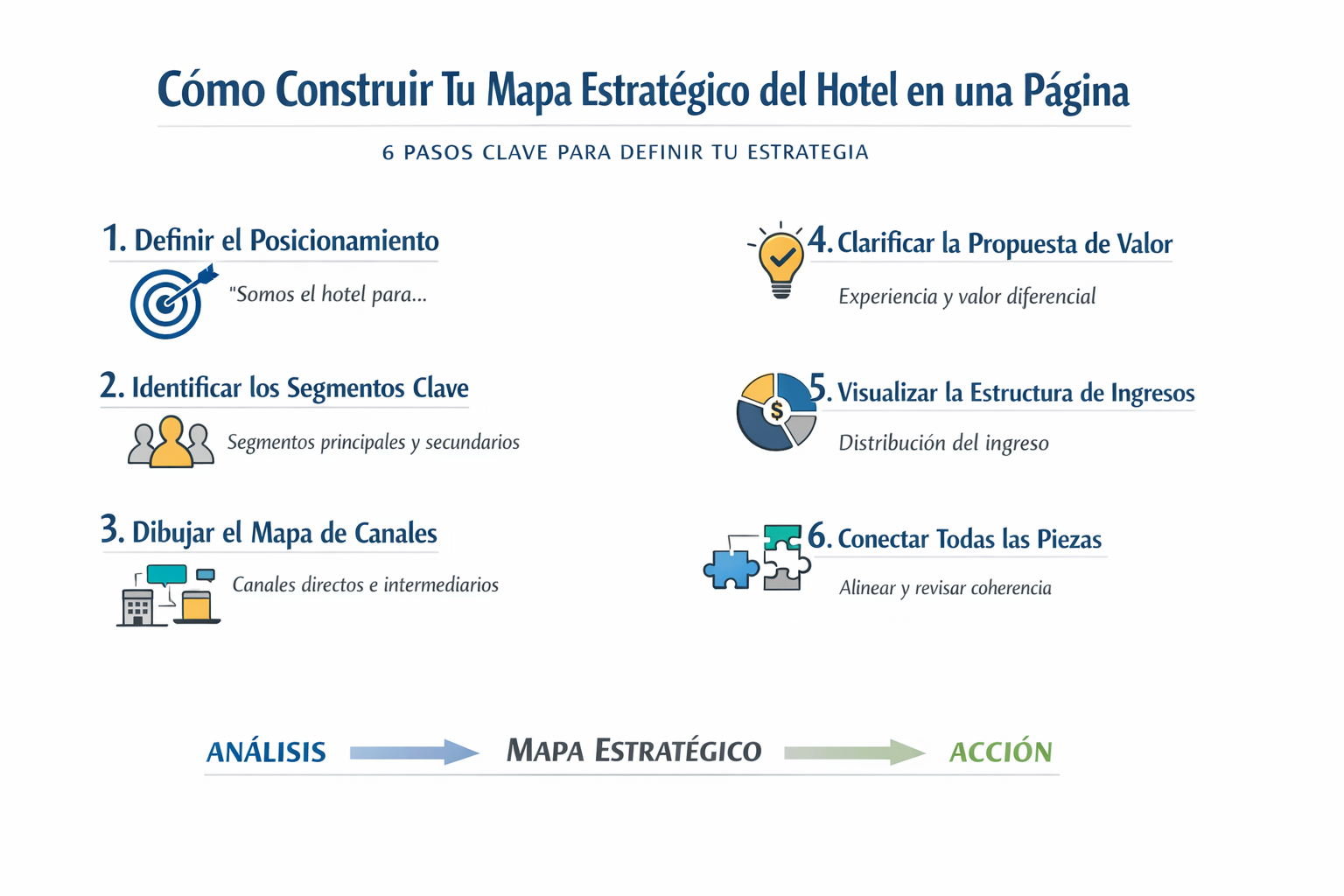
Step 1. Define the positioning
Answer in a single sentence: “We are the hotel for…” If the sentence is not clear, neither will the strategy be.Step 2. Identify the key segments
Make a list of:- the 3 main segments
- the 2 secondary segments
- the segments that do not fit
Step 3. Map out the channels
Represent:- direct channels
- intermediaries
- commercial agreements
Step 4. Clarify the value proposition
Define three elements:- core experience
- point of difference
- reason to choose
Step 5. Visualise the revenue structure
Create a simple chart showing:- percentage by business line
- estimated profitability
Step 6. Connect all the pieces
This is where it gets interesting. Ask yourself:- do my segments fit my positioning?
- do my channels attract the right guest?
- does my value proposition justify my price?
- is my revenue structure coherent?
Signs That Your Strategic Map Has Problems
When I review hotel strategic maps, recurring symptoms tend to appear. For example:- Premium positioning with low-value channels
- Mass-market segments with a boutique experience
- A direct strategy dependent on OTAs
- A poorly differentiated value proposition
- A revenue structure overly dependent on rooms
Why This Tool Is So Powerful
The strategic map forces us to do something we do not always do in hospitality: think about the business as a coherent system. When everything is on a single page:- inconsistencies emerge
- opportunities become visible
- strategic decisions become simpler