
Strategic Governance for Hotels: Making Decisions Beyond the Hotel GM’s Mood

Albert BarraMarch 10, 2026 · 6 min read


In hospitality, there is an uncomfortable reality that is rarely discussed openly: many hotels do not operate with a decision-making system, but according to the emotional state of the director on any given day.
There are days when everything seems clear. The market is responding, the team is aligned, and decisions flow naturally. And there are other days when a bad night’s sleep, a guest complaint, or a result below expectations shapes the way decisions are made. What seemed strategic yesterday is perceived as urgent today. What was a necessary investment yesterday now appears to be an unnecessary expense.
This is one of the silent risks of hotel leadership: when the organisation depends too heavily on the psychology of the person leading it. It is not a matter of talent or commitment. It is simply a natural consequence of operating in an environment where pressure is constant, information is incomplete, and decisions must be made quickly.
 The problem emerges when the governance structure is weak. When decisions are not anchored in clear criteria, defined processes, and shared strategic frameworks, the organisation swings between impulses, reactions, and constant corrections. In this scenario, the hotel may appear active, but in reality it is living in a state of permanent, sophisticated improvisation.
Over the years, I have learned that one of the greatest leaps in hotel management maturity occurs when decisions stop depending on one person’s emotional state and begin to depend on a system of organisational thinking. It does not mean eliminating intuition. It means giving it structure.
In other words: it is not about making fewer decisions, but about making better ones with less emotional noise.
The problem emerges when the governance structure is weak. When decisions are not anchored in clear criteria, defined processes, and shared strategic frameworks, the organisation swings between impulses, reactions, and constant corrections. In this scenario, the hotel may appear active, but in reality it is living in a state of permanent, sophisticated improvisation.
Over the years, I have learned that one of the greatest leaps in hotel management maturity occurs when decisions stop depending on one person’s emotional state and begin to depend on a system of organisational thinking. It does not mean eliminating intuition. It means giving it structure.
In other words: it is not about making fewer decisions, but about making better ones with less emotional noise.
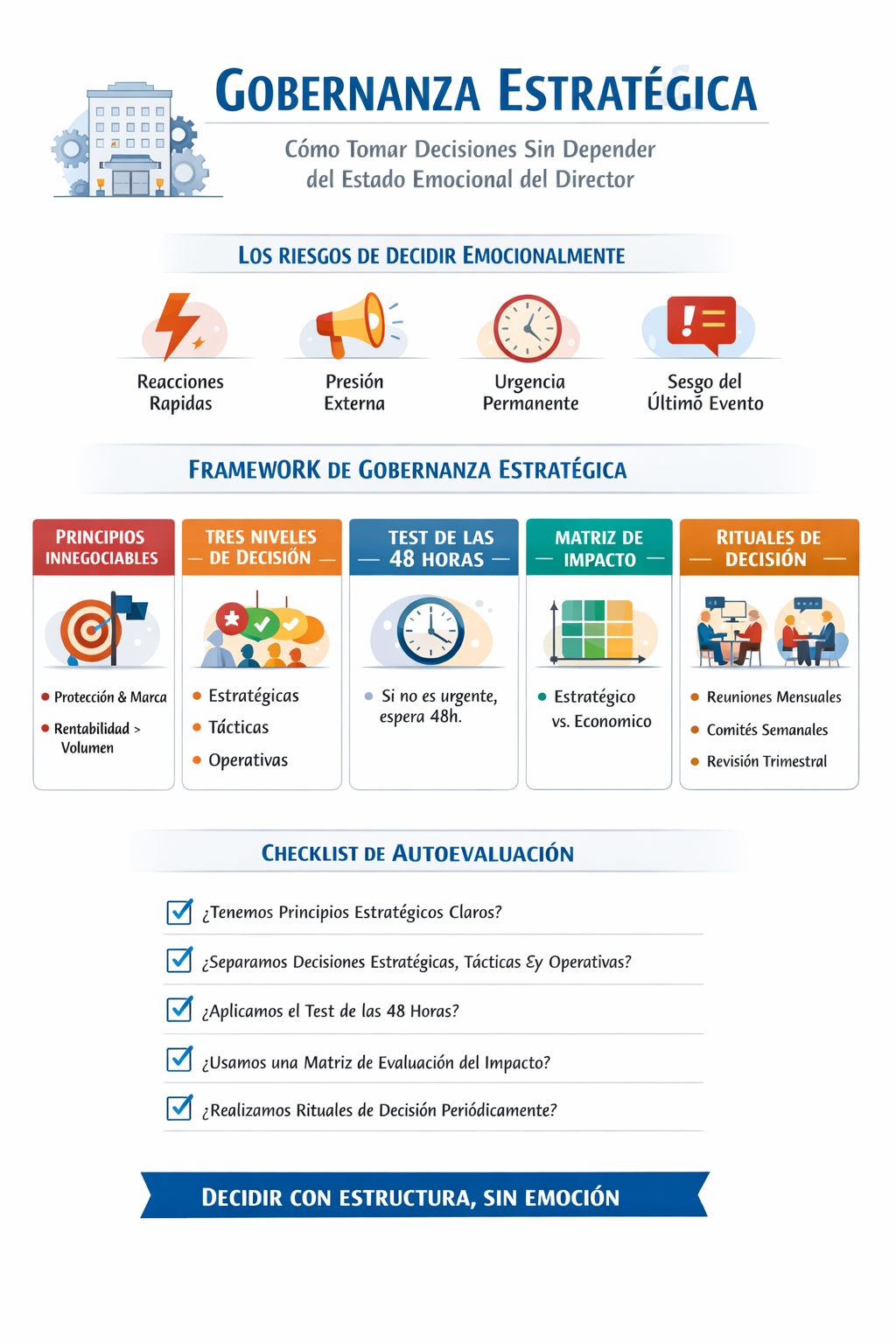 I summarise it in five pillars.
The problem emerges when the governance structure is weak. When decisions are not anchored in clear criteria, defined processes, and shared strategic frameworks, the organisation swings between impulses, reactions, and constant corrections. In this scenario, the hotel may appear active, but in reality it is living in a state of permanent, sophisticated improvisation.
Over the years, I have learned that one of the greatest leaps in hotel management maturity occurs when decisions stop depending on one person’s emotional state and begin to depend on a system of organisational thinking. It does not mean eliminating intuition. It means giving it structure.
In other words: it is not about making fewer decisions, but about making better ones with less emotional noise.
Why many hotels make emotional decisions (even if they do not admit it)
Hospitality is a deeply human business. That is part of its beauty, but also part of its complexity. Hotels operate in an ecosystem where guests, teams, suppliers, owners, online reputation, revenue, and expectations converge every day. Everything happens at once. In this context, it is easy for decisions to be influenced by emotional factors. Not always consciously. Some of the most common patterns I observe in the industry are these:- Decisions reactive to immediate results. When a hotel experiences a temporary drop in occupancy or revenue, there is a temptation to make quick decisions to correct the symptom. Hasty promotions, aggressive discounts, or strategy changes that respond more to the anxiety of the moment than to a sound positioning rationale.
- Decisions influenced by external pressure. Owners, guest comments, rankings, comparisons with other hotels, or market reports can create psychological pressure on management. When this happens, many decisions stop responding to the hotel’s strategic model and start responding to the noise around it.
- The illusion of control. A very common phenomenon in hotel management is the belief that every problem requires direct intervention. However, many hasty decisions do not improve results; they simply create operational instability.
- The culture of permanent urgency. In some hotels, everything appears urgent. Everything requires immediate attention. But when everything is urgent, nothing is truly strategic.
- The bias of the latest event. A recent complaint, a poor review, or a conversation with an influential guest may carry more weight in a decision than months of operational data.
Strategic Governance Framework for Hotels
Mature hotel leadership is not about always having the right answer. It is about having a system that enables consistent decisions, even on difficult days. Over the years, I have been structuring a simple yet highly effective model to prevent decisions from depending on the emotional state of the moment.
I summarise it in five pillars.
1. Non-Negotiable Strategic Principles
Every hotel should define between three and five strategic principles that serve as a compass for every decision. They are not objectives. They are decision-making criteria. For example:- Protecting the hotel’s positioning. If a decision improves short-term revenue but damages brand positioning, the answer must be no.
- Profitability before volume. Not all bookings are equal. Some segments generate occupancy, but not margin.
- The guest experience as a strategic asset. If a decision compromises the guest experience, it must be reconsidered.
- Operational simplicity. Strategies that complicate operations ultimately erode profitability.
2. Separate Three Levels of Decision-Making
One of the most common mistakes in hospitality is mixing decisions of different natures. Not all decisions belong at the same level.- Strategic decisions. They define the hotel’s positioning, value proposition, and business model. Examples: segmentation, repositioning, dining concept.
- Tactical decisions. They optimise the existing model. Examples: pricing, campaigns, packages, promotions.
- Operational decisions. They resolve day-to-day situations. Examples: incidents, resource allocation, service adjustments.
3. The 48-Hour Test
A simple but extremely useful principle. If a decision does not affect the guest within the next 48 hours, it probably does not need to be made today. Hospitality is surrounded by false urgencies. This simple filter prevents hasty decisions. Very often, when a decision is reviewed two days later, new information emerges—or simply a clearer perspective.4. The Strategic Impact Matrix
Before making significant decisions, I use a very simple exercise: Assess any decision across two dimensions:- Strategic impact: Does this decision strengthen or weaken the hotel’s positioning?
- Real economic impact: Does it generate margin or only volume?
- High strategic impact + high economic impact → immediate priority
- High strategic impact + low economic impact → strategic investment
- Low strategic impact + high economic impact → tactical decision
- Low strategic impact + low economic impact → probably not worth attention
5. Create Decision-Making Rituals
Mature organisations do not make strategic decisions amid operational noise. They make them in spaces designed for thinking. In hospitality, three rituals work particularly well:- Monthly strategic meeting. An in-depth review of the hotel’s positioning, market developments, and structural decisions.
- Weekly performance committee. Analysis of revenue, costs, and commercial performance.
- Quarterly business model review. A deliberate pause to challenge assumptions and adjust course.
A Practical Strategic Governance Checklist for Hotel Directors
To determine whether a hotel depends too heavily on the leadership team’s emotional state, simply answer these questions:- Does the hotel have defined strategic principles to guide its decisions?
- Are important decisions made in structured forums for reflection?
- Does the organisation clearly distinguish between strategic, tactical, and operational decisions?
- Do relevant decisions go through a clear evaluation framework?
- Does the team understand why decisions are made?