
The Hidden Cost of Indecision in Hotels

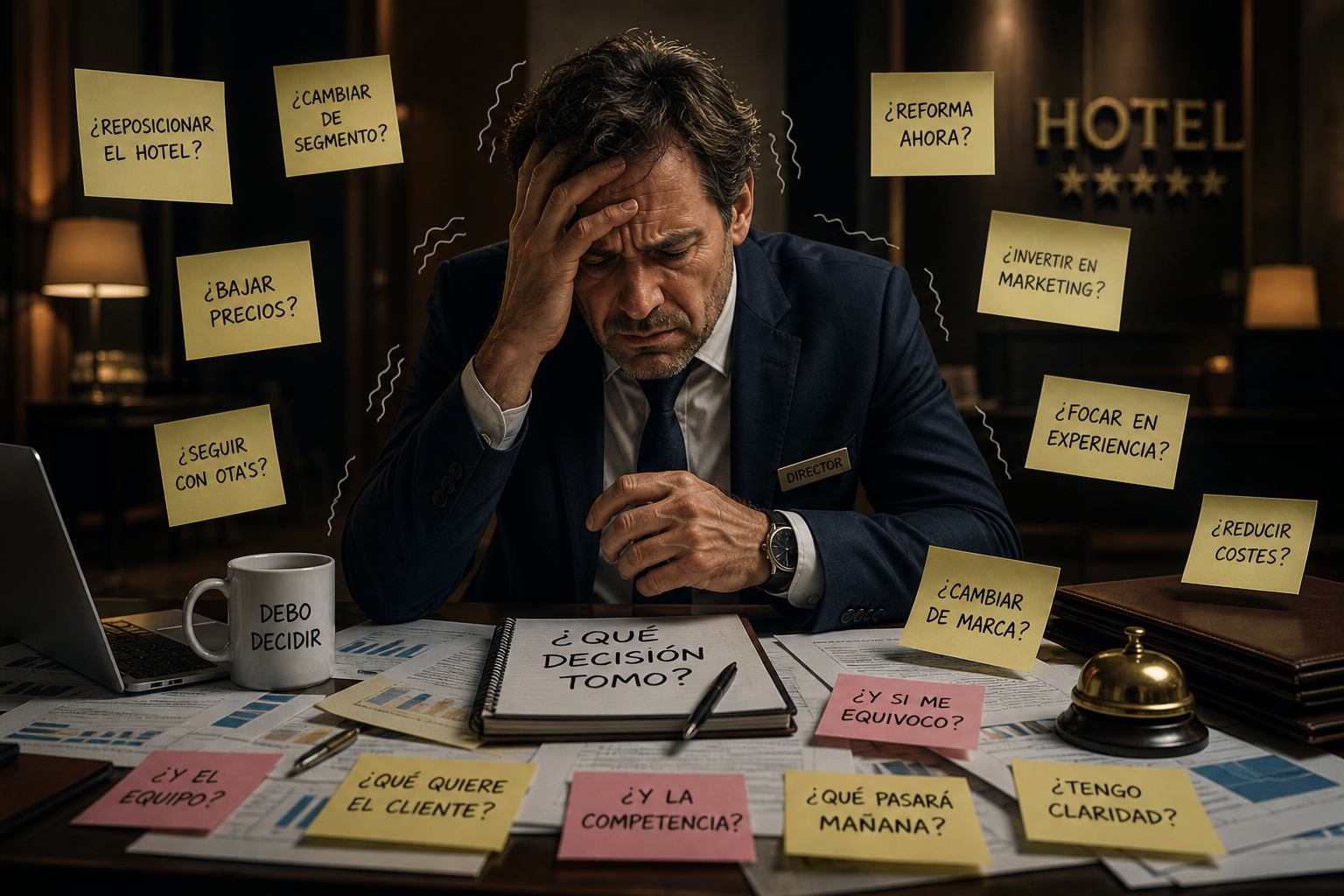

There is a deeply dangerous idea in hospitality: believing that not making a decision is a form of prudence.
Waiting, watching, delaying, requesting another report, calling another meeting and letting “the market tell us a little more” may seem sensible. But very often, it is not prudence. It is fear dressed up as analysis.
In a hotel, strategic indecision does not usually explode overnight. It makes no noise. It does not come through the front door with a red alarm. It gradually settles into the positioning, the pricing, the segmentation, the team culture and the guest perception.
A bad decision, if detected early, can be corrected. A wrong decision provides learning, forces adjustments and creates momentum. Indecision, on the other hand, accumulates. And by the time you want to react, the market has already decided for you.
I have seen hotels lose more value by failing to choose than by getting it wrong. Hotels that did not know whether they were boutique, wellness, gastronomic, family, corporate, lifestyle—or all of the above. And when a hotel tries to be everything, it usually ends up becoming something far more dangerous: irrelevant.
Indecision is not neutral: it is also a decision
In hospitality, we tend to talk a great deal about visible decisions: a refurbishment, a price reduction, a rebranding, a new commercial strategy, an investment in the guest experience or a change to the operating model.
But we speak very little about invisible decisions. The ones that are not made. The ones that are postponed. The ones hidden behind seemingly reasonable phrases such as “it is not the right time yet”, “let’s wait and see how the season develops” or “we would rather not touch anything for now”.
The problem is that the market does not wait. Guests do not wait. Competitors do not wait. And the P&L, although it may have accounting patience, does not wait forever either.
Inaction in hospitality carries a very specific cost:
- Loss of positioning: when you do not define the place you want to occupy in the guest’s mind, you end up occupying the space others leave for you.
- ADR erosion: a hotel without a clear proposition ends up defending price rather than value.
- Commercial confusion: if you do not know whom you want to attract, your campaigns speak to everyone and persuade very few.
- Operational fatigue: teams grow more tired of ambiguity than of hard work.
- Dependence on intermediaries: when a hotel does not lead its own demand, others manage it on its behalf.
- Lost opportunity: every season spent without deciding leaves less room to correct course in the next one.
Indecision is often justified with a phrase I have heard many times: “We do not want to get it wrong.” I understand. Nobody wants to get it wrong. But in a business with a perishable product, high fixed costs and increasingly complex demand cycles, not deciding is also getting it wrong.
The difference is that a bad decision usually has an author. Indecision usually has a committee.
And that is part of the problem. In hospitality, we often confuse participation with the absence of accountability. Listening is essential. Validating data is too. But there comes a point when someone has to say: “This is the way forward.”
Without that moment, the hotel enters a kind of strategic fog. Everything seems to be moving, but nothing moves forward.
The repositioning that never happens
One of the most common costs of indecision emerges in hotel repositioning.
There are hotels that know perfectly well that their product no longer fits the market. They see it in reviews, in the type of guest they attract, in rate pressure, in the difficulty of building loyalty and in the internal feeling that “something is just not working”.
And yet, they do not decide.
They do not change the narrative. They do not review their segment. They do not update the experience. They do not adjust the service. They do not redefine the product. They do not reframe the brand promise.
They keep waiting.
And while they wait, the asset loses appeal, the team loses conviction and guests lose their reasons to choose it.
Repositioning does not necessarily mean undertaking a major refurbishment. Sometimes it starts with something much deeper: deciding what you want to stand for in the market.
A hotel is not repositioned simply by changing furniture, photographs or amenities. It is repositioned when every decision begins to answer the same question:
Why should the right guest choose us?
If that question has no clear answer, the hotel does not have a strategy. It has rooms available.
Indecisive pricing: when price stops communicating value
The second major territory of indecision is hotel pricing.
A rate is not just a number. It is a signal. It communicates positioning, confidence, expectation, scarcity, perceived quality and strategy.
When a hotel constantly hesitates in its pricing policy, the market notices. And it notices quickly.
The hotel that changes rates without criteria, drops them too early, raises them too late, copies competitors without understanding its own value or accepts any demand for fear of empty rooms ends up entering a dangerous dynamic: the rate stops being a strategic tool and becomes an emotional sedative.
We reduce rates because we become anxious. We raise them because we see others doing so. We open channels “just in case”. We apply restrictions too late. We accept groups that do not fit. We give away added value to compensate for an insecurity we do not want to name.
And so, little by little, the hotel teaches the market to buy from it on worse terms.
The problem is not selling cheaply when it is appropriate. That can be smart. The problem is selling cheaply because you do not know what to do.
The difference is enormous.
- A strategically low price responds to an assessment of demand, calendar, segment, channel and profitability.
- A low price born of indecision responds to fear.
The first can generate business. The second destroys value.
Segmentation means giving things up, which is why it is so difficult
Hotel segmentation demands a word that makes many people uncomfortable: sacrifice.
Choosing a priority segment means accepting that not all guests are equally attractive. And although that may seem obvious, it remains difficult for many hotels to embrace.
Some guests fill rooms but undermine the experience. Some generate occupancy but put pressure on costs. Some contribute volume but not reputation. Some help in low season but damage positioning if they become central to the model.
Indecision appears when the hotel wants to attract everything:
- Leisure guests, but corporate guests too.
- Couples, but families too.
- Quiet luxury, but noisy events too.
- Thoughtful gastronomy, but high-volume quick-service menus too.
- Wellness, but aggressive turnover too.
All of these can coexist in some very well-designed models. But not everything can coexist without strategic architecture.
When a hotel mixes incompatible segments without clear criteria, the experience breaks down. And when the experience breaks down, guests do not always complain. Sometimes they do something worse: they do not return.
Segmentation is not about excluding people on a whim. It is about protecting the coherence of the business.
In hospitality, the wrong guest also comes at a cost. They occupy space, consume energy, alter the atmosphere, shape other guests’ perceptions and can push the hotel towards a promise it does not want to fulfil.
Sometimes, the most profitable decision is not to capture more demand. It is to capture better demand.
The team also pays for indecision
Strategic indecision does not remain in the executive offices. It reaches the front desk, enters the kitchen, sits in the restaurant, moves through housekeeping and ultimately affects the internal climate.
A team can work hard when it understands what it is working for. It can withstand pressure when it sees direction. It can adapt to change when that change makes sense.
What profoundly wears a team down is not high expectations. It is contradiction.
Today we want one thing. Tomorrow, another. Today we defend rate. Tomorrow we give it away. Today we say we are premium. Tomorrow we accept dynamics that do not fit. Today we demand excellence. Tomorrow we tolerate improvisation. Today we talk about experience. Tomorrow we decide solely on occupancy.
That is not flexibility. That is confusion.
And confusion carries an enormous human cost.
- It reduces initiative: nobody dares to decide because they do not know which criterion will prevail tomorrow.
- It increases dependence on senior management: everything is escalated because there are no clear frameworks.
- It weakens accountability: if the direction changes every week, nobody feels ownership of the outcome.
- It multiplies internal conflict: each department interprets the strategy in its own way.
- It wears down the best people: talent usually tolerates pressure, but not a lack of clarity.
In a hotel, strategic clarity is a form of respect for the team.
It does not mean having all the answers. It means providing a framework that enables people to act with sound judgement, make coherent decisions and understand what is expected of them.
A team without clear direction may look busy. But being busy is not the same as making progress.
The false security of waiting
Indecision has a psychological advantage: it allows us to avoid the vertigo of choosing.
As long as you do not decide, you do not expose yourself. Nobody can say you got it wrong. Nobody can point to a specific decision. Nobody can ask for an explanation about a direction that was never openly declared.
But that comfort is false.
Because the hotel does pay the price. It pays through missed opportunity, dispersed energy, uncaptured value and a weakened competitive position.
Waiting can be strategic when it responds to conscious analysis. But waiting because of an inability to decide is not strategy. It is erosion.
There are moments when the best available data is not perfect, but it is sufficient. And in hospitality, making a timely decision with 70% of the information is often worth more than deciding with 95% once the opportunity has passed.
The pursuit of absolute certainty is a trap. Especially in a business where demand depends on variables we will never fully control: weather, connectivity, events, the economy, destination perception, competitive pressure, social change and even that wonderful guest habit of booking precisely when we had already lost faith.
Excellence does not consist of always being right. It consists of creating a system capable of deciding, measuring, correcting and learning.
How to build a hotel culture that makes better decisions, sooner
Breaking the cycle of indecision requires method. Asking for courage is not enough. Courage without data can become recklessness. But data without decisions becomes corporate decoration.
A decision-making culture needs clarity, discipline and accountability.
1. Define your positioning in an uncomfortably clear sentence
If your team cannot explain what your hotel is in one simple sentence, guests will probably not be able to remember it either.
A strong positioning statement should answer:
- Who we exist for: who our priority guest is.
- What value we deliver: what problem we solve or what desire we activate.
- Why we are relevant: what makes us preferable to the alternatives.
- What we give up: what we will not pursue, even when it is tempting.
The final part is the most important. A strategy without trade-offs is merely a wish list.
2. Separate strategic decisions from tactical decisions
Many hotels live by confusing what is urgent with what is important.
A one-off promotion is not strategy. A price reduction is not strategy. A social media campaign is not strategy. A romantic package with petals, sparkling wine and a beautiful photo is not strategy either, although I admit it can brighten the week considerably.
Strategy answers fundamental questions:
- Which market we want to occupy.
- Which guest we want to attract.
- Which experience we want to deliver.
- Which revenue structure we want to build.
- Which internal capabilities we need to develop.


My published books
Tactics must serve strategy. When the reverse happens, the hotel becomes a collection of random ideas.
3. Create decision-making frameworks for pricing
Pricing cannot depend on Monday morning’s mood.
A hotel needs clear criteria:
- Demand calendar: identify high-, medium-, low- and compressed-demand dates.
- Priority segments: understand which guests bring margin, reputation, repeat business and stability.
- Profitable channels: distinguish useful volume from expensive volume.
- Commercial restrictions: decide when to protect inventory and when to stimulate demand.
- Strategic minimum rate: do not confuse filling rooms with making money.
The question is not only how much we sell. The question is what kind of revenue we are buying with every commercial decision.
Because occupancy can sometimes be expensive. Anyone who has filled a hotel with the wrong guest, at the wrong rate, through the wrong channel, and then celebrated 100% occupancy with the same enthusiasm as someone celebrating having to buy a round for the entire town knows this.
4. Turn segmentation into a daily tool
Segmentation is not about creating a beautiful PowerPoint once a year. It is about making daily decisions with sound judgement.
It should affect:
- Communication: which messages we use and which promises we avoid.
- Distribution: where we sell and under which conditions.
- The experience: which services we prioritise and how we design the stay.
- Reputation: which type of guest we want talking about us.
- Investment: where we allocate resources because that is where value is built.
A hotel that segments well stops chasing demand and starts building preference.
5. Establish a decision-making rhythm
Indecision grows when decisions have no timetable.
That is why it is advisable to establish rhythms:
- Weekly decisions: pricing, pickup, channels, restrictions and operational issues.
- Monthly decisions: segment mix, reputation, campaigns and profitability by channel.
- Quarterly decisions: positioning, product, experience and commercial investment.
- Annual decisions: business model, strategic priorities, capex and organisational structure.
When no rhythm exists, everything appears urgent and nothing appears final.
A decision calendar protects the hotel from permanent improvisation.
6. Measure the cost of not deciding
Committees analyse investments, costs, variances and results. But they rarely measure the cost of not acting.
It is worth beginning to put numbers to inaction:
- Uncaptured revenue: the difference between the rate sold and a reasonable potential rate.
- Opportunity cost: business rejected too late or accepted on poor terms.
- Reputational deterioration: the impact of an incoherent experience on reviews and repeat business.
- Intermediation cost: increasing dependence on higher-commission channels.
- Talent turnover: the loss of key people due to a lack of direction.
- Operational wear: hours spent correcting contradictions that could have been avoided.
What is not measured becomes romanticised. And indecision, when it is not measured, tends to disguise itself as prudence.
7. Accept that deciding means making people uncomfortable
Every strategic decision makes someone uncomfortable.
If you reposition, someone will say things worked before too. If you raise prices, someone will be afraid. If you change segments, someone will remember the long-standing guest. If you reduce dependence on certain channels, someone will ask what happens if demand does not come in. If you choose a clear identity, someone will miss the comfort of being undefined.
That is normal.
Strategy is not about avoiding discomfort. It is about choosing which discomforts are worth it.
A hotel cannot evolve without tension. The key is ensuring that tension has direction.
8. Protect coherence over bright ideas
Hospitality is highly prone to the elegant bright idea.
We see a trend, an article, an idea from another market, a gastronomic fashion, a wellness concept, an inspiring phrase at a trade fair or a presentation filled with English buzzwords, and suddenly we feel compelled to incorporate it all.
But not every trend fits your hotel. Not every innovation improves your proposition. Not every opportunity adds value.
The key question must always be:
Does this strengthen our strategy, or does it merely entertain us?
Because dispersion is also a form of indecision. It is failing to decide what deserves attention.
9. Give people permission to correct course
Many organisations do not make decisions because they penalise mistakes too heavily.
If every failed decision becomes a trial, people learn not to decide. If every adjustment is interpreted as failure, nobody dares to test. If every change triggers reproach, the team will choose the safety of paralysis.
A decision-making culture needs a culture of correction.
Deciding does not mean getting it right the first time. It means setting a hypothesis, executing it rigorously, measuring it honestly and adjusting it without drama.
In hospitality, the ability to correct course quickly is an enormous competitive advantage.
10. Remember that clarity sells too
Guests perceive clarity.
They perceive it on the website, in the photographs, in the tone of communication, in the pricing policy, in the services, in the type of guests, on arrival, in the room, at breakfast, in the restaurant, at check-out and even in that response to a review, where it becomes clear whether the hotel knows who it is or is merely trying to please everyone.
A clear hotel conveys confidence.
And confidence sells.
It sells better than a discount. Better than a generic promise. Better than “we have everything”. Because guests are not looking for a hotel that has everything. They are looking for a hotel that makes sense for them.
Strategic clarity turns a hotel into a recognisable option. And in a market saturated with messages, being recognisable is already a form of advantage.
I have learned that the important question is often not “What decision should we make?”, but rather “What decision have we been avoiding for too long?”
That question is often uncomfortable. But it also often opens the right door.
If a hotel has spent years hesitating over its positioning, target guest, pricing policy, food and beverage model, wellness proposition, dependence on intermediaries or its true level of service, the problem is probably no longer a lack of information. It is a lack of decision.
And the sooner this is recognised, the sooner value can begin to be recovered.
My advice is simple: identify one pending strategic decision and give it a date. Not a symbolic date. A real date. With an owner, minimum required data, possible scenarios and accepted consequences.
Then communicate the decision. Explain it. Cascade the criteria to the team. Measure the impact. Correct what is necessary. But do not allow ambiguity to continue governing the hotel from the shadows.
Because in hospitality, value is often not lost through one major mistake. It is lost slowly, season after season, while everyone waits for the perfect moment to decide.
And the perfect moment, like some last-minute bookings, usually arrives late, badly… or through a channel with far too much commission.
This article ends here. The archive does not.
Lead Hospitality brings together 1200 English articles published since 2018: years of experiences, decisions and lessons you can keep exploring.
What would you like to explore next?
Choose a direction and keep reading around what you want to solve, learn or challenge.