
The Hotel That Tried to Be Everything—and Ended Up Being Nothing

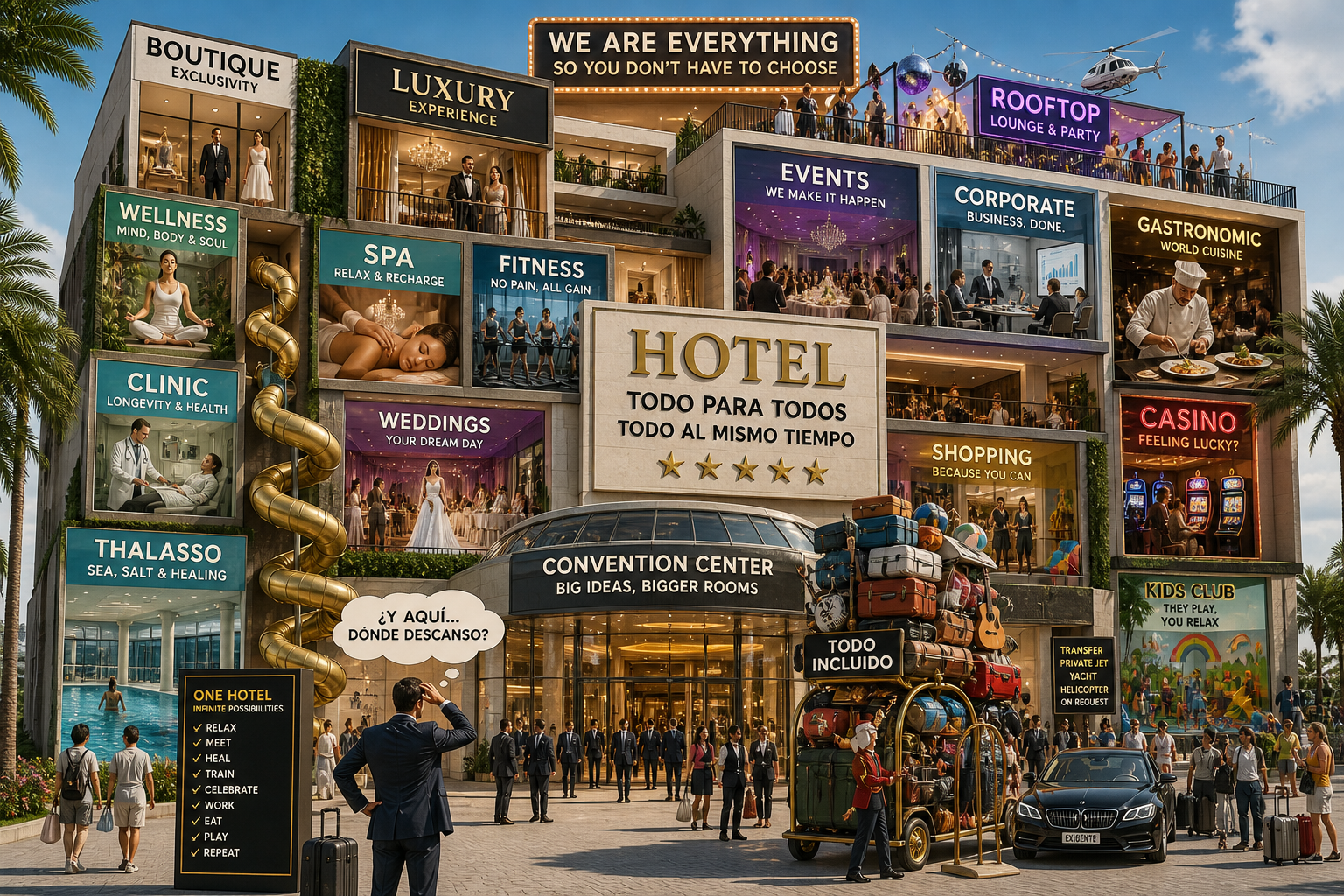

There is a scene that repeats itself far too often in today’s Hospitality industry. A project born with ambition, significant investment, a good location and an apparently brilliant idea: “we are going to be everything to everyone”.
I remember conversations in which people spoke enthusiastically about creating a boutique, luxury, wellness, gastronomic hotel, with a clinic, spa, events and a corporate segment. All in the same building. All at the same time. All for every audience. At that point, I already knew the problem would not be execution alone. Above all, it would be the lack of focus.
The industry has evolved into one of enormous complexity. Guests are more demanding, channels are more fragmented, costs are more sensitive and competition is more specialised. In that context, trying to cover everything is not always ambition. Very often, it is an elegant way of avoiding difficult decisions.
Because in Hospitality, as in any serious business, choosing not to decide is still a decision. And it almost always works against clarity, profitability and the guest experience.
What is most concerning is not that hotels like this exist. What is concerning is that many still believe this is the right way to compete: adding services, labels, concepts and promises until they build a product so broad that no one knows exactly what it is.
The strategic trap of trying to be everything
When a hotel tries to be several things at once, it enters dangerous territory: that of operational and commercial ambiguity. The hotel wants to speak to many audiences, but ultimately fails to connect deeply with any of them.
A wellness hotel needs silence, unhurried moments, rituals, a sense of sanctuary and an operation designed to support rest. An events hotel needs activity, logistics, capacity, flexible schedules, managed noise and teams prepared for peaks in intensity. A corporate hotel needs efficiency, speed, connectivity, agile processes and practical solutions. A gastronomic hotel needs a culinary narrative, product quality, consistency, talent in both kitchen and service, and an identity that goes far beyond having an attractive restaurant.
All of this can coexist to some extent, yes. But it cannot coexist without a strategic hierarchy. The problem is not having several business lines. The problem is not knowing which one leads.
I have seen hotels with spas that do not feel like wellness properties. Hotels that present themselves as boutique but operate like generic establishments. Hotels that speak of luxury while cutting back on essential details. Hotels that proclaim themselves gastronomic yet have no recognisable culinary proposition. Hotels that want to attract events but whose operational design struggles with medium-sized groups. Hotels that want corporate guests during the week and couples on romantic weekend breaks, without truly adapting the experience for either.
And here we find the first major mistake: confusing having services with having positioning.
A spa does not make a hotel wellness. An extensive menu does not make a hotel gastronomic. A multi-purpose room does not make a hotel an events benchmark. Attractive design does not automatically make a hotel boutique. And charging high rates, of course, does not make any hotel luxurious. We all know that, even if some sales brochures appear to have been written after an overly generous tasting.
True hotel strategy begins when a hotel can clearly answer three questions:
- Who do we exist for? It is not enough to say “all guests”. We must identify the guest we want to attract, the guest we can serve best and the guest who makes economic sense for our model.
- What problem or desire do we solve better than others? It may be rest, switching off, celebration, productivity, gastronomy, health, exclusivity or location. But there must be one primary answer.
- What must we stop doing to protect our proposition? This is the most uncomfortable question, but also the most profitable. Strategy is not only about choosing paths; it is also about closing doors.
When a hotel has no clear answer, every department begins to interpret the business in its own way. Marketing sells one promise. Reception manages another reality. Operations tries to survive. Revenue adjusts prices without a solid narrative. The kitchen works according to daily pressure. Maintenance puts out fires. And management ends up acting as a simultaneous interpreter between worlds that should never have become disconnected.
The result is an inconsistent experience. And inconsistency, in Hospitality, is one of the greatest enemies of trust.
The value proposition must be understandable, defensible and operationally deliverable. Understandable for the guest, defensible against the competition and deliverable for the team. If any one of those three dimensions fails, positioning becomes verbal decoration.
Specialisation is not limitation: it is how advantage is built
For years, the idea has taken hold that specialisation reduces opportunities. I believe exactly the opposite. In a saturated market, well-designed specialisation does not narrow the business; it makes it recognisable.
Guests do not remember the hotel that did a little of everything. They remember the hotel that solved something for them in an extraordinary way.
They remember the hotel where they genuinely rested. The hotel where they had a memorable dinner. The hotel where they celebrated something important. The hotel where they felt cared for. The hotel where everything seemed designed for them. The hotel where the experience made sense from arrival to departure.
Specialisation does not mean giving up ancillary revenue. It means bringing strategy into order. A hotel may have a restaurant, spa, events and corporate services, but all those elements must serve one central idea. If each unit pulls in a different direction, the hotel does not gain depth: it gains confusion.
When I think through a hotel model, I always return to a very simple idea: identity must come before the offer. First define what you want to be. Then decide which services make sense. Not the other way around.
The usual mistake is to build a catalogue and then look for an identity to justify it. “We have a spa, so we are wellness.” “We have a restaurant, so we are gastronomic.” “We have meeting rooms, so we are MICE.” “We have design, so we are boutique.” But the market does not buy labels. It buys consistency.

My published books
To bring that consistency into order, it is worth reviewing five critical dimensions:
- Real segmentation: Not all guests are equally valuable, nor are all of them a fit for the product. Attracting the wrong guest may generate one-off revenue, but it can also create friction, poor reviews, operational pressure and brand erosion.
- Operational design: Every positioning requires specific processes. A leisure and relaxation hotel cannot operate according to the same logic as an events hotel. A gastronomic hotel needs a different culture in service and kitchen from a purely accommodation-led hotel.
- Consistent revenue management: You cannot optimise pricing effectively if you do not understand the value perceived by the guest. Pricing should not simply be a reaction to demand; it should express the hotel’s position in the market.
- Honest hotel marketing: Communication must amplify what the hotel can genuinely deliver. Promising more than operations can sustain is a short-term gain and tomorrow’s complaint.
- Aligned internal culture: The team must know what kind of experience it is trying to create. Without that clarity, every employee improvises based on goodwill, and goodwill without a system does not always produce excellence.
One of the clearest symptoms of a hotel without focus is that every opportunity seems like a good one. A wedding. A corporate group. A wellness retreat. A gastronomic package. A social event. An agreement with a clinic. A getaway promotion. A last-minute discount. A campaign for couples. A campaign for businesses. A campaign for families, even though the hotel was not designed for families. Everything seems attractive because there is no strategic filter to say: “this fits” or “this takes us off course”.
And when there is no filter, the market ends up filtering for you. Usually, through price.
That is the great penalty of ambiguity: the hotel ends up competing on rate because it has not built a sufficiently powerful reason to compete on preference.
Hotel profitability does not depend only on selling more rooms. It depends on selling better, to more aligned guests, with less operational friction, greater satisfaction and a proposition capable of sustaining price. RevPAR matters, of course. But so do GOP, acquisition cost, the operating cost of serving each segment and the reputational impact of attracting demand that does not fit the product.
A hotel full of the wrong guests may look like a success in occupancy terms while being a failure in profitability, workplace climate and positioning.
That is why I like to speak of strategic trade-offs. Not as a loss, but as a way to protect value. Giving up certain segments allows you to serve others better. Giving up certain promotions allows you to sustain rate. Giving up certain events allows you to protect tranquillity. Giving up certain trends allows you to build identity.
Hospitality needs less anxiety about appearing modern and more discipline in being relevant.
When a hotel makes decisions clearly, everything begins to fall into place. Investment is prioritised more effectively. The team understands the standard. Marketing becomes more precise. Revenue has a framework. The experience becomes consistent. The right guest recognises the value. And the owner begins to see something far more interesting than a collection of services: a business model.
A boutique hotel does not have to be wellness, clinical, gastronomic, corporate and events-focused in order to be profitable. It has to be memorable for the right guest. A wellness hotel does not need to resemble a medical centre if its promise is emotional rest and balance. A gastronomic hotel does not need to multiply concepts if it has an honest, recognisable and well-executed kitchen. A corporate hotel does not need to pretend to be romantic at weekends if its advantage lies in flawless efficiency. Every model has its own beauty when it is well conceived.
The question is not how many things a hotel can add. The question is how many it can sustain without losing its soul.
My advice is to conduct an honest positioning audit. Not from the brochure, but from the real experience. Book as a guest. Visit the website. Read the reviews. Observe breakfast. Listen to the team’s tone. Look at what type of guest feels comfortable and which one seems out of place. Analyse which services generate margin and which merely generate noise. Ask the team what they believe the hotel is. If everyone gives a different answer, you have a more reliable diagnosis than many consulting reports full of colourful charts.
Then define a positioning statement that a guest can understand, a team can deliver and a P&L can support. If that statement needs three lines, five adjectives and a philosophical explanation, it is probably not clear yet.
And, above all, remember something that Hospitality should never forget: the guest does not come to admire our internal complexity. They come to enjoy an experience that makes sense. The clearer the hotel is, the easier it will be for the guest to understand it, value it, recommend it and want to return.
This article ends here. The archive does not.
Lead Hospitality brings together 1200 English articles published since 2018: years of experiences, decisions and lessons you can keep exploring.
What would you like to explore next?
Choose a direction and keep reading around what you want to solve, learn or challenge.