
AI Doesn’t Need More Prompts: It Needs to Understand How Your Hotel Works

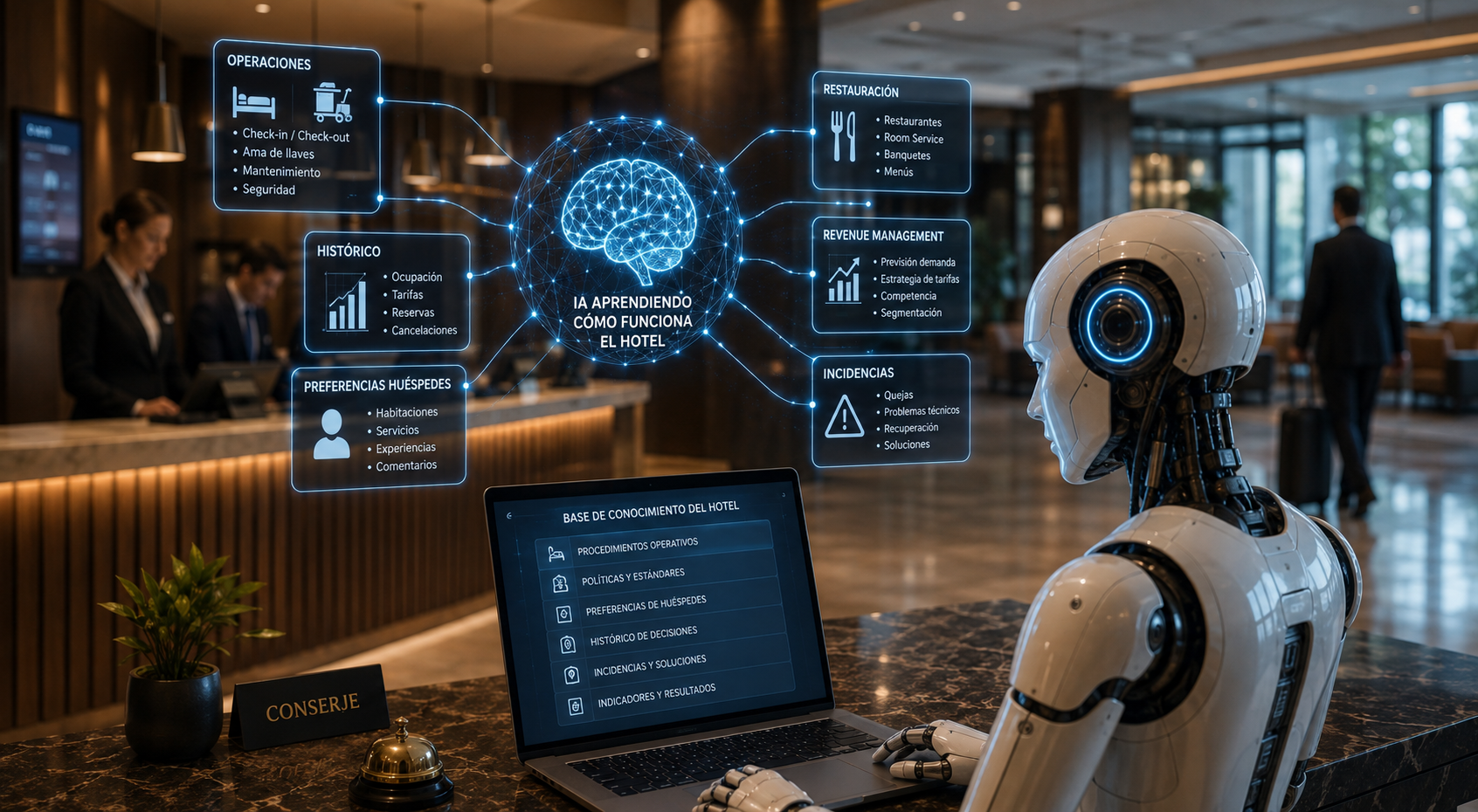

There is one idea I find particularly useful for understanding how we should introduce Artificial Intelligence in Hospitality. The principle is very similar to bringing a new person into the team. We can hand them a list of tasks, show them where their workstation is and expect that, with a little intuition and considerable patience, they will work out for themselves how we do things. Or we can explain our procedures, priorities, standards, exceptions and decision-making criteria. In both cases, we will have someone working. What we are unlikely to have in the first is consistency.
Exactly the same applies to Artificial Intelligence. We can open a tool, write an instruction and expect a brilliant answer. Sometimes, we will even get one. But if we intend to use AI to influence real hotel decisions—Housekeeping planning, guest communications, commercial analysis, revenue management, training, maintenance, purchasing or any other process—we soon discover that an AI that does not know the hotel can reason correctly and still recommend the wrong decision.
The reason is simple. A hotel contains hundreds of rules that rarely appear together in a single manual. We know which rooms should be released first, when it is worth accepting an exception, which complaints require escalation, which guests have particular conditions, what criteria we use to assign a room, which standards are negotiable and which are not, when inventory should be protected, or which seemingly minor incident may end up becoming a major problem. That knowledge exists, but it often exists within people.
For years, we have been able to live reasonably well with this situation because the organisation learned through human transmission. An experienced person taught another, the Executive Housekeeper explained the particularities of certain rooms, Front Office passed on the recurring preferences of some guests, and each department developed a kind of collective memory. The problem is that this memory is difficult to scale, vulnerable to turnover and extraordinarily dependent on particular individuals.
The arrival of AI brings a consequence that I consider far more important than the tool itself: it forces us to ask how much our organisation really knows about itself, and how much of that knowledge is structured. And this is where an interesting paradox emerges. Many hotels want to adopt Artificial Intelligence before they have turned their own operational experience into usable knowledge. We expect the machine to learn how we think when, in reality, we had never been particularly concerned with writing down how we think.
From procedure to operational knowledge: the real training of hotel AI
For a long time, we have associated operational documentation primarily with procedures. That makes sense. A hotel needs to establish how check-in is carried out, how a room is cleaned, how a complaint is handled, how breakfast is prepared or how to act in an emergency. Organisations function precisely because they combine people, responsibilities, systems, policies, practices and procedures.
But when we begin working with AI, we discover that a procedure does not necessarily contain all the knowledge required to make a good decision.
Let us imagine daily Housekeeping planning. We can tell an AI:
"Allocate the rooms among the available room attendants."
Technically, that is a perfectly understandable instruction.
Operationally, it is almost useless.
To create a sensible plan, it will need to know, among other things, which rooms are departures, arrivals and stayovers; which rooms require a linen change; which have priority because of early arrivals; how they are physically distributed; what workloads we consider equivalent; which room attendants work in particular zones; what incidents exist; which rooms are blocked; which exceptions must be respected; and what criteria we use when two priorities conflict.
In other words, it needs something very similar to what a good Executive Housekeeper who has just joined the hotel would need.
And therein lies, in my view, one of the least understood keys to applying AI in Hospitality:
The prompt explains what we want AI to do. Operational knowledge explains how we want it to think about our hotel.
They are two completely different things.
That is why I believe hotels should begin building a genuine operational knowledge base, not as a vast document repository designed to accumulate PDFs that no one will open again, but as an organised representation of how the property operates.
I would distinguish at least the following layers:
- Procedures. They define how we do things. They should explain the work sequences, responsibilities, controls and standards required to execute each process properly.
- Policies. They determine what is permitted, what is not, and under what conditions. Cancellations, upgrades, late check-outs, compensation, pets, complimentary services, discounts, access, authorisations and gestures of goodwill are obvious examples.
- Priorities. They explain what takes precedence when several needs compete simultaneously. And anyone who has worked in a hotel knows that this begins approximately five minutes after opening their eyes in the morning.
- Exceptions. A procedure describes normal operations; hotel operations also live on exceptions. A good knowledge base must establish when we may depart from the rule and who can authorise it.
- Decision-making criteria. I find this layer particularly important. It is not enough to record the decision we made; we must try to explain why we made it. This is where much of the knowledge lies that can later help an AI make useful recommendations.
- Service standards. AI needs to understand what quality means for our property. Two hotels may resolve the same situation correctly in entirely different ways because their value proposition is different.
- Property context. Room types, physical features, services, operating hours, guest segments, seasons, operational constraints, departmental structure and any particularity that affects a decision.
- Cases and precedents. Certain real-life situations contain more knowledge than twenty pages of procedure. Documenting relevant cases makes it possible to show how we apply criteria when reality does not exactly match the manual.
This does not mean turning the hotel into a documentation bureaucracy. In fact, we should do the opposite. Document only what improves a decision, prevents an error, facilitates training or protects service consistency.
Nor should the objective be to replace professional judgement.
That would be a major mistake.
A hotel is an extraordinarily contextual system. Operational work combines rooms, food and beverage, people, costs, revenue, service and guest expectations; moreover, much of the outcome depends directly on the decisions and actions of the teams. That is why no knowledge base can anticipate every possible situation.
What is interesting about AI is not eliminating that judgement, but giving it context before asking it for a recommendation.
There is also an enormous difference between information and knowledge.
We can say:
Check-in: 3:00 pm.
That is information.
But we can add:
If a room is available before 3:00 pm, it may be released early at no charge provided this does not compromise operational priorities; rooms for in-house guests awaiting availability will take priority over arrivals who have not yet presented themselves.
That begins to be operational knowledge.
And we can take it further:
When there is high pressure from early arrivals, Housekeeping will prioritise departure rooms with a confirmed incoming arrival, coordinating with Front Office according to estimated arrival time and availability by room type.
Now we are conveying judgement.
And judgement is precisely what turns generic AI into a tool that begins to understand how a specific organisation works.
Hotel knowledge can become a competitive advantage
There is another dimension that I find even more interesting.
For decades, we have thought of a hotel’s competitive resources primarily in terms of visible elements: location, facilities, brand, product, distribution, price or capital. Yet much of competitive advantage also comes from less visible resources: knowledge, culture, processes, organisational capabilities and accumulated experience. Hotel strategy identifies precisely those resources and capabilities which, combined, make it possible to develop competencies that are difficult to replicate.
Artificial Intelligence can amplify that difference.
Two hotels can use exactly the same AI model.
They may even pay exactly the same licence fee.
But if one has years of structured procedures, commercial criteria, service standards, policies, decision histories, operational knowledge and documented learnings, while the other simply writes prompts every morning, they are not really using the same Artificial Intelligence.
The model may be identical.
The organisational intelligence that feeds it is not.
This changes the conversation about competitive advantage considerably.
Over the coming years, many AI capabilities will inevitably become democratised. What seems extraordinary today will ultimately become a standard feature. When virtually any hotel can access extraordinarily powerful models, having AI will no longer constitute an advantage in itself.
The difference will lie in what each organisation knows and how it turns that knowledge into decisions.
That is why I believe one of the most intelligent investments a hotel can make today is not necessarily to buy another tool, but to begin taking a serious inventory of its own knowledge.
We can begin with seemingly simple questions:
What decisions do we repeat every week?
What does an experienced person know that appears in no document?
My published books
What mistakes occur when someone new joins?
What exceptions arise repeatedly?
Which situations always require asking the same person?
What criteria do we use to decide when the procedure offers no answer?
What information does someone need to make a good decision without asking us?
The answers will probably reveal something uncomfortable: our hotel knows far more than it has documented.
And that has consequences that go far beyond AI.
When we structure knowledge, we improve onboarding, reduce dependence on particular professionals, facilitate training, increase consistency, make delegation easier and protect the experience accumulated by the organisation.
The literature on organisational excellence has long emphasised the relationship between purpose, strategy, culture, people, operations, transformation and results. It is not enough to have knowledge; an organisation needs to turn it into consistent operations and continually review whether what it does still creates value.
AI now adds another reason to do so.
But there is an important warning: poor documentation also scales errors.
If our policy is inconsistent, AI will be able to apply it with extraordinary consistency.
If our procedure is outdated, it will be able to make mistakes much faster.
If our criteria contain contradictions, we may receive seemingly sophisticated recommendations built on incorrect premises.
And if we fill a knowledge base with duplicate documents, incompatible instructions and old versions, we will have created something akin to hiring a new person and having five different managers explain five different ways of doing the same job.
Then we will be surprised that it asks too many questions.
That is why any serious project should include knowledge ownership: who creates a rule, who validates it, when it takes effect, what it replaces, when it must be reviewed and who may amend it.
We must also distinguish between permanent rules and temporary context.
“Rooms must be inspected before being released” may be a stable rule.
“Tomorrow, prioritise third-floor rooms because a group arrives at 1:00 pm” is operational context.
Mixing the two categories quickly turns any knowledge system into a catch-all drawer.
The same logic can be applied to virtually any department.
In Revenue Management, AI will be considerably more useful if it knows our segmentation, demand patterns, restrictions, events, historical data, pricing strategy and commercial criteria. Effective revenue management is built precisely on knowledge of guests, pricing, events, historical performance, competition, distribution and systems, and decisions should be based on knowledge rather than impressions.
In Front Office, it will need policies, standards, complaint-handling protocols, compensation criteria, room knowledge and the ability to identify when a situation needs to be escalated.
In Food and Beverage, it may need menus, allergen information, operating hours, procedures, standards, costs, recipe specifications, purchasing criteria and service-specific requirements.
In Maintenance, equipment inventories, preventive maintenance schedules, recurring incidents, priorities, suppliers, warranties and safety protocols.
In Human Resources, onboarding procedures, roles, training, internal policies, organisational criteria and employment documentation that can be used within appropriate access and confidentiality limits.
And in Guest Experience, something even more important: AI should understand the experience we want to create, because hotel service depends to a great extent on the capabilities, motivation and behaviour of the people who interact with the guest.
That is why, if I had to start tomorrow, I would not try to document everything.
I would choose an important operational process, probably one involving a great deal of repetitive decision-making and tacit knowledge. I would identify the rules, speak to the people who know the process best, document the exceptions, include a few real cases and then test whether another person—or an AI—can reach a reasonably similar recommendation using that knowledge alone.
If it cannot, we probably still lack information.
If it can, we will have achieved something far more important than writing a good prompt: we will have turned individual experience into organisational knowledge.
My second piece of advice would be to review that knowledge base regularly with the people who actually carry out the processes. I have learned that procedures written exclusively from an office tend to have one fascinating characteristic: they work perfectly until someone tries to use them. Operational knowledge must be built by listening to Front Office, Housekeeping, Restaurant Service, Kitchen, Maintenance, Reservations and all the other people who know the exceptions because they live them every day.
And my third would be not to become obsessed with getting Artificial Intelligence to make autonomous decisions. I find it much more interesting to begin by ensuring that it asks better questions, detects contradictions, remembers our criteria and proposes well-founded alternatives. We will make the decision afterwards. Because the objective should not be to build a hotel where machines know how to decide without people, but an organisation where people can make better decisions because the hotel’s knowledge is no longer dispersed and begins to work in their favour.
This article ends here. The archive does not.
Lead Hospitality brings together 1200 English articles published since 2018: years of experiences, decisions and lessons you can keep exploring.
What would you like to explore next?
Choose a direction and keep reading around what you want to solve, learn or challenge.