
6 min read•Albert Barra
Management Science and Making the Possible Happen: Give Me Knowledge and I Will Move the World

Albert BarraMarch 26, 2025 · 6 min read
Discover how hotel managers can become workplace superheroes by combining knowledge, strategic thinking, simulation and intuition to turn ambitious business goals into reality.
LEAD HOSPITALITY·INSIGHTS
HOTEL MANAGEMENT

We have grown up with the mindset that only superheroes possess the strength to move the world. Every day, thanks to comics, TV and cinema, many more are added to the list of superheroes. Mindsets, as we know, are difficult to change, and we always expect these media to introduce us to each one of them. Yet it is difficult to imagine that we live surrounded by them, and that many of us could even be among these admired heroes. Knowledge can achieve what may seem impossible. The managers of our time are equipped with visible and invisible weapons and are still unaware of their great power…
Allow me to explain with a story from the world of physics:
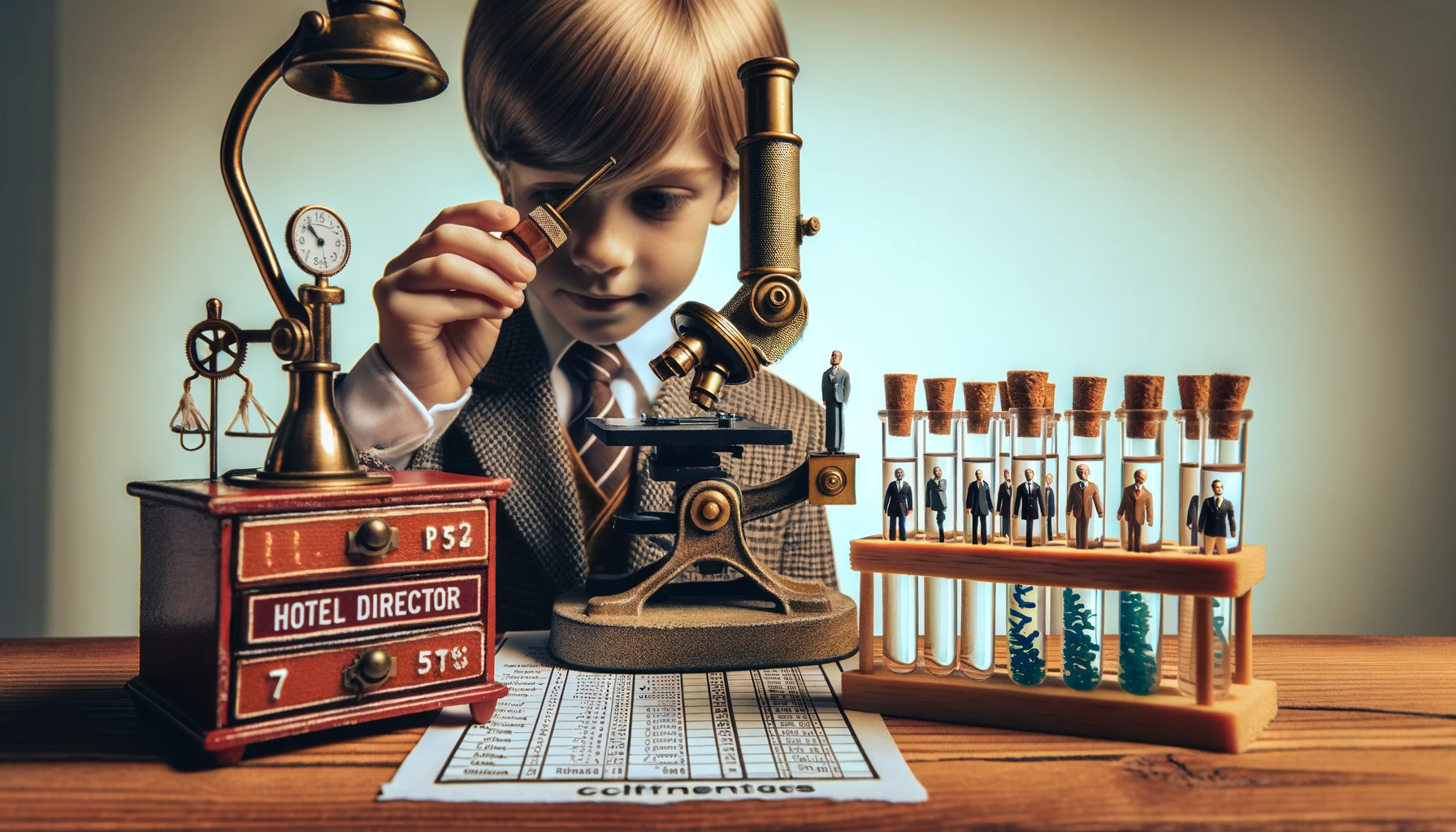
“We believe that acceleration is an effect of the vacuum acting on the vacuum. The repulsion of the vacuum against the vacuum is what accelerates expansion. If the vacuum is not empty and is a substance, it can be made to vibrate, and the vibrations of a substance at a fundamental level correspond to new particles; the particle resulting from the vibrations of the vacuum would be the Higgs particle…”Extraordinary and fantastic jargon, expertly woven into the explanation given by Álvaro de Rújula, the project’s theoretical physicist, who, through the construction of the “Large Hadron Collider”, the largest scientific machine ever built, aims to reproduce the conditions of the Big Bang. For many of us, all the theory surrounding the formation of the universe has seemed somewhat fantastical. From the first time I heard about the Big Bang, it became something entirely abstract and remote from reality for me, and I never imagined that, so soon, such an experiment could be conducted—one capable of reproducing the conditions of such an event. The gigantic machine is located at the European Organization for Nuclear Research (CERN) and was expected to be tested during these months. The machine will attempt to identify the particles resulting from the collision of two proton beams travelling at speeds close to the speed of light inside a tunnel with a circumference of 27 kilometres, under conditions similar to those recorded after the great explosion described by the Big Bang theory. This machine…, according to Rújula’s explanation, will be capable of accelerating protons to an energy 10 times greater than anything previously studied. Every time two particles collide at very high energy, new things can be created that were not there before. This is based on Albert Einstein’s formula, according to which energy equals mass times the speed of light squared, meaning that we can convert energy into mass. Thus, the energy of the movement of these particles is transformed into the mass of new particles, which are highly unstable and do not exist in nature because they have disintegrated; therefore, to study them, they must be created…” I wanted to offer this example of something that, until now, has apparently been impossible to know because of its very nature, and which has given rise to so much speculation, even within the scientific world. Yet, in some way, truly impressive steps are already being taken to reach the essence—the real and objective understanding of the phenomenon—through experimentation and simulation. Who knows what may result from this experiment—not simply from the operation of the equipment, but afterwards, if the desired outcome is finally achieved… But what attracts me most about this whole matter and remarkable piece of news are the doors it may open, not for physics and science in general, but for the human mind. Human beings are, by nature, rather sceptical, resistant to change, to what is new, to what is different; moreover, they are reluctant to take risks when they are not sufficiently certain of the outcomes. Experiments are not common across many branches of science, much less in the business sphere. Of course, no one likes to take risks when there is little chance of success, especially when methods and/or tools that would allow us to reach the future, test ideal formulas and see their outcomes do not exist or are unknown… Simulation is a tool before us, awaiting significant achievements in business, and although it is addressed in every course and academic programme related to management science, we are not able to use it sufficiently or derive all the value we could from it. Large organisations, as well as those that proclaim and parade themselves as innovative, with major development and research departments, devote substantial resources to development research and technological innovation. Yet their processes are still managed by those with heavy doses of bureaucracy and little scientific grounding. Let us imagine any process within a hotel in which we identify certain variables that influence and take part in it. Let us choose a desired outcome for that process. Let us play with the variables until we reach that outcome. Let us establish control loops in every process and act upon them… Of course, many will say, that is logical; it is something for scientists, not managers, not business… But management is science—great science, and even more science than we may think… It is not merely art and intuition. Hence the ever-growing need to achieve a higher scientific standard in our organisations… Simply by simulating a process, we could discover, without having to experiment in real life, its outcomes and the variables and/or resources required to achieve what we want… It is time to act. We have the information, we possess the knowledge, and we are entering the very heart of its era. Here are the tools required to achieve the accomplishments we so greatly need. Let us shift our mindset somewhat; let us complement intuition and art with analysis, with those scientific methods and technologies printed on our diplomas and CVs. The gap between what we desire and what we have today is not impassable. Strategic management is not a plan to display; it is a weapon for reaching the dream, one that, through shrewdness, intelligence, information and knowledge, can become reality. With these weapons, we can move the world of our business and add to the ranks of superheroes. Jerry Wind and Colin Crook, in The Power of Impossible Thinking, state:
“Acting means making decisions, doing so quickly, under a certain degree of stress and pressured by the rapid passage of time, battling uncertainty and making up for a lack of information with our knowledge of the subject.
People with in-depth knowledge of a particular subject can identify the meaning of a related situation far sooner than others, even when they have less information. There are two ways of making decisions: one is analytical and the other intuitive. If we had all eternity to decide what steps to take, we could analyse countless elements; however, we often face time constraints that force us to decide quickly, and then we rely on our intuition. At its best, intuition invites us to make creative leaps. At its worst, however, it has several weaknesses, such as the danger of making the wrong decision or the difficulty of communicating and coordinating with others.”
FREE READING LIMIT REACHED
Keep reading without waiting for the next reset
Your free access includes 6 reads per week. Subscribe to continue now.
Already have access?Sign in