Lead Hospitality

How Hotels Can Compete with Food Delivery Services

THE IDEA

Food delivery platforms are reshaping guest expectations and challenging hotel restaurant and room service revenue. Explore practical strategies hotels can use to adapt, strengthen their food and beverage offering, and create dining experiences that delivery services cannot replicate.

In today’s landscape, the hospitality industry stands at a turning point. The arrival and growth of food delivery services have reshaped guest expectations and preferences, presenting a significant challenge for the hotel sector. Platforms such as Glovo and JustEat, with their extensive variety and convenience, have captured our guests’ attention, leading to a noticeable decline in restaurant and room service sales at many hotels. This reality calls on us to reflect and seek creative solutions in order to remain relevant and competitive. The key question is: How can hotels compete effectively in this new landscape? The answer is not straightforward and requires an in-depth assessment of our strengths and capabilities. As hospitality professionals, we must embrace this challenge—not merely to survive, but to thrive in an increasingly crowded and changing market. This article explores a range of strategies and approaches that can help hotels adapt and stand out in this competitive environment. Our focus must be on innovation, personalisation and creating unique experiences that go beyond what food delivery services can offer. In doing so, we will not only respond to an immediate challenge, but also prepare for future market trends and demands. Below, we will explore in detail the strategies and tactics that can help hotels compete successfully in this challenging and constantly evolving environment.

The dilemma of allowing food delivery orders for hotel guests

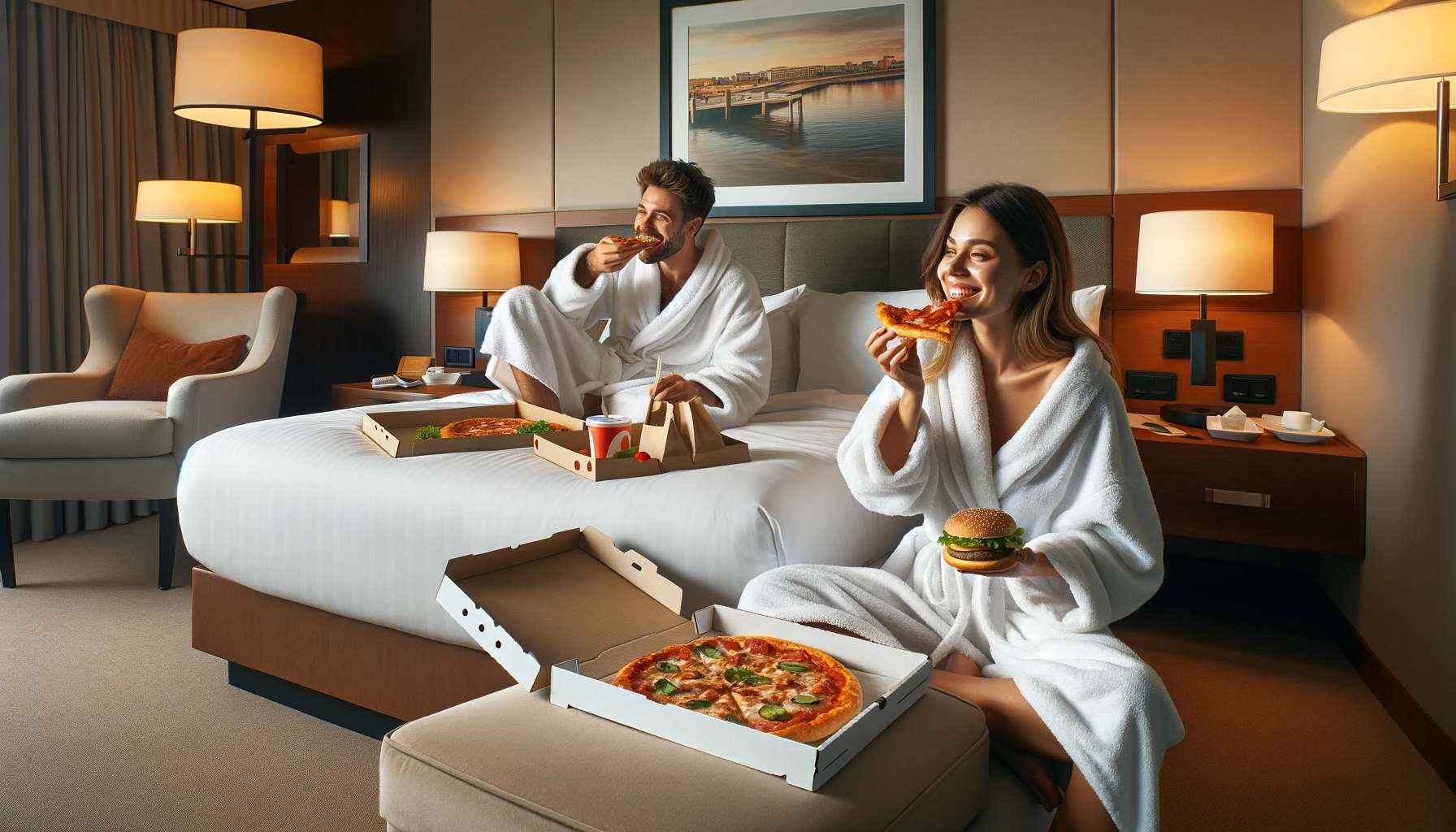
The dilemma of allowing food deliveries from services such as Glovo and JustEat to hotel guests is complex and requires a balanced assessment of the advantages and disadvantages. Here is a perspective that considers several aspects:

1. Advantages of Allowing Deliveries

  • Guest Satisfaction: Allowing these deliveries can increase guest satisfaction by offering greater choice and flexibility.
  • A Modern, Adaptable Image: By adapting to emerging trends, the hotel can project an image of modernity and flexibility.
  • Reduced Operational Pressure: During periods of high demand, allowing external deliveries can ease the pressure on the hotel’s kitchen and room service operations.

2. Disadvantages and Risks

  • Loss of Revenue: By choosing external services, guests may reduce their spend in the hotel’s restaurants, affecting revenue.
  • Quality and Food Safety Control: By allowing external deliveries, the hotel loses control over the quality and food safety of what its guests consume.
  • Logistical and Security Issues: Deliveries can create logistical and security challenges, such as allowing non-hotel personnel access to the property.

3. Balanced Strategies

  • Establish Designated Delivery Areas: Specific areas could be assigned for deliveries, enabling access to be managed while maintaining security.
  • Strategic Partnerships: Establish partnerships with selected delivery services to ensure quality and security standards.
  • Enhance the In-House Offering: Improve and diversify the hotel’s food offering, making room service and restaurants more appealing to guests.

4. Final Considerations

  • Understanding the Guest Base: It is essential to understand guest preferences. Some market segments may place greater value on the variety and convenience of external deliveries.
  • Balancing Service and Control: A balance must be found between delivering service and maintaining control over the guest experience.
The decision to allow food deliveries at a hotel should be made by considering both guest needs and expectations and the hotel’s commercial and operational interests. A well-considered strategy, tailored to the specific circumstances of the hotel and its guest base, can provide a balanced solution.

Competing with Food Delivery Services: A Challenge for Hospitality

One of the most recent challenges is competition from food delivery services. Platforms such as Glovo and JustEat have changed the rules of the game, offering convenience and variety that appeal to our guests. In light of this situation, what can we do? I will try to offer a fresh, practical perspective on how to address it.

1. Analysing the Current Situation

Assessing the Impact First, it is crucial to understand how these services are affecting our restaurant and room service sales. Recent studies indicate that a significant percentage of guests prefer to order food through these platforms because of their variety and convenience. However, this does not mean that our services have lost their value; it simply means that we must reassess and adjust our offering. Understanding Guest Preferences To compete effectively, we need to understand what guests value in these services. Variety, speed and convenience are key factors. But what can we offer that they cannot? This question leads us to explore our unique strengths as hotels.

2. Innovation and Adaptation Strategies

Reinventing Room Service One way to adapt is to reinvent our room service concept. We can explore rotating menus, partnerships with local chefs, or even incorporate healthy and organic options that align with current trends. Unique Culinary Experiences Another strategy is to create culinary experiences that cannot easily be replicated through a delivery service. This could include themed dinners, tasting events or even cooking classes at the hotel. These experiences can become an attraction in their own right.

3. Effective Marketing and Communication

Highlighting Our Strengths The key lies in how we communicate our offerings. Using effective digital marketing strategies to highlight the exclusivity, convenience and quality of our food service is essential. This includes compelling storytelling across social media and online platforms. Loyalty Programmes and Personalised Offers In addition, we can strengthen our loyalty programmes with personalised offers. This not only encourages guests to use our services, but also helps us gather valuable data about their preferences.

4. Continuous Learning and Constant Improvement

Adaptation and Flexibility In this industry, the ability to adapt and learn from new trends is vital. There is always room for improvement, and constant innovation must be our guiding principle. As I once said: "Success in hospitality is measured not only in numbers, but in the ability to adapt and grow in the face of new challenges." Gathering Feedback and Adjusting Strategies Collecting guest feedback and analysing sales data will allow us to continuously refine our strategies. There is no one-size-fits-all solution; every hotel must find its own path to stand out. In conclusion, competing with food delivery services is not only a challenge, but also an opportunity to innovate and improve. With well-designed strategies, effective communication and a focus on the unique experience we can offer, we can not only survive but thrive in this new environment. Let us always remember that in hospitality, as in life, change is the only constant.
PREMIUM ARTICLE

Continue reading this Premium analysis

Unlock this article individually or choose a subscription that includes Premium access.