
The Guest Journey: Why I Wrote a Book About What Really Happens Before, During and After a Stay



There is a scene I have experienced many times in hotels and that, over the years, has become particularly revealing to me. We meet to discuss results, and each department brings its own metrics. Marketing talks about campaigns and conversion. Revenue talks about demand, ADR and RevPAR. Front Office talks about arrivals and departures. Housekeeping talks about rooms. Food and Beverage talks about covers and average spend. Reputation talks about ratings. Sales talks about production. We can all be right and, even so, the guest may be having a mediocre experience.
The explanation is relatively simple: the guest does not know our organisational chart. They do not know where Marketing ends and Reservations begins, what falls under Front Office, what belongs to Food and Beverage, or who is responsible for responding after their departure. Nor should they care. For them, there is only one relationship with the hotel. One conversation that begins long before they walk through our door and may continue long after they have returned the room key.
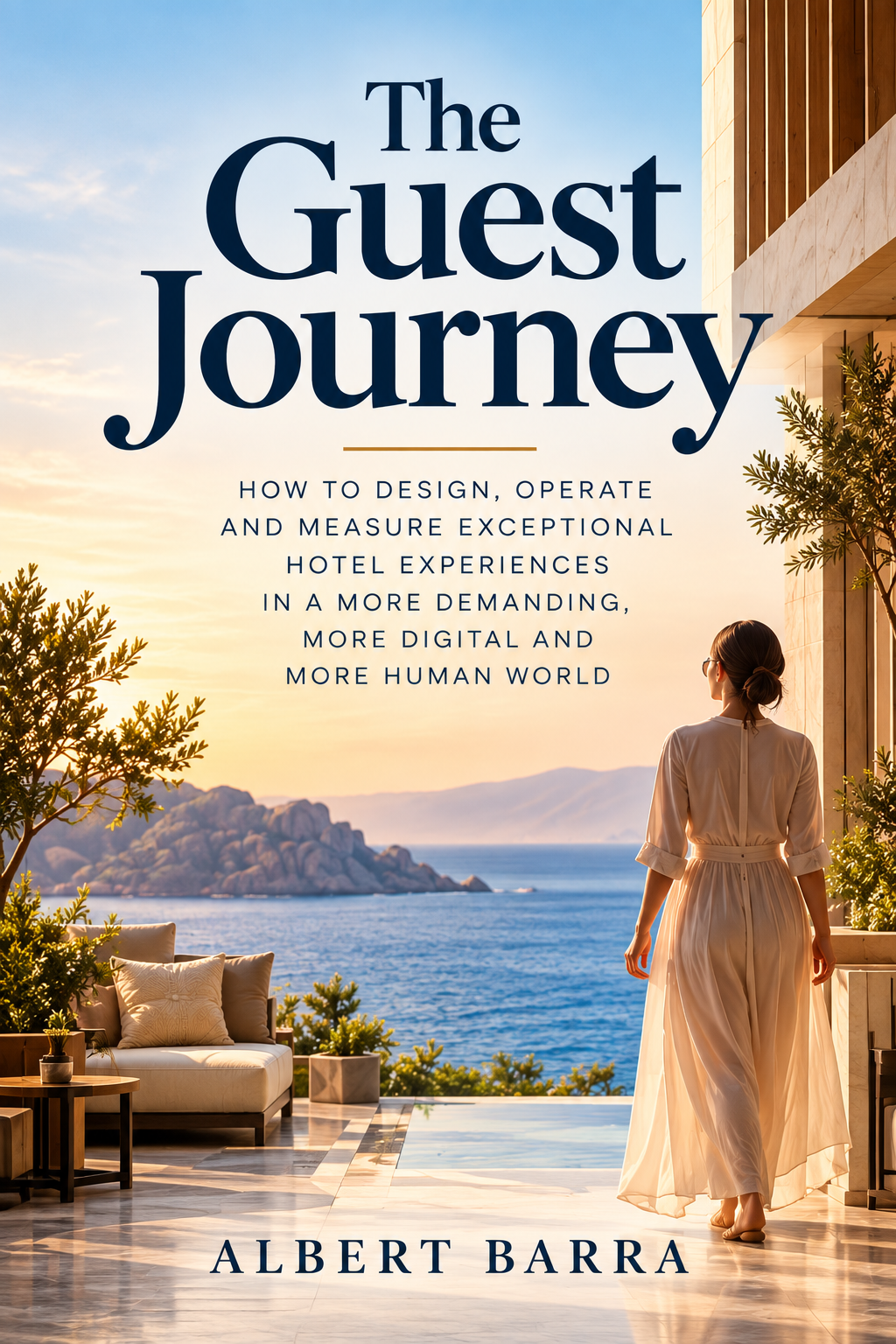
That idea lies at the origin of The Guest Journey. I did not want to write solely about service, nor did I want to create another catalogue of best practices for delighting guests. I was interested in something considerably more complex: understanding how the perception of an experience is built through a sequence of decisions, expectations, touchpoints, frictions, emotions and memories, and what we can do in Hospitality to manage it in a far more conscious way.
After many years working in and around hotels, I have learned that an experience rarely fails because of one major disaster. More often, it deteriorates through an accumulation of small inconsistencies. Information that is difficult to find. An overly ambitious commercial promise. A booking that requires too much effort. An unclear email. An arrival without context. A seven-minute wait that feels like twenty. A request the guest has to repeat. An excellent breakfast followed by a cold checkout. These are seemingly independent details that, internally, belong to different departments. For the guest, they form a single story.
That is why the book’s title is no coincidence. The guest is already travelling even before arriving at the hotel. They travel while discovering, comparing, hesitating, booking, anticipating, arriving, using, asking, buying, waiting, enjoying, being disappointed, remembering, commenting and deciding whether to return. Understanding that journey profoundly changes the way I believe we should approach Hospitality, guest experience, hotel marketing, loyalty and business strategy.
The hotel we see and the hotel the guest experiences
One of the greatest challenges in hotel management is that we tend to view the property from the inside out. It is understandable. To operate, we need departments, managers, budgets, procedures, shifts, systems, metrics and hierarchies. That structure enables a hotel to function.
But it can also distort the way we see it.
The guest sees exactly the same organisation from the opposite direction: from the outside in.
For us, there is a booking.
For the guest, there is the uncertainty of deciding where they will spend several days of their life.
For us, there is a check-in.
For the guest, there is an arrival moment charged with expectations.
For us, there is a clean room.
For the guest, there is a space they will consider their own for a few hours.
For us, there is an incident.
For the guest, there is a promise that may not have been fulfilled.
For us, there is a checkout.
For the guest, there is the final chapter of an experience they have paid for.
This difference in perspective is one of the pillars on which I built The Guest Journey. When we begin to think this way, different questions emerge.
We no longer ask only:
How does our Front Office operate?
We begin to ask:
How does the guest experience their arrival?
We do not ask merely:
How much do we sell in Food and Beverage?
We ask:
At what point in the journey are we offering something that makes sense for that guest?
And we stop asking ourselves exclusively:
What is our average rating?
Instead, we try to understand:
What memories are we creating, and which of them will ultimately determine recommendation or repeat business?
This is not a semantic shift. It is a shift in mindset.
For years, we have talked extensively about Customer Experience and the Customer Journey. Both concepts have generated excellent tools, but also a degree of oversimplification. Too often, I have seen customer journey maps turned into attractive diagrams placed in a presentation and forgotten a few weeks later.
A true hotel Customer Journey Map should not be corporate decoration.
It should become a management tool.
And for that to happen, I believe several ideas are especially important:
- The journey begins before the booking. The first contact may occur while searching for a destination, reading a recommendation, consulting a review, seeing a photograph or hearing about the hotel. The experience has already begun because this is when the expectations against which our delivery will later be assessed are formed.
- The booking is part of the experience. We sometimes talk about guest experience as though it starts at Reception. That is too late. If information is difficult to find, terms and conditions create uncertainty, the process requires too much effort or subsequent communication is poor, we have already used up part of the trust capital we have not yet even had the opportunity to build.
- The pre-stay experience shapes the actual experience. Two guests may receive exactly the same service and assess it differently because they arrived with different expectations. That is why Marketing and Operations cannot exist in separate worlds. Everything we promise eventually reaches the operation in the form of an expectation.
- Not all touchpoints carry the same weight. Seemingly small moments can shape the entire memory of a stay. The welcome, entering the room for the first time, the way a problem is resolved or the farewell can have emotional significance far greater than their duration.
- Friction is also part of the experience. Waiting, repeating information, not knowing what to do, not knowing the status of a request or having to find out who can resolve something are small burdens we place on the guest. Luxury, in many cases, is not about adding things but about removing effort.
- Personalisation does not mean intrusion. True personalisation begins with understanding context, intent and preferences. It is not about showing the guest everything we know about them, but about enabling them to feel that the hotel understands what they need.
- The employee is part of the Customer Journey. No experience design can survive in an organisation that does not give its teams information, autonomy, training and the ability to resolve issues. We can design magnificent processes on paper; in the end, there will be one person facing another person.
- Service recovery is also part of the journey. I aspire for things to go well, but I know that a real hotel will have errors. What distinguishes an excellent organisation is not the absolute absence of incidents, but its ability to detect, acknowledge, resolve and learn.
- Checkout does not end the relationship. After departure come the invoice, the memory, the survey, the review, the recommendation, shared content, the possibility of returning and, above all, the final interpretation of the experience.
Reputation can no longer be viewed solely as a post-stay metric. It directly influences the next purchase decision. Other guests’ reviews reduce uncertainty, build trust and shape the willingness to book, making guest experience a commercial variable as well as an operational one.
I consider this an especially important reflection for those who still separate customer experience and hotel profitability. A better experience does not merely create happier guests. It can generate greater confidence before purchase, reduce price sensitivity, improve conversion, increase recommendations and encourage repeat business.
Research into traveller behaviour is also deepening this longitudinal view of the experience. It is becoming increasingly clear that guests’ thoughts, emotions and behaviours evolve throughout the different phases of the journey. There is no single moment of truth. There are many, connected to one another.
This is precisely where I believe there is an enormous opportunity for Hospitality.
For too long, we have tried to optimise individual photographs while the guest is watching a film.
From managing touchpoints to leading a complete experience
As I worked through the ideas that would eventually shape The Guest Journey, I came to a conclusion that now strongly influences the way I observe a hotel: we should not try to improve touchpoints in isolation without first understanding the complete story.
Imagine a property that decides to speed up check-in.
It seems like a good decision.
But perhaps the real problem is not the length of check-in. Perhaps the guest arrives without knowing where to park. They then cannot easily find the entrance. When they finally reach the lobby, they do not know whether their room is ready. While waiting, no one tells them how long it will take. And when they receive the key, they have to ask where the lift is.
We can reduce the administrative process from four minutes to two and still deliver a poor arrival experience.
The problem was not the process.
It was the journey.
I consider that distinction essential.
That is why, when I analyse a hotel experience, I try to do so by following a sequence like this:
- What the guest is trying to achieve. Before designing any interaction, I need to understand their purpose. A couple celebrating something does not travel in the same way as someone arriving late after working for twelve hours.
- What they expect to happen. Expectations are shaped by price, category, photographs, reputation, messages, previous experiences and the travel context.
- What they need to do to move forward. Every additional step requires effort. Some are unavoidable; others we have created ourselves.
- What information they need. A large proportion of hotel friction does not come from poor service, but from uncertainty.
- What they feel during the process. Experience is not exclusively functional. Two identical processes can generate completely different perceptions depending on how a situation is communicated, supported or resolved.
- What happens afterwards. A touchpoint should never be assessed solely by what happens at that moment, but also by the effect it has on the next one.
- What they ultimately remember. The guest does not retain an objective recording of the stay. They construct a selective memory and will make future decisions based on it.
This way of thinking has an important consequence: it requires us to break down some traditional Hospitality silos.
Guest experience does not belong to Front Office.
Nor does it belong to Marketing.
Nor to Quality.
Nor to the Sales department.
It belongs to the entire organisation because it runs through the entire organisation.
And here we come to one of the issues that interested me most when writing the book: the relationship between experience and business.
There is a certain tendency to discuss customer experience in excessively emotional language, as though caring for guests belongs to a world apart from financial performance.
I have never understood that separation.
A properly designed experience can affect conversion, price, ancillary revenue, productivity, repeat business, reputation and new customer acquisition.
Take personalisation, for example.
I do not see personalisation as an invitation to bombard guests with offers.
Quite the opposite.
I see it as a call to be relevant.
An offer sent to everyone is a promotion.
A proposal linked to the purpose of travel, presented at the right time and genuinely capable of improving the stay can become a service.
And the difference between the two is enormous.

The Intelligent Hotel
Data, Artificial Intelligence and a New Way to Run Hotels
Go deeper into how AI, data and automation are transforming hotel management, commercial performance and the guest journey.
One of the ideas I seek to convey in The Guest Journey is precisely this relationship between knowledge, context and value. The better we understand what a person is trying to achieve, the better able we are to design an experience that both improves their satisfaction and creates legitimate business opportunities.
Good hotel upselling works this way.
Good cross-selling does too.
It is not about selling more things.
It is about identifying when there is a reasonable opportunity to improve the guest’s journey and charge fairly for the additional value we are creating.
The same applies to reputation.
For years, hotels have viewed reviews as the final point in the process. I prefer to regard them as a bridge between two journeys.
The review from someone who has just departed forms part of the decision-making process of someone who has not yet booked.
That is where the circle closes.
One guest’s journey feeds the next guest’s journey.
That is why hotel reputation does not belong only to the department that responds to comments. It is created in the room, at breakfast, during a phone call, while resolving an incident, when responding to an email and in the way someone is properly seen off.
This perspective also requires us to review hotel KPIs.
ADR, RevPAR, occupancy, GOPPAR, conversion, acquisition cost, average rating, NPS and repeat business are all necessary. I use them and believe in them.
But none of them explains the journey on its own.
We also need to observe behaviours.
Where the guest drops off.
What they repeatedly ask.
Where they wait.
What information they do not understand.
What request they make again.
At what point a complaint arises.
What service they purchase after another.
Which commercial promise subsequently creates an expectation that is difficult to fulfil.
What differentiates those who return from those who never do.
There is an extraordinary source of knowledge there.
And an extraordinary opportunity for improvement too.
Because the hotel Customer Journey should not end with a map.
It should lead to changed decisions.
If, after analysing the guest journey, we have not changed any process, communication, standard, responsibility, commercial proposition or metric, we have probably carried out an interesting exercise, but we have not yet managed the experience.
There is something else I consider especially important: do not design the journey solely from a meeting room.
The hotel constantly provides information.
We simply need to observe it.
Sitting discreetly near Reception for a few minutes reveals questions that no report captures.
Following a room from the moment it becomes vacant until it is occupied again makes it possible to understand operational dependencies the guest will never see, although they will experience their consequences.
Having breakfast as a guest reveals flows, waits and small moments of uncertainty.
Trying to make a booking from scratch reveals barriers that those of us who know the hotel have stopped noticing.
Reading twenty reviews in succession while looking for patterns can be far more valuable than looking only at the average rating.
And asking frontline teams which questions they hear every day often reveals a surprisingly precise list of opportunities.
This is perhaps one of the lessons I would most like the reader to take away after reading The Guest Journey: experience is not managed through intuition; it is observed, listened to, designed, delivered, measured and improved again.
There is a discipline behind hospitality.
Warmth is not at odds with method.
Nor is spontaneity at odds with standards.
And guest orientation is not at odds with profitability.
In fact, when everything is well designed, these dimensions begin to reinforce one another.
If I had to recommend an initial exercise to any hotelier who wants to work seriously on this subject, it would be surprisingly simple: choose a real stay and follow it in full through the guest’s eyes. Start before the booking. Search for your own hotel. Compare. Book. Read every message received. Arrive as someone who has never been there would arrive. Try to find your way without asking. Use the services. Request something. Raise a reasonable question. Check out. Read the post-stay communication. Do not assess departments: assess continuity.
Then I would carry out a second, even more uncomfortable exercise. I would bring together people from different departments and ask: at what moments do we make the guest exert effort that we could avoid? I would not look for major innovations. I would look for repetition, waits, doubts, contradictions, handovers of responsibility and information that arrives too late. Very often, the best experience improvements add nothing to the hotel. They remove friction.
And finally, I would remember something I try never to lose sight of. Behind every booking is someone who has chosen to entrust us with a limited portion of their time. It may be two nights of holiday after months of work, a celebration that will not be repeated, an important meeting, a reunion, a getaway or simply a few hours to rest. Understanding The Guest Journey means understanding the responsibility that comes with that choice. And perhaps that is where an essential part of this profession lies: ensuring that, when that journey ends, the guest feels that choosing us was worthwhile.
This article ends here. The archive does not.
Lead Hospitality brings together 1200 English articles published since 2018: years of experiences, decisions and lessons you can keep exploring.
What would you like to explore next?
Choose a direction and keep reading around what you want to solve, learn or challenge.