
ChatGPT Now Has Ads: Opportunity, Risk and a New Battle for Hotel Distribution

Albert BarraOctober 4, 2026 · 11 min read


The ad is not the story
Advertising has existed for decades. Google has ads. Instagram has ads. YouTube has ads. OTAs have sponsored placements. The novelty is not that advertising is appearing. It is where it appears. ChatGPT is not simply a results page. It is a conversation. The user does not simply type “hotel Valencia”. They may say they are looking for a quiet hotel for a three-day break with their partner, near the sea, with excellent food and perhaps a spa treatment. That is far more than a keyword. It is context. It is intent. It is behaviour. It is a partial description of a future decision. From an advertising perspective, that information is exceptionally valuable. But that is precisely why we should also be asking some questions.ChatGPT
You can organise a simple dinner for 6 people with vegetarian options...
Heirloom Groceries · Sponsored
Enchilada kit for an easy dinner
Available today · estimated delivery 25–35 min
To what extent can an advertising-funded assistant remain neutral?
OpenAI states that ads are separate from responses and do not influence them. According to its current documentation, ads may appear below a response, are identified as sponsored, and the advertising system is independent from the model that generates the response. That principle is fundamental. But separating organic results from sponsored ones was also fundamental for Google. The question is not necessarily whether OpenAI manipulates its responses today. The relevant question is what economic incentives the advertising model introduces over the long term. If a company earns revenue when a user interacts with certain ads, there is inevitably an incentive to increase the number of advertising opportunities. That does not necessarily mean altering a response; it may mean designing new formats, identifying more moments of commercial intent, or integrating transactional experiences at increasingly deeper stages of the decision-making process. Each of those decisions may be reasonable from a business perspective. But taken together, they may progressively transform the nature of the product.From assistant to marketplace
There is a fairly predictable evolution: first we ask an AI, then the AI recommends, then it enables us to compare, then it enables us to buy, and finally some companies pay to be present throughout that process. When that happens, artificial intelligence ceases to be merely an assistant. It also becomes an intermediation platform. And this should sound quite familiar to the hotel industry. The sector’s recent history is full of platforms that began by facilitating access to customers and ended up occupying a critical position between the customer and the hotel. OTAs are probably the most obvious example. They provided distribution, then scale, then convenience, then demand concentration, and ultimately considerable dependency for many properties. We should not assume that history will repeat itself exactly. But neither should we ignore it.Convenience always comes at a price
Travellers use platforms because they reduce friction. Booking.com reduces the difficulty of comparing hotels. Google reduces the difficulty of finding information. ChatGPT reduces that friction even further. It can do something no previous interface has done so easily: understand a need expressed in natural language and synthesise a response. That is extraordinarily useful. But economically, it also means that the platform occupies a position closer to the decision. And the closer a platform is to the moment of decision, the greater its potential ability to monetise it. For the hotel industry, this raises an important question: for years, we have talked about reclaiming the direct relationship with the guest. Now a new layer could emerge between the two. Not necessarily an OTA. Not necessarily a search engine. An assistant.Travel conversation
User: I’m looking for a two-night seaside break, adults only, with a spa and excellent food. ChatGPT: I can help you compare areas, hotel types and amenities...SPONSORED
Recommended reading309 pages · PDF
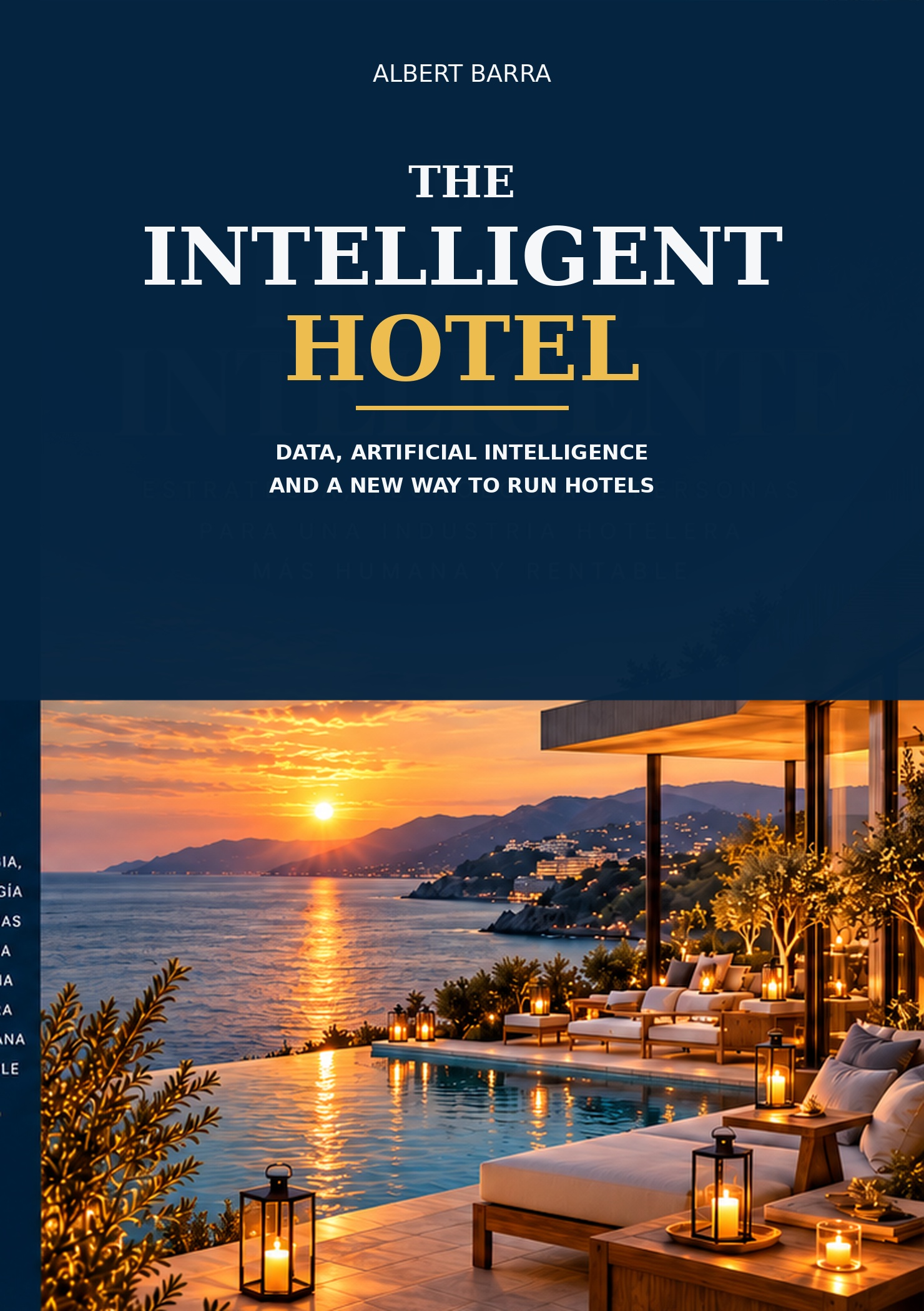
The Intelligent Hotel
Data, Artificial Intelligence and a New Way to Run Hotels
Go deeper into how AI, data and automation are transforming hotel management, commercial performance and the guest journey.
Digital edition · Personal licence · Amazon soon
Hotel Costa Serena · Adults Only
Spa · near the sea · fine-dining restaurant
The risk of delegating too much
There is also an aspect we rarely discuss when talking about artificial intelligence applied to travel: people may end up delegating decisions, not simply searches. Today we ask: “Which hotels do you recommend?” Tomorrow we might say: “Plan a three-day weekend for me for under €900.” The system could select the destination, hotel, restaurant, activities and transport. It might even book it. This is extremely convenient. But it also concentrates power. Because the user stops evaluating hundreds of options and instead evaluates the few options the system chooses to show.In any market where selection exists, there is an unavoidable question: what determines who appears and who does not?Relevance, availability, price, reputation, structured data, commercial agreements, advertising. Probably a combination of all of them. For an independent hotel, understanding these mechanisms may become as important as understanding Google or Booking.com is today.
Conversational advertising can be better advertising
It is also worth acknowledging the other side. The model could significantly improve the quality of advertising. Much of today’s digital advertising is mediocre because its targeting remains relatively superficial. Conversational advertising can draw on a far richer context. OpenAI explains that its system may take into account the intent and context of the current conversation, alongside other ad elements and, when personalisation is enabled, certain additional signals from the user experience. A relevant ad in that context may even be useful, rather than necessarily intrusive. This changes the advertising logic: we move from interrupting the user to trying to appear when a specific need exists.But relevance does not mean neutrality
An ad may be perfectly relevant and still be advertising. If I ask where to stay in Barcelona, I may receive a reasoned response and, below it, a sponsored option. That sponsored option may also be excellent. But there is a fundamental difference: one appears as part of the generated response; the other appears because an advertising relationship exists. This distinction must remain absolutely clear. If it becomes blurred, one of the greatest risks for any artificial intelligence system emerges: the loss of trust.Independent hotels may face a familiar problem
When a new acquisition channel emerges, large platforms usually have the advantage: budget, technology, data, specialist teams and the capacity to experiment. Booking.com and Expedia can invest far more than any independent hotel in new advertising formats. Major chains also have significant resources. This creates an obvious risk: conversational advertising could quickly become another auction in which the brands with the largest budgets win visibility. It is exactly the problem that already exists in other channels. A hotel may work for years to build its brand. Then an OTA buys advertising using the hotel’s own name. The customer searches for that hotel. The OTA appears first. And it ends up charging commission on demand that may already have existed. Artificial intelligence should seek to avoid reproducing some of these imbalances. But the economic incentives will be there.The new battle may not be for the click
For twenty years, digital marketing has fought to generate traffic: SEO, SEM, social ads, metasearch, email marketing and remarketing. Artificial intelligence may change that logic because many answers will no longer require visiting a website. The user asks. The AI answers. If it can check availability, compare prices and make a booking, the click may even disappear. This presents a considerable challenge for hotels. The website will remain important. The booking engine will remain important. But a higher layer may emerge: the agent that decides which options are worth considering. The battle would no longer be solely about generating traffic. It would be about becoming part of the set of options artificial intelligence considers relevant.From SEO to GEO, without falling for another fad
This explains the growing interest in concepts such as Generative Engine Optimization. Until now, companies optimised content to appear in search engines. Now they are beginning to optimise information so generative systems can understand, interpret and use it. For a hotel, that means something quite specific: AI should be able to understand what type of hotel it is, where it is located, what rooms it has, what services it offers, which segments it serves, which experiences can be booked, what policies it has, what rates are available, what availability it has, what reputation it enjoys and what differentiates it. The quality of that data will probably matter more than publishing a hundred articles designed solely to rank for keywords. But we should also avoid repeating a familiar pattern in digital marketing: whenever a new technology emerges, methodologies, consultants, acronyms and promises immediately follow. Not everything requires inventing a new discipline. A large part of optimisation for artificial intelligence consists of something far less sophisticated: having accurate, structured, consistent, accessible and useful information.The underlying issue remains the same
Hotels have spent decades trying to resolve one question: who controls the relationship with the guest? The hotel. The travel agency. The OTA. The metasearch engine. Google. The social network. Now a new player enters the equation: the artificial intelligence assistant. If that assistant becomes the place where travellers discover, compare and purchase, we will have to discuss distribution again. And perhaps also commissions, attribution, data, advertising, visibility and dependency. None of this is conceptually new. What is new is the interface.Should hotels be advertising already?
Not necessarily all of them. We still need to observe the cost of acquisition, targeting capabilities, attribution and conversion, as well as compare the real cost with Google Ads, Meta, metasearch and OTAs. What would make no sense would be joining simply because it is new. The hotel industry has a worrying tendency to chase the next technology before properly making the most of the previous one. Some hotels are experimenting with artificial intelligence while still having poor photography, a slow website, a mediocre booking engine or no CRM strategy at all. Technology does not fix an unclear value proposition. Nor does it fix a poor product.Nor should we ignore it
The opposite extreme would be equally misguided. Thinking this is merely a fad could be dangerous. Conversational interfaces have an enormous advantage: they are intuitive. They do not require learning filters. They do not require navigating through twenty pages. We simply have to explain what we want. That dramatically reduces friction. If users broadly adopt this behaviour for planning trips, artificial intelligence will inevitably become a relevant player in travel distribution. Advertising simply accelerates that process because it creates an economic model to fund it.The real debate is not about ads
The debate is about intermediation. Who controls the interface. Who decides which options are shown. Which criteria are used. Which part of that selection is organic. Which part is commercial. What data the advertiser receives. What data the platform retains. How a conversion is measured. What happens when the assistant can make the booking. And how much a hotel will ultimately pay to access a customer who may originally have been searching directly for its product. These questions matter far more than the ad format.An opportunity that warrants scrutiny
Advertising in ChatGPT could become an extraordinarily interesting channel for hotels, especially those with clear value propositions and well-defined segments. It could make it possible to connect supply and demand in a much more contextual way. It could reduce irrelevant advertising. It could open up new opportunities for direct bookings. But it could also create a new layer of intermediation. It could increase dependency on platforms. It could favour those with greater advertising capacity. And it could introduce tensions between recommendation and monetisation. We do not yet know which of these scenarios will carry the most weight. We will probably see a little of all of them.The lesson the hotel industry should have learned
Every major digital platform began as an opportunity. And many also ended up becoming a dependency. That does not mean we should reject them. It means we must understand them before committing to them completely. ChatGPT and other artificial intelligence assistants can radically transform how travellers discover, compare and book hotels. Advertising is simply another sign that this process is advancing. For the hotel industry, the question should not yet be: “How do we advertise on ChatGPT?” The more important question is:What position do we want to occupy when artificial intelligence becomes a new gateway to our customers?Because the history of hotel distribution has taught us something: generating demand is important, but understanding who controls access to that demand is even more important.
Sources consulted: OpenAI Help Center — “Ads in ChatGPT” and “Ads in ChatGPT: The Basics”; OpenAI — “Testing ads in ChatGPT”; OpenAI Ads — “Advertise in ChatGPT”. Ads in ChatGPT · The Basics · Testing ads in ChatGPT · OpenAI Ads
This article ends here. The archive does not.
Lead Hospitality brings together 1200 English articles published since 2018: years of experiences, decisions and lessons you can keep exploring.
CONTINUE FROM HERE
What would you like to explore next?
Choose a direction and keep reading around what you want to solve, learn or challenge.
01MAKE MOREProfitability, revenue and decisions that reach the bottom line.
02LEAD BETTERTeams, culture, talent and the conversations that matter.
03SELL BETTERPositioning, marketing, distribution and customers.
04CREATE EXPERIENCESService, loyalty and details guests remember.
05UNDERSTAND WHAT'S NEXTInnovation, AI and new ways of thinking about Hospitality.
✦SURPRISE MEShow me something worth five minutes of my time.