
Occupancy Doesn’t Show How Much Operational Pressure Your Hotel Can Handle

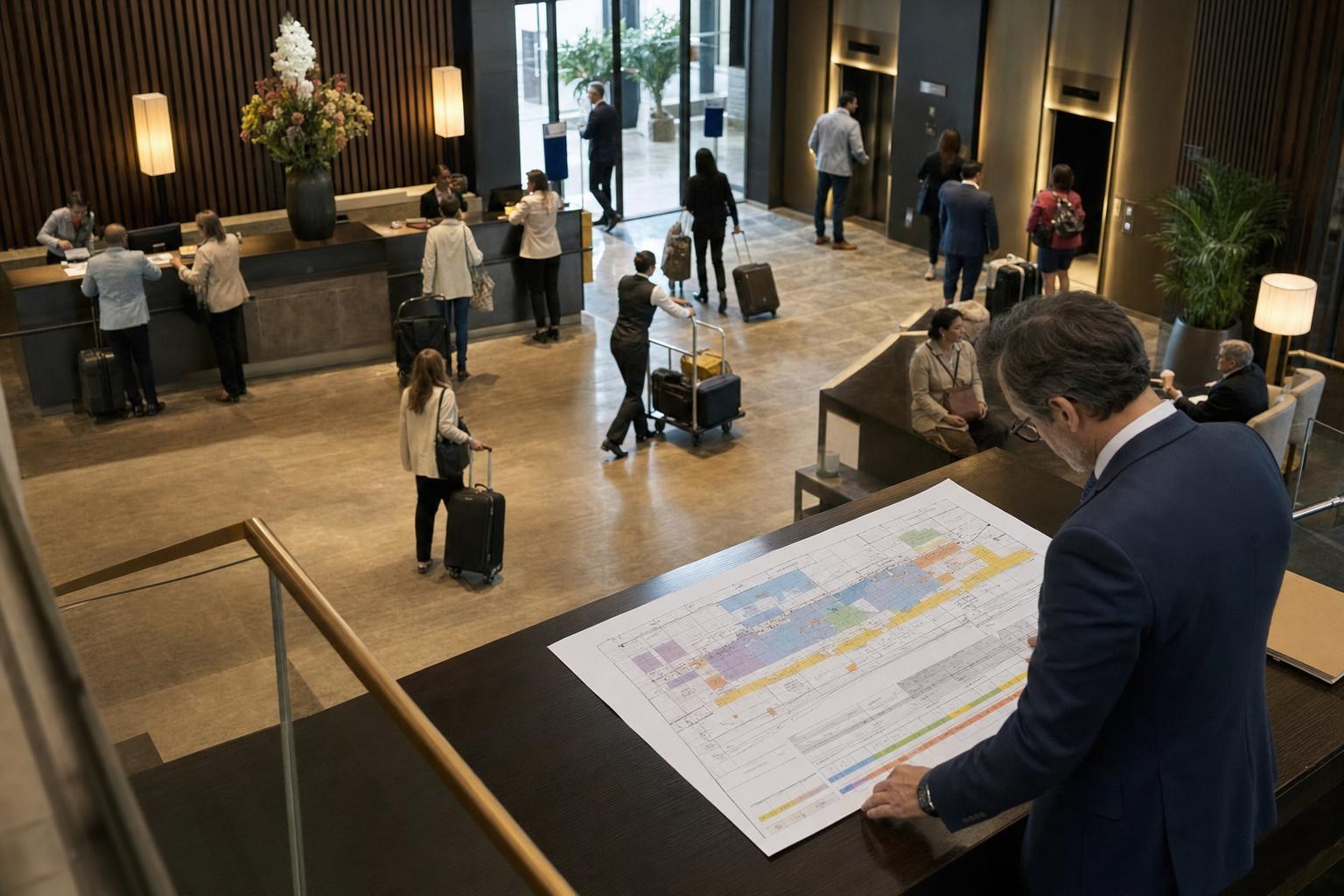

I remember a day when the hotel had not reached a particularly striking occupancy level. We were below some of the season’s peaks and, according to the room report, there was still inventory available. Yet between six and eight in the evening, the operation behaved as though we had sold far more than the building could accommodate. Arrivals, luggage, enquiries, vehicles, family requests, technical incidents and last-minute restaurant bookings all converged. There was no shortage of rooms. What was missing was the operational capacity to deliver everything we had promised simultaneously.
A few days later, we operated at higher occupancy and the feeling was entirely different. Departures were better distributed, rooms reached Reception with sufficient lead time, arrivals were not concentrated within a single time window, and breakfast absorbed demand without significant queues. The team finished tired, as is reasonable after an intense day, but not overwhelmed. That comparison reminded me once again of something daily percentages conceal remarkably well: two identical occupancy levels can represent two operationally different hotels.
In Hospitality, we tend to express capacity in rooms, beds, places, tables, treatments or occupancy limits. These are necessary units for selling and budgeting, but they are insufficient for management. A booking does not consume merely one night of inventory. It consumes attention before arrival, preparation capacity, front-desk time, equipment, lifts, breakfast space, housekeeping resources, technical response and the ability to recover from any deviation. Nor does it do so evenly. Most of that load may be concentrated in just a few windows during the day.
That is why a hotel real capacity audit should not be limited to asking how many rooms are physically available or how many Housekeeping can prepare. The more useful question is this: how many promises can coincide within the same time interval without compromising service, exhausting the team, multiplying incidents or destroying margin. A hotel’s sales limit does not always appear at one hundred per cent occupancy. Sometimes it is reached at eighty-five per cent with the wrong mix and, on other occasions, a robust operation can be maintained at almost full occupancy.
My proposal is to audit capacity through the lens of operational simultaneity. This requires us to set aside, for a few hours, the comfort of the daily average and view the stay as a sequence of loads passing through different points in the hotel. The objective is neither to sell less nor to grant Operations a permanent right of veto. It is to learn to sell the demand the hotel can profitably serve, reshape or reschedule, while maintaining enough reserve to respond when the day stops following the plan.
Capacity is consumed by time slots, not by nights
The room remains the basic unit of hotel inventory, but it does not by itself describe the effort a booking generates. Two three-night stays may produce similar revenue and radically different workloads. A returning couple arriving in mid-afternoon, familiar with the property and not using ancillary services, requires a different service framework from that of a family requesting connecting rooms, a cot, a special diet, early check-in, a parking space and several activities. Both bookings occupy one room. Only an overly simplistic view would conclude that they consume the same capacity.
I have learned to think of each booking as a time-based pressure profile. Before arrival, it may trigger emails, calls, payments, changes, supplier coordination or the preparation of special touches. At check-in, it may require identification, explanations, luggage handling, parking, escorting or the management of expectations. Throughout the stay, it may concentrate demand at breakfast, in food and beverage outlets, at the pool, spa, activities, maintenance or guest services. Finally, departure may involve billing, luggage storage, transport, late check-out or a particularly demanding room turnaround.
This approach changes the unit of analysis. I no longer observe only the room sold per night, but rather the booking by time slot and promise. Capacity stops being a fixed number and becomes a curve. At four in the morning, Reception attention may be plentiful while technical capacity is lacking in the event of a breakdown. At half past eight, room inventory may be available, but breakfast capacity may be short. At two in the afternoon, clean rooms may exist while there is no remaining capacity to manage twenty early arrivals with luggage and vehicles.
Imagine a 160-room hotel with 144 rooms occupied. On one day, sixty arrivals are concentrated within forty-five minutes, twenty-eight departures have purchased an extended check-out, two groups require luggage movements and more than one hundred guests intend to have breakfast within a very narrow time slot. On another day with the same 144 occupied rooms, arrivals are spread out, there are hardly any late departures and service consumption is distributed throughout the day. The occupancy percentage is identical. The simultaneous pressure is nothing alike.
I call Simultaneous Promise Capacity the volume of commitments the hotel can fulfil within a specific time slot while maintaining four conditions: standards, safety, economic contribution and recovery capacity. It is not a new occupancy limit, nor does it seek to replace all existing metrics. It is a way of making visible what daily occupancy cannot explain.
To calculate it, I begin by identifying the critical service nodes. Every hotel has its own, and it is worth resisting the temptation to copy a corporate template without reflection. In a family resort, they may be Housekeeping, breakfast, the pool, activities and arrival reception. In an urban property, they may be room turnaround, luggage storage, lifts and the concentrated departure of corporate guests. In a hotel with extensive food and beverage facilities, the room may cease to be the main constraint for several hours each day.
The simultaneous capacity of a time slot is determined by the node that reaches its limit first, but it must be adjusted for two factors that are often overlooked: variability and recovery. An operation capable of handling exactly fifty arrivals in one hour should not sell fifty expected arrivals as though all guests would present themselves in order, with correct documentation, no last-minute changes and not a single incident. Theoretical capacity that leaves no room for variability turns every unforeseen event into a crisis.
Nor do I consider it sufficient to measure how much work a department can perform. I am interested in how long it takes to regain a stable position after a peak. If Reception absorbs a concentration of check-ins but needs two hours to update tasks, return calls, review guarantees and close outstanding items, the workload has not ended when the queue disappears. It has changed location. The same happens in Housekeeping when rooms are released at the cost of postponing checks, linen, pantry work, maintenance reporting or preparation for the following day.
For this reason, I incorporate an operational recovery reserve. This is the margin that makes it possible to deal with a deviation without removing resources from another promise already sold. It does not have to be identical every day. It should increase when teams are incomplete, facilities are unstable, weather is adverse, there is a high number of children, events, special requests or a particularly demanding concentration of movements. It can also be reduced when demand is known, the team is fully staffed and the operation has demonstrated stability.
A useful audit needs to get into detail without becoming an endless investigation. I usually select representative days and reconstruct what happened in thirty- or sixty-minute intervals. I include high-occupancy dates, days with groups, seasonal changes, weekends, events and a day that appeared normal but ended up accumulating incidents. The intention is not to find the worst day in history to justify endless caution, but to recognise which combinations create pressure and which allow the operation to flow smoothly.
The analysis should include, at a minimum, the following dimensions:
- Concentration of movements. It is not enough to know the total number of arrivals and departures. It is useful to measure how many accumulate in the most demanding window, what percentage requires additional attention and which departments are involved. Forty arrivals spread over four hours are not equivalent to forty arrivals in fifty minutes.
- Promise density. Each booking may include commitments relating to the room, timing, configuration, dining, mobility, service, activities or personalisation. The more promises a stay includes, the more coordination occupancy requires and the greater the likelihood that a failure will spread across departments.
- Equivalent stay workload. I assign a simple weighting to bookings according to the expected effort they generate. I am not seeking to label guests as easy or difficult, which would in any case be inhospitable, but rather to anticipate the capacity required to serve different needs properly.
- Recovery time. I measure how long each node takes to return to a stable situation after a peak. A department that completes a task while leaving numerous outstanding items has not recovered capacity; it has simply shifted the pressure to a later time slot.
- Substitution fragility. I analyse how many people, facilities or suppliers can take on a critical function. If a single absence, breakdown or delay drastically reduces service, effective capacity is lower than scheduled capacity.
- Contribution per unit of pressure. I compare the expected margin of a booking with the operational load and displacement it creates. An apparently attractive sale may consume the time slot that would have made it possible to serve other more profitable stays or protect a higher-value promise.
These weightings should not become an incomprehensible formula that only one person can use. I have seen highly elegant analytical models die as soon as the people who built them were no longer involved. I prefer a shared, reviewable scale that is sufficiently accurate to change decisions. If Reception, Housekeeping, Food and Beverage, Maintenance, Sales and Revenue cannot explain in simple terms why a date is under pressure, the system is not yet ready to govern inventory.
A practical way to begin is to classify each time slot using three statuses. The green zone indicates that the hotel can sell more demand while retaining its recovery margin. The amber zone indicates that capacity still exists, but only for certain booking profiles or under specific conditions. The red zone means that a new promise would consume the margin required to fulfil commitments already accepted. The colour should not depend solely on the number of vacant rooms, but on the combination of movements, services, staffing, assets and contingencies.
The amber zone is the most interesting because it forces us to think. Closing all inventory may protect the operation, but it can also waste profitable demand. Keeping it fully open may fill rooms while the rest of the hotel deteriorates. Between those two extremes lie more intelligent decisions: accept stays without early check-in, restrict certain extras, protect room types, distribute time slots, modify packages, reinforce resources or set a rate that compensates for the additional pressure.
At this point, it is worth clarifying a common tension. Operations understands service fragility and may tend to protect itself. Sales and Revenue see opportunities that disappear if decisions are not made quickly. Neither perspective is sufficient on its own. Caution without challenge can turn any difficulty into an excuse to sell less; commercial optimism without evidence can turn occupancy into an operational bill. This is why I argue that demand, capacity, promise and margin must decide together, using shared data and then reviewing what actually happened.
The audit must also observe the capacity the hotel has pretended to retain at the expense of the team. If a day only works because managers cover positions, rest days are postponed, hours accumulate, controls are omitted or several people sustain an intensity that cannot be repeated, we are not looking at sustainable capacity. We are using future human energy to solve current sales. The cost may not appear that night, but it will arrive in the form of absences, turnover, errors, reduced initiative and defensive service.
Likewise, reducing staffing while keeping the commercial promise intact does not automatically improve productivity. It may reduce budgeted cost while increasing operational exposure. The reflection developed in cutting staff is not low-season management is equally valid on high-demand dates: every reduction in capacity should be accompanied by an explicit decision about what we will no longer sell, what we will simplify or what level of risk we are prepared to accept.
Turning the audit into sales limits the hotel can manage
An audit that ends in a report protects no promise. Its value emerges when it changes inventory, group acceptance, ancillary services, schedules, staffing plans or sales conditions. I have participated in impeccable operational assessments that disappeared as soon as an attractive commercial request emerged. The document said the date was under pressure; the booking was accepted anyway because nobody had defined who could reject it, what compensation should be required or what additional resources it needed.
For this reason, the audit’s outcome must become a dynamic sales limit. I am not referring to setting a universal maximum occupancy percentage. That would be as imprecise as claiming that all guests generate the same workload. The limit must vary according to the distribution of arrivals and departures, the segment mix, the promises included, the services booked, the condition of assets, the availability of people and the capacity to absorb deviations.
This limit can be expressed as a combination of inventory and conditions. The hotel may still be able to sell ten rooms, but not ten family bookings with early check-in. It may accept an additional group if arrivals are staggered and luggage is coordinated, but not if this coincides with a mass departure. It may sell spa treatments in the morning, even if it must close the afternoon to new requests. It may accept late check-out for certain room types and withdraw it from floors that will handle the greatest number of arrivals.
Books to run a hotel with judgement
Written from the general manager’s chair: technology, guest experience, leadership and management.
 Directing HotelsWhat Nobody Tells You Before You Sit in the General Manager’s Chair
 The Intelligent HotelData, Artificial Intelligence and a New Way to Run Hotels
 The Guest JourneyDesigning Customer Experience Across the Entire Hotel Journey
 Leadership and High-Performance Team ManagementPeople, Experiences and Results in Today\\\'s Hospitality
This precision improves hotel revenue management because it stops managing availability that merely appears homogeneous. The last room is not always the scarcest unit. On some dates, preparation time will be scarce; on others, a breakfast time slot, a connecting room type, a parking space, a table, a treatment slot or the attention needed to resolve a complex arrival. Revenue needs to know what capacity it is selling before deciding how much to charge for it.
It also requires a review of ancillary sales. An additional service generates revenue, but it may consume the recovery reserve that protected the core stay. Late check-out, early access, an extra bed, a dining experience, pet services or a children’s activity should not be sold merely because a price has been configured. As I have argued when analysing why cross-selling begins with knowing what not to sell, every recommendation needs delivery capacity, coherence and net contribution.
To implement the system without bringing the hotel to a standstill, I propose a specific sequence:
- Select between ten and fifteen representative days. Include easy days, pressured days, groups, high occupancy, incidents and dates with positive commercial results. Auditing only disasters produces a defensive view; studying only the best days creates unrealistic confidence.
- Map the operational journey by time slot. Record arrivals, departures, cleaning, breakfast, food and beverage, activities, maintenance, luggage and relevant requests in manageable intervals. You do not need academic precision, but you do need enough detail to identify concentrations and dependencies.
- Translate bookings into equivalent workloads. Define which characteristics increase or reduce pressure at each node. Weightings should be developed with the teams and corrected with evidence, avoiding subjective judgements about the guest’s personal value.
- Calculate the effective capacity of each node. Deduct foreseeable absences, unreliable equipment, non-delegable tasks, travel time, quality controls and outstanding work. Effective capacity rarely matches the theoretical maximum of a perfect day.
- Introduce a stress test. Simulate a significant absence, several out-of-order rooms, an early arrival or a breakdown during the peak. If a common deviation destroys the entire plan, the hotel was operating without a recovery reserve.
- Define decisions for green, amber and red. Each status must activate specific restrictions, prices, reinforcements, schedule changes or authorisations. A traffic-light system without consequences is administrative decoration, and we already have enough coloured folders in offices.
- Review the outcome after every critical date. Compare forecast and reality, identify which workload was underestimated and remove rules that add no value. The audit must learn from the operation, not impose an immutable theory on it.
In this process, I use an additional concept that I call the acceptable friction budget. Every hotel absorbs small deviations, waits and unplanned tasks. Attempting to eliminate them entirely would be unrealistic. The problem arises when we sell so much pressure that we consume that budget before service even begins. From that point onward, every delayed room, failed payment or stopped lift forces us to break another promise.
The friction budget should not become permission to tolerate mediocre processes. Its function is to recognise that operations contain variability and that responsible planning reserves capacity to manage it. If the hotel needs to use that margin every day to compensate for the same failures, we are no longer dealing with variability. We are dealing with a structural problem that requires investment, process redesign, training or a conscious reduction in the promise.
Another important decision is to separate capacity to produce from capacity to coordinate. A hotel may have enough people to carry out tasks and still fail because information arrives late, priorities conflict or nobody has the authority to resolve exceptions. In such cases, hiring more hands may relieve the symptom without correcting the cause. Capacity disappears in calls, waits, confirmations, movement and rework.
This is why hotel management also needs to audit decision latency. How long does it take to approve an alternative room? Who can withdraw a service from sale? When is a time slot reinforced? Who decides that a commercial request requires a different condition? If every exception must go up an excessively long hierarchy, response capacity may be exhausted before staffing is.
Governance should be set out in simple rules. For every critical time slot, it is useful to define which indicator is observed, which threshold changes its status, which decisions are activated, who can authorise them and when they are reviewed. This discipline is directly connected to the need to ensure that the integrated manual changes real decisions. If the date enters the red zone and everything continues to be sold in the same way, the hotel does not have a capacity system. It has a warning report.
It is also worth monitoring incentives. If Revenue is assessed solely on revenue and occupancy, it will have little reason to protect an operational time slot. If Operations is assessed only on the absence of incidents, it will tend to request excessive margins. If Finance looks exclusively at labour cost, it may reduce the capacity that makes it possible to capture profitable demand. Each department needs its own indicators, but also a shared measure that reflects the complete outcome.
One of the metrics I consider most useful is contribution per unit of pressure. It is not intended to assign an exact cost to every minute of service, but to compare business that competes for the same critical capacity. A booking with a good ADR may become less attractive if it requires several promises, displaces other demand, generates overtime and consumes an already pressured time slot. Another stay with a somewhat lower rate may generate greater contribution if it fits better into the operation’s actual gaps.
This perspective helps prevent capacity from becoming an exclusively defensive conversation. The goal is not to prove that the hotel is full of limitations, but to identify where underused capacity exists and what demand can occupy it. Perhaps the property should not capture more arrivals between four and six, but it may be able to incentivise late-evening arrivals. Breakfast may be saturated at nine yet have capacity early in the morning. Housekeeping may be unable to absorb more late check-outs, while Food and Beverage can still sell certain experiences.
Hotel marketing can also play a role. Communicating schedules, designing benefits for less congested time slots, structuring packages compatible with operations and directing direct sales towards demand that fits best are commercial decisions, not merely internal solutions. The hotel guest experience improves when the proposition is designed around real capacity, rather than when guests discover on arrival that the promised service exists, but only after a wait.
There is also a leadership dimension in the hotel sector that should not be underestimated. Recognising a capacity limit can be uncomfortable when demand is available and ownership expects growth. Saying that an additional booking requires pricing, conditions or resources takes more judgement than accepting the revenue and trusting the team to resolve it. I have made the mistake of placing too much trust in that problem-solving ability. Teams usually respond, but every repeated act of heroism teaches the organisation that poor planning has no consequences.
Maturity emerges when we stop using people’s commitment as free capacity. A hotel may consciously decide to take on a highly demanding date, reinforce resources and accept a higher level of pressure for an exceptional opportunity. What it should not do is present that exception as normal operations or turn sacrifice into a budgetary standard. Extraordinary capacity has a cost, a duration and a limit.
I recommend starting with just one critical time slot and one commercial decision. It may be breakfast, room turnaround or the concentration of arrivals. Reconstruct several days, identify which promises consume that capacity and define a threshold that triggers a specific response. If the system changes no decisions, simplify it until it becomes usable. Sophistication only adds value when it reaches, in time, the place where a promise is sold or rejected.
Then observe whether the new discipline improves three outcomes at once: operational stability, experience and contribution. If it only reduces incidents at the cost of rejecting profitable demand, the limit is poorly calibrated. If it increases revenue while compensation, overtime and service deterioration grow, it is also poorly calibrated. Real capacity lies in that demanding space where the hotel can sell ambitiously without forcing the operation to finance sales through exhaustion, improvisation or future reputation.
My final advice is not to ask only how many rooms remain. Ask which promises remain to be absorbed, when they will coincide and how much margin the hotel will retain after accepting them. Occupancy tells us how much inventory we have sold. Simultaneous capacity reveals whether we are still able to fulfil it. Between those two figures lies a considerable part of hotel profitability and, above all, the credibility of our promise.
This article ends here. The archive does not.
Lead Hospitality brings together 1200 English articles published since 2018: years of experiences, decisions and lessons you can keep exploring.
What would you like to explore next?
Choose a direction and keep reading around what you want to solve, learn or challenge.