
Your Hotel Enters the Same Data Four Times and Calls It Operations

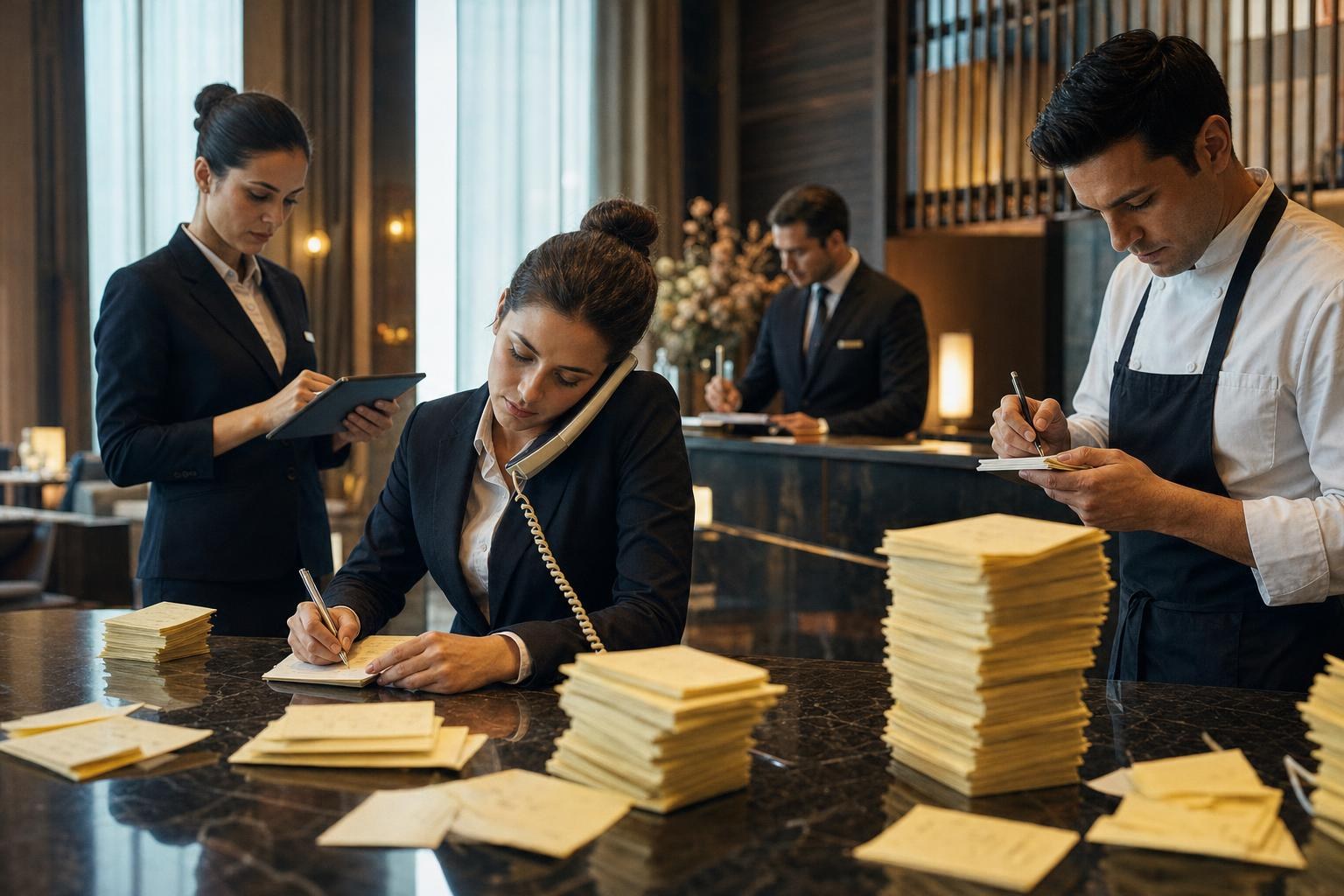

A guest notes in her booking that she has a nut allergy. Reservations sees it and copies it into a note in the PMS. Front Desk transfers it to the day’s arrivals list. Someone sends a message to the Head Chef. The maître d’ writes it on the restaurant whiteboard. Four copies of the same information, written by four different people, in four places that do not communicate with one another. None of them is the official one. And if the guest changes rooms, extends her stay or arrives with someone who has another allergy, the process starts all over again.
In most hotels I know, this is not considered a problem. It is considered operations. It is what we do every day, what we teach new joiners and what works reasonably well as long as the usual people are on shift. For years, I saw it that way too. It seemed to me a natural consequence of working across several departments and several systems. It took me time to realise that we were paying an invisible salary for a task nobody had chosen to create: manually moving data from one place to another.
When analysing the innovation ceiling a PMS can impose, I discussed the operational translation tax from the system’s perspective. In this article, I want to look at each department in detail, with a simple method for measuring how many times the same information is re-entered, what it costs and what should be integrated first. You do not need to buy anything to get started. You need to take a closer look at something we have been overlooking for years.
Data re-entry is not a systems problem; it is an operating cost
When we talk about integrations, the conversation usually remains with the IT department or the supplier. That is the wrong approach. Every time someone copies a piece of information from one screen to another, the hotel consumes working hours, takes on the risk of error and creates a new version of the truth. This is not a technical issue. It is an operating cost spread across payroll, overtime, guest compensation and opportunities that are never acted upon.
The difficulty is that this cost is never presented all together. Three minutes at Front Desk, five in Administration, two in Housekeeping, ten during an event close-out. None of these figures alone warrants a management meeting. Added up over a year, they can amount to one full-time person dedicated exclusively to acting as a bridge between systems that should communicate on their own.
I have learned to distinguish four different costs in every instance of re-entry:
- Time. This is the easiest to measure and usually the one that starts the conversation. Minutes multiplied by frequency and by the hourly cost of the role that absorbs them.
- Error. Every manual copy introduces the possibility of a changed digit, an incorrect date or a note that never arrives. Some errors are minor inconveniences. Others affect billing, food safety or the hotel’s reputation.
- Guest experience. When information does not travel, the guest has to repeat it. Few things convey the feeling of not being heard more clearly than having to explain for the third time something we already stated in the booking. That is why I believe that loyalty should mean that guests need to ask for less.
- Dependence on individuals. Many re-entry tasks are sustained because someone knows they need to be done. When that person has a day off, goes on holiday or leaves the hotel, the process fails without warning. It is a vulnerability that is only discovered once it has already caused a problem, something worth bearing in mind when preparing an operational continuity manual.
Where information is re-entered in a hotel
Every hotel has its own map, but some workflows appear almost everywhere. I list them because they often go unnoticed precisely because they are routine:
- From the booking to the PMS. Group terms, special requests received by email, OTA notes that are not fully imported, or commercial agreements that exist only in a signed document. In addition, a significant part of the booking context is lost along the way, as I explained when discussing how every booking erases the conversation that made it possible.
- From Front Desk to Housekeeping. Early departures, room moves, late check-outs or priority rooms communicated by telephone, radio or messaging, which someone then has to note down on the schedule.
- From the guest profile to Food and Beverage. Allergies, intolerances, celebrations and preferences that live in the PMS but are consulted on paper or a whiteboard.
- From incidents to Maintenance. Requests that arrive through Front Desk or from the guest directly and must be transcribed into a sheet, notebook or separate tool, without anyone informing Front Desk again once they are resolved.
- From charges to the bill. Restaurant, bar, spa or activity charges recorded in one system and manually transferred to the room account.
- From billing to accounting. Daily close-outs exported, reviewed and re-entered, with reconciliations consuming the first hours of every month.
- From Sales to Operations. The terms of an event or group are negotiated in a document and rewritten in the function sheet, the PMS and each department’s schedule.
- From the rota to payroll. Shifts, changes and overtime recorded in one place and recalculated in another.
None of these workflows is inherently absurd. Almost all arose for a good reason: a system that did not include a field, an integration that did not work or an urgent situation solved with a spreadsheet. The problem is that the temporary solution became permanent and ultimately became part of the job description.
The Re-entry Inventory
To make this cost visible, I use an exercise I call the Re-entry Inventory. Its purpose is not to audit anyone, but to give a name and a number to work that until now had neither. It can be carried out in two weeks, without consultants or suppliers, and it usually produces more clarity than any sales presentation.
- Choose a representative period. Two weeks of normal activity, avoiding seasonal closures or exceptional events that might distort the sample.
- Ask each department to record every manual copy. Every time someone transfers information from one system, document or message to another location, they note it in a shared sheet. The purpose should be clearly explained: the aim is not to measure people’s productivity, but the productivity of processes.
- Always record the same fields. What information is copied, from where, to where, who does it, how many minutes it takes, how many times it happens per day and what would happen if it were copied incorrectly.
- Group by workflow. At the end of the period, entries are grouped by the information’s journey. It is common to discover that three or four workflows account for most of the time.
- Review the outcome with department heads. They usually know of re-entry tasks that nobody recorded because they were considered too obvious to mention.
Calculating the cost
The time calculation is deliberately simple: minutes per copy, multiplied by the number of times per day, by operating days and by the hourly cost of the role performing it. It is not intended to provide accounting precision, but rather an order of magnitude that allows comparison.
Let us take an illustrative example. If, in a mid-sized hotel, a three-minute re-entry task is repeated sixty times a day, the result is three hours a day. Over a year, that is just over one thousand hours. At an hourly cost of €22, that one task alone represents around €24,000 a year. And that calculation does not yet include the errors it causes or the time spent correcting them.
When a hotel adds up all the workflows in its inventory, the figure is usually surprising. Not because each task is costly, but because they have never previously been viewed together.
Measuring risk, not just time
If we measured only minutes, we would end up prioritising the longest tasks and not necessarily the most dangerous ones. That is why I add a simple impact score to each workflow:
- Impact 1, inconvenience. An error is detected quickly and corrected without consequences for the guest or the bottom line.
- Impact 2, cost. An error results in compensation, lost revenue, an incorrect invoice or a poor review.
- Impact 3, safety or compliance. An error may affect someone’s health, legal or tax obligations, or the protection of personal data. Food allergies and invoicing almost always fall into this category.



My published books
A one-minute re-entry task with an impact score of 3 deserves more attention than a ten-minute task with an impact score of 1. Time justifies the investment; risk determines the urgency.
Deciding what to do with each workflow
Using frequency, time and impact, each workflow can be classified into one of four decisions:
- Eliminate the step. This is the most profitable option and the most often overlooked. Some copies exist only because someone requested a report years ago and nobody has read it since. Before integrating, it is worth asking whether the information really needs to reach that destination.
- Integrate. For frequent, high-impact workflows where a connection between systems exists or can be procured at a reasonable cost. The key question is not only whether an integration exists, but whether it works in both directions and at the required speed.
- Automate with a lightweight solution. When no direct integration exists, an intermediary tool, a single form or an automated rule can reduce manual copying without waiting for a major project.
- Accept and document. Some workflows are so infrequent or low-impact that changing them is not worthwhile. In that case, they should at least be documented so that they do not depend on one person’s memory.
Before integrating, decide where each piece of information originates
The most common mistake when addressing re-entry is to connect everything to everything. The result is usually a hotel where information moves faster, but nobody knows which version is correct when two systems do not match. Integration without governance only accelerates disorder.
That is why, before requesting any connection, it is worth answering one question for every important piece of information: where does it originate and who is responsible for ensuring it is accurate? A booking originates in the channel or in the PMS. A guest preference should live in a single location, from which it is consulted rather than copied. An incident originates in the maintenance system and informs Front Desk from there. When every piece of information has a single source and an owner, the other systems can read it rather than rewrite it.
This principle also changes how technology is purchased. Before signing with a supplier, I would ask them to demonstrate what information they can receive, what they can send back and how frequently, using the specific workflows in the inventory rather than a demonstration example. I have already explained that the technology you buy also buys part of your hotel, and an integration that works in only one direction leaves the other half of the work in the hands of the team. It is also worth ensuring that the supplier does not turn every connection into a new source of dependency, something that happens when a supplier forgets that the hotel is the customer.
What changes when information travels on its own
The first benefit is clear: the team regains time. But what that time becomes is more interesting. A receptionist who no longer has to transcribe lists can spend those minutes welcoming a guest without looking at a screen. A Head Chef who receives allergy information automatically can review it instead of chasing it. Hospitality requires attention, and attention is exactly what manual copying consumes.
The second benefit is reliability. When there is only one version of each piece of information, the discussions about who had the correct information disappear. Errors are not eliminated entirely, but they are corrected once and corrected for everyone.
The third concerns the immediate future. Artificial intelligence can only help a hotel with the information it can read. If preferences live on whiteboards, incidents in notebooks and group terms in emails, no tool will be able to use them. As I noted recently, AI knows a great deal about hotels and almost nothing about your hotel. Organising the flow of information is, in practice, the first step towards helping it know more. Along the same lines, the smart hotel is not the one that uses the most technology, but the one that makes the best decisions with the information it has.
A checklist to start this week
If you want to see how much your hotel enters the same information twice, these questions are a good starting point:
- Which guest information is written more than once before the guest arrives at the hotel?
- What Front Desk information reaches Housekeeping or Maintenance by telephone, radio or messaging?
- Where are allergies consulted in the restaurant, and who updates them?
- Which charges are entered manually into the room account?
- How many hours does Administration spend each month reconciling data between systems?
- Which process would stop working if a particular person were absent tomorrow?
- Which report is produced every week by copying data, and when was the last time anyone made a decision using it?
My advice is not to start by asking what software you need. Start by counting how often your team acts as a bridge between systems. That number, expressed in euros and risk, will tell you what to integrate, what to automate and, above all, what to stop doing. Very often, the best integration is the copy you discover nobody needed.
This article ends here. The archive does not.
Lead Hospitality brings together 1200 English articles published since 2018: years of experiences, decisions and lessons you can keep exploring.
What would you like to explore next?
Choose a direction and keep reading around what you want to solve, learn or challenge.