
The Smart Hotel Is Not the One Using the Most AI—It’s the One Making Better Decisions

Albert BarraOctober 1, 2026 · 18 min read


From the chatbot to the hotel that understands, decides and acts
One of the mistakes I see most often when we talk about artificial intelligence in hotels is starting with the tool. An interesting solution emerges and, almost immediately, we look for something it can do. I believe we should work in exactly the opposite direction. First, we identify a genuine business friction point. Then we ask whether artificial intelligence is truly a good way to resolve it. It may be something as everyday as discovering why certain rooms remain pending for too long, preparing the arrivals briefing, identifying a duplicate invoice, accurately answering a cancellation-policy query, detecting an emerging trend in reviews or managing a late check-out request. None of this sounds particularly futuristic. That is precisely why it interests me. Because the real transformation of hotel management rarely begins with a major presentation. It begins by removing small frictions that occur hundreds of times each year. The research summarises this approach through an extraordinarily simple idea: AI interprets and proposes; authorised systems confirm; a person is accountable for the outcome. I have come away convinced that this phrase contains far more strategy than it appears to. If a guest asks whether they can check out at 3 pm, artificial intelligence can understand the request. It can consult certain rules. It can analyse information. It can even calculate which option seems reasonable. But if it needs to check availability, apply a charge, amend a booking, communicate it to housekeeping and ensure the guest receives the correct confirmation, we are no longer dealing with a conversation. We are dealing with hospitality. And hospitality needs facts. That is why the study proposes understanding any application through five connected steps:- Data. Before inferring anything, the authorised source must be consulted. If a system knows the actual availability, we should not ask an AI to imagine it. The same applies to prices, payments, bookings, restrictions or contracted services.
- Context. An isolated booking says relatively little. It must be connected with the guest, the stay, purchased services and the hotel’s operational situation. Personalisation is not simply about knowing the guest’s name.
- Decision. This is where one of AI’s greatest contributions can emerge: interpreting dispersed information, comparing alternatives and preparing a recommendation. But the explanation must reflect the calculation performed, rather than simply being persuasive text.
- Action. Before execution, permissions must be checked, conditions revalidated and action taken in the responsible system. Between a proposal and its execution, the price, availability, room status or even the booking itself may have changed.
- Learning. The process does not end when the screen says “completed”. We need to know what happened afterwards: whether the guest received what was promised, whether operations was able to deliver it, whether a manual correction was required or whether we created additional work in another department.
Five levels of autonomy that should replace “automatic or manual”
Another practical contribution of the study is to move beyond an excessively binary discussion. We do not have only two options: doing something manually or automating it. It proposes five levels:- Informs. Retrieves information and explains it.
- Assists. Prepares work for someone to review.
- Recommends. Proposes an alternative and provides evidence.
- Acts within limits. Executes only pre-authorised rules.
- Acts after confirmation. Applies an expressly accepted operation.
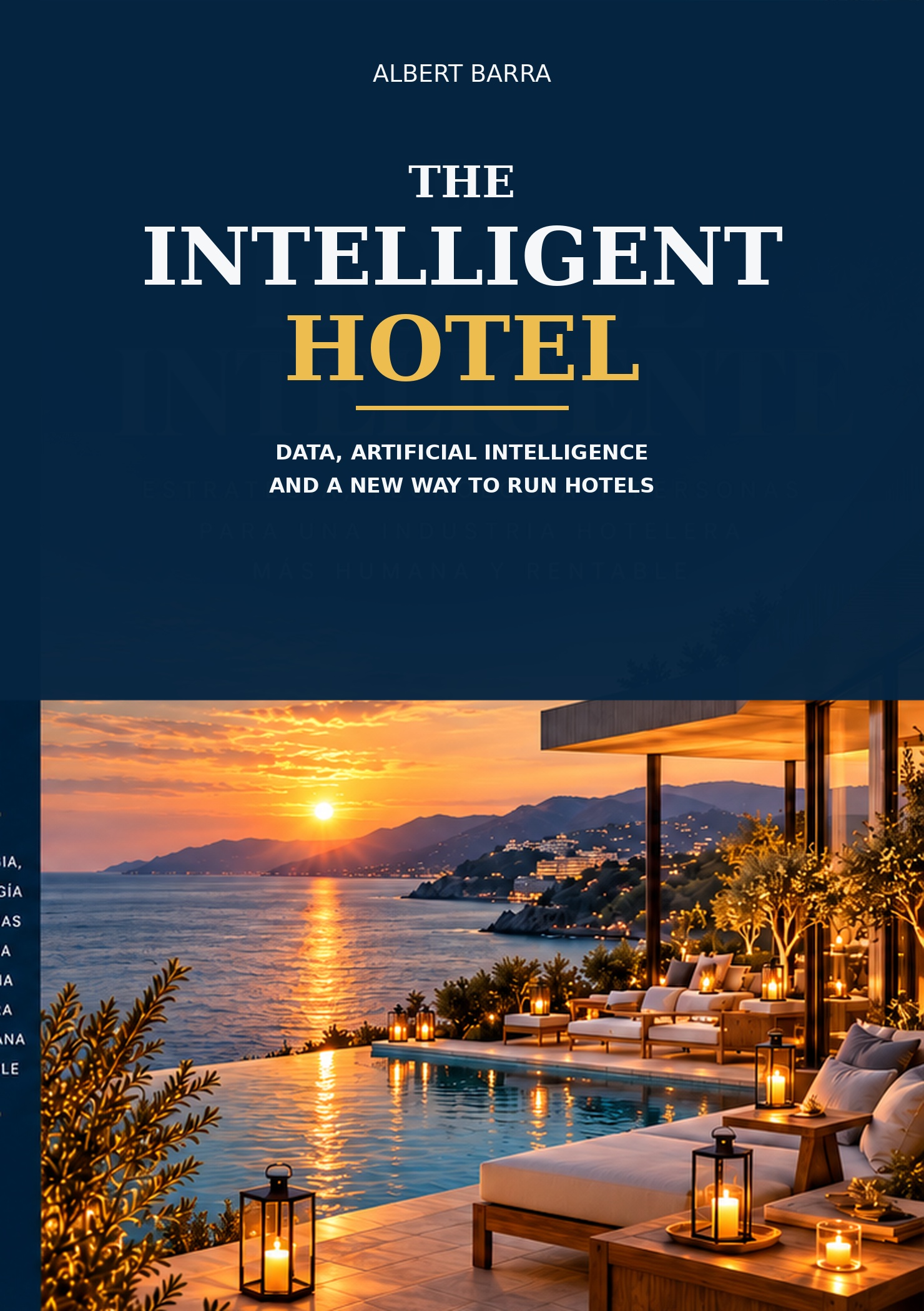
Recommended reading309 pages · PDF
The Intelligent Hotel
Data, Artificial Intelligence and a New Way to Run Hotels
Go deeper into how AI, data and automation are transforming hotel management, commercial performance and the guest journey.
Digital edition · Personal licence · Amazon soon
80 use cases: the question is no longer “what can AI do?”
One of the most interesting pieces of work during the preparation of this study was analysing and classifying 80 artificial intelligence use cases in hospitality. They were not limited to marketing or guest service. They include revenue, sales, reservations, operations, maintenance, housekeeping, food and beverage, administration, finance, reputation, content, human resources and internal coordination. Each case is analysed through five questions: what level of autonomy it requires, what data it uses, what metric should validate it, what its risk level is and whether it can operate without PMS integration. This final question seems especially interesting to me. There is a tendency to think that a hotel first needs a complete transformation of all its systems before it can benefit from artificial intelligence. Not necessarily. The study identifies numerous applications that can generate value without writing a single change into the PMS.- Queries about internal procedures. The team quickly obtains the appropriate policy or procedure using controlled documentation. It is frequent, measurable and relatively straightforward to oversee.
- Contextual guidance during the stay. It makes it possible to resolve questions using the property’s own content without needing to perform transactions.
- Explanation of rates and conditions. Particularly useful during booking. Many conversions are lost because the guest does not fully understand what they are purchasing.
- Detection of themes in reviews. It does not replace human reputation analysis, but it makes it possible to identify patterns that an average score may conceal.
- Preparation of review responses. It reduces administrative workload while retaining human approval before publication.
- Translation and adaptation of content. Especially relevant in international hotels, provided that appropriate terminology validation is in place.
- Assignment of guest requests. An example of simple yet highly useful automation when clear rules exist and we can measure the percentage of requests handled on time.
- Classification of maintenance work orders. It helps ensure that an issue reaches the appropriate person more quickly, without attempting to replace technical diagnosis.
- Shift-handover summary. Probably one of the least spectacular yet, in my view, most interesting use cases. Information losses between shifts continue to cause countless operational failures.
- Content prepared for emerging AI-driven search environments. The way guests discover hotels is also beginning to change.
- Creation of relevant packages. Here, AI can connect the stay, catalogue and context to suggest commercially attractive combinations, always checking prices and assumed savings.
- Detection of potential duplicate invoices. A financial application that is easy to understand and validate because the outcome can be administratively reviewed.
The truly intelligent hotel begins with better management
During the research, there was a point at which the discussion stopped being primarily technological and began to become a discussion about leadership, strategy and organisation. That was probably where I felt most comfortable. Because after many years in hotels, I have learned something quite simple: a tool never resolves a lack of organisational judgement; it usually makes it more visible. If sales believes one thing, reception another, revenue uses a different rule, the PMS contains different data and operations works from a third interpretation, introducing artificial intelligence does not create consistency. It creates inconsistency faster. The study proposes six decisions that I consider an excellent agenda for any management team wishing to progress seriously in this area. 1. Choose the problem. Let us not begin by saying “we want to implement AI”. That is not an objective. We can say: “We want to reduce omissions between shifts.” “We want to respond more quickly to rate queries.” “We want to identify requests that still have no owner sooner.” “We want to improve the margin on ancillary services sold before arrival.” Those are problems. And they can be measured. 2. Establish authority. This word appears repeatedly in the study because it seems fundamental to me. For every piece of data, we must know which system is authoritative. Who determines the price? Who confirms a booking? Who holds the inventory? Where is the guest balance held? Which system confirms that a service has been added? A hotel does not necessarily need a single system. It needs a single source of truth for each item of data. They are not the same thing. 3. Share context. One of hospitality’s greatest current inefficiencies is forcing both the guest and the team to constantly repeat information. The guest explains something during booking. They explain it again before arrival. Then at reception. Perhaps also in the restaurant. And if they return six months later, we start all over again. True hotel personalisation should increasingly mean asking again less and remembering accurately, validating where appropriate and anticipating whenever we can. But this requires identity. And here, we need to be extremely cautious. We cannot confuse two guests because their names are similar. We cannot automatically transfer authorisation associated with a previous booking. We cannot turn a preference into a certainty. Personalisation without reliable identity ceases to be service and begins to become risk. 4. Choose the appropriate autonomy. Not everything should be automated. And probably not everything will ever be automated. Some decisions are entirely appropriate for AI to recommend, while others should remain in human hands. A rate recommendation does not have the same consequences as an answer about gym opening hours. Classifying a maintenance request does not carry the same risk as confirming that a meal is safe for someone with an allergy. And here, caution does not mean rejecting innovation. It means professionalism. The document sets out several principles with which I completely agree: an artificial intelligence system should not guarantee food safety by inference, improvise in an emergency, grant access without independent authentication, send sensitive data to unauthorised tools or use sensitive inferences to determine how a person should be treated. There are times when the best design is precisely knowing when to stop. 5. Measure the full value. I believe this will be one of the major debates of the coming years. We are entering a stage in which almost any company will be able to present an impressive artificial intelligence demonstration. The question will be whether it works economically. And to answer it, we will need to move beyond comfortable metrics: incremental revenue, incremental margin, time genuinely saved, errors avoided, errors created, human corrections, repeat contacts, integration cost, vendor cost, oversight cost, perceived quality and operational incidents. All of this is part of the outcome. An artificial intelligence system that saves one hundred hours and causes another eighty hours of review has not saved one hundred hours. It has merely moved the work elsewhere. 6. Learn systematically. The major potential advantage of these systems is not merely automation. It is turning the hotel into an organisation capable of learning better from what happens. But this requires recording what we normally hide as well: corrections, errors, exceptions, complaints, cases requiring human intervention, rejected recommendations and processes that ultimately worked better through a conventional rule. I do not consider withdrawing an initiative that fails to produce sufficient value a failure. I consider it exactly the opposite. It is business discipline.From pilot to outcome: a twelve-month roadmap
One of the most practical aspects of the study is that it avoids proposing a complete transformation overnight. It proposes gradual development over twelve months, with clear decision gates. During the first 30 days, my priority would be to identify frictions, information sources, owners and permissions. I would not buy too many things. I would not try to transform too many departments. I would measure. I would choose a small number of problems. And I would establish a baseline against which to compare. Between 30 and 90 days, I would test focused cases. Preferably intelligence that informs, assists or recommends. I would carefully review responses, errors and real consequences with the teams doing the work. Between three and six months, I would begin connecting processes. That is where everything changes. Identity, actions, synchronisation, availability, shared statuses, duplicates, vendor failures and operations requiring confirmation all emerge. It is also where many seemingly extraordinary demonstrations begin to reveal the complexity of a hotel. And between six and twelve months, I would scale only what had already demonstrated value, quality and security. The principle is simple: we do not scale because the pilot looked good; we scale because the outcome was demonstrable. This philosophy also incorporates something that many innovation strategies forget: a gate also serves to prevent progress. If we do not have appropriate data, let us fix the data. If there is no owner, let us assign one. If integration still cannot guarantee the operation, let us reduce autonomy. And if the case does not produce value, let us stop it. Moving to the next stage without evidence only transfers the same problem to a more expensive stage.Twenty questions that should probably be in many management meetings
The study concludes by proposing something I would like to see on many tables before approving any AI initiative in hospitality. There are twenty questions. They are not asked of the supplier. The hotel asks them of itself. They begin with seemingly basic questions: What specific friction are we trying to solve? What is our baseline? Why does this problem require artificial intelligence? Who is accountable for the outcome? Then come the difficult questions: Which system governs each item of data? Can we legally use that information for this purpose? How do we verify identity? What information may be outdated? What can the system read? What can it modify? Which actions are expressly prohibited? When must a person or the guest confirm? Which conditions are checked again immediately before execution? Finally come the questions that determine whether we are truly prepared: How do we recover the operation if something fails? How do we test errors and improper access? What is recorded to reconstruct what happened? How do we measure complete success and service quality? What is the total cost during the period analysed? What vendor dependency are we creating? How do we train the team and make use of its judgement? What would need to happen for us to decide to stop or redesign the project? I especially like the final one. Because it introduces something that is often missing from the way we innovate: deciding in advance when we will acknowledge that something is not working. It also prevents an initiative from surviving simply because we have already spent too much money on it.Artificial intelligence is also changing hotel distribution
There is another part of the study that I consider strategically important. Search is evolving from a logic based exclusively on lists towards one based on intent. For years, travellers have used filters: destination, date, category, price, score, distance. It will increasingly be more common to express directly what they need: “I want a quiet hotel near the sea for a three-night break, with a good restaurant, massage availability and no family atmosphere.” That significantly changes hotel distribution. The research finds that 37% of the travellers analysed already use language models integrated into travel websites to plan and book. This does not mean that Google, OTAs or metasearch engines will disappear tomorrow. That would be an irresponsible conclusion. But it does indicate a direction. When search becomes conversation, the quality of the hotel’s structured information becomes even more important: our services, policies, opening hours, room types, attributes, experiences, prices and conditions. Everything must be correctly understood. Hotel marketing is therefore beginning to incorporate a new requirement: we must not only be appealing to a person viewing our website. We must also be understandable to the systems that mediate the discovery process. And this brings us back to the same principle: reliable information, context, consistency and authority.The hotel of 2030 will probably be less spectacular than we imagine
When we speak about the future, we tend to imagine receptions without people, robots carrying luggage and rooms that anticipate every desire. Perhaps we will see some of that. But I suspect the truly intelligent hotel will be far less cinematic. It will be a hotel where housekeeping knows sooner which rooms are genuinely the priority. Where revenue identifies a deviation without spending half the morning finding it. Where sales can analyse a group request while correctly considering displacement and expected contribution. Where an issue does not disappear when the shift changes. Where an intolerance communicated previously does not depend on someone remembering that they read an email. Where reception can resolve a complex request without consulting four applications and calling three departments. Where the team can spend less time locating information and more time dealing with exceptions that require judgement. And where management receives exceptions requiring attention, not another twenty dashboards. That hotel does not replace people. It places them where they generate the greatest value. And that difference seems fundamental to me. After actively collaborating on this study, my first piece of advice for any hotelier considering introducing artificial intelligence into their hotel would be surprisingly simple: do not start by buying AI. For one week, note down repetitive decisions that force your teams to consult several sources, repeat information, wait for confirmations or reconstruct conversations. Choose one. Assign it an owner. Measure how long it takes today and how many errors it produces. You already have a potential use case. My second piece of advice would be to resist the temptation to automate too soon. First let artificial intelligence observe, then inform, then assist, and only when you know its limits sufficiently well should you allow it to act. Autonomy should be earned through evidence. In hospitality, a slightly slower but reliable process remains far better than an extraordinarily fast one that later requires discovering exactly what it did. And the third may be the most important: do not allow artificial intelligence to move hospitality further away from the guest. Use it to eliminate waits, restore memory, coordinate teams, identify exceptions, prepare decisions and reduce work that adds no value. The truly intelligent hotel will not be the one that can boast of using more artificial intelligence. It will be the one where guests and teams barely need to think about it, because things simply work better.This article ends here. The archive does not.
Lead Hospitality brings together 1200 English articles published since 2018: years of experiences, decisions and lessons you can keep exploring.
CONTINUE FROM HERE
What would you like to explore next?
Choose a direction and keep reading around what you want to solve, learn or challenge.
01MAKE MOREProfitability, revenue and decisions that reach the bottom line.
02LEAD BETTERTeams, culture, talent and the conversations that matter.
03SELL BETTERPositioning, marketing, distribution and customers.
04CREATE EXPERIENCESService, loyalty and details guests remember.
05UNDERSTAND WHAT'S NEXTInnovation, AI and new ways of thinking about Hospitality.
✦SURPRISE MEShow me something worth five minutes of my time.