
Cheap Hotel Purchases Get Expensive When You Ignore Total Cost of Ownership

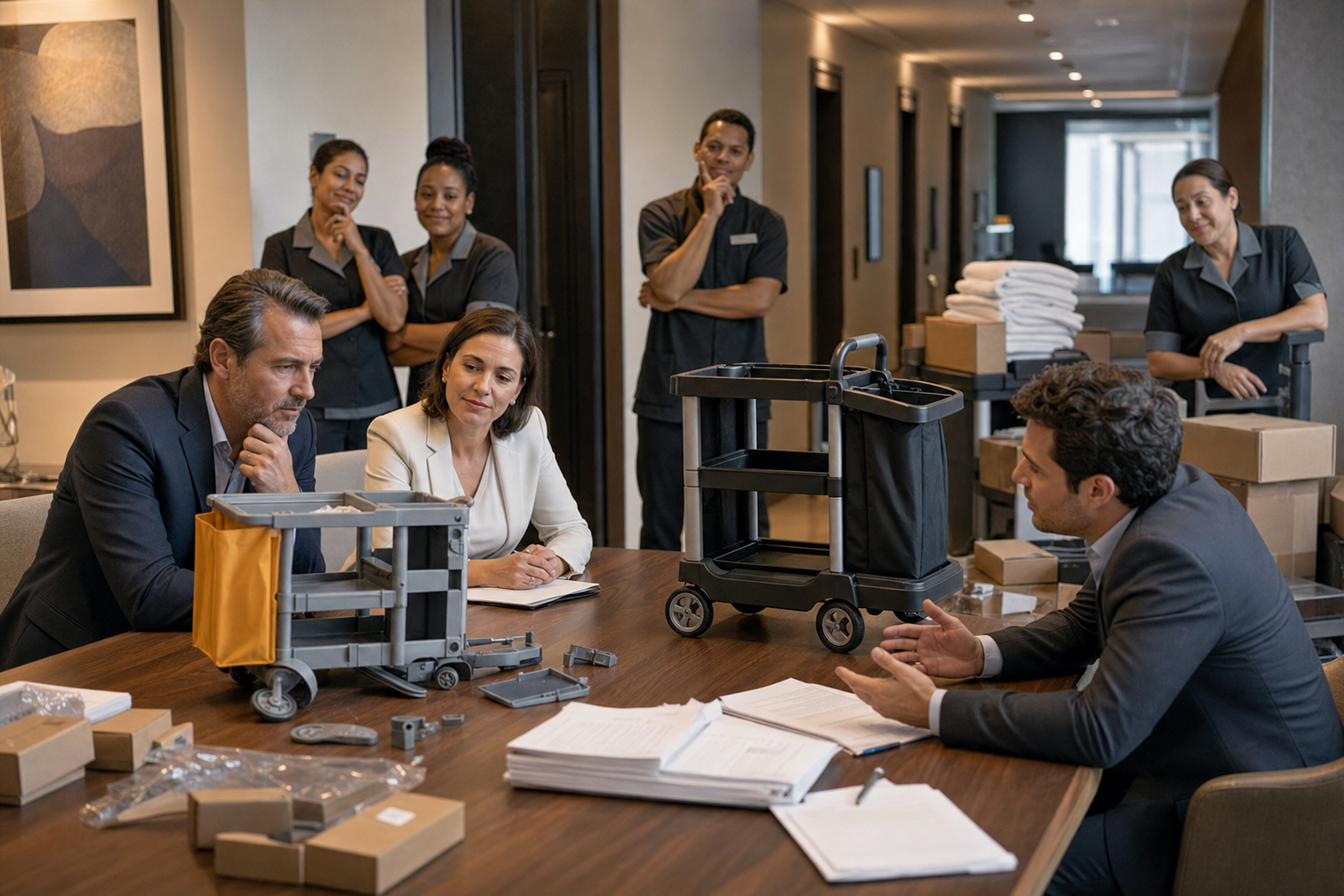

The proposal came with the kind of figure that brightens a budget meeting: a price 18% lower than the alternative most highly rated by the operations team. The presentation was brief, the savings were highlighted in green, and the decision seemed so obvious that asking questions almost felt uncomfortable. Why complicate matters if both products, viewed in a photograph and described in a technical sheet, appeared to do exactly the same thing? The cheaper supplier won. Six months later, Maintenance was dealing with a growing backlog of incidents, Housekeeping had improvised minor repairs, and Procurement was preparing an early replacement order. The savings were still recorded in the original file, immaculate and proud, although they no longer existed anywhere else in the hotel.
This scene is repeated because in hotel management we have a strange relationship with price. We see it with great clarity when approving a purchase, but lose our ability to observe it when that same price turns into consumption, breakdowns, time, waste, complaints or administrative work. The initial invoice arrives neatly organised, with a supplier and a date. The subsequent invoices are scattered across departments, months and different ledger accounts. This is how one of Hospitality’s oldest financial tricks begins: calling something a saving when it is really a cost that has not yet found a place to hide.
The uncomfortable truth is that many cheap purchases survive their own failure. Maintenance repairs the part that breaks. Housekeeping manages the textile that ages prematurely. The crockery that increases breakages is diluted into replacement orders. Uncomfortable equipment slows the team down without issuing an invoice. The consumable that worsens guest perception ends up in a review that nobody links to the tender celebrated nine months earlier. And when every consequence belongs to a different department, the purchasing decision retains an almost touching administrative innocence.
I have learned to distrust both the suspiciously cheap product and the automatic reaction of buying the most expensive option to make ourselves feel safe. Total cost of ownership is not an excuse for increasing budgets, nor a financial ritual for justifying premium brands. It is a discipline for comparing alternatives according to what they will actually cost over their useful life. Sometimes it will confirm that the economical option is the best one. At other times, it will reveal that the supposed saving was an operational mortgage with faulty wheels, an imprecise warranty and a generous amount of commercial optimism.
That is why I propose incorporating a total cost of ownership matrix for hotels that makes the full economics of every relevant decision visible. Its purpose is to connect what we usually separate: price, installation, consumption, maintenance, replacement, human labour, operational continuity, risk, guest experience in hotels and residual value. It does not aim to predict every incident with mathematical precision. It aims to do something more useful: prevent us from approving a significant purchase by looking only at the part of the cost the supplier has kindly printed in bold.
The purchase price is only the first invoice
A hotel does not buy isolated objects. It buys years of operation, maintenance requirements, cleaning routines, spare-parts availability, dependence on a supplier and consequences for the guest. When we purchase a Housekeeping trolley, a lock, a mattress, a coffee machine, a chemical product, a piece of furniture or a range of amenities, we are introducing a small economic architecture into the operation.
The difficulty is that this architecture becomes fragmented. Finance records the investment. Procurement negotiates the rate. Maintenance receives the breakdowns. Operations absorbs the complexity. The team carries the inconvenience. The guest perceives the result. Each area sees one part that is true, but incomplete. If nobody reconstructs the whole, the hotel compares prices while ignoring costs.

Stop managing isolated systems. Start managing the whole hotel.
HotelGEX connects guests, operations, Revenue, F&B, Groups & Events and Management into one intelligent hotel context — so every decision starts with a clearer picture.
To avoid this, I use a simple conceptual equation:
Hotel total cost of ownership = acquisition + implementation + operation + maintenance + replacement + additional labour + quality impact + risk + exit costs − residual value.
The formula does not require us to convert absolutely everything into euros from day one. It does require us to identify every component, estimate its relevance and state the assumptions we are using. A reasoned approximation is preferable to fictional precision. In Hospitality, we are rather fond of spending half an hour debating whether an incident costs 17 or 19 euros while ignoring the fact that it occurs three hundred times a year. The decimal point conveys rigour; omission, curiously, tends to attract less attention.
The first distinction worth making is between unit price and cost per unit of service. A product may be more expensive per item and less expensive per stay, per room cleaned, per breakfast served or per year of use. That functional unit allows us to compare alternatives that would otherwise appear equivalent.
A sheet should not be assessed solely by its price, but by its cost per acceptable use: purchasing, laundry cycles, associated consumption, losses, repairs and the percentage of items withdrawn before reaching the intended standard. A dishwasher is not compared only by its initial investment, but by each cover processed, including energy, water, chemicals, maintenance, downtime and peak-hour capacity. A mattress does not stop costing money when it is installed; it stops costing money when it no longer properly supports the room’s experience, rate and reputation.
These are the dimensions I include in a comprehensive assessment:
- Acquisition and implementation. Beyond the price, I include transport, installation, space adaptations, initial training, testing, licences, mandatory accessories and the internal time required to get the solution up and running. Some offers appear economical because an important part of the product is sold later under the discreet label of “essential optional items”.
- Operating consumption. I analyse water, energy, ancillary products, dosages, refills, wear parts and any resource required to use the purchase. A small difference per service can quickly exceed the initial difference when multiplied by rooms, covers, wash cycles or years.
- Durability and replacement frequency. Theoretical useful life is not enough. I ask how long the product lasts under our actual conditions of occupancy, handling, humidity, temperature, laundering and storage. A catalogue enjoys a considerably calmer existence than a high-turnover hotel with loaded trolleys and breakfasts operating at full capacity.
- Maintenance and repairability. I assess the likely frequency of breakdowns, the cost of parts, intervention times, ease of diagnosis and the possibility of local repair. Low-cost equipment with sealed components can turn a minor failure into a complete replacement. A more expensive alternative may allow a simple part to be changed and work to continue.
- Availability and downtime. A breakdown does not cost only what the technician invoices. It may also block rooms, reduce capacity, require outsourcing, disrupt production or undermine service. The more critical the item, the more weight operational continuity should carry in the decision.
- Additional or avoided labour. I measure minutes spent on preparation, movement, cleaning, supervision, correction, handling and administrative management. Cheap products are often very generous in distributing small unpaid tasks among the team. Unpaid for the supplier, naturally; the hotel continues to pay the payroll.
- Quality and guest experience. I estimate how the alternative affects comfort, aesthetics, reliability, noise, perceived cleanliness and alignment with the property’s positioning. Not every quality difference changes the experience, but when it does, it can affect complaints, compensation, reputation and the ability to defend rate.
- Safety, ergonomics and compliance. I include exposure to accidents, injuries, contamination, fires, electrical failures, non-compliance or evacuation difficulties. The absence of a historical incident does not make a risk nonexistent; it merely means it has not yet presented its invoice.
- Supplier dependence and continuity. I review spare-parts availability, lead times, after-sales service, financial stability, geographic coverage, documentation and compatible alternatives. A purchase may be economical while everything works and become extraordinarily expensive when the supplier stops responding or unilaterally changes essential conditions.
- End of life and residual value. I consider removal, transport, disposal, recycling, recovery, resale and reinstatement of the space. Replacing an integrated element may require dismantling others, closing areas or repairing surfaces. That cost belongs to the original purchase, even if it appears years later disguised as a new problem.
There is also a particularly hotel-specific cost: the variability a purchase introduces into the operation. Two products may deliver similar average performance, but one may do so consistently while the other produces irregular results. That instability requires inspection, correction and supervision. A cleaning product that works properly eight times out of ten does not have a minor quality issue; it has a business model based on someone repeating the task the other two times.
It is also useful to distinguish between visible costs, displaced costs and contingent costs. Visible costs appear on an invoice. Displaced costs move to another department, such as Maintenance time caused by an Operations purchase. Contingent costs depend on an event occurring, such as a critical failure, an injury or a complaint. All three categories matter, but they require different treatment.
Visible costs can be estimated using historical records. Displaced costs require observing processes and speaking to those who use the product. Contingent costs should be assessed by combining probability and impact. It makes no sense to assign the maximum cost of every risk as though all were inevitable, but neither should we treat them as zero simply because they have not yet occurred.
Let us imagine a hypothetical comparison between two Housekeeping trolley models. Model A costs 420 euros per unit and model B costs 650. For a purchase of twenty trolleys, A requires 8,400 euros and B, 13,000. If the analysis ends there, the cheaper model saves 4,600 euros and the meeting can end before coffee.
Now let us extend the horizon to five years. Let us assume that A needs to be replaced every two years, accumulates 90 euros in annual repairs per unit and adds two minutes of daily friction per trolley because of its wheels, manoeuvrability and adjustments. B lasts the full five years, requires 35 euros in annual maintenance and adds half a minute per day. Using an illustrative fully loaded labour cost of 18 euros per hour, A reaches approximately 56,100 euros over five years, compared with 21,975 euros for B.
The apparently economical model ends up costing around 561 euros per trolley per year. The more expensive option at the outset comes in at approximately 220 euros. The assumptions must of course be verified through real tests, but the example shows where the difference hides: replacement, repairs and operational minutes multiplied by frequency. The initial saving of 4,600 euros could end up generating more than 34,000 euros in additional cost. A small masterpiece of austerity.
We have not even monetised ergonomics, corridor noise, frustration, injury risk, guest-facing appearance or service interruptions in that exercise. We do not always need to convert these factors into euros, but we should make them visible and assign them weight. When a relevant variable cannot be quantified with confidence, excluding it does not improve the analysis; it simply favours the alternative whose problems are harder to measure.
This perspective also changes the relationship between hotel profitability and quality. Quality ceases to be an embellishment added only if budget remains and is instead assessed as a potential source of useful life, stability, efficiency and revenue protection. This does not mean purchasing specifications beyond what is required. Over-quality also has a cost. Buying a solution designed for extreme industrial use when the hotel needs moderate intensity can be as irrational as buying a domestic product for a twenty-four-hour operation.
The right question is not “which is the best product?”, because that wording invites excess. I ask which alternative delivers the appropriate level of performance, for the required horizon and at the lowest risk-adjusted total cost. That precision protects us both from short-sighted cuts and from fascination with premium options.
A matrix that compels Procurement to see the entire hotel
The matrix must be rigorous enough to change a decision and simple enough that someone will want to use it. If purchasing a professional toaster requires an advanced course in financial modelling, it will become another exemplary file that nobody opens. I prefer to work with a common structure and adapt its depth to the value, criticality and reversibility of each purchase.
A practical version can be organised as follows:
| Dimension | What we need to estimate | Required evidence | Validation owner |
|---|---|---|---|
| Acquisition | Price, transport, installation, accessories, financing and non-recoverable taxes | Complete quotation and contractual breakdown | Procurement and Finance |
| Implementation | Adaptations, training, testing and internal hours | Implementation plan | Operations and user department |
| Operation | Consumption per use, capacity, times and ancillary materials | Operational trial and comparable records | User department and Finance |
| Maintenance | Preventive and corrective maintenance, spare parts, call-outs and downtime | History, references and after-sales terms | Maintenance |
| Replacement | Actual useful life, breakages, losses and deterioration | Pilot, samples and internal history | Operations and Procurement |
| Experience | Comfort, perceived quality, noise, aesthetics and reliability | In-context testing and structured feedback | Operations and Guest Experience |
| People | Ergonomics, learning, handling, safety and added workload | Task observation and team consultation | User department and People |
| Risk | Probability, impact, dependence, compliance and continuity | Risk matrix and failure scenarios | Functional owners |
| Exit | Removal, recycling, deinstallation and residual value | Contractual terms and technical estimate | Procurement, Finance and Maintenance |
We can assign each dimension an economic value, a range or a weighted score. For recurring and readily measurable purchases, I prefer to calculate a cost per use. For critical investments, I use multi-year scenarios. When impacts are difficult to monetise, I include a risk and quality score that cannot be outweighed by a small price difference.
A basic scoring model could allocate weight as follows: 20% acquisition, 15% operating costs, 15% durability, 10% maintenance, 10% additional labour, 10% quality and experience, 10% risk, 5% supplier continuity and 5% end of life. I do not consider these percentages universal. A security system should assign much more weight to risk. An amenity may require greater attention to perception, consumption and waste. A critical kitchen asset should weight capacity, downtime and technical service more heavily.
The matrix gains value when we apply a disciplined sequence:
My published books
- Define the function before requesting quotations. I specify what problem the purchase must solve, under what conditions, at what intensity and for how long. If we begin by comparing catalogues, we risk allowing each supplier to define the need in favour of its own product. The specification should describe the expected outcome, not copy the commercial sheet of an alternative selected in advance.
- Choose a coherent horizon. The analysis period should correspond to the expected useful life, the contract or the renewal cycle. Comparing only the first year favours cheap products with high future costs. Using an excessively long horizon can also distort the decision if the asset will become obsolete, the hotel concept will change or uncertainty is high.
- Determine the functional unit. It may be a stay, a room cleaned, a laundry cycle, a cover, a door opening, an operating hour or a year of availability. The unit must reflect the service we are actually buying. Only then can we compare solutions with different prices, capacities and lifespans.
- Gather information from those who will use and maintain the purchase. The operational team identifies frictions that rarely appear in a quotation. Maintenance recognises designs that are difficult to repair. Housekeeping detects surfaces that age badly. Kitchen teams discover whether nominal capacity works during a real peak. Listening to them late turns their knowledge into a complaint; listening early turns it into prevention.
- Separate data, assumptions and promises. Measured consumption is not the same as catalogue data. A contractual warranty is not the same as a commercial statement. A verifiable reference is not the same as “we have many satisfied clients”. Every figure should indicate its source and level of confidence. Excessive trust in a presentation is an expensive form of courtesy.
- Build three scenarios. I work with an expected scenario, a favourable one and an adverse one. I vary useful life, consumption, failure rate, usage volume, labour cost and replacement lead time. If an alternative is attractive only under perfect assumptions, it is probably not attractive; it is simply optimistic.
- Run a pilot when the cost of being wrong is material. A sample installed under real conditions can reveal timings, noise, resilience, ease of cleaning and guest response. The pilot must have defined duration, criteria and owners. “We tried it and it seemed fine” is an impression, not a test.
- Turn promises into contractual conditions. If the supplier assures a certain lifespan, consumption level, spare-parts availability or response time, I try to transfer it into the agreement. When a promise disappears during contract drafting, it is usually because it was never quite so confident in itself.
- Review the actual cost after purchase. I compare observed performance with the assumptions used. This review improves future decisions, reveals deviations and enables renegotiation. Without it, the organisation repeats mistakes because every purchase begins as though the hotel had lost its memory.
The operational pilot deserves particular attention. It should not be limited to asking the team whether they like the product. It must measure specific variables: minutes per task, number of incidents, consumption per unit, resulting quality, physical effort, ease of storage, compatibility and learning time. It should also be tested at times of greatest pressure, because almost everything works admirably on a quiet Tuesday morning.
For equipment or consumables linked to the guest experience, the pilot should observe the effect on guests without turning it into an endless survey. We can record complaints, replacement requests, spontaneous comments, frequency of use and operational behaviour. The purpose is not to ask guests to select suppliers, but to identify whether an alternative changes what the hotel promises.
Another common mistake is to assess every purchase with the same degree of intensity. I propose classifying them along two axes: total economic impact and operational criticality. A low-value purchase with high criticality may deserve more analysis than an expensive one that is easily reversible. An inexpensive component capable of taking an essential installation out of service is not a minor purchase; it is a significant risk with a low entry price.
This classification enables four approaches:
- Low impact and low criticality. Apply simple controls, comparable pricing and minimum standards. Discipline matters, but we do not need to write a doctoral thesis for every box of office supplies.
- High impact and low criticality. Prioritise volume, cost per use, commercial terms, standardisation and substitutability. Savings may be significant as long as minimum quality is protected.
- Low impact and high criticality. Give greater weight to reliability, availability, compatibility and continuity. Price becomes less important because a small part can stop a high-value service.
- High impact and high criticality. Require full analysis, cross-functional involvement, scenarios, a pilot, a performance contract and a post-implementation review. Here, the decision must be part of hotel strategic planning, not a rushed comparison of quotations.
The matrix also compels us to review how we measure Procurement performance. If we reward only the discount achieved against the initial quotation, we encourage dangerous behaviour: maximising visible savings even as the cost borne by others increases. A department can report excellent results while Operations and Maintenance quietly pay for the celebration.
I prefer to combine several indicators: total cost avoided, variance between forecast and actual TCO, early replacement rate, incidents by supplier, service compliance, additional internal time and the percentage of purchases reviewed after implementation. In this way, Procurement stops being the area that secures prices and becomes a capability that protects value.
That requires shared accountability. The user department cannot demand the most convenient product while ignoring the budget. Finance should not reduce the decision to initial outlay. Maintenance cannot appear only once the equipment has already been installed. Procurement needs to challenge specifications and promises. Ownership must accept that protecting capital means looking beyond the immediate financial year.
I also recommend appointing a total cost owner for significant acquisitions. This is not necessarily the person who authorises the spend, but the one who gathers information, maintains the assumptions, coordinates the review and presents the complete outcome. Without this role, every cost returns to shelter in its own department and the matrix loses continuity.
Supplier negotiations change when we adopt this perspective. I no longer ask only how much they can reduce the price. I ask what they can do to reduce consumption, incidents, capital tied up, downtime and replacements. I can negotiate performance-linked warranties, local spare-parts stock, included maintenance, training, buy-back arrangements, temporary replacements or response commitments. Sometimes the best financial improvement lies not in paying less for the product, but in distributing risk more effectively.
This approach also makes it possible to compare purchasing, leasing, pay-per-use and fully managed service models. Leasing may appear more expensive when instalments are added up, but it can transfer maintenance, obsolescence and availability. Purchasing may be more profitable if the hotel has technical expertise, stable usage intensity and a long useful life. No model is inherently superior. We must compare which costs the hotel retains, which it transfers and how much it pays for that transfer.
We must, however, watch for false turnkey solutions. Some contracts transfer ownership of the asset while leaving most of the risk with the hotel through minimum consumption requirements, exclusivity arrangements, penalties or ambiguous service levels. Total cost must also read the small print, that space where certain offers discreetly recover all the generosity displayed on the first slide.
Standardisation also deserves a nuanced assessment. Reducing the number of product lines can simplify training, inventory, maintenance and negotiation. But standardising an unsuitable product multiplies the mistake across every room, department or property. Before scaling, I need evidence that the solution works. Scale does not correct a poor decision; it distributes it with admirable efficiency.
In hotels with multiple areas or assets, it is worth maintaining a learning database that records supplier, product, terms, expected useful life, incidents, replacements, operational satisfaction and actual cost. It does not need to be a sophisticated platform. It requires the discipline to prevent knowledge from disappearing when an individual changes roles or a contract ends.
This memory is particularly useful when preparing budgets. Rather than applying historical increases, we can anticipate replacement cycles, renegotiate contracts that generate displaced costs and prioritise alternatives with better performance. The budget stops being a list of expected prices and becomes a tool for full-cycle hotel profitability.
My advice is to begin with three purchasing categories that generate recurring incidents, replacements or significant consumption. Reconstruct their cost over the past twelve months, even if the information is imperfect. Speak with the people who use them and identify where the consequences appear. That first exercise usually reveals more genuine savings than several rounds of negotiations focused exclusively on cents.
If you receive two quotations tomorrow, avoid asking first which is cheaper. Ask how long the solution needs to work, what resources it will consume, who will need to care for it, what happens when it fails and how it will affect the guest. Then calculate. The sequence matters, because once the low price settles too early in our minds, the rest of the analysis risks becoming an elegant justification.
Buying well requires judgement, memory and a certain resistance to the immediate satisfaction of a discount. Genuine savings do not mean paying less today, but reducing the full cost without weakening the operation, the team or the guest experience. Everything else may still be called savings in a spreadsheet, but sooner or later the hotel will end up paying for it. And hotels, unlike some procurement reports, have the unfortunate habit of living in the real world.
This article ends here. The archive does not.
Lead Hospitality brings together 1200 English articles published since 2018: years of experiences, decisions and lessons you can keep exploring.
What would you like to explore next?
Choose a direction and keep reading around what you want to solve, learn or challenge.