
CAPEX That Protects GOP: How to Renovate Before Assets Hurt Operations

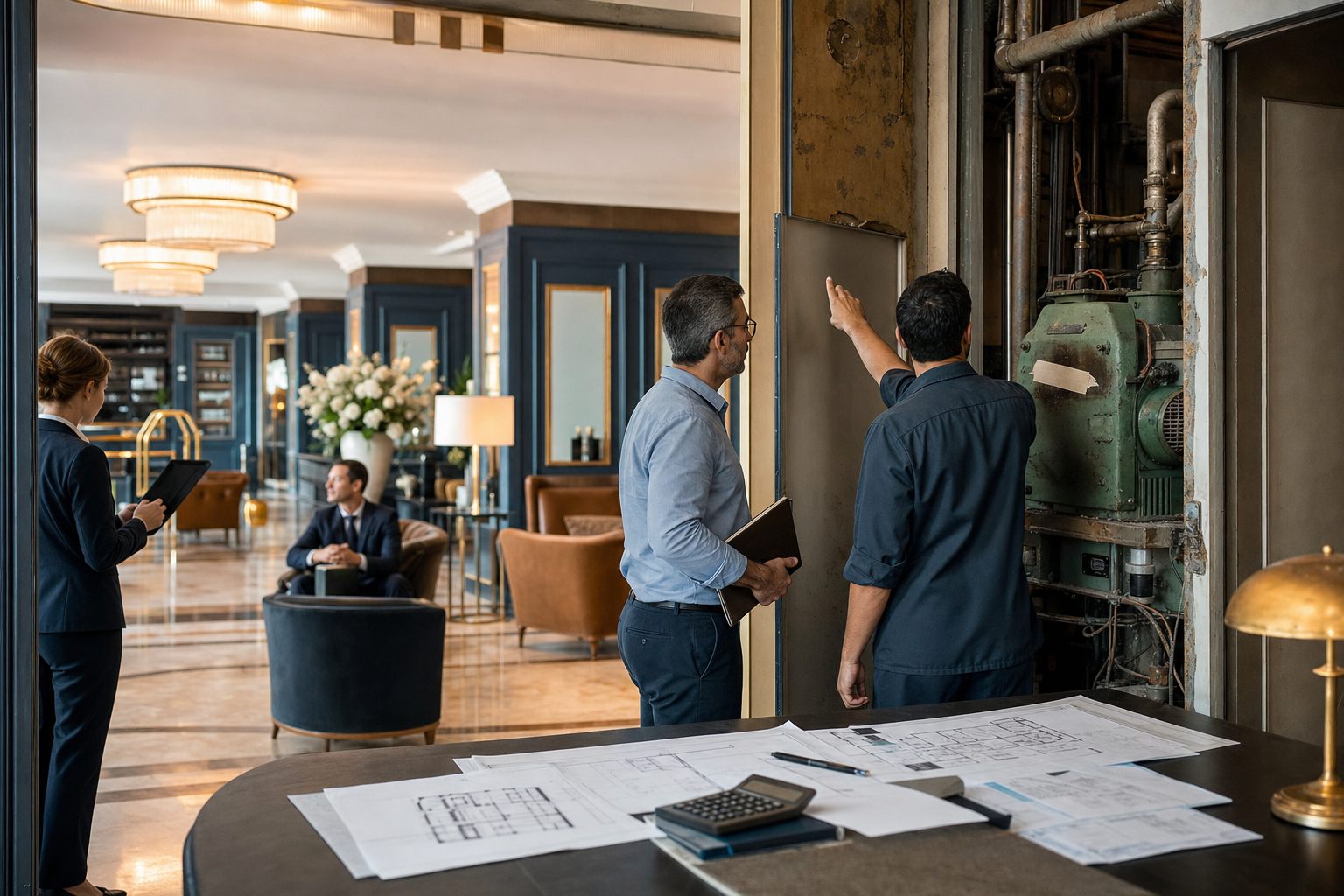

The first sign was not a major breakdown. It was a brief conversation in the service corridor. Maintenance had entered a guest room for the third time that week to inspect an air-conditioning unit that was still running, although with diminishing conviction each time. Housekeeping was delaying the room’s release, Front Office avoided assigning it until the last minute, and the technical team kept a spare part nearby, just in case. Nothing seemed important enough to justify immediate investment. Yet that unit had already achieved something remarkable: it had conditioned four departments without ever actually breaking down.
I have encountered that same situation many times in different forms. A door that needs two checks before it closes, a hot-water system that requires higher temperatures and consumption to compensate for losses, flooring whose deterioration multiplies interventions, furniture that remains usable but begins to constrain rate, or a kitchen whose layout forces the team to walk hundreds of unnecessary metres during every service. The asset remains open, sells rooms and passes basic inspections. Even so, it has begun to charge a kind of internal tax simply for continuing to exist.
That tax rarely appears together on a single P&L line. It is spread across repairs, staff hours, utility consumption, out-of-order rooms, discounts, compensation, urgent purchases, lower productivity and negative comments that are difficult to attribute to a single cause. Each item seems manageable when viewed separately. Together, they tell another story: part of GOP is quietly financing the obsolescence of the building, equipment or operating design.
The problem begins when we make hotel CAPEX decisions using almost exclusively three criteria: the asset’s age, its visible appearance and the available budget. These are useful references, but insufficient ones. An old item may remain reliable, efficient and aligned with the positioning. A much newer one may consume resources, create friction and undermine the guest experience every day. The purchase date tells us how long it has been installed; it does not explain how much money it is taking from the business.
My proposal is to view CAPEX as a tool for proactively protecting GOP. This means measuring the operational penalty before the definitive failure, comparing the cost of intervening with the cost of waiting, and prioritising renewals according to the value they preserve. The question is no longer “what is oldest?” but rather the far more useful one: which asset will begin to erode margin, rate or guest confidence if we do not act within its economic renewal window?
An asset starts charging long before it stops working
There is an overly binary view of the life cycle of a hotel asset. We imagine that it works first and then breaks down. Real operations contain a long and costly middle ground in which the equipment continues to provide service, but requires greater monitoring, consumes more than it reasonably should, produces inconsistent results or demands minor adaptations around its limitations. This is where the greatest amount of money is often lost, because there is not yet an urgency visible enough to mobilise CAPEX.
When a machine stops working, the decision seems obvious. When it operates at 82% of its capacity, requires weekly checks, occasionally generates noise, reduces comfort on high-demand days and has spare parts that are increasingly difficult to source, the decision becomes uncomfortable. Technically, it is operational. Economically, it may no longer be. I have learned to mistrust the phrase “it is still holding up”, because it almost always describes the equipment’s physical resilience and almost never the profitability of keeping it.

Stop managing isolated systems. Start managing the whole hotel.
HotelGEX connects guests, operations, Revenue, F&B, Groups & Events and Management into one intelligent hotel context — so every decision starts with a clearer picture.
It is useful to separate three investment families that often compete within the same budget. Compliance CAPEX addresses safety, regulation, integrity and basic continuity. Growth CAPEX seeks to create new revenue, capacity or positioning. Between them lies a less celebrated yet decisive category: operational protection CAPEX, intended to prevent the existing asset from continuing to erode GOP and the commercial promise.
This third category often loses out to the more visible projects. Refurbishing a lobby is easy to explain in a presentation, appears in photographs and creates an immediate sense of transformation. Replacing pumps, improving insulation, redesigning a linen room or upgrading extraction systems has less glamour. I have never heard a guest say they will return because the secondary pump was perfectly sized. Yet I have seen how well-designed infrastructure protects comfort, reduces incidents and allows the team to spend its time serving rather than chasing faults.
To identify the economic penalty, it is helpful to examine six channels of deterioration. Each affects a different part of the business and, when analysed together, they reveal projects that a conventional reading of the budget would postpone:
- Accumulated reactive maintenance. This includes materials, call-outs, external contracts, temporary repairs and urgent purchases. The usual mistake is to measure only the supplier invoice. We must also include the internal time spent diagnosing, gaining access, coordinating, supervising, checking and returning to intervene when the repair does not resolve the root cause.
- Compensatory operational labour. Some assets continue working because the team manually compensates for their weaknesses. Housekeeping checks a room twice, the Kitchen reorganises preparation due to insufficient capacity, Front Office blocks certain units and Maintenance carries out additional rounds. That labour does not appear as an asset cost, although it exists solely to keep the asset going.
- Inefficient consumption of energy, water and consumables. Degraded equipment, poor building envelopes, leaks, imprecise controls or poorly balanced installations can turn every occupied room into a more expensive unit to produce. In a hotel that operates continuously, a modest deviation repeated thousands of times ceases to be modest.
- Loss of inventory and sellable capacity. An out-of-order room, a terrace that cannot be used, a room with unstable temperature or kitchen equipment that reduces output creates nominal capacity that exists on the plans but not in the income statement. The hotel may have 200 rooms and operate economically as though it had 196.
- Deterioration of experience, reputation and rate. Physical wear does not always trigger a direct complaint. It often reduces the overall perception of value: the guest finds the room adequate, but not compelling; the bathroom works, but conveys fatigue; soundproofing meets expectations during the day and fails at night. That impression may affect repeat business, recommendation and the ability of hotel revenue management to sustain a given price level.
- Risk of failure and disruption. The probability of breakdown must be multiplied by its economic consequence. An inexpensive piece of equipment may support a critical process; a costly one may have sufficient redundancy. Priority depends less on book value than on what happens in the hotel when it stops providing service.
I call the sum of these six channels the Asset Annual Operational Penalty. It is not intended to become a new accounting line or replace technical judgement. Its value lies in bringing together costs that the organisation has distributed across different departments and periods. The basic calculation can be expressed as follows:
Annual Operational Penalty = reactive maintenance + compensatory labour + excess consumption + lost contribution from unavailable capacity + service recovery costs + attributable commercial dilution + expected cost of failure.
The expected cost of failure deserves further explanation. It is obtained by estimating the probability that the asset will fail during the period and multiplying it by the reasonable economic consequence of that failure. If we assign a 20% annual probability to a breakdown whose resolution, inventory loss and operational impact would amount to €100,000, the expected cost would be €20,000. This does not mean the hotel will pay exactly that amount. It means that retaining the risk has an economic price that should form part of the comparison.
Double counting must also be avoided. If we have already included rooms blocked by a failure as lost capacity, we should not add the same revenue again within the commercial impact. If compensation captures the full cost of service recovery, we should not add another identical estimate for dissatisfaction. The aim is not to inflate the problem in order to secure project approval. It is to build a sufficiently honest representation to make sound decisions.
Let us imagine a central system that accumulates €48,000 a year in repairs, consumes €36,000 more than an efficient alternative would consume, causes €8,000 in lost contribution through room blocks, requires €9,000 in additional labour and generates approximately €14,000 in compensation and service recovery. If we add an expected failure cost of €25,000, the annual penalty approaches €140,000. These figures are a calculation example, not an industry benchmark.
Now suppose replacement requires a net investment of €420,000 and eliminates €104,000 annually from the estimated penalty, while retaining some maintenance and risk that will still exist with the new system. Simple payback would be around four years. But the decision would still be incomplete. We would need to analyse expected useful life, financing costs, available incentives, seasonality, redundancy during the works, spare-parts inflation and residual value. Even so, we would already have improved greatly on the usual explanation: “we need to replace it because it is old”.
Protected GOP does not always equate to visible savings either. One part will appear as cost reduction; another will be margin that stops being lost. Preventing out-of-order rooms protects contribution. Restoring thermal stability may reduce compensation. Improving the product can defend ADR without immediately generating higher occupancy. Reducing the number of interventions frees technical capacity for preventive maintenance. All of this has value, even if it does not reach the P&L under a single label called “refurbishment benefit”.
In guestrooms and public areas, there is also a particularly sensitive dimension: erosion of sellability. Some assets do not break down, but they no longer justify the price the hotel is trying to charge. A bathroom may retain all its functions while at the same time limiting the perception of category. Carpet may meet minimum technical standards and still make photographs age badly. A headboard may remain intact while the room as a whole loses commercial relevance.
To measure that erosion, it is not enough to ask whether the guest complains. Complaints detect obvious failures; few people go down to Front Desk to announce that they found the product 12% less compelling than expected. The signal appears elsewhere: greater price sensitivity, difficulty selling higher room categories, recurring references to wear, lower conversion for certain rooms, pressure to offer upgrades or a growing gap between service quality and physical product scores.
The hotel guest experience and CAPEX meet precisely there. The physical product creates the conditions within which service operates. If a room has noise, temperature, water-pressure or lighting problems, the team can respond with empathy and professionalism, but it is recovering an experience that the asset has already damaged. When that recovery becomes routine, the organisation ends up using human talent to subsidise infrastructure deficiencies.
That is why I am interested in calculating the penalty per operating unit. We can divide it by available rooms, occupied rooms, covers, square metres, opening hours or units produced, depending on the asset. A system that penalises GOP by €120,000 in a hotel with 60,000 available room nights per year is imposing a penalty of two euros per available room, before considering broader commercial effects. That figure makes it possible to connect the technical conversation with Revenue, Finance and Operations.
Another useful measure is to express the penalty as a percentage of GOP. A group of assets may silently consume 1%, 3% or a larger proportion of operating profit. When presented in this way, renewal no longer appears to be a departmental request. It becomes a hotel profitability decision. The debate no longer pits Maintenance against Finance; it pits two alternative uses of capital against one another: investing to eliminate a recurring loss or continuing to pay it.
The right time for renewal lies within an economic window. It begins when the expected operational penalty exceeds the annualised cost of replacing, refurbishing or redesigning the asset. It ends when deterioration causes a critical failure, forces an urgent purchase or damages the business in a way that is difficult to reverse. Waiting until the end may seem prudent because it extends physical life. In reality, it usually reduces options, worsens supplier negotiations and shifts the works into the least convenient period.
Renewing too early also destroys value. I have seen reliable equipment replaced because budget was available, because a project was attractive or because someone confused novelty with efficiency. CAPEX does not automatically improve a hotel. A new asset that does not resolve a constraint, reduce costs, improve the proposition or limit a risk is capital tied up in a pretty photograph. Sometimes it even adds complexity, specialist maintenance and third-party dependency.
A mature decision emerges when we can answer four questions with reasonable confidence: how much it costs us to retain the asset, how much intervention will cost, what proportion of the penalty will actually disappear and how long that benefit will last. If any answer remains uncertain, that does not mean we should stand still. It means we should declare the uncertainty, build scenarios and prevent an optimistic estimate from being disguised as data.
From a wish list to a GOP-governed CAPEX portfolio
Most hotels can draw up a list of necessary investments within a few hours. The real work begins when all of them are reasonable, capital is limited and every department believes its project should come first. That is when photographs of wear, supplier quotations, guest anecdotes, technical risks and memorable phrases such as “if we do not approve it now, it will be worse later” begin to appear. It normally will be worse, yes; the question is what will worsen first and how much it will cost.
To structure that conversation, I use a GOP Protection Map. Each project is positioned according to two main axes: the operational penalty it eliminates and the economic urgency of intervening. I then add four modifiers: disruption risk, impact on the guest, ability to defend revenue and execution difficulty. The result does not replace the decision, but it compels projects to be compared in a common language.
Before scoring anything, I apply an entry gate. Investments related to safety, structural integrity, regulatory compliance or serious risks do not compete on equal terms with an aesthetic improvement. They must be resolved according to their technical and legal requirements. Turning them into an exercise in financial return can produce elegant precision and an irresponsible decision.
Once that gate has been passed, I classify the portfolio into four groups. This distinction helps prevent projects with different economic rationales from being mixed together:
- Mandatory CAPEX. It protects safety, licensing, essential continuity and asset integrity. Its central question is how to execute it with the lowest risk and total cost, not whether it generates an immediate commercial return.
- Margin-protecting CAPEX. It reduces maintenance, consumption, waste, compensatory labour, lost inventory and recurring failures. Here, the business case should be built around the operational penalty that will disappear.
- Product- and rate-protecting CAPEX. It preserves the hotel’s relevance, category consistency, reputation and ability to sustain price. Its assessment requires combining commercial data, physical observation and expectation analysis.
- Transformational CAPEX. It adds capacity, repositions the hotel, opens a revenue stream or substantially changes the proposition. It may offer a high return, but it also requires far more demanding demand and execution assumptions.
A project may belong to more than one category, although it is useful to identify its dominant rationale. Bathroom refurbishment could reduce failures, improve consumption, update the product and defend ADR. If we try to justify it using every possible benefit, we risk adding incompatible effects or attributing revenue that depends on other changes. I prefer to present a robust conservative case and leave additional benefits as scenarios, rather than construct a financial promise that works only if everything goes perfectly.
Every proposal should reach the investment committee with a concise yet rigorous decision sheet. I have seen multi-million-euro projects defended with less information than is used to choose a domestic coffee machine. The sheet does not need one hundred pages; it needs to answer the elements that determine value creation or destruction well:
- Verifiable operational symptom. It must describe what happens, how often, since when and which processes it affects. “The system is outdated” says little. “It has generated 37 interventions, 216 internal hours and 54 room blocks in twelve months” allows analysis.
- Technical cause and scope. Before replacing the whole system, we must know whether the problem lies in the equipment, installation, control system, use, sizing or maintenance. Replacing a machine without correcting the cause that makes it work poorly merely buys a younger breakdown.
- Counterfactual of waiting. The proposal must explain what will happen if we defer for twelve, twenty-four or thirty-six months. That projection will include deterioration, inflation, spare parts, risk, operational impact and execution opportunities that may disappear.
- Annual Operational Penalty. The full cost of retaining the asset must be brought together, with identifiable internal sources and ranges of uncertainty. When a commercial impact cannot be demonstrated with sufficient confidence, it should be presented separately.
- Real alternatives. Repairing, refurbishing, partially replacing, leasing, redesigning the process, adding redundancy or eliminating the service may offer different outcomes. If the only alternative assessed happens to be what the consulted supplier sells, we do not yet have a decision; we have a quotation.
- Full net investment. The budget must include works, design, permits, dismantling, transport, testing, training, initial spare parts, contingencies, financing, lost business during the intervention and transition costs. The price of the equipment rarely matches the cost of putting it into service properly.
- Protected GOP and capture period. It is necessary to specify what saving or margin is expected to be preserved, when it will begin to appear and who will be responsible for verifying it. A project that promises €100,000 annually but needs eighteen months to stabilise does not create the same value as another that can capture it from the first quarter.
- Execution risk. Noise, dust, access, affected rooms, permits, interruptions, safety, coexistence with guests, team capacity and seasonal dependency must be analysed. Financial return can evaporate if the works require more inventory to be closed than anticipated.
- Conditions for success. Some investments require new procedures, training, contract adjustments or behavioural changes. The asset will not deliver the full improvement on its own. Technical commissioning marks the beginning of value capture, not its end.



My published books
The cost of inaction should be compared with the cost of acting now, not with zero. This distinction changes many conversations. Deferring an investment does not preserve all capital: it buys another year of maintenance, consumption, risk and deterioration. Sometimes that purchase is sensible because it allows time to gather information, coordinate a larger refurbishment or avoid a critical season. The important thing is to acknowledge that we have paid to wait and verify whether the value of waiting exceeds its cost.
It is also useful to incorporate the option value. A temporary repair may be sensible when it sustains the asset for the time needed to integrate its replacement into a broader project. A modular intervention may preserve flexibility for future repositioning. The fastest-return solution is not always the best if it locks the hotel into costly architecture for ten years.
To prioritise projects, I use a combination of monetary value and operational judgement. First, I calculate the percentage of the penalty that each alternative can eliminate. I then assess the confidence of the estimate. A project promising savings of €200,000 with weak evidence should not automatically prevail over another that protects €130,000 with consistent data, low risk and straightforward execution. Uncertainty also consumes capital.
Rather than hiding it within a spreadsheet, I assign each assumption a confidence level: high, when it comes from consumption data, work orders or observed losses; medium, when it depends on internal comparables or technical calculations; and low, when it is based on future market behaviour or commercial attribution that is difficult to isolate. The committee can then distinguish proven benefit from possible benefit.
Decisions concerning guestrooms require the joint involvement of Operations, Maintenance, Housekeeping, Revenue, Marketing and Finance. Revenue can identify categories that are difficult to sell, ADR differences and periods when inventory is most valuable. Marketing understands the gap between commercial imagery and the current product. Housekeeping identifies materials, designs and equipment that multiply time requirements. Maintenance knows which elements are consuming resources. Finance can translate these signals into cost and return.
This cross-functional conversation prevents one of the most frustrating refurbishments I know: the visually new room that remains operationally old. Colours, fabrics and light fittings change, but inconvenient access, inconsistent air conditioning, insufficient sockets, dirt-accumulation points, poorly functional lighting or materials that are difficult to replace remain. The project improves the photograph while retaining the daily penalty.
The design of a refurbishment should begin with an asset friction inventory. Before deciding on finishes, I would ask each department what it must manually compensate for, what breaks down, what takes too long, what is difficult to clean, what drives consumption, what generates complaints and what limits sales. The answers turn the team’s experience into investment intelligence. Listening to them late is often expensive: once the stone has been installed, even the most sensible suggestion can seem like a personal attack on the plans.
The relationship with hotel marketing also requires discipline. Refurbishment creates a new commercial promise, but it should be activated when the product can be delivered consistently. I have seen campaigns launched before commissioning, photographs taken before finishing work was completed and categories sold with features that were still unstable. CAPEX is intended to close a value gap; premature communication can open another one.
From the perspective of hotel revenue management, return should not be calculated by applying an arbitrary ADR increase to all refurbished rooms. We need to analyse what part of the price was constrained by the product, and in which segments, channels, dates and categories. A refurbishment may create more value by defending rate in weak periods, reducing complimentary upgrades or improving sales of higher categories than by attempting to impose a uniform increase.
We must also measure lost contribution during the works. Closing twenty rooms in low season may seem an obvious decision, but the full calendar needs to be considered: displaced demand, contracts, groups, fixed costs, works logistics and contractor productivity. Sometimes it is more profitable to intervene in larger blocks over a shorter period. In other cases, complexity favours smaller phases. The objective is not to keep the maximum inventory open every day, but to minimise the total loss of contribution and guest experience.
The CAPEX calendar must engage with the commercial calendar several years in advance. If we know the expected life of roofs, lifts, air conditioning, kitchens, guestrooms and wet areas, we can reserve execution windows before urgency chooses for us. This is one of the clearest differences between hotel management and simple budgetary reaction: governing the asset cycle rather than waiting for every failure to demand capital loudly.
For this purpose, I recommend working with a rolling five-year plan, reviewed quarterly. It should not be a rigid list of future projects, because demand, costs, regulations and technical condition evolve. It should show replacement cycles, dependencies, works windows, investment estimates, operational penalties and pending decisions. Each quarter, we incorporate new evidence and shift priorities with an explicit explanation.
The replacement reserve should not be set through an inherited percentage and then forgotten either. A percentage reference can serve as a first approximation, but every hotel has a different age, complexity, positioning, intensity of use and renewal calendar. The right reserve stems from an asset plan: what will need to be replaced, when, what it may cost and what risk we accept if the available fund does not cover the anticipated cycle.
Seasonal hotels need to pay particular attention to investment concentration. A strong season can create the illusion of financial capacity while several significant renewals approach in the same year. If air conditioning, guestrooms, the roof and the kitchen all reach their replacement window simultaneously, the challenge will not be purely financial. There will also be insufficient physical time to execute all projects without compromising opening.
In urban hotels with more continuous occupancy, the difficulty lies in finding windows. There, planning by floors, wings, redundant systems and partial closures coordinated with the forecast becomes valuable. The CAPEX decision must incorporate the future price of inventory that will be unavailable. One week of works does not cost the same on every date, even if the contractor’s invoice is identical.
Among the errors that most undermine investment returns, I would highlight the following:
- Prioritising only what is visible. Aesthetics matter because they influence perception and rate, but a budget concentrated on surfaces may leave untouched the systems that generate failures, consumption and operational frustration.
- Turning repeated repairs into normality. When an incident has occurred for years, the hotel stops recording it as an exception. That psychological adaptation is dangerous: the team learns to live with the cost and management loses sensitivity to its accumulation.
- Buying unnecessary capacity. Oversizing can increase investment, consumption, maintenance and complexity. The project should respond to reasonable operational demand, including peaks and redundancy, but avoid using CAPEX as emotional insurance against every imaginable scenario.
- Choosing based on purchase price. The relevant cost includes useful life, consumption, spare parts, cleaning, training, technical service, availability and intervention time. Two assets with different prices can completely reverse their order when we calculate total cost of ownership.
- Forgetting commissioning. Efficient equipment can operate inefficiently because of poor configuration, lack of balancing, incorrect parameters or insufficient training. Handing over the keys is not the same as delivering performance.
- Failing to establish a baseline. If we do not know consumption, incidents, times and affected capacity before intervening, it will be difficult to demonstrate afterwards whether the investment worked. Without a baseline, every project ends up being declared a success out of institutional courtesy.
- Not assigning ownership of the benefit. The person responsible for the works should not always be the person responsible for capturing the return. Someone will need to review consumption, change procedures, maintain the asset and communicate deviations. If no one governs the benefit, it dissipates after the opening.
- Confusing completed scope with a solved problem. The works may meet the plans and budget while the original friction remains. Acceptance should include operational tests carried out under conditions similar to those the hotel will face in service.
The post-investment audit deserves as much attention as approval. At thirty, ninety and one hundred and eighty days, I would review consumption, maintenance, productivity, incidents, guest comments, availability and affected revenue. The period will depend on the project and seasonality, but there should always be a date on which we compare the promise with the outcome.
If the investment does not deliver the protected GOP, we need to identify the cause without prematurely looking for blame. Perhaps the hypothesis was wrong, the team did not receive training, the configuration is unsuitable, the new process is not being applied or the original problem depended on another bottleneck. This review improves the asset and, above all, improves the quality of subsequent hotel strategic planning decisions.
I find it particularly useful to maintain a register of uncaptured benefits. There I record completed investments whose savings, revenue or operational improvement have not yet materialised as expected. The project remains economically open until the benefit is verified or the estimate is corrected. This practice prevents the hotel from celebrating execution while forgetting the outcome.
CAPEX governance also reveals the quality of leadership in the hospitality sector. Approving what is urgent is usually straightforward; what is difficult is intervening while the asset still works and the evidence indicates that waiting will destroy more value. That decision requires judgement, the ability to explain uncertainty and the willingness to protect the future over the present’s budgetary comfort.
To begin, I advise you to select ten assets generating recurring incidents and reconstruct their last twelve months. Gather work orders, internal hours, consumption, room blocks, compensation and effects on sales. Do not look for a major refurbishment yet. Seek to discover how much GOP your hotel is paying to keep operating what apparently still works.
Then bring a project to the budget expressed in economic and operational language. Present the annual penalty, the cost of waiting, the alternatives, the full investment, the conservative benefit and the appropriate execution window. When ownership, Finance, Operations and Maintenance share those figures, the conversation stops revolving around departmental preferences and begins to focus on protecting the business.
The best CAPEX is not always the most visible, nor the one that inaugurates a new chapter for the hotel. Very often, it is the one approved a few months before complaints, breakdowns and discounts make its necessity obvious. Arriving sooner requires patient observation, measuring what accounting disperses and accepting a lesson that is not very glamorous but is profitable: an asset does not need to be broken to have started costing us too much.
This article ends here. The archive does not.
Lead Hospitality brings together 1200 English articles published since 2018: years of experiences, decisions and lessons you can keep exploring.
What would you like to explore next?
Choose a direction and keep reading around what you want to solve, learn or challenge.