
The Stages of Adapting to Change

Albert BarraAugust 13, 2018 · 3 min read


The hospitality sector’s capacity to learn never ceases to pleasantly surprise me. Perhaps because of the need to stay up to date, as though it were a matter of survival. There is no doubt, however, that while there are highly mature stages, there are also segments—or isolated cases—where the degree of adaptation to the online world and the ability to manage it are truly low.
Some time ago, the limited degree of adaptation to the online world among certain hotels caused me some discomfort, perhaps because of my inability to convey a message and the limited receptiveness to that message.
Over time, I learned that it was not a matter of technical training, but simply a lack of awareness of certain needs, partly because those needs were already being met.
Then came stagnation; with the lack of demand, those needs were laid bare. Once they were no longer being met, those needs became centred on knowledge and training.
All of this brings to mind the competency-based learning model, which links psychological states in the progression from incompetence to competence and skill.
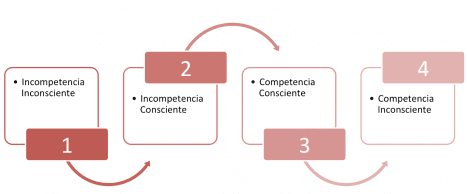 In an initial phase, known as Unconscious Incompetence, human beings are completely unaware of their shortcomings and limitations. All hospitality professionals have gone through this phase; unfortunately, some are still there. Need, competitiveness or a desire for innovation makes us evolve to the next stage, and each person does so when they feel the time is right.
The next stage is Conscious Incompetence. In other words, it is the psychological state in which the professional or company is aware of its shortcomings in terms of talent, experience, resources and training required to address the change process. This phase leads hoteliers to subscribe to countless blogs, attend conferences and participate in communities. Their thirst for knowledge is such that they spare no resources in satisfying their need to acquire competencies. This process can last between one and three years, and during that time they will see success stories—other people’s—and, having not overcome this phase themselves, many may give up because of the lack of results; it is said that as many as 85% may abandon the process at this stage.
Naturally, as they acquire capabilities, hoteliers enter the state of Conscious Competence. That is, they are aware of what they have learned and begin to apply it in their professional environment, making constant efforts to remain faithful to what they have learned and resisting the temptation to do what they have been doing out of habit for years. I know many hospitality colleagues who are at this stage, fighting tooth and nail within their organisations against other professionals who are still in the earlier phases in order to achieve their goals.
Eventually, competencies become automatic; in other words, the level of attention paid to acquired knowledge is no longer at its peak, because reactions have already become habitual. We then find ourselves in the state of Unconscious Competence, in which we act by instinct because the new environment has already become part of our professional habitat. Generally speaking, professionals at this stage do not communicate or publicly display their status; they do not need to—it is part of who they are. Perhaps that is why I do not know whether there are any hoteliers in it. ;-D
In reality, all this may seem like a lot of fuss, but try to remember when you learned to drive and everything that has happened since then, and relate it to the professional sphere. There are not that many differences.
In an initial phase, known as Unconscious Incompetence, human beings are completely unaware of their shortcomings and limitations. All hospitality professionals have gone through this phase; unfortunately, some are still there. Need, competitiveness or a desire for innovation makes us evolve to the next stage, and each person does so when they feel the time is right.
The next stage is Conscious Incompetence. In other words, it is the psychological state in which the professional or company is aware of its shortcomings in terms of talent, experience, resources and training required to address the change process. This phase leads hoteliers to subscribe to countless blogs, attend conferences and participate in communities. Their thirst for knowledge is such that they spare no resources in satisfying their need to acquire competencies. This process can last between one and three years, and during that time they will see success stories—other people’s—and, having not overcome this phase themselves, many may give up because of the lack of results; it is said that as many as 85% may abandon the process at this stage.
Naturally, as they acquire capabilities, hoteliers enter the state of Conscious Competence. That is, they are aware of what they have learned and begin to apply it in their professional environment, making constant efforts to remain faithful to what they have learned and resisting the temptation to do what they have been doing out of habit for years. I know many hospitality colleagues who are at this stage, fighting tooth and nail within their organisations against other professionals who are still in the earlier phases in order to achieve their goals.
Eventually, competencies become automatic; in other words, the level of attention paid to acquired knowledge is no longer at its peak, because reactions have already become habitual. We then find ourselves in the state of Unconscious Competence, in which we act by instinct because the new environment has already become part of our professional habitat. Generally speaking, professionals at this stage do not communicate or publicly display their status; they do not need to—it is part of who they are. Perhaps that is why I do not know whether there are any hoteliers in it. ;-D
In reality, all this may seem like a lot of fuss, but try to remember when you learned to drive and everything that has happened since then, and relate it to the professional sphere. There are not that many differences.
All of this brings to mind the competency-based learning model, which links psychological states in the progression from incompetence to competence and skill.
In an initial phase, known as Unconscious Incompetence, human beings are completely unaware of their shortcomings and limitations. All hospitality professionals have gone through this phase; unfortunately, some are still there. Need, competitiveness or a desire for innovation makes us evolve to the next stage, and each person does so when they feel the time is right.
The next stage is Conscious Incompetence. In other words, it is the psychological state in which the professional or company is aware of its shortcomings in terms of talent, experience, resources and training required to address the change process. This phase leads hoteliers to subscribe to countless blogs, attend conferences and participate in communities. Their thirst for knowledge is such that they spare no resources in satisfying their need to acquire competencies. This process can last between one and three years, and during that time they will see success stories—other people’s—and, having not overcome this phase themselves, many may give up because of the lack of results; it is said that as many as 85% may abandon the process at this stage.
Naturally, as they acquire capabilities, hoteliers enter the state of Conscious Competence. That is, they are aware of what they have learned and begin to apply it in their professional environment, making constant efforts to remain faithful to what they have learned and resisting the temptation to do what they have been doing out of habit for years. I know many hospitality colleagues who are at this stage, fighting tooth and nail within their organisations against other professionals who are still in the earlier phases in order to achieve their goals.
Eventually, competencies become automatic; in other words, the level of attention paid to acquired knowledge is no longer at its peak, because reactions have already become habitual. We then find ourselves in the state of Unconscious Competence, in which we act by instinct because the new environment has already become part of our professional habitat. Generally speaking, professionals at this stage do not communicate or publicly display their status; they do not need to—it is part of who they are. Perhaps that is why I do not know whether there are any hoteliers in it. ;-D
In reality, all this may seem like a lot of fuss, but try to remember when you learned to drive and everything that has happened since then, and relate it to the professional sphere. There are not that many differences.