
Staff Cuts Are Not a Low-Season Strategy

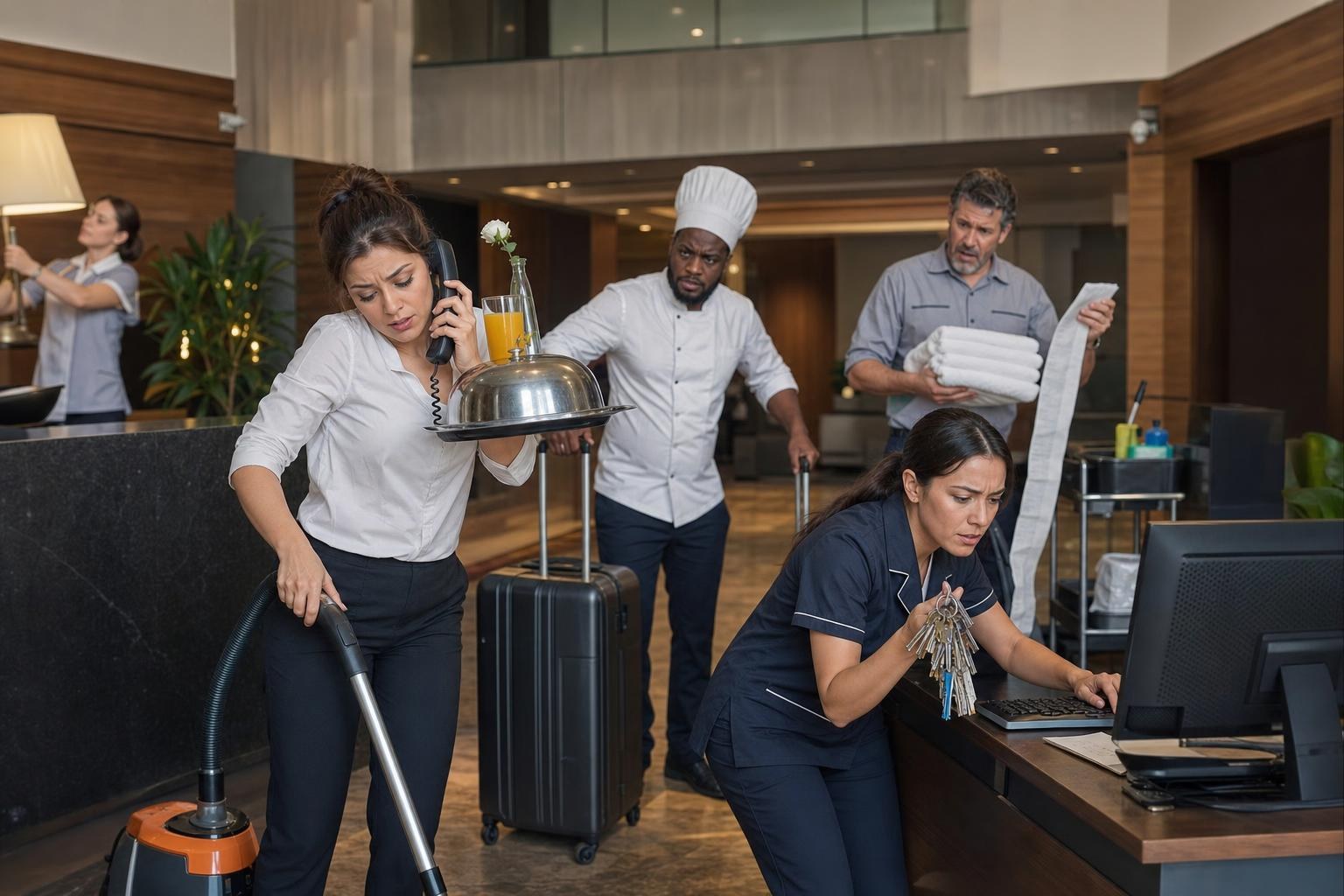

There are budget meetings in which a figure suddenly acquires an almost moral authority. The projected drop in occupancy appears, someone points to labour costs and, minutes later, low season seems to have been resolved with a phrase as simple as it is dangerous: we will have to operate with fewer people. The spreadsheet breathes a sigh of relief, but the hotel starts holding its breath.
I do not question the need to control costs. I have had to review staffing levels, postpone hires, reduce hours, close outlets and make employment decisions that are never pleasant. A hotel cannot retain a structure designed for peak occupancy when demand falls for a prolonged period, but neither can it pretend that service will remain the same after removing part of the capacity that made it possible.
The problem arises when staffing reductions are not accompanied by a conscious reduction in complexity, promises, opening hours or services. That is when the familiar solution of “everyone will do a bit of everything” emerges, usually presented as flexibility and team spirit. In many cases, it is something else: an elegant way of passing the cost of planning that nobody dared to undertake onto employees.
I have seen hotels get through difficult low seasons with discipline, commercial creativity and highly precise organisation. I have also seen properties enter a cycle of cuts, improvisation and decline because they confused cost containment with managing the business. The difference was rarely the severity of the market; it lay in the courage with which uncomfortable decisions had been addressed before winter arrived.
My position is deliberately critical. Reducing staff while keeping the hotel promise unchanged is not efficiency; it is an operational lie. If we want to spend less, we must also decide what we will stop opening, selling and promising, and which capabilities we consider non-negotiable. Everything else amounts to asking the team to subsidise, through effort, stress and disorder, a model that no longer sustains itself.
The cut that looks like savings and ends up throwing the hotel into disarray
The first trap of a cost-cutting policy is its extraordinary visibility in the accounts. The eliminated salary appears immediately in the budget, while the side effects are spread across overtime, mistakes, delays, sick leave, compensation, deferred maintenance, lost guests and the erosion of the best professionals. Savings have their own line; the damage is usually hidden across several.
This asymmetry encourages dangerously superficial hotel management. We celebrate a reduction in labour costs because we can measure it quickly, but it takes months to acknowledge that Front Office is responding less effectively, Housekeeping is accumulating rooms not yet ready, Food and Beverage is becoming less consistent, and managers are spending their days covering absences. The budget appears more efficient just as the operation becomes less manageable.
Not all multi-skilling is negative. In well-organised hotels, a person can take on complementary functions because they have received training, understand priorities, have the time and know the limits of their authority. That professional multi-skilling broadens capabilities, supports development and allows the hotel to respond to reasonable variations in demand.
A very different matter is defensive multi-skilling. It appears when a staffing reduction leaves tasks without an owner and the organisation expects someone to pick them up out of personal responsibility. Nobody has redesigned processes, reviewed shifts or eliminated work; there is simply an assumption that the most committed people will make an extra effort, even though they do not know for how long or what should take priority.
The difference between the two forms of multi-skilling is easy to recognise. The first involves training, boundaries, sequencing and recognition. The second is dominated by phrases such as “while you are at it”, “it will only take five minutes”, “we need to help each other” and “it is only for a few weeks”. In Hospitality, those weeks have a curious ability to last the entire season.
When everyone does everything, something more serious usually happens: nobody knows precisely who is accountable for the final result. The task may be completed, but ownership, follow-up and specialist judgement disappear. A receptionist can carry a tray in an emergency; that does not mean we should design room service on the assumption that Front Office will leave the desk whenever someone orders dinner.
The loss of specialisation does not affect technical quality alone. It increases interruptions, movement between areas, context switching and the time needed to regain concentration. The employee appears busy throughout the shift, but an increasing share of their effort is spent trying to work out what must be done first, where the equipment is and who will cover their position while they deal with another need.
This phenomenon creates what I call role debt. Every time a responsibility is shifted without redefining the role, transferring knowledge or assigning capacity, the hotel incurs organisational debt. At first, it is paid with goodwill; later, with mistakes, tensions between departments, exhaustion and loss of trust.
Role debt usually begins quietly. The Food and Beverage manager takes on purchasing because there is no longer enough administrative support, Front Office manages reservations while handling arrivals, Maintenance covers furniture moves, and Housekeeping ends up reporting issues that nobody processes in time. Each adaptation seems reasonable in isolation, but together they produce a hotel full of busy people and incomplete tasks.
In that environment, urgency replaces priority. Teams stop working to a sequence and start reacting to the latest call, the person who insists most or the problem that has already reached the guest. It is a particularly costly expression of the tyranny of urgency in hotels: plenty of visible activity and very little ability to improve the system causing it.
The guest may not know our organisation chart, but they can clearly perceive its consequences. They notice that they have to wait, repeat a request, look for someone or settle for an imprecise answer. The guest experience in hotels rarely deteriorates because travellers know how many employees are available; it deteriorates because the hotel stops responding consistently.
This is one reason why supposed staff savings end up affecting future business. Inconsistent service reduces trust, weakens recommendations and makes the price seem less justified. If we also force guests to chase solutions, we move directly into the problem of making them waste time to receive what they had already paid for.
There is also internal damage that is less visible but no less costly. The most responsible professionals are the first to absorb the gap because they struggle to see a task left undone or a guest unattended. The hotel interprets that response as proof that the reduction was viable, when what it is actually observing is an extraordinary effort that cannot become a permanent structure.
In this way, we punish precisely those who do most to sustain the operation. They are given more functions because they solve problems, interrupted because they know the hotel, and asked to be patient because “the situation is difficult”. Over time, some reduce their commitment and others leave. We are then surprised to discover that commitment also has limits, as though goodwill were an unlimited resource included in the employment contract.
A poorly designed cost-cutting policy usually displays several recognisable signs:
- The promise remains unchanged while capacity falls. The same opening hours, channels, services, standards and exceptions are maintained, but with fewer people available. The hotel has not reduced the work; it has only reduced the people expected to perform it.
- Critical tasks lose a clear owner. Everyone can do them, but nobody has protected time to ensure they are completed. When they fail, a retrospective search for culprits begins instead of a review of the design.
- Managers become permanent cover staff. Helping in operations is part of the profession, but filling vacancies every day prevents them from observing, training, planning and correcting. The hotel gains an extra pair of hands for a few hours and loses management capacity for weeks.
- Productivity improves because the metric is incomplete. Dividing revenue or rooms by fewer employees can produce an apparently impressive figure. If we do not include waiting times, errors, rework, overtime, complaints and service deterioration, the KPI ends up rewarding the wrong behaviour, a risk I have already examined when explaining how metrics can generate harmful decisions.
- Training is replaced by improvised instructions. A person is asked to cover another function after a quick explanation, without supervised practice or escalation criteria. The outcome depends on individual intuition and turns every shift into a small survival test.
- The team no longer knows what doing its job well means. When every priority is urgent and standards are adjusted to resource shortages, professionals end their shift feeling that they have run all day without completing anything. That perception erodes pride, motivation and belonging.
We should be especially critical of labour-cost indicators during these processes. The staff-to-revenue percentage may rise in low season even when staffing is properly sized, because the denominator has fallen. Cutting staff to artificially preserve a ratio can be as absurd as removing lifeguards because there are fewer swimmers, without considering that the pool remains open and the responsibility is unchanged.
Low season cannot be used as an excuse to turn professional roles into a succession of errands. Flexibility is valuable when it expands the hotel’s capacity to respond, but it becomes degrading when it removes every reasonable boundary around work. Asking for occasional support strengthens the team; institutionalising “everyone does everything here” usually reveals that nobody wanted to decide what work is worth continuing.
I have been involved in operations where reductions were unavoidable. In those cases, the most honest approach was to explain the situation, redefine responsibilities, close services during certain periods and reduce saleable inventory. It was not pleasant, but it was far less damaging than maintaining a façade of normality supported by an increasingly exhausted team.
There is nothing mediocre about reducing costs when the business requires it. The mediocrity lies in doing so without accepting the trade-offs that accompany the decision. The mediocre cut wants to retain all the benefits of a full operation without paying for the capacity it requires, and expects employees and guests to silently absorb the difference.
Low season demands the decisions that cuts seek to avoid
Low season does not arrive by surprise. Its intensity may vary, it may begin earlier than expected or last longer, but it forms part of the economic structure of many hotels and resorts. Treating it each year as a staffing emergency is an admission that there is no genuine hotel strategic planning for that period.
Preparing does not mean predicting each day’s occupancy precisely. It means designing several possible operating models and establishing when each should be activated. The hotel should know in advance which services it will retain at low demand, which spaces it can close, which hours it will reduce, which inventory it will stop selling and which capabilities it will protect even if the month is loss-making.
The first decision is to define a minimum service capacity. I do not mean the smallest possible number of employees needed to keep the building open, but the capacity required to deliver, consistently, the promise we continue to market. A hotel may be technically operational while being unable to serve with dignity the guests it has agreed to accommodate.
That minimum capacity must be built around service moments, not daily averages alone. Forty occupied rooms can generate a very different workload depending on arrivals, departures, guest mix, meal plans, requests, breakfast periods and open services. Hotel Revenue Management, Operations and those responsible for workforce planning need to interpret that workload together.
If we reduce staff based on average occupancy, we ignore the peaks that actually break the service. A hotel may appear quiet for much of the day and yet concentrate breakfast, departures, enquiries and room preparation into ninety minutes. The problem is not a lack of total hours, but their poor synchronisation with the work we must deliver.
I propose adding a trade-off budget alongside the financial budget. Every significant reduction in capacity should explicitly state which activity, level of availability or promise is being removed to make it viable. If we cannot identify the trade-off, we have probably not eliminated work and are simply trusting someone else to absorb it.
The trade-off budget forces us to answer uncomfortable questions. If we close a night position, who receives a late arrival while handling an incident? If we reduce Housekeeping staff, how many rooms can we release, and by what time? If we simplify Food and Beverage, which offering will we stop selling? If a manager covers operations, which supervisory tasks will they no longer carry out?
This exercise completely changes the conversation with ownership and Finance. We no longer discuss only how many euros we save, but what capacity we withdraw from the hotel and what risk we accept. Staffing ceases to be an abstract figure and becomes connected to services, response times, protected revenue and specific commitments to the guest.



My published books
To assess a staffing reduction honestly, I use a very simple sequence:
- Define the promise that will remain in force. Before discussing shifts, we must decide which experience, opening hours and services we will continue to offer. Hotel marketing and distribution cannot keep selling a version of the hotel that Operations no longer has the capacity to deliver.
- Remove complexity before human capacity. Review menus, opening periods, open spaces, exceptions, reports, meetings, duplication and low-demand services. Letting someone go while retaining every task is quicker than redesigning the work, but also considerably less intelligent.
- Protect the functions that sustain continuity and safety. Some roles cannot be assessed solely by visible volume. Preventive maintenance, supervision, reservations, food safety or night service may appear overstaffed until the day an incident demonstrates why they existed.
- Schedule according to workload, not tradition. Shifts inherited from high season are rarely suitable for low season. We need to examine arrivals, departures, food and beverage, cleaning, groups, maintenance and commercial activity by time period in order to place capacity where it actually delivers service.
- Design multi-skilling before requiring it. Every shared function needs training, practice, boundaries, priority and a person accountable for the standard. Flexibility cannot depend on the most experienced employee always being available to rescue everyone else.
- Calculate net savings, not just nominal savings. From the wage reduction, we must deduct overtime, compensation, lost sales, rework, sick leave, turnover, future training and deferred maintenance. Savings that disappear once their consequences are included were never savings.
- Review warning signs of deterioration weekly. There is no need to wait for a poor monthly score. Repeated requests, rooms not ready on time, extended shifts, postponed preventive tasks and constant managerial interventions are early warnings of insufficient capacity.
The sequence matters. Too often, we start by reducing people and then ask departments to “adapt”. A more sensible strategy begins by defining what hotel we are going to operate during those months, reducing complexity and only then determining the structure required.
It is also worth comparing alternatives that are often dismissed through inertia. Keeping everything open with an understaffed team is not always more profitable than closing a restaurant on certain nights, concentrating occupied rooms by zone, limiting certain services or temporarily suspending the sale of categories requiring specific attention. Available occupancy does not have to equal saleable inventory.
Even a partial or full closure may be more professional than a degraded opening. Closing involves costs, loss of presence and difficult employment decisions, but remaining open without sufficient capacity also consumes cash, damages reputation and exhausts the team. The choice must be made using complete numbers, not out of the pride of saying that the hotel never closes.
Courage sometimes means recognising that the operating model does not work with the forecast demand. At other times, it requires accepting a lower monthly result in order to preserve knowledge, continuity and commercial capability. Not every cost should be eliminated when occupancy falls; some protect the possibility of growing again when the market returns.
In seasonal hotels, that protection includes deciding whom we want to bring back and which knowledge we cannot afford to lose. Dismissing people without a strategy and then rehiring under pressure months later creates a restart cost that is rarely attributed to the original decision. This is why it is useful to address continuity before closure and avoid having every reopening teach the same standards all over again.
There is also a commercial responsibility we must not ignore. Low season cannot be managed solely through expenditure; it also needs its own demand, appropriate segments, reasons to travel and propositions compatible with available capacity. A hotel that only reacts by cutting costs is admitting that it has no other strategic response.
Marketing, Sales and Revenue must be involved long before the occupancy gap appears. Their job is not to fill any date at any price, but to build demand that generates contribution and can be served. If the only winter commercial strategy is to lower rates, we will need ever more volume to cover costs and place even greater pressure on a reduced team.
This contradiction is common: staff are cut to save money, then offers are launched that increase the workload for every euro of revenue earned. Reservations arrive with discounts, included services, extensive flexibility and little additional contribution. The hotel celebrates occupancy while the team wonders how to serve it, proving once again that demand, capacity, promise and margin should be decided as one business.
Achieving this requires a governance system that prevents isolated decisions. Commercial teams should not commit services without understanding capacity; Finance should not impose reductions without identifying their trade-offs; Operations should not maintain unworkable standards for fear of acknowledging limits. The approach developed in a common playbook for deciding as one hotel is particularly relevant in low season.
Measurement must also change. Alongside labour cost and productivity, I would review the percentage of preventive tasks completed, rooms released within the promise, repeated requests, response times, overtime, absences, shift changes, reopened incidents and managers’ time devoted to cover. These data are less comfortable than a payroll percentage, but they describe the health of the operation far better.
I am not proposing an endless dashboard. A few indicators linked to the cutback hypothesis are enough. If we claim that we can operate with fewer people without affecting service, we must define which results would prove us wrong and what decision we will make when they appear.
We must also listen to the team without turning consultation into theatre. Those doing the work know which tasks are duplicated, which schedules are poorly designed and where there is genuine scope for simplification. Listening does not mean accepting every proposal, but it does mean avoiding the arrogance of reorganising, from a spreadsheet, processes we have never observed throughout a full shift.
Communication requires the same honesty. If the hotel is going through a difficult season, it is worth explaining this clearly, sharing the criteria and acknowledging the trade-offs. What destroys trust is not the reduction alone, but hearing speeches about excellence while each week another part is removed from the system meant to make it possible.
Demanding professionalism from a team means providing an achievable definition of good work. We cannot ask for personalised attention, upselling, speed, accuracy, empathy and collaboration while the same person answers the phone, welcomes the guest, prepares paperwork and looks for someone who can take a cot upstairs. At some point, excellence stops being a standard and becomes a provocation.
I have learned that a serious cutback must also include a review date and exit conditions. Temporary measures tend to become permanent because the hotel grows accustomed to the team’s sacrifice and because restoring capacity is later interpreted as an increase in costs. Without an explicit commitment, exceptional measures end up becoming the new base budget.
That is why I recommend documenting what has been reduced, for how long, which signs will require it to be reversed and who has the authority to request the review. Otherwise, even when demand recovers, the team continues operating by crisis criteria and the hotel tries to capture high-season revenue with a structure designed to survive the winter.
Hotel profitability does not improve by shifting costs from the profit and loss account to human fatigue, guest time or deferred maintenance. Those costs may take time to emerge, but they do emerge. Sometimes they arrive as turnover; at other times, as reputational damage, rate erosion, equipment failures or the inability to win back former guests.
My practical advice is to bring together Finance, Operations, Revenue, Commercial and departmental heads before approving any significant reduction. For each proposal, I would place one mandatory question: what work, promise or availability will cease to exist alongside this cost? If nobody can answer, the hotel is not eliminating work; it is hiding it.
There are three professional paths: maintain the required capacity, transparently reduce the proposition during certain periods, or fully or partially close what cannot be sustained. There is a fourth path, far more common and considerably less honest: keep the same promise, remove people and hope that individual effort will cover the difference. That path usually appears cheap until we begin paying for its consequences.
Facing low season with courage does not mean resisting every cut. It means accepting the full cost of every decision and preventing employees and guests from paying for what the budget has chosen to ignore. A hotel does not demonstrate strength by always operating with less, but by knowing what capacity it needs to keep its word even when the market stops helping.
This article ends here. The archive does not.
Lead Hospitality brings together 1200 English articles published since 2018: years of experiences, decisions and lessons you can keep exploring.
What would you like to explore next?
Choose a direction and keep reading around what you want to solve, learn or challenge.