
Many Hotels Don’t Have a Sales Problem: They Have a Product Guests Won’t Buy at Their Asking Price

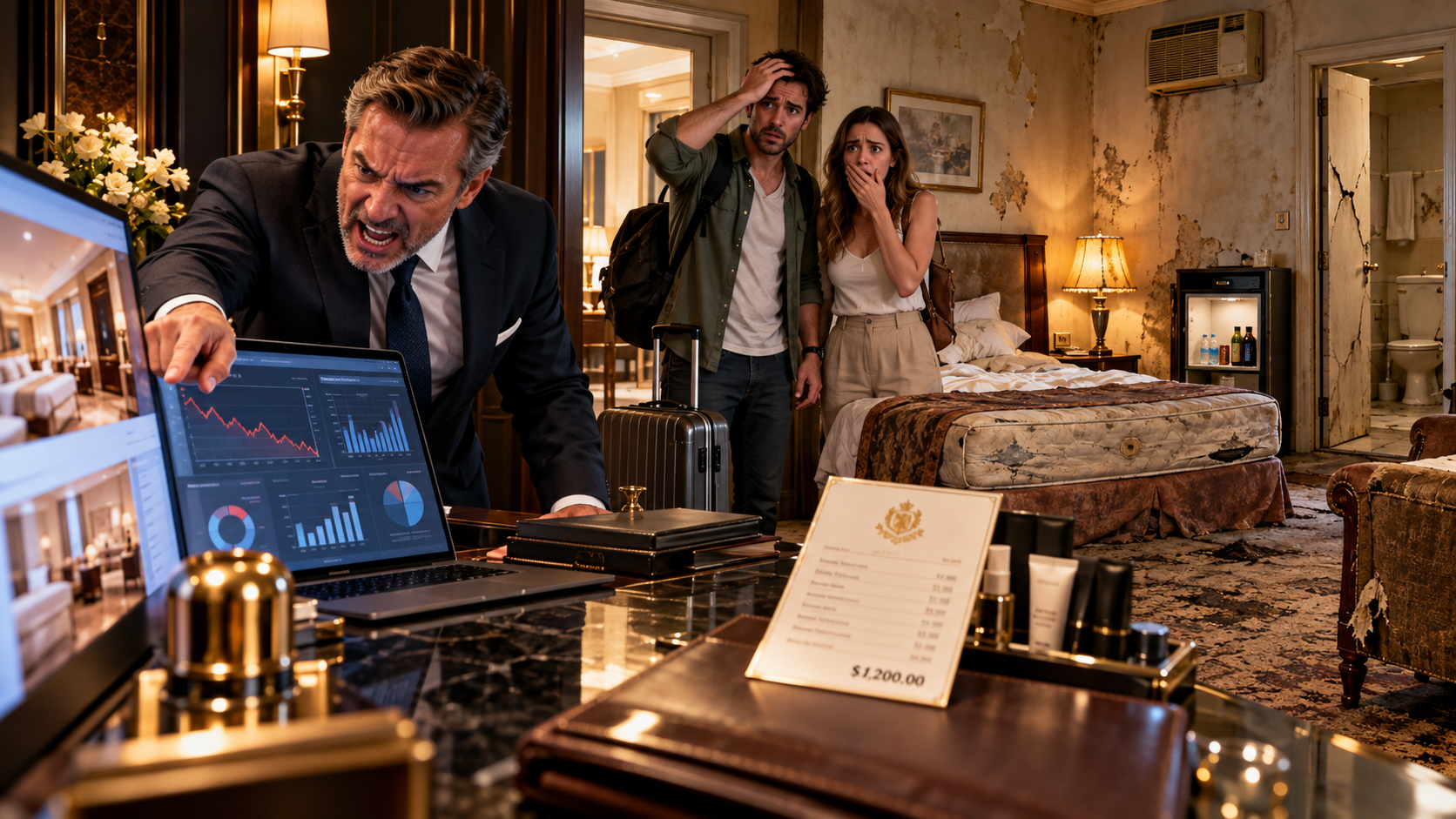

Before hiring another agency, perhaps we should dare to look at the room.
I say this because I have attended too many meetings where a hotel was not selling as expected and, before seriously analysing the product, we had already found several culprits. Marketing was not generating enough demand. Revenue Management had set rates too high. The sales team needed to spend more time out selling. Distribution channels were not working as they should. The website was not converting. The market was challenging. Competitors were dumping rates. We always found a reasonable explanation and, curiously, it almost always pointed somewhere other than what we were actually offering the guest.
I particularly remember those meetings where someone would project an occupancy report and ask why a nearby hotel was managing to sell at higher rates. The answer usually revolved around digital positioning, campaigns, visibility or sales policy. Rarely did anyone propose something much simpler: book a room at our own hotel, pay what we were asking the market to pay and spend a night there. Not as managers of the property, but as guests. Arrive without excuses, look at the furniture, test the mattress, take a shower, listen to the corridor noise, observe the details and ask ourselves whether we would repeat the experience at the price paid. That exercise can be extraordinarily revealing. It can also be rather uncomfortable.
In hospitality, we have developed a remarkable ability to overcomplicate commercial problems. We talk about hotel revenue management strategies, market segmentation, channel optimisation, conversion, demand acquisition, competitive positioning and revenue per available room. These are fundamental disciplines, and it would be irresponsible to downplay them. But none of them can indefinitely turn a mediocre product into an excellent one. We can get more people to see a room. We can improve how it is presented. We can make booking easier. We can adjust the price. What we cannot do is guarantee that someone will perceive value where they can barely find it.
There is a huge difference between a hotel that does not sell because the market does not know it exists and one that does not sell because, once it knows it, the market decides it is not worth what it costs. The former probably has a visibility, distribution or sales problem. The latter has a much deeper issue: the gap between the value it believes it offers and the value the guest actually perceives. And that gap is not necessarily resolved with a new campaign.
That is why I believe we need to dare to raise an uncomfortable question in many management and ownership meetings: what if the problem is not that we are selling our hotel poorly, but that we are trying to charge too much for something that needs improving? I am not referring only to old hotels or deteriorated facilities. I am also thinking of relatively new properties, with good photographs, significant investment and an aspirational positioning that does not match the actual experience. Because the market does not automatically reward how much we have invested, how much revenue we need to generate or how much we would like to be worth. Within its means and the available alternatives, the market rewards the value it recognises.
When the problem is not Marketing, but behind the guestroom door
There is one idea I consider fundamental to understanding hotel sales strategy: price is a promise. When a guest books a room for €90, they form certain expectations. When they pay €180, they form others. And when they spend €350 per night, they expect to find enough reasons to justify that decision. They do not necessarily expect luxury in every case. They may be paying for location, exclusivity, tranquillity, comfort, dining, personalised service or simply an exceptionally well-executed experience. But they expect something.

AI is only as smart as the context you give it. HotelGEX gives it your whole hotel.
Guests, Revenue, operations, F&B, Groups & Events and Management connected in one intelligent context, so HotelGEX AI can understand what is really happening across your hotel.
Full hotel context.
And the higher the price, the greater the expectations surrounding that something. This is where one of our common mistakes appears: we think that simply increasing the rate improves positioning. As if moving from €140 to €190 automatically turned a conventional hotel into a premium property. That is not how it works. Price can communicate positioning, but it cannot replace the product that should justify it.
Research published in Tourism Management in 2021, based on more than 44,000 guest reviews linked to the prices actually paid, found that higher rates could negatively affect perceptions of quality and value for money. The study showed that the increase in expectations associated with price could outweigh any positive effect arising from the assumption that a more expensive product should be better. We do not always need to lower prices. But we do need to understand that raising them also increases the commitment we make to the guest. And that commitment does not end when we secure the booking. It begins there.
The room does not know how much revenue we need to generate
Let us imagine a fairly common situation. We have a hotel with a target average rate of €180. Ownership has made significant investments, labour costs have risen, energy is more expensive, suppliers have increased their prices and the annual budget requires higher revenue. So far, entirely understandable.
But the guest enters the room and finds a shower screen that leaks, an uncomfortable mattress, curtains that do not block out the light properly, a small television, inadequate lighting, worn furniture and a bathroom that seems to have decided to remain in 2009. The guest does not know our budget. They do not know how much we pay for financing. They are unaware of our depreciation. They did not take part in preparing the business plan. And, frankly, they do not have to. They only know they have paid €180 and that their experience does not seem to be worth it.
Our cost structure explains the price we need to charge. It does not prove the price the guest is willing to pay. Confusing financial need with commercial value is one of the most costly mistakes we can make in hotel management. Naturally, a business must cover its costs, generate profitability and adequately remunerate invested capital. But if the price required to make the business viable consistently exceeds the price the market recognises, we have an economic model problem. It is not enough to ask the sales department to perform miracles. Nor does it seem particularly fair to hold Revenue Management responsible for profitability that the product, in its current condition, may not be able to support.
Marketing can conceal a weakness. The guest will eventually discover it
I have nothing against aspirational marketing. On the contrary. Good positioning needs an engaging narrative, excellent photography, a coherent identity and a sales proposition capable of conveying emotion. But we must distinguish between communicating value and creating expectations that the product cannot fulfil.
An outstanding photographer can find the best angle in a mediocre room. They can make the most of excellent light. They can carefully select the details. They can make twenty square metres look like an extraordinary suite. But when the guest opens the door, the square metres will remain exactly the same. And then one of the most dangerous phrases for any hotel will emerge: “It does not look like the photographs.” That phrase is not merely a complaint about communications. It is a breach of trust.
Marketing has promised something that operations have not delivered. And when this happens systematically, the organisation enters a rather absurd cycle. Marketing needs to generate more bookings to offset falling conversion. Revenue needs to adjust prices to maintain occupancy. Reception needs to manage disappointment. Housekeeping receives more comments. Maintenance accumulates incidents. Management analyses negative reviews. And ownership asks why we cannot achieve the planned rates. Everyone works harder to offset a problem that might begin to be resolved by replacing a mattress, refurbishing a bathroom or honestly redefining the positioning.
It is not a lack of commercial effort. It is a lack of consistency between what we promise, what we charge and what we deliver.
The data tells a story we should listen to
The relationship between product, perceived value and commercial performance is not mere intuition. An academic study that analysed 42,668 reviews of 774 hotels found that aspects such as beds, reception, room size and room décor were among the elements to which guests paid particular attention and where significant levels of dissatisfaction existed. Another study, published in 2025, examined 46,278 review excerpts from budget hotels in Indonesia. 46.6% of the excerpts analysed related to guestrooms: cleanliness, bathrooms, air conditioning, bedding, odours and the functioning of facilities. This does not mean that 46.6% of guests were dissatisfied, but it does reflect the extraordinary weight of the core product in conversations about the experience.
Research by the Cornell Center for Hospitality Research found, under the conditions and within the sample studied, that a 1% improvement in the online reputation score was associated with increases of up to 0.89% in ADR and 1.42% in RevPAR. These figures should be interpreted correctly. They do not represent a universal rule, nor do they guarantee that a specific improvement will automatically produce those results. But they illustrate something important: perceived quality, subsequently expressed through reputation, is related to a hotel’s ability to defend its rates.
Perhaps we are treating reputation as a review-response issue when we should also treat it as an indicator of the real condition of our product. If ten different guests mention that the air conditioning is noisy, we are probably not dealing with ten overly sensitive guests. If several independent comments describe uncomfortable mattresses, we should review the mattresses. If criticism of lighting, maintenance or cleanliness appears repeatedly, perhaps we should stop drafting clever responses and start addressing the causes. One negative review may be unfair. Twenty reviews describing the same defect are operational information.
The dangerous habit of confusing price with positioning
I have often heard statements like these: “We want to position ourselves in the upper segment.” “Our goal is to attract higher-spending guests.” “We need to increase ADR.” “We do not want to compete on price.” These are entirely legitimate aspirations. I myself argue that hotel profitability should not be built exclusively on volume and discounts. But there is one essential condition: to charge like a hotel in a particular segment, we need to offer an experience the guest recognises as belonging to that segment.
It is not enough to change the photographs. It is not enough to use an elegant typeface. It is not enough to add the word boutique. It is not enough to replace “double room” with “deluxe”. And it is certainly not enough to increase the price and expect the market to interpret the new amount as sufficient proof of exclusivity. Positioning is the place we manage to occupy in the guest’s mind relative to the available alternatives.
Décor matters. Comfort matters. Cleanliness matters. Maintenance matters. Dining matters. Team professionalism matters. Tranquillity matters. Consistency matters. Even something as unglamorous as a door closing properly matters. Because the guest may forget the name of the designer who selected the furniture. But they are unlikely to forget a sleepless night.
Maintenance is a commercial tool that we often treat as an expense
In many hotels, maintenance appears in budget discussions as an item that must be contained. Contracts are reviewed. Replacements are postponed. Items that should perhaps be renewed are repaired. Investment is delayed because things still work. And technically, that may be true. A door works. A shower works. Air conditioning works. A sofa works. But there is a considerable difference between working and delivering an experience commensurate with the price.
A mattress can remain in use long after it has lost much of its comfort. A room can be clean and still look neglected because of worn materials. A bathroom can fulfil its function while conveying an image incompatible with the desired positioning. A terrace can have magnificent views and furniture that detracts from the overall experience.
Not every investment necessarily generates sufficient return, and refurbishing for the sake of refurbishing is not an intelligent strategy either. But systematically postponing the investments that sustain quality ultimately transfers the cost to the guest and, later, to the profit and loss account. First comes dissatisfaction. Then reviews. Later, loss of differentiation. And finally, pressure on price. What initially appeared to be an operational saving may end up weakening our commercial capability.
That is why I believe maintenance, housekeeping, operations, sales and revenue should jointly participate in product investment decisions. Not all improvements have the same impact. And that is precisely why we need to prioritise them.
How to stop demanding commercial miracles and start building a sellable product
If a hotel is not achieving its commercial targets, my first recommendation would not be to dismiss the agency, change the booking engine or immediately reduce rates. Nor would I rule out any of those measures. What I would do is check that we are diagnosing the right problem. Because a hotel can simultaneously have distribution, product and positioning challenges. The question is to identify which factor is actually limiting its performance. And, above all, to avoid a solution that merely conceals the problem for a few weeks.
1. Conduct a product audit as if you were a guest
I do not mean a quick walkthrough with a maintenance manager who knows every defect perfectly well. I mean a rigorous, structured assessment. I would book different room types. I would try rooms in different locations. I would sleep in them. I would use the showers. I would test the mattresses. I would assess soundproofing. I would have breakfast as a guest. I would review the public areas. And I would pay particular attention to what we have stopped seeing precisely because we live with it every day.
There are defects that the team internalises as normal. A small stain. A damaged corner. A poorly placed socket. Recurring noise. Unpleasant lighting. Confusing signage. The guest does not share that sense of normality. They discover it for the first time. And they compare it with what they have paid. To conduct a genuinely useful audit, I would review at least the following elements:
- Sleep comfort. Mattress quality, pillows, bedding, blackout, climate control, acoustics and insulation from corridors and adjoining rooms. Sleep remains one of the main reasons someone pays to stay at a hotel. If we fail here, decorative details lose much of their value.
- State of repair. Paintwork, walls, furniture, doors, floors, fittings, seals, lighting and equipment. I would distinguish between aesthetic, functional and critical defects. Minor wear may be tolerable in a particular segment, whereas a recurring fault should not be normalised.
- Perceived cleanliness. It is not enough for a room to be sanitised. It must convey visual and sensory cleanliness. Odours, darkened grout, worn textiles and deteriorated materials can create a negative impression even when cleaning procedures have been correctly carried out.
- Consistency between photographs and reality. I would compare every room type with the images used in sales communications. The guest should not feel they have received an inferior version of the product advertised.
- Everyday functionality. Space to open a suitcase, lighting for reading, accessible power sockets, ease of using the shower, stable temperature, suitable connectivity and the ability to work comfortably where the segment requires it. Functionality is also hospitality.
- Quality of ancillary services. Breakfast, restaurant, bar, pool, spa, parking and public areas must be assessed against what has been promised and their contribution to the price. A service promoted as a differentiator can become a major source of disappointment if its execution does not match.
- Human experience. The hotel product does not end with the facilities. It includes information, response times, welcome, incident resolution and consistency between departments. A physically outstanding hotel can be commercially weak if the service experience is inconsistent.
- Final perception of value. At the end of the stay, I would ask three questions: would I return at the same price? Would I recommend it to someone who had to pay that price? And what would need to change for me to agree to pay 15% more? The answers may be more useful than many sales meetings.
We should not conduct this audit to find people to blame. We should conduct it to identify specific opportunities for improvement.
2. Compare experiences, not only rates
One of the most common errors in hotel benchmarking is comparing properties by category, location and price without sufficiently analysing the product. We see another hotel selling at €220 and conclude that we should be able to do the same. But perhaps that hotel offers more modern rooms, better soundproofing, superior beds, a different dining experience or a considerably more consistent level of service. Or perhaps it has a better location, an outstanding reputation, a recognised brand or a very different demand segment. A competitor’s price does not prove that our product deserves the same price.
To make a useful comparison, I would assess three or four alternatives that our target guest genuinely considers. And I would use a simple matrix:
| Dimension | Our hotel | Competitor A | Competitor B |
|---|---|---|---|
| Comfort and sleep quality | 3/5 | 5/5 | 4/5 |
| Room condition | 3/5 | 4/5 | 5/5 |
| Service | 4/5 | 4/5 | 3/5 |
| Location | 5/5 | 4/5 | 4/5 |
| Dining offering | 3/5 | 4/5 | 4/5 |
| Price-value consistency | 2/5 | 4/5 | 4/5 |
Illustrative example; scores should be obtained through a consistent and verifiable assessment. The exercise is not intended to turn hospitality into a simplistic sum of scores. It aims to identify something much more important: what genuine reasons a guest has to choose us rather than another alternative. And if we cannot find enough reasons, perhaps we should stop asking Marketing to invent them.
3. Distinguish between excessive pricing and an insufficient product
Imagine two hotels. The first has good facilities, comfortable rooms, a strong reputation and a consistent experience, but has set a rate of €250 when comparable demand is responding better at around €190. We may be facing a pricing problem. The second aims to charge €250 for a deteriorated, undifferentiated experience with recurring quality issues. Here, we may be facing a product problem.
In both cases, occupancy may improve by reducing the price. But the implications are different. In the first, adjusting the pricing strategy may be enough. In the second, a reduction may temporarily improve conversion, but it does not solve the property’s structural inability to defend higher rates. That is why it is useful to measure together:
- ADR: the average rate actually achieved per room sold.
- RevPAR: room revenue per available room.
- GOPPAR: gross operating profit per available room.
- Commercial conversion: the proportion of visitors or enquiries that become bookings.
- Reputation by attribute: the specific performance of cleanliness, comfort, facilities, service and value for money.
- Incident compensation: the direct financial cost of product failures.
- Repeat business and recommendation: guest behaviour after the stay, wherever it can be measured consistently.
- Acquisition cost: how much it costs to acquire demand through different channels.
The aim is not to accumulate indicators. It is to establish relationships. For example, if we increase ADR but value-for-money ratings begin to deteriorate, we should investigate whether we are exceeding the level of expectations the product can support. If commercial investment increases but conversion does not improve, we must review both the traffic acquired and the proposition offered. If reputation specifically deteriorates in maintenance and comfort, it does not seem reasonable to interpret the problem exclusively as a marketing challenge. Revenue Management optimises demand monetisation. It does not replace value creation.
4. Calculate the cost of not investing in the product
There is a way of approaching room investments that I find particularly useful. Rather than asking only how much refurbishment costs, I would ask: How much is not refurbishing costing us? Consider a 100-room hotel. Let us assume that a meaningful product improvement allows ADR to rise sustainably by €12, while maintaining annual occupancy of 70%. The theoretical additional revenue would be: 100 rooms × 365 days × 70% × €12 = €306,600 per year.
I am not saying that any refurbishment will generate that result. That would be a dangerous oversimplification. But the exercise forces us to place investment within a business rationale. If, for example, we allocate €600,000 to improving rooms, we must analyse what increase in revenue, reduction in costs or combination of both could justify the outlay. We also need to consider revenue lost during works, future maintenance, financing, taxation and the cost of capital. And something especially important: we must not confuse incremental revenue with incremental profit.
The Intelligent Hotel
Data, Artificial Intelligence and a New Way to Run Hotels
Go deeper into how AI, data and automation are transforming hotel management, commercial performance and the guest journey.
Investment should be assessed by its contribution to cash flow and asset value, not solely by revenue growth. The example may seem obvious. Yet I still encounter situations where we approve sizeable commercial budgets relatively easily while postponing product improvements that could potentially enhance our competitiveness for years. Advertising buys attention. A sound product investment can improve the reason why that attention becomes a booking.
5. Do not try to sell to everyone: define who you are genuinely valuable to
Not every hotel needs major investment to reposition itself. Sometimes the main problem is that we are trying to sell the wrong product to the wrong segment. A hotel may have relatively small rooms and an outstanding location. It may not be competitive for long family stays, but it could offer an excellent proposition for short urban breaks. Another property may have traditional facilities, spacious areas, tranquillity and attractive value for money. Perhaps it should not compete with the destination’s most modern accommodation. It can build a proposition around rest, warm service and authenticity.
A resort with extensive sports facilities may be particularly appealing to certain segments, even though it makes no sense to present it as an intimate and exclusive retreat. Here we reach one of the major decisions in hotel strategic planning: it is not about convincing the entire market that our hotel is extraordinary, but about identifying who it can be extraordinarily suitable for.
Segmentation must go far beyond classifying travellers by nationality, age or booking channel. We need to understand motivations. What they seek. What they value. What bothers them. What they are willing to pay. What they consider essential. And which alternatives they use to compare us. Correct positioning does not always require being the best hotel. It requires being a particularly relevant choice for a specific group of guests.
6. Stop calling everything a premium experience
The word premium has suffered considerably in recent years. We find it in rooms, breakfasts, packages, services, amenities and experiences. But premium should not simply mean more expensive. Nor should it mean adding a sophisticated label to a conventional service. A premium breakfast needs to offer recognisable differences. A premium room must provide superior attributes. A personalised service must be genuinely personalised. And an exclusive experience should have some element that justifies its exclusivity.
If every product is premium, probably none of them is. In hospitality, we need to recover a discipline I consider fundamental: naming products according to the value they actually deliver. Because the more ambitious the promise, the greater the risk of disappointment. And disappointment affects loyalty, reputation and future willingness to pay.
7. Do not make the sales team responsible for every shortcoming
There is an organisational injustice that is repeated far too often. The hotel needs better results. Pressure reaches the sales team. More visits are demanded. More calls. More agreements. More campaigns. More companies. More groups. More business. But nobody asks whether sales objections are revealing a structural problem.
What are clients saying when they visit the hotel? Why are groups not confirming? What are agencies saying? What is causing lost opportunities? Why do some companies not return? Why do certain segments choose other properties? Sales departments often hold extremely valuable information about the product. But we need to listen to it without interpreting it as an excuse.
If several companies reject our hotel because the meeting rooms need updating, perhaps the problem is not the sales manager’s negotiation skills. If certain operators consider the rooms below the expected standard for the price, perhaps we do not need another sales pitch. And if clients conducting a site inspection end up choosing other alternatives, we should analyse what they saw during that visit. A sales professional can sell advantages. They cannot indefinitely turn an obvious weakness into a competitive advantage.
8. Accept that some rooms should not be sold at the same price as others
This matter deserves particular attention from Revenue Management. In many properties, we still use rate structures that do not sufficiently reflect real differences in the product. Two rooms may belong to the same category and offer considerably different experiences. One has been refurbished. Another needs maintenance. One is quiet. Another receives noise. One has better views. Another overlooks an inner courtyard. One has an updated bathroom. Another retains old fittings. Yet both are sold at the same price.
Operational simplification may be convenient, but it is not always commercially correct. Relevant differences should be reflected in the product structure, inventory allocation, expectations communicated or pricing strategy where appropriate. This does not mean we need to create twenty room categories. It means we need consistency. Because a guest who pays the same rate as someone else and receives a clearly inferior experience may reasonably feel disappointed. A room is not worth what its room-type code says. It is worth what the guest recognises in it within the competitive context.
9. The value proposition must be explainable without mentioning price
I propose a simple exercise. Bring together your management team and ask this question: Why should a guest choose us if another comparable hotel costs exactly the same? Do not allow generalities as answers. “Because we offer excellent service” is not enough. “Because we are well located” may be insufficient. “Because we have good facilities” does not explain very much either. We need specific advantages.
A distinctive dining experience. Exceptional sleep quality. A genuinely differentiated location. A particularly thoughtful personal connection. Memorable architecture. Facilities especially suitable for a segment. A compelling wellness offering. An unusual combination of services. Or operational simplicity that turns a complicated stay into something surprisingly comfortable. Then I would ask a second question: Can we demonstrate each of these advantages through observable facts?
If we claim to offer exceptional rest, we must be able to support it through the comfort, acoustics and quality of our rooms. If we talk about personalised service, there should be evidence in our procedures and in guests’ actual experiences. If we promise exclusivity, we should be able to explain where it lies. The value proposition must be credible. And, above all, it must be experienceable.
10. Learn to distinguish between insufficient demand and product rejection
To diagnose a commercial problem, we need to understand where the purchase process breaks down. Not receiving visits is not the same as receiving them and failing to convert them. Nor is converting bookings and failing to achieve repeat business the same thing. Each situation requires a different response. I would analyse the commercial journey in this way:
- If nobody discovers the hotel, I would review visibility, awareness, distribution and demand-generation capacity.
- If many discover it but few consider it, I would review positioning, reputation, first impressions, photography and suitability for the target market.
- If they consider it but do not book, I would analyse price, conditions, value proposition, booking experience and competitive alternatives.
- If they book but end up disappointed, I would investigate the gaps between promise and delivery.
- If they are satisfied but do not return, I would review the nature of the trip, the likelihood of repeat need, loyalty and the product’s future relevance.
This approach avoids a common temptation: applying indiscriminate discounts to problems that do not necessarily originate in price. Because a rate reduction may temporarily improve conversion, but it can also attract less profitable segments, erode positioning and complicate future ADR recovery. And in certain cases, it does not even solve the problem. An unattractive product does not necessarily become desirable because it is cheaper. Sometimes it simply becomes an unattractive product sold at a lower margin.
The question we should ask before approving the next commercial budget
I am increasingly convinced that we need to integrate Marketing, Revenue Management, Operations, Maintenance and product strategy more effectively. They should not operate as independent disciplines that meet only when budget variances arise. They are part of the same value-creation system. Marketing helps communicate it. Sales turns it into relationships and commercial opportunities. Distribution enables it to reach the market. Revenue optimises its monetisation. Operations delivers it. Maintenance preserves its condition. And management must ensure that all of this responds to a coherent strategy.
When one of these elements fails, the system loses effectiveness. But when the core product is insufficient, pressure ultimately shifts to all the others. And this raises a question we rarely discuss in sufficient depth: what percentage of our commercial problems actually originates in decisions made outside the sales department?
Think about deferred maintenance. Investments that were never made. Services we continue to promise even though they have lost quality. Poorly defined room types. A dining offering that is no longer competitive. Photographs that show an overly optimistic reality. Positioning that nobody has reviewed for years. Facilities that continue to function but have stopped inspiring guests. It is entirely possible that we are demanding extraordinary commercial results from rather ordinary product decisions. And that, besides being ineffective, is profoundly unfair to teams.
A simple tool: the price-value consistency index
To translate this reflection into concrete decisions, I propose creating an internal indicator that I would call the Price-Value Consistency Index (PVCI). It is not a standardised industry metric or a universal formula, but a diagnostic tool that can help structure conversations. I would calculate it using five dimensions:
| Dimension | Indicative weight |
|---|---|
| Physical quality and maintenance | 25% |
| Comfort and functionality | 25% |
| Service and human experience | 20% |
| Competitive differentiation | 15% |
| Perceived value for money | 15% |
| Total | 100% |
Each dimension could be rated from 1 to 5 using internal observations, audits, reviews and competitive comparisons. The formula would be: PVCI = Σ (score for each dimension × corresponding weight). To express it out of 100, we would divide the result by five and multiply it by one hundred.
For example, a property could score 3/5 for physical quality, 4/5 for comfort, 4/5 for service, 2/5 for differentiation and 2/5 for value for money. Its index would be 63/100. That result does not mean the hotel should apply a 37% discount, nor that there is a mathematical relationship between score and rate. It would be a mistake to interpret it that way. Its usefulness lies in identifying where the weakness is concentrated.
In this case, the problem does not appear to lie so much in service or comfort as in differentiation and the perception of value relative to price. The next decision might be to analyse whether we need to strengthen differentiating attributes, review communications, adjust rates or modify the priority segment. Repeating the exercise periodically would make it possible to observe whether our investments are genuinely improving the product. I am less interested in the number than in the conversations it can prompt.
Because a hotel may have excellent financial indicators in the short term while silently eroding its ability to compete in the future. It may also have magnificent rooms while destroying value through poor commercialisation. The question is to identify the right cause. And act on it.
Three decisions that can change the next results meeting
The next time occupancy is below budget, before requesting another campaign or demanding a rate reduction, I would suggest starting with a shared product review. Invite Marketing, Revenue, Reception, Housekeeping, Maintenance and Sales. Review the same rooms, listen to the same complaints and analyse the same lost opportunities. This is not about assigning blame. It is about building a shared diagnosis. When each department has a different explanation for the problem, we normally have not yet understood the full problem.
I would also recommend setting aside part of the annual budget for small product improvements whose effectiveness we can measure. We do not always need a full refurbishment. Sometimes renewing mattresses, correcting acoustic problems, improving lighting, updating textiles, replacing worn furniture or redesigning certain details of the experience can produce important results. That said, let us assess these actions using economic criteria: cost, expected impact, effect on reputation, willingness to pay, satisfaction and profitability. Improvements should not be approved because we like them more, but because they provide demonstrable value to those who will enjoy them.
And perhaps most importantly: when someone tells us that the hotel should sell at a higher rate, let us ask a question that seems simple but requires considerable professional honesty: “What have we improved to deserve it?” The answer may lie in outstanding service, an excellent reputation or a competitive advantage the market does not yet know. But we may also have no convincing answer. If that happens, there is nothing wrong with acknowledging it. What would be worrying is continuing to ask Marketing to sell a promise that the product is not yet ready to fulfil. Before hiring another agency, perhaps we should dare to look at the room.
This article ends here. The archive does not.
Lead Hospitality brings together 1200 English articles published since 2018: years of experiences, decisions and lessons you can keep exploring.
What would you like to explore next?
Choose a direction and keep reading around what you want to solve, learn or challenge.