
The Guest Is Not Always Right—and Pretending Otherwise Is Hurting Hotel Teams

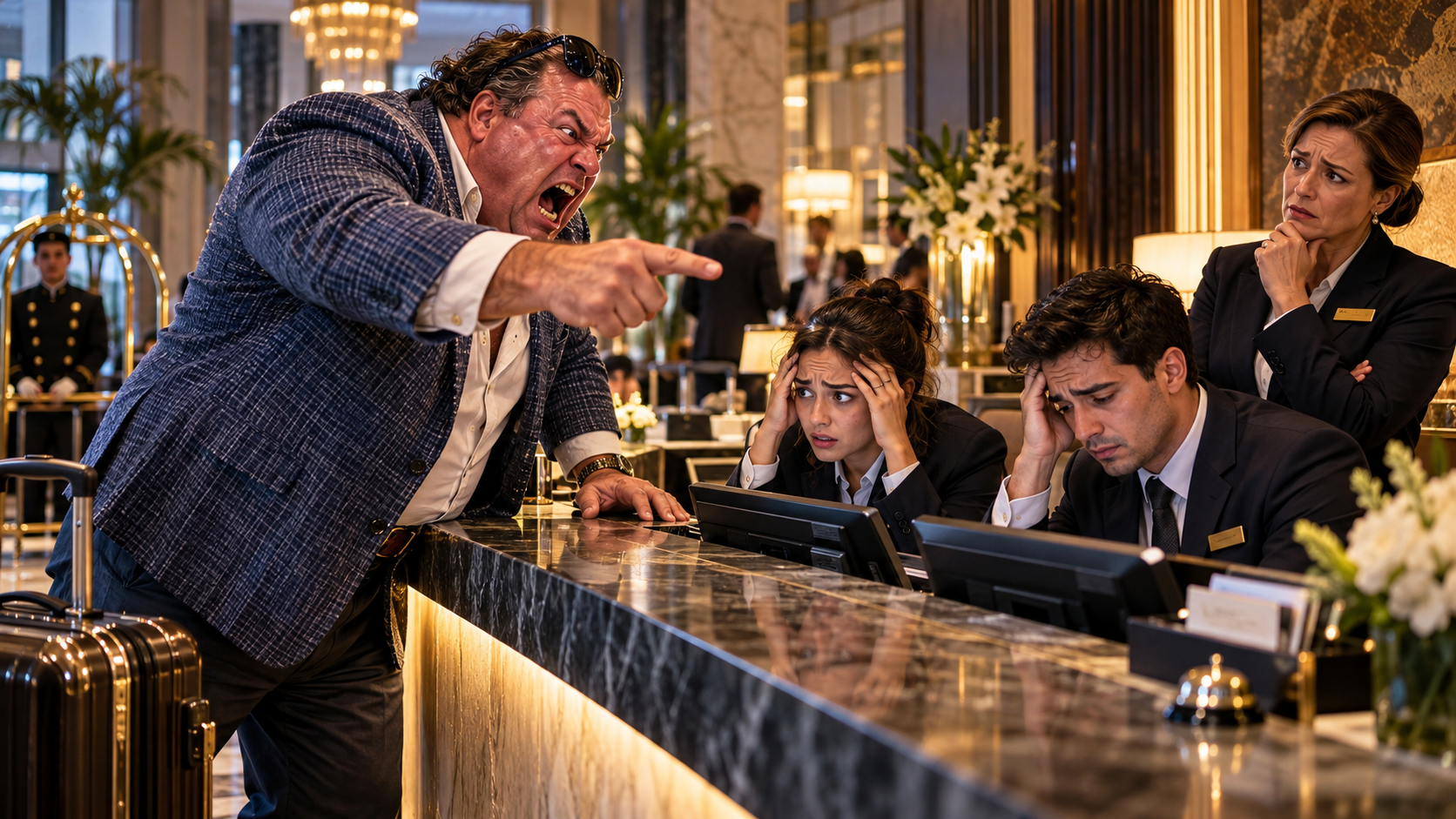

For many years, we have repeated a phrase in Hospitality that has probably done more harm than we are willing to acknowledge: “the customer is always right”. We have placed it in service manuals, training sessions, operational meetings and speeches about customer focus until it has become a kind of professional dogma. Questioning it seems almost heretical. Yet, after many years of seeing all kinds of situations in hotels, I am increasingly convinced that it is not only false, but that interpreted literally, it can become a very poor management policy.
Naturally, guests deserve respect. We must listen to them, understand them, anticipate their needs whenever we can, resolve our mistakes and do everything reasonably possible to ensure they enjoy an excellent experience. Hospitality exists precisely because someone places their trust in us for part of their journey. But hospitality does not mean submission. Service does not mean accepting any behaviour. And satisfying a guest does not require us to agree with them when they are objectively wrong.
I have seen the same scene too many times. An employee correctly explains a hotel policy. The guest insists. The employee explains it again. The guest raises their voice. A manager appears. And, to “avoid problems”, the manager contradicts the employee, grants what was impossible five minutes earlier, adds compensation and sends the guest away with a smile. From the outside, it looks as though we have resolved an issue. Internally, we have just created several more.
Because there is one person watching that entire scene whom we often forget: the employee we have just overruled in front of the guest. We have taught them that knowing the procedures is of limited use, that maintaining a reasonable position may be penalised and that, under sufficient pressure, the organisation will probably prefer to sacrifice its judgement rather than face a negative review. Afterwards, we will meet to discuss engagement, empowerment, leadership or corporate culture, and perhaps wonder why certain people have stopped making decisions for themselves.
That is why I believe we need to revisit one of the oldest dogmas in our profession. The guest is not always right. Sometimes they are right, sometimes they are mistaken, sometimes they do not understand how the hotel works and, on occasion, they know perfectly well that they are wrong but discover that persistence pays off. Our job is not to win arguments against them. It is to distinguish between each of those situations and act fairly. Because there is something we should remember much more often: a hotel that always protects the guest, even when the guest is wrong, ends up failing to protect the people who work there.
The hidden cost of turning the guest into an absolute authority
The phrase “the customer is always right” is often attributed to the first great merchants of the early 20th century, although its original meaning was much more closely related to taking consumer preferences seriously than to accepting every complaint as true.
We have taken it considerably further.
In too many hotels, we have turned a healthy guest focus into an unsettling subordination to the guest. And they are entirely different things.
A guest may say breakfast should finish at noon. They may prefer a colder room. They may find a mattress uncomfortable. They may consider a particular rate too high. All of these are legitimate perceptions.
But they may also claim they were promised something we know was never promised. They may arrive four hours before check-in and demand an immediate room. They may turn up after a service has closed and demand that it reopen exclusively for them. They may insult a receptionist. They may humiliate a room attendant. They may try to consume something and then claim they should not have to pay for it. They may threaten a negative review to secure compensation.
And none of those situations automatically becomes reasonable simply because the person involved has paid for a room.
Buying hospitality does not mean buying impunity.
I believe we have made an important conceptual mistake here. For years, we have argued that putting the guest at the centre meant placing them above everything else. It is not the same thing. The guest should be at the centre of our value proposition. But around that centre are also employees, suppliers, owners, the community, shareholders and the business itself.
A sustainable model of excellence must necessarily balance stakeholders. The EFQM model approaches value creation from that broad perspective: purpose, culture, people, stakeholders, performance and results are all part of the same system. An excellent organisation cannot optimise the satisfaction of one stakeholder indefinitely by destroying that of the others.
And in Hospitality this is extraordinarily important because our guest experience still depends enormously on people. Front office, restaurant, bar, housekeeping, maintenance, reservations, spa, events... The hotel experience is often delivered in front of the guest and through direct human interaction. That is why emotional strain has real consequences.
Various studies published in the International Journal of Hospitality Management have linked customer incivility with emotional exhaustion and the intention to leave the organisation. They have also examined how support from managers and the organisation itself can mitigate that impact.
In other words, an incident that may have lasted seven minutes at the front desk can stay with the employee for several hours. And when an employee is being treated unfairly and their manager appears only to automatically take the guest’s side, the problem is no longer solely the guest’s behaviour. It also becomes a leadership problem.
This matters even more in a labour market where engagement is already under pressure. Gallup’s State of the Global Workplace 2026 report, based on 2025 data, places employee engagement globally at around 20%, and in Europe at around 12%. Those who lead teams have a great deal of responsibility for the workplace climate.
We can invest enormous sums in employer branding, training, recruitment and benefits. Yet a manager can undo much of that work in thirty seconds by saying in front of a guest: “Well, it does not matter. We’ll do it for them.” Especially when, five minutes earlier, the employee had correctly explained why it should not be done.
The dangerous business of rewarding conflict
There is another consequence we rarely analyse: human behaviour learns through incentives. If every time someone protests intensely enough they get something, we are creating an extraordinarily simple mechanism: conflict = reward. And some guests learn quickly.
Those of us who have worked in hotels for many years have encountered profiles who, curiously, seem to suffer extraordinarily serious problems at virtually every property they visit. The room is never clean enough. The temperature is never right. Breakfast always has some flaw. The room always seems inferior to the one booked. The noise is always unbearable. And, coincidentally, the solution usually involves some combination of a discount, a bottle, dinner, parking, late check-out, a room upgrade or a partial refund.
I am not referring to the guest with a legitimate complaint. That guest should concern us deeply. When we fail, we must acknowledge it. And when the failure is significant, compensation may be entirely appropriate.
A room delivered in poor condition, a reservation error, a major malfunction, a contracted service that was not provided or an unjustifiable wait require a proportionate response. That is service recovery. But we must distinguish between service recovery and buying silence. They are not the same thing.
I would try to separate every complaint into five categories:
- Objective hotel error. We have failed to deliver something that was contracted or reasonably promised. Here, we must take responsibility, resolve it quickly and, where proportionate, provide compensation.
- Shared error or ambiguity. The information could be interpreted in different ways, or our communication was not sufficiently clear. Here, it is advisable to seek a reasonable solution without becoming obsessed with determining who “wins”.
- Expectation gap. The hotel has fulfilled what was contracted, but the experience does not align with the guest’s subjective preferences. We should listen and help, although that does not necessarily mean providing compensation.
- Opportunistic complaint. The service has been delivered correctly and inconsistent arguments emerge, primarily intended to obtain a financial advantage. Listen, yes. Automatically give things away, no.
- Abusive behaviour. Insults, threats, discriminatory comments, intimidation, harassment or aggression towards employees or other guests. Here, compensation should no longer be the priority. It should be protecting people and re-establishing boundaries.
We should not manage all five situations in the same way. Yet many organisations do. And then something particularly unfair happens: the reasonable guest ends up funding the disruptive guest.
Because all those compensations have a cost. A complimentary late check-out can affect housekeeping. A room upgrade takes up sellable inventory. A complimentary dinner has a cost. A discount reduces ADR. A partial refund affects revenue. An apparently small gesture, multiplied hundreds of times over the year, stops being small.
But there is an even greater cost that does not appear in the P&L: the loss of team authority.
When every decision can be immediately overturned by someone more senior, employees learn to stop making decisions. And then one of the most dangerous phrases in any organisation appears: “I’ll call the manager.”
Not because the situation genuinely requires escalation. But because we have taught the employee that making decisions is risky and passing the problem upwards is safe. That is exactly the opposite of the empowerment we then claim to want to build.
Protecting the guest without abandoning the team
For me, the alternative is not to create hostile hotels or employees who argue with guests. That would be absurd. The guest experience remains one of our main competitive assets. Satisfaction drives repeat business, recommendation, reputation and profitability. Excellent service will continue to distinguish good hotels from exceptional ones.
What we need is a more mature service culture. A culture in which we can say simultaneously: “We want to do everything possible for our guests” and “We will not accept anyone treating our team with indignity”. The two statements are perfectly compatible. In fact, I believe they reinforce each other.
An employee who knows the organisation will support them when they act correctly is usually far more confident about being generous when it is genuinely worthwhile.
1. Facts first; compensation afterwards
A complaint should not automatically trigger a goodwill gesture. It should trigger a question: What happened? Listen. Reconstruct the situation. Verify. Speak with the team. Check the reservation. Look at the timings. Review the notes. Understand expectations. Then decide.
Sometimes we will discover that the guest was entirely right. In that case, I have no problem clearly acknowledging it: “We made a mistake.” Saying it does not weaken the hotel. On the contrary. What weakens an organisation is inventing excuses when it knows it has failed.
But we must also be able to say: “I have reviewed what happened and the team acted correctly.” That phrase should also be part of our hospitality vocabulary.
2. Never undermine an employee unnecessarily in front of the guest
This is probably one of the rules I consider most important. If a team member is wrong, of course we must resolve the issue. But we can do so without humiliating them.
There is an enormous difference between saying, “My colleague made a mistake. They should not have told you that,” and saying, “Allow me to review the situation personally so that I can find the best solution.”
The second phrase keeps the resolution open without destroying the employee’s authority. We can talk internally afterwards. We will correct, train and explain. But training belongs backstage, not in the public performance in front of the guest.
3. Compensation must follow a rationale, not depend on the volume of the complaint
Hotels should have guiding criteria for service recovery. Not necessarily rigid ones, because every situation is different, but they should be consistent.

Directing Hotels
What Nobody Tells You Before You Sit in the General Manager’s Chair
A practical look at leadership, teams, operations and the real decisions that define hotel management from the General Manager’s chair.
- Level 1 — minor inconvenience: a sincere apology, immediate resolution and follow-up.
- Level 2 — material service failure: resolution and a proportionate goodwill gesture.
- Level 3 — significant failure to deliver: resolution and financial compensation or equivalent value.
- Level 4 — critical failure: management intervention, substantial compensation and subsequent root-cause analysis.
The important thing is that there should be some relationship between actual harm and compensation. The opposite leads to rather absurd situations: a guest receives a cold coffee and we end up offering a late check-out, a bottle of cava and a thirty-euro discount. At that rate, perhaps we should simply include a section in the buffet called “Complaints and compensation”.
4. Give the team financial authority
If we want accountable employees, we must allow them to resolve problems. That means establishing reasonable levels of autonomy:
- Front office: the ability to make certain goodwill gestures within an established limit.
- Department heads: greater autonomy for proportionate compensation.
- Management: intervention in situations with significant financial or reputational impact, or that are particularly sensitive.
But empowerment means more than being allowed to spend money. It also means the authority to say no. This second part is often forgotten. We do not truly empower an employee if they can give away a bottle but cannot politely uphold a reasonable policy.
5. An angry guest is not automatically a mistreated guest
We must learn to live with an uncomfortable reality: we can do the right thing and someone may still be angry. Not every negative emotion can be avoided.
If a hotel is full and we do not have the room someone wants to purchase that same night, the guest may feel frustrated. If check-out is set at a specific time and we need that room for a later arrival, denying six additional complimentary hours may upset them. If a non-refundable rate has clearly communicated terms, applying them may cause disagreement.
But a good decision does not stop being a good decision simply because it provokes a negative reaction. The obsession with achieving immediate satisfaction can lead to very poor long-term decisions.
6. Reputation threats should not change the facts
This is probably one of the great distortions of contemporary Hospitality: “Well, I’m going to put it on the internet.” “I’m going to write a review.” “I have lots of followers.” “You’ll see what I post.”
Online reputation is extremely important. We must listen to it, analyse it and learn from it. But a reputational threat does not turn a lie into the truth or make an unjustified demand reasonable. If we change our position solely because of the threat of a negative review, we have created a highly dangerous incentive. We are teaching people that the hotel’s reputation can be used as leverage. And the problem is not exclusively financial. It is cultural.
7. We must establish red lines
There are behaviours that should not be negotiable. A hotel needs to define clearly what happens in the event of:
- Personal insults
- Threats
- Racist, xenophobic, sexist or homophobic comments
- Sexual harassment of employees
- Physical aggression
- Ongoing intimidation
- Deliberate shouting after being politely asked to moderate one’s tone
- Deliberate damage
- Conduct that seriously disrupts other guests’ stays
Hospitality has limits. And setting those limits does not mean abandoning our service vocation. It means having values.
The International Labour Organization has indicated that more than one in five employed people have experienced violence or harassment at work during their working lives. We cannot seriously speak about workplace wellbeing if we then regard abuse from guests as “part of the job”. It should not be.
8. Management steps in when it needs to
There are times when I believe leaders must leave their office. Not to give something away. To take responsibility. If an employee is facing an aggressive situation, we must be available. Sometimes our presence will be enough. At other times, we will need to intervene.
And sometimes we will need to say a phrase that still seems uncomfortable in Hospitality: “I understand your dissatisfaction, but I will not allow you to treat a member of our team this way.” It can be said calmly. Without raising one’s voice. Without arguing. Without losing professionalism. Even with a smile, if we are capable of it. But it needs to be said. Because what we tolerate also defines our culture.
9. After every significant conflict, we should speak with the team first
There is a very simple question I ask, or try to ask, after difficult situations: “Are you okay?” It seems small. It is not. Before analysing procedures, compensation, CRM, reputation or quality reports, there is a person who may have just endured twenty minutes of aggression.
Listening to them for two minutes makes a great difference. And then, yes: What happened? What did we do well? What could we have done better? Did any process fail? Do we need to change anything? Should we document the incident? Is there a pattern? That is how we turn an unpleasant situation into learning.
10. Do not confuse demanding guests with abusive guests
This distinction is also important. A demanding guest can be extraordinarily valuable. They ask questions. They observe. They compare. They notice details. They expect consistency. And they often help us identify opportunities for improvement that we have stopped seeing internally. We should not use this debate as an excuse to discredit every complaint. That would be precisely the opposite error.
The fundamental difference lies between high expectations and disrespect; between complaining and humiliating; between requesting and threatening; between explaining disappointment and trying to gain an advantage through intimidation. A good professional knows how to tell the difference.
What it truly means to be guest-focused
For years, we have obsessively measured satisfaction, reputation, NPS, reviews and scores. That is good. We must continue doing so. But perhaps we should also look inwards.
How many times has our team faced insults this month? How much compensation have we provided? For what reasons? Which employees authorised it? How much did it cost? How many cases genuinely resulted from our errors? Which complaints recur? Which guests are repeat offenders? How many incidents ended with an employee being overruled? How many times did a manager intervene?
Those data also speak to service quality. Because the guest experience is not manufactured in a marketing department. It is created by people. And it is difficult to build a genuinely hospitable experience with professionals who are tired, insecure or convinced that the company will abandon them as soon as someone raises their voice loudly enough.
I have learned that protecting the team does not mean always agreeing with them either. Employees can make mistakes. And when that happens, we must correct them, teach them and help them improve. Blindly defending our employees would be as absurd as blindly defending every guest. The important word is not unconditional protection. It is fairness.
So, when the next conflict arises, I would try to resist the temptation to quickly decide who is right. First, I would seek to understand what actually happened. I would listen to the guest and listen to the employee. I would separate facts, perceptions and emotions. I would resolve what we can resolve, compensate when it is genuinely warranted and maintain our position when necessary. Good service does not mean ensuring everyone always gets what they want. It means treating everyone with respect.
And there is something else we should not forget when we talk again about leadership in the hotel sector, talent management, guest experience or high-performing teams. Our employees pay particular attention to what we do when things become difficult. That is when they discover what our values truly are. We may have them written on a wall, explain them during onboarding and repeat them for years. But it will take only one angry guest to test whether we really believe in them. Because a hotel that always protects the guest, even when the guest is wrong, ends up failing to protect the people who work there. And no hotel can deliver excellent hospitality for long after it has stopped being hospitable to its own people.
This article ends here. The archive does not.
Lead Hospitality brings together 1200 English articles published since 2018: years of experiences, decisions and lessons you can keep exploring.
What would you like to explore next?
Choose a direction and keep reading around what you want to solve, learn or challenge.