
When Hotel Recruitment Becomes a Wish List



This issue never goes away. Unfortunately.
Today, my good friend Javier shared a post on LinkedIn highlighting the inconsistency of some recruitment processes and how, sometimes through inexperience or simply a lack of understanding, recruitment firms and hotel recruitment specialists create an impossible wish list when searching for candidates.
The vacancy is for a Corporate Director of Operations for a company:
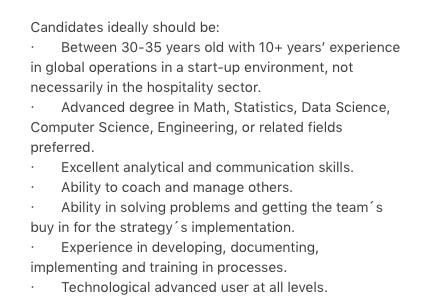
In other words, they are looking for a candidate aged 30–35, with 10 years (or more...) of operations experience.
Clearly, the wish list continues with a set of requirements that the dream candidate should have begun accumulating when they were barely 18–20 years old. Logically, they will have to start looking for candidates in primary school.

Needless to say, this is neither the first nor the only process I have seen like this, and I have no doubt that the search will be long and painful. But two things come to mind:
- It is clear that, in these cases, it is the company itself that requests these profiles, with no other aim than avoiding having to pay a salary commensurate with what a candidate with such a level of experience would clearly demand.
- What role does the recruiter play in this case? I am afraid none at all, because as a recruitment expert—and specifically one with sector expertise—they should at the very least justify their fee by helping the company understand what the profile of the candidate to be recruited should be.
Naturally, processes drag on, and it is difficult to recruit the ideal candidate. I have serious doubts and, depending on whom I ask, the answers may even alarm me: who defines what makes a candidate ideal? What criteria are used to reject a candidate? Does management get involved in reviewing the CVs received? Is 100% trust placed in a recruitment firm with no hotel management experience when it comes to its criteria for rejecting and/or validating an application? If the rejection criteria are so flimsy, do we still not know that paper will accept anything?



My published books
In recruitment processes, it is common to encounter inconsistent situations in which companies request candidate profiles that seem to be some kind of unattainable “ideal candidate”. On many occasions, these demands go beyond what is reasonable, calling for a combination of experience and skills that is difficult to find in a single individual. This type of request often leads to long and tedious search processes, as candidates who meet every requirement are scarce.
In this regard, it is important to consider the role the recruiter plays in these situations. As a recruitment expert, the recruiter should be able to advise the company on the realistic characteristics and requirements an ideal candidate should have. However, in many cases, the recruiter simply looks for someone who meets the requirements established by the company, without questioning their viability or proposing alternatives.
Faced with this issue, it is necessary to rethink how recruitment processes are conducted. Below is a step-by-step numbered list for doing so:
- Set realistic requirements: It is essential to define the requirements and characteristics that are genuinely necessary for the role. Avoid requesting unnecessary or unrealistic skills and experience.
- Effective communication between the company and the recruiter: It is important for there to be a fluid and open dialogue between the company and the recruiter. The recruiter must be able to advise the company and propose viable alternatives.
- Broaden the search: Rather than focusing solely on candidates who meet every requirement, it is advisable to widen the search to similar profiles that can adapt to and grow into the role.
- Review rejection criteria: It is necessary to establish clear and objective criteria for rejecting candidates. This will prevent decisions based on bias or subjectivity.
- Involve senior management: Company management should actively participate in the recruitment process, reviewing the CVs received and making informed decisions.
- Value the recruiter's expertise: It is important to trust the recruiter's experience and knowledge, especially if they have experience in the sector in which the candidate is being sought. Their advice can be key to finding the ideal candidate.
In conclusion, recruitment processes need to be reconsidered and requests for unattainable candidate profiles avoided. Effective communication between the company and the recruiter is essential, as are realistic requirements and objective rejection criteria. This will make it possible to find the ideal candidate more efficiently and avoid endless search processes.
I am convinced I am missing something, but anyway, everyone knows what they are doing. I suppose.
This article ends here. The archive does not.
Lead Hospitality brings together 1200 English articles published since 2018: years of experiences, decisions and lessons you can keep exploring.
What would you like to explore next?
Choose a direction and keep reading around what you want to solve, learn or challenge.