
The Ignorant Assert. The Wise Doubt and Reflect.

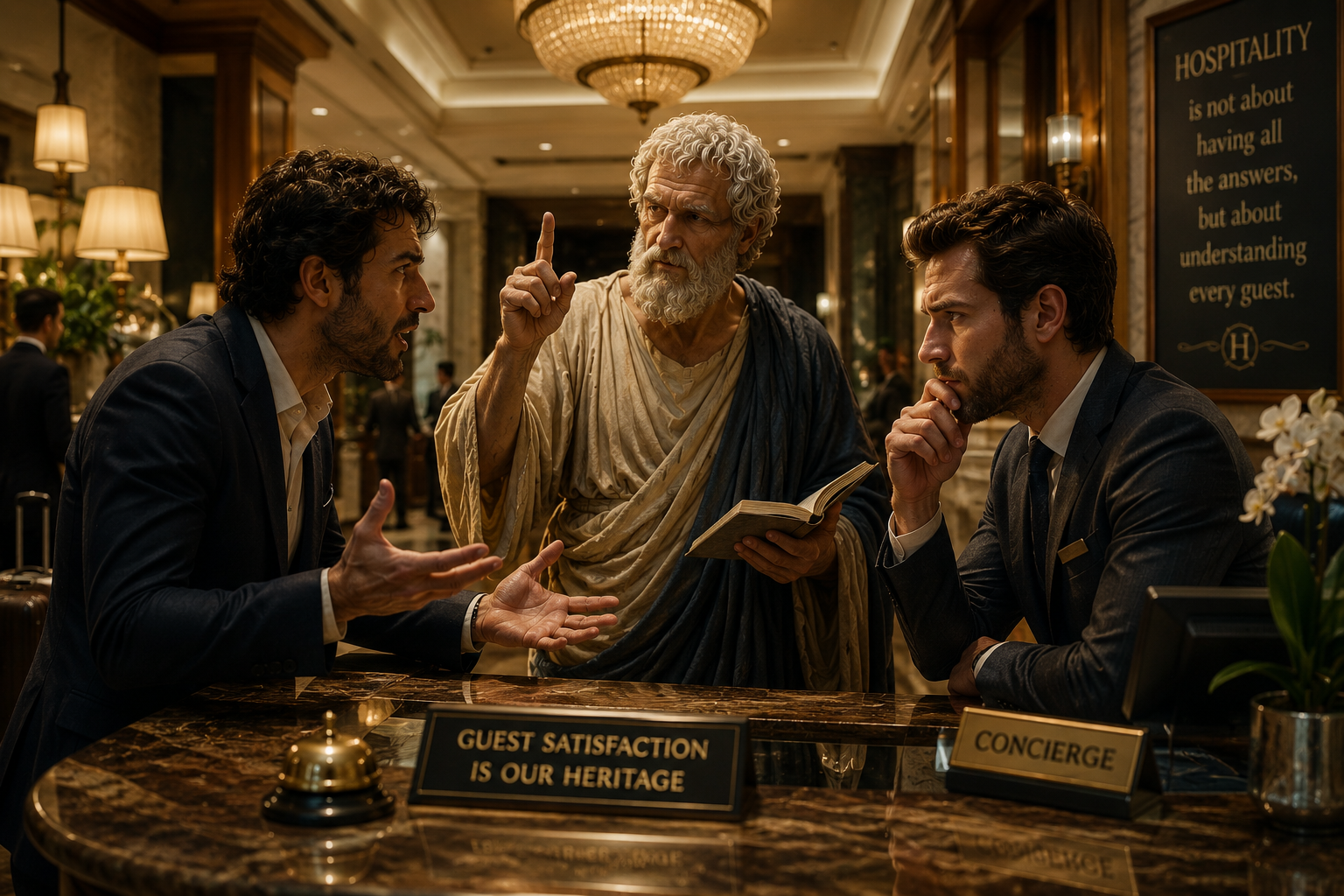

There is a phrase attributed to Aristotle that, over the years, I have come to feel is increasingly relevant to the day-to-day reality of hospitality:
“The ignorant assert; the wise doubt and reflect.”
And the more I observe this industry, the more convinced I am that one of the greatest differences between hotels that evolve and those that gradually begin to decline does not lie solely in investment, location or even the product. Very often, the real difference lies in an organisation’s ability to keep questioning itself.
Because hospitality has a silent problem that is rarely discussed: the dangerous comfort of believing that we already fully understand the business.
I have seen exceptional hotels begin to lose relevance without realising it. Not abruptly. Not overnight. But gradually. Almost imperceptibly. First, they stop questioning small details. Then, they stop reviewing old decisions. Later, they stop listening to certain market signals. And eventually, they end up managing the present through ideas that belonged to the past.
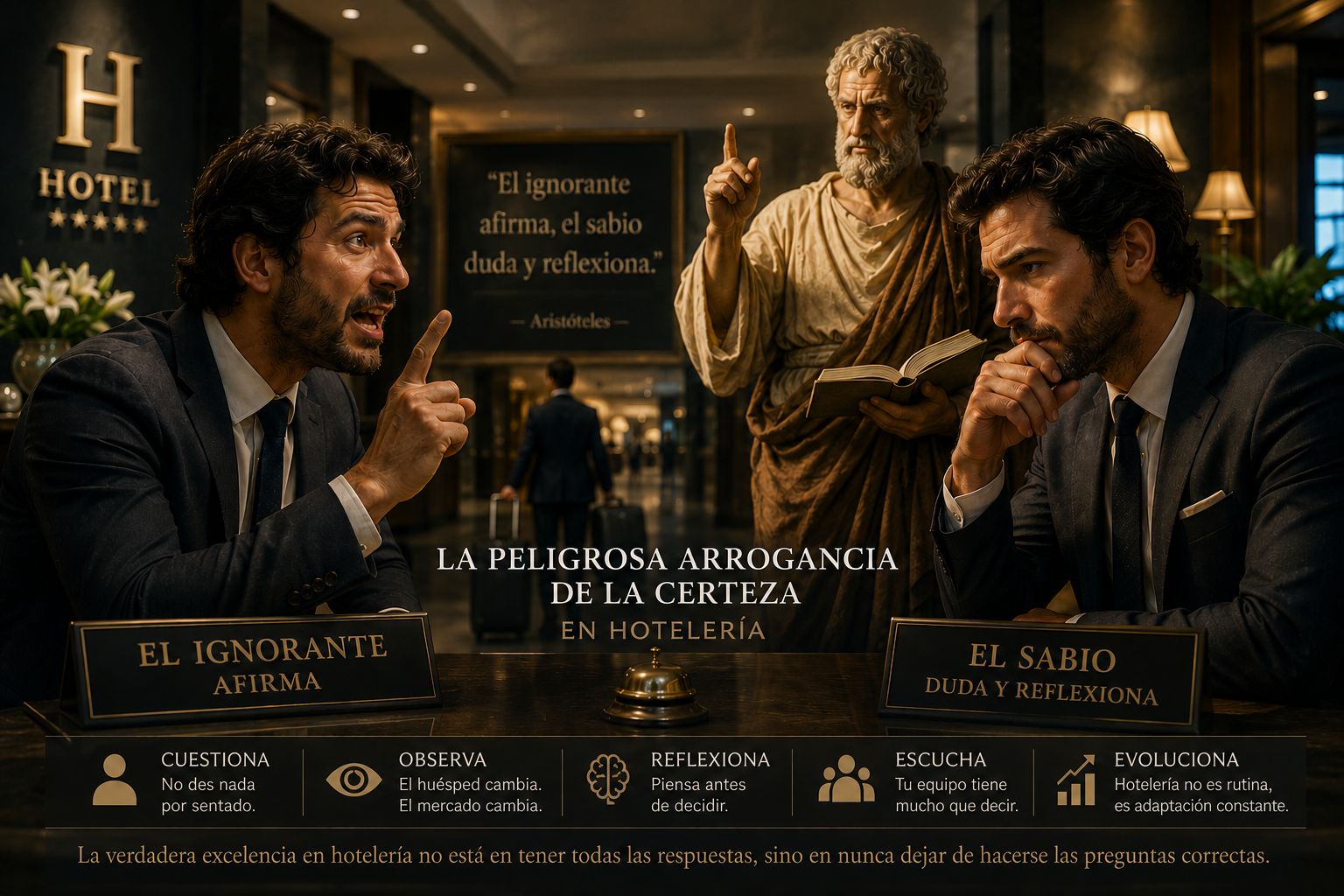
What is most unsettling is that, from within, it often does not even seem as though anything is wrong.
- Occupancy may still be acceptable.
- The numbers may still look healthy.
- The hotel may still be functioning operationally.
- Guests may even continue to arrive.
But internally, something begins to disconnect.
Because in hospitality, as in many industries, decline rarely begins with a major visible crisis. It usually begins when reflection disappears.
When responses become automatic. When no one questions processes. When meetings become filled with quick opinions and emptied of deep thinking. When phrases such as “this is how we have always done it here” or “I already know how this business works” begin to replace curiosity.
And that is where something tremendously dangerous emerges: intellectual arrogance disguised as experience.
Experience is extraordinarily valuable. In fact, few industries teach us as much as hospitality. But I have also learned that experience can have two entirely opposite effects on a person.
It can make them increasingly observant, more humble and more aware of the complexity of the business… or it can make them rigid, incapable of questioning their own certainties.
And that difference completely changes an organisation’s future.
I have known professionals with decades of experience who continued to observe the hotel with genuine curiosity. People capable of pausing to analyse how a guest moves through the reception area, how the team reacts under pressure, or how small changes in the atmosphere can completely alter the perception of service.
And I have also seen the other extreme: people who stopped learning years ago, even though they continued to work in hotels every day.
Because working in hospitality for many years does not guarantee evolution. Sometimes, it simply guarantees repetition.
And prolonged repetition without reflection ultimately becomes inertia.
One of the greatest risks in modern hospitality is precisely this: automatically managing realities that have already changed.
- The guest has changed.
- Their expectations have changed.
- Their relationship with time has changed.
- Their perception of luxury has changed.
- Their tolerance for waiting has changed.
- Even the way they assess service has changed.
Yet many hotels continue to operate from mindsets designed for a guest who, for all practical purposes, no longer exists.
And what is concerning is that organisations often take far too long to realise it.
Because hotels can survive for years on the strength of a good location, a strong market or historical commercial momentum. But sooner or later, the market ends up exposing every weakness that the organisation stopped questioning internally.
I have also learned that the smartest hotel environments are not necessarily the most sophisticated or the most technological.
They are those where there is still room for intelligent doubt.
Where someone can ask:
- Are we still relevant?
- Do we truly understand the guest?
- Does this add real value, or do we simply do it out of habit?
- Do our processes help, or do they create friction?
- Is the team engaged, or simply exhausted?
Organisations that retain this capacity for reflection tend to evolve far more quickly than those obsessed solely with projecting constant certainty.
Because true professional maturity does not consist of having an answer for everything.
It consists of understanding enough of the complexity to know that many important decisions require observation, analysis and humility.
And in hospitality, that is essential.
We manage people, emotions, operations, financial pressure, guest experience, leadership, internal conflict, expectations and profitability simultaneously. Thinking that all of this can be reduced to simple formulas or absolute certainties is usually a fairly clear sign that one does not truly understand the depth of this industry.
In fact, ignorance in hospitality often does not present itself as ignorance.
It presents itself as overconfidence.
- Categorical opinions voiced too quickly.
- Decisions made without listening.
- Leaders who no longer observe.
- Hotels that stop analysing themselves because they believe they already know all the answers.
And that is usually where the real problem begins.
My published books
Because when an organisation stops thinking critically, it begins to automate old decisions in entirely new contexts.
Then highly recognisable symptoms emerge:
- Irrelevant hotel products.
- Impersonal experiences.
- Emotionally disconnected teams.
- Absurdly rigid processes.
- Strategies copied from other hotels.
- An obsession with superficial metrics.
- Cultures in which questioning anything is interpreted almost as a threat.
There is something particularly delicate about our industry: the tendency to confuse hierarchy with absolute knowledge.
Sometimes, the higher someone rises, the less they are challenged.
And that can be devastating for a hotel.
Because when organisations begin to reward obedience more than reflection, people stop contributing ideas, stop raising problems and ultimately limit themselves to merely surviving operationally.
I have seen entire teams identify strategic mistakes perfectly… and remain silent.
Not because they lacked the ability. But because they understood that no one wanted to hear uncomfortable questions.
And perhaps that is where one of the great differences between leadership and authority emerges.
Authority needs to be right all the time. Intelligent leadership needs to keep learning.
That is why I increasingly admire professionals who are capable of saying:
- “I do not know entirely.”
- “I need to observe it more closely.”
- “Perhaps we need to rethink it.”
- “Or perhaps we are looking at the problem from the wrong angle.”
Because in hospitality, the capacity for reflection is often far more valuable than the constant need to project certainty.
The industry is full of noise.
- Quick opinions.
- Simplistic solutions.
- Instant experts.
- Strong statements on social media about exceptionally complex operations.
But real hospitality happens somewhere else.
It happens when rooms are not ready for release. When the kitchen is overwhelmed. When the PMS goes down. When there is a queue at reception. When the team is exhausted. When there is an overbooking situation. When a guest arrives emotionally distressed. When decisions have to be made under real pressure, rather than from the comfort of a LinkedIn post.
That is where many theoretical certainties disappear.
And the true complexity of the business emerges.
Perhaps that is why, the more time I spend in this industry, the less impressed I am by those who speak as if they know everything.
And the more respect I have for those who still retain the ability to observe, listen, analyse and continue to doubt.
Because perhaps one of the greatest threats to any hotel is not failing to know enough.
It is beginning to believe that there is nothing left to learn.
This article ends here. The archive does not.
Lead Hospitality brings together 1200 English articles published since 2018: years of experiences, decisions and lessons you can keep exploring.
What would you like to explore next?
Choose a direction and keep reading around what you want to solve, learn or challenge.