
Hotel Distribution in 2026: Less Focus on Disintermediation, More on Building Relevance



A few years ago, much of the conversation in hospitality revolved around an almost magical word: disintermediation. The ultimate goal for any hotel seemed to be to free itself from intermediaries, regain absolute control over sales and turn its own website into a perfect direct booking machine.
Today, after years of digital transformation, shifting consumer habits, the emergence of artificial intelligence, operating cost inflation, rate wars, travel marketplaces, metasearch engines, social media and increasingly unpredictable algorithms, I believe the industry is beginning to understand something important: hotel distribution was never a war between channels. It was—and remains—a matter of strategic balance.
While many hotels obsessively pursued direct bookings as though they were a dogma, consumers were evolving much faster than we were. Today’s guest does not think in terms of “channels”. They think about convenience, trust, speed, comparison and value. They book wherever it is easiest, where they encounter the least friction and where they feel most secure. And that is constantly changing.
For years, we have also seen many hotels confuse digital presence with strategy. Opening social media profiles, impulsively investing in campaigns, adopting tools or chasing viral trends did not always mean building more profitable distribution. In fact, in many cases it merely increased the noise, the cost of acquisition and dependence on external platforms.
The reality is that, in 2026, we are still pursuing exactly the same fundamental goals we were pursuing fifteen years ago. The only thing that has changed is the complexity of the environment and the speed at which everything happens.
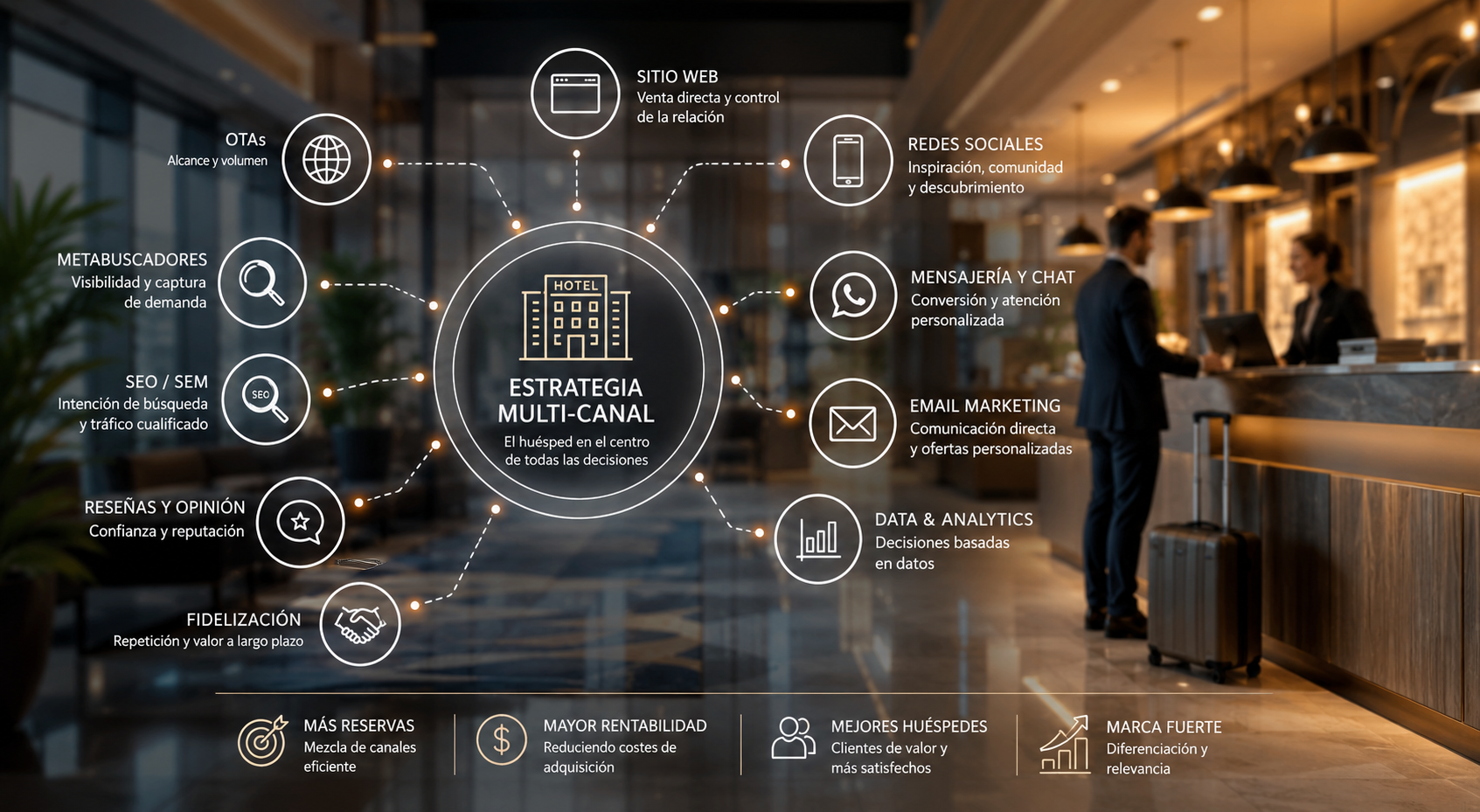
Hotel distribution has not changed as much as we think
Despite all the technological revolution, the essential principles of hotel distribution remain virtually the same:[cre_gate]
- Maximise revenue without undermining the hotel’s positioning.
- Reduce customer acquisition costs.
- Capture sufficient demand to sustain occupancy and profitability.
- Attract high-value guests, not simply volume.
- Build loyalty and future repeat business.
- Build the brand beyond price wars.
What is interesting is that today we know something many hotels were previously unwilling to accept: no single channel delivers all of those objectives at the same time.
OTAs continue to provide extraordinary global reach. Denying that would be absurd. They remain major drivers of visibility and conversion. The problem arises when a hotel stops using them strategically and becomes structurally dependent on them.
But direct bookings are not automatically profitable by definition either. Some hotels boast about direct sales while investing substantial sums in Google Hotel Ads, PPC campaigns, remarketing, CRM, metasearch, exclusive discounts, loyalty programmes and in-house marketing teams. And when you add up all the real costs, you discover that the difference compared with certain commission levels is not always as dramatic as it seemed.
That is where commercial maturity begins.
Because the real question should no longer be:
“How do I eliminate intermediaries?”
But rather:
“How do I build a profitable, sustainable distribution ecosystem that is aligned with my positioning?”
And that changes the conversation completely.
Today more than ever, hospitality needs to understand that distribution is no longer solely a commercial issue. It is also a matter of:
- brand,
- guest experience,
- product architecture,
- revenue management,
- online reputation,
- segmentation,
- algorithmic visibility,
- and perceived value.
In fact, one of the major mistakes today is continuing to believe that distribution depends exclusively on the commercial or revenue department.
No.
Distribution begins much earlier.
It begins with product quality. With the brand narrative. With visual consistency. With the real experience the guest has. With the photography. With the promise you make. With the positioning you build. With how you respond to reviews. With your website’s loading speed. With whether your proposition is genuinely relevant or simply one more among thousands of virtually identical options.
And this is where another interesting 2026 phenomenon emerges: hyper-transparency.
Guests compare absolutely everything:
- prices,
- reviews,
- location,
- breakfasts,
- cancellation policies,
- experiences,
- real photographs,
- TikTok videos,
- Reddit comments,
- Instagram,
- Google Maps,
- and even AI-generated reviews.
The purchase decision no longer takes place in a single channel. It happens in fragments across multiple digital touchpoints.
That is why believing that the strategy is simply about “having more direct bookings” is an oversimplification of a far more complex ecosystem.
The future belongs to hotels that understand distribution as a complete system
The smartest hotels I am seeing are not necessarily those investing most heavily in technology, talking most about artificial intelligence, or boasting most about direct sales.
They are the ones that understand something far more important:
each channel has a different strategic role within the hotel’s overall ecosystem.
And that requires us to move beyond emotional approaches.
For years, part of the industry fell into a kind of ideological war against intermediation. And honestly, I never found that especially smart.
A hotel should not fall in love with any channel.
Not Booking.
Not Google.
Not Instagram.
Not even its own website.
It should fall in love with only one thing:
the sustainable profitability of the business.
That means understanding:
- which channel delivers volume,
- which channel delivers profitability,
- which channel delivers repeat business,
- which channel delivers awareness,
- and which channel creates dependency.
Because not every sale is the same.

My published books
And not every guest has the same value.
One of the major conceptual advances of recent years has been moving beyond measuring only the initial acquisition cost and beginning to analyse Customer Lifetime Value in hospitality.
Some guests acquired through OTAs ultimately become extremely profitable direct guests on future stays.
And there are also “direct” guests who are extremely expensive to acquire and completely disloyal.
Oversimplification never works in hospitality.
Furthermore, the emergence of artificial intelligence and automation will profoundly transform how guests discover hotels in the years ahead. The future battle will probably not be solely about appearing on Google, but about appearing in:
- AI-generated recommendations,
- virtual assistants,
- conversational platforms,
- automated travel agents,
- and predictive recommendation engines.
That means digital reputation, brand consistency and genuine product quality will be even more important.
Because algorithms may be able to buy traffic.
But they cannot manufacture authenticity.
And here is something I keep repeating:
many hotels try to solve strategic problems with tactical tools.
They believe the problem is the channel.
When, very often, the real problem is:
- an irrelevant product,
- an undifferentiated proposition,
- a poor experience,
- a weak operational culture,
- or a completely confused positioning.
No distribution strategy can fix that.
No algorithm can fix that.
No OTA can fix that.
And no social media campaign can fix that.
Efficient distribution is always ultimately the result of something deeper: a hotel that knows who it is, what value it delivers and who it exists for.
My advice today remains very similar to what it was years ago, although it is probably more nuanced by accumulated experience.
Do not obsess over chasing every new digital trend.
Do not turn distribution into an emotional war.
Do not confuse tools with strategy.
And above all, never forget to look at distribution through the guest’s eyes.
Because in the end, guests do not think in terms of “channels”.
They simply think about booking the right hotel, at the right price, with enough confidence to feel comfortable even before they arrive.
And perhaps that is still, even today, the true essence of modern hotel distribution.
This article ends here. The archive does not.
Lead Hospitality brings together 1200 English articles published since 2018: years of experiences, decisions and lessons you can keep exploring.
What would you like to explore next?
Choose a direction and keep reading around what you want to solve, learn or challenge.