
Global Thinking Is No Longer Enough in Hotel Management



On the same morning, I have seen a family arrive at a hotel after a twelve-hour flight, a couple from a neighbouring country, an executive staying for just one night, and a group whose trip depended on flight connections, visas and schedules beyond their control. All of them had purchased a room, but none had purchased exactly the same thing. Their benchmarks for quality, their relationship with time, their tolerance for uncertainty and their way of interpreting service were different. This diversity makes international Hospitality a far more complex activity than selling accommodation to people from different countries.
The figures help us understand the scale of the phenomenon. In 2025, travel and tourism contributed approximately US$11.6 trillion to the global economy and supported 366 million jobs. Around 3.08 billion overnight stays were recorded in the European Union, with an almost even split between domestic and international demand. Growth was driven especially by foreign visitors. Behind these numbers lies an obvious opportunity, but also a warning: the more international demand becomes, the greater the hotel’s exposure to changes taking place far beyond its building.
A change in air connectivity can alter the booking calendar. Currency depreciation can turn an affordable destination into an unaffordable one for a source market. A regional conflict can affect travellers who are not even from the area but use its airports for connections. Regulation, a perception of insecurity or a change in border requirements can transform purchasing behaviour within weeks. Hotel strategic planning can no longer be built solely around occupancy history and a relatively stable demand forecast.
I have also learned that importing international solutions without translating them into the local context usually produces disappointing results. What works in a European capital may fail at an island resort; what improves conversion in North America may create distrust in an Asian market; and a service standard admired in one culture may be perceived as distant, intrusive or overly informal in another. Good international practice is not about copying models, but about understanding which principle makes them work and adapting it without losing consistency.
That is why, when I think about topics of interest to international hoteliers, I try not to produce yet another list of trends destined to age before the annual budget does. I am more interested in identifying the tensions that change real decisions. They are tensions between growth and fragility, standardisation and context, revenue and contribution, talent mobility and belonging, visibility and commercial control. Reading them correctly makes it possible to turn global uncertainty into a concrete agenda for hotel management.
The new international agenda consists of tensions, not trends
Global tourism continues to grow, but that growth is not distributed evenly. Some regions are advancing rapidly, others are losing share, and certain destinations are receiving more visitors while seeing their average length of stay or real spend decline. Even within the same country, overcrowded cities, emerging areas and assets that remain dependent on two or three source markets can coexist. Celebrating global growth without analysing the hotel’s specific position is like being pleased that it has rained heavily without checking whether the water has fallen into our reservoir.
The first discipline of international hotel strategy is to separate industry noise from the property’s specific exposure. In my view, six tensions deserve to recur in conversations between ownership, operations, Sales, Marketing and Revenue.

- Demand growth versus the fragility of flows. A market can grow and still remain vulnerable. It is worth analysing how many air routes it depends on, what proportion arrives through connections, which operators concentrate capacity and how much time elapses between booking and arrival. Two markets capable of generating the same annual revenue may present completely different risks. When one has multiple access points and the other depends on a seasonal route, the production figure conceals a considerable strategic difference.
- Global profile versus local legitimacy. Travellers seek recognisable destinations, but they are increasingly able to tell when a hotel could be located anywhere in the world. Local identity is not built by placing three regional products on the breakfast buffet or decorating a wall with old photographs. It emerges in purchasing decisions, in the relationship with the community, in the culinary offer, in the team’s recommendations and in the way the destination is explained. The contradiction arises when we try to be internationally understandable and end up being locally irrelevant.
- Service standardisation versus cultural interpretation. Standards protect consistency, but they do not eliminate cultural differences. Physical distance, eye contact, informal conversation, anticipation and speed do not mean the same thing to everyone. I have seen teams apply a procedure correctly and receive a negative response because the standard described the action but did not consider how it would be interpreted. A strong guest experience in international hotels requires a stable core of service and protected room for adaptation.
- Market revenue versus its real contribution. A nationality or source region may generate a high average rate while also carrying high costs of acquisition, cancellation, service, culinary adaptation, intermediation or service recovery. Hotel revenue management should evaluate each market beyond ADR. The analysis needs to incorporate length of stay, channel, booking window, cancellation behaviour, ancillary spend, cost to serve, seasonality and likelihood of repeat business. The most expensive room in the report does not always deliver the most attractive margin.
- Talent mobility versus operational belonging. International Hospitality depends on diverse teams and professionals building their careers away from their place of origin. This diversity broadens language capabilities, cultural sensitivity and relationship-building capacity, although it also raises challenges around integration, housing, training, skills recognition and continuity. Hiring internationally without creating belonging may cover shifts and increase turnover. The aim should not be limited to bringing people in, but to ensuring they understand the hotel’s judgement and can confidently contribute their own.
- Global visibility versus commercial sovereignty. Being available in more markets is valuable, but every intermediary introduces conditions, costs and a different relationship with the guest. A hotel can expand its reach while losing data, communication capacity and control over its commercial promise. This does not make intermediaries the enemy. It requires us to measure them better and remember that loyalty can be built regardless of the originating channel if the stay makes it possible to establish a legitimate and useful relationship.
These tensions are interconnected. A hotel marketing campaign can open up a new market, but that success changes languages, consumption times, payment methods, requested room types and the pre-arrival service workload. Revenue can capture demand and raise prices, although increased expectations will require a review of operational capacity. Human Resources can bring in international profiles, but diversity only becomes an advantage when there is a shared professional language.
One of the most uncomfortable lessons experience has taught me is that internationalisation can increase revenue before the hotel is ready to serve it. Commercial growth tends to appear in reports several weeks before its consequences reach Front Office, Housekeeping or Food and Beverage. When they finally appear, they take the form of repeated enquiries, unforeseen requests, concentrated queues, communication difficulties or expectations that no one has translated into operations.
That is why it is useful to introduce a measure I call Market-Adjusted Exposure. It is not intended to create false mathematical precision, but rather to force us to look at what business volume usually conceals. For each relevant market, I assess four dimensions on a scale of one to five: revenue weight, volatility, difficulty of replacement and operational complexity. Multiplying the four values generates a simple signal. A market with high production, high volatility, few alternatives and extensive operational needs deserves more attention than another of similar size that is easily replaced.
This perspective changes the conversation. We no longer ask only how much Germany, the United States, France, China, Brazil or any other significant origin produces. We ask what would happen if its demand fell by 20%, how long it would take us to replace it, which inventory would remain unsold, what ancillary spend we would lose and which costs we could adjust without harming other guests. That is the difference between observing a market and understanding our dependence on it.
Cultural interpretation also needs operational data. I would monitor pre-arrival enquiries, confirmation requests, underused services, explanations guests request repeatedly, score differences by origin and incidents related to expectations. Not every complaint represents the same signal, and we should avoid allowing an isolated opinion to govern strategy. In this respect, it is useful to distinguish between learning and reacting, because not every complaint should change the hotel.
Pricing adds another layer of complexity. International travellers compare currencies, taxes, policies, exchange rates, packages, benefits and channels that may display different amounts. Explaining this variation clearly is part of service and trust. The apparent simplicity of comparing rates conceals a commercial architecture worth reviewing, especially because the same room can appear at different prices for reasons the guest does not always know.
In international markets, a poorly explained difference is easily interpreted as arbitrariness. If a condition varies by country, channel or payment method, the hotel should be able to justify it clearly. Transparency does not require publishing our profit and loss account, but it does require preventing the guest from discovering too late a restriction, an unfavourable currency conversion or a charge that would have influenced their decision.
Turning an international perspective into hotel decisions
Following Hospitality trends has little value if it does not change a decision. I have taken part in meetings where people spoke enthusiastically about emerging markets, new behaviours and major opportunities, while the hotel continued using the same policies, the same schedules and the same segmentation. International information had reached the presentation, but had not yet entered the operation.
To avoid this, I work with an international translation agenda. Its purpose is to turn an external signal into commercial, operational and financial implications. Whenever a relevant change appears, I try to answer five questions: what has changed, which market does it affect, which behaviour could it alter, which departments will feel the impact and what decision should we prepare before we see its consequences.
A fall in the exchange rate, for example, may reduce a guest’s purchasing power without eliminating their intention to travel. The response does not necessarily have to be lower rates. It may be smarter to review minimum length of stay, design an offer with greater spending certainty, provide included value or protect certain services. Hotel marketing interprets the change; Revenue models scenarios; operations confirms what can be delivered; and Finance validates the contribution. The response no longer belongs to an isolated department.
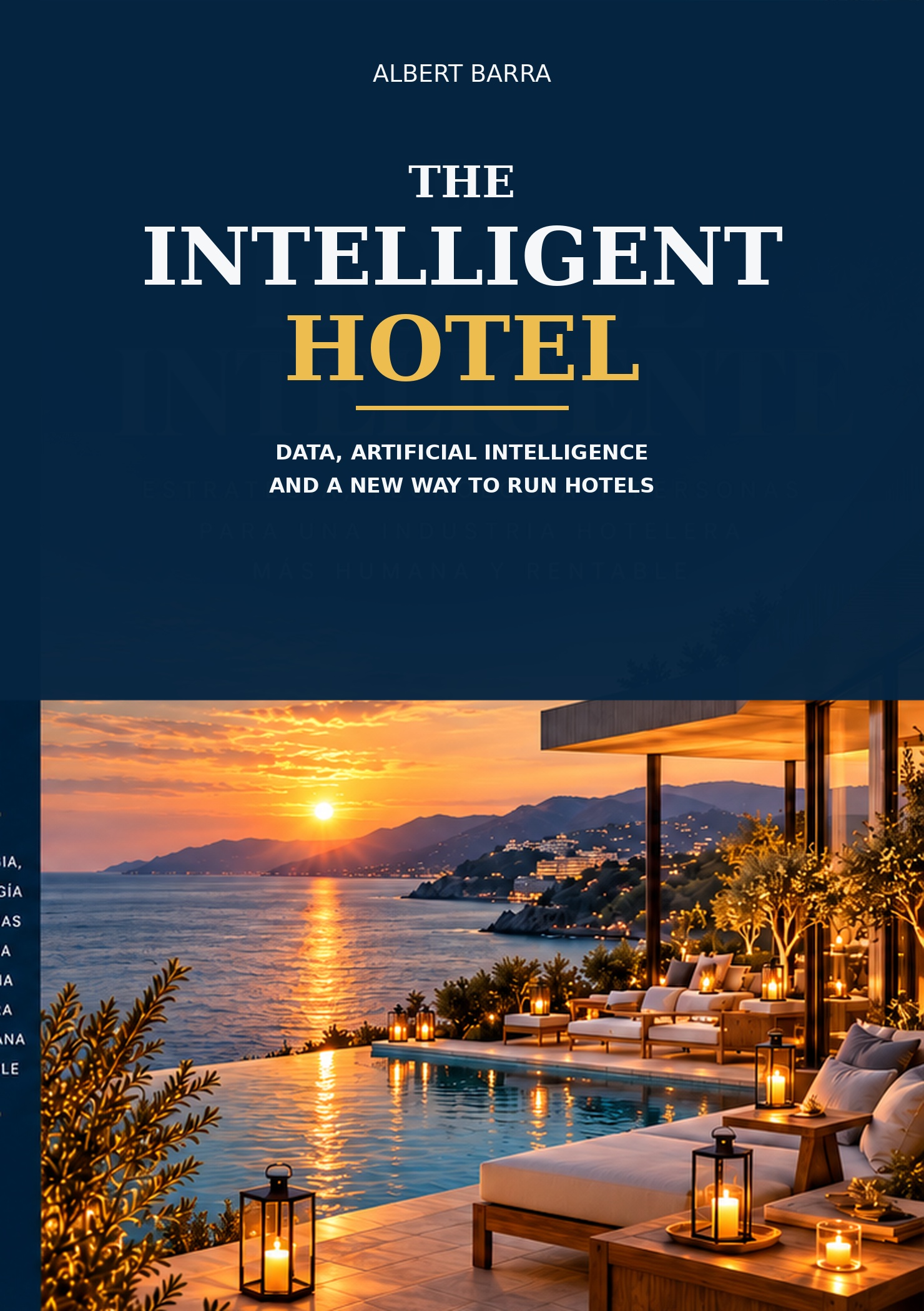
The Intelligent Hotel
Data, Artificial Intelligence and a New Way to Run Hotels
Go deeper into how AI, data and automation are transforming hotel management, commercial performance and the guest journey.
I recommend structuring this agenda around six practical actions:
- Build an economic map of markets. Identify the eight or ten origins that contribute most to performance, and distinguish between country of residence, nationality, channel and travel purpose. Mixing these variables leads to weak conclusions. Two guests from the same country may behave in opposite ways if one travels for business and the other with family, or if one books direct and the other arrives as part of a package.
- Create an operating profile for each relevant market. The profile should cover booking window, average length of stay, cancellation, preferred room types, concentration of arrivals, languages, payment methods, ancillary spend, common enquiries and recurring friction points. Its purpose is not to manufacture cultural stereotypes, but to recognise verifiable patterns that help with planning. As soon as an observation becomes prejudice, it ceases to be business intelligence.
- Define scenarios with action thresholds. It is not enough to imagine that a market may decline or grow. It is advisable to establish what change would trigger a decision. If bookings decline by 10%, perhaps we simply monitor. If they fall by 20% for several weeks, we review investment, inventory and alternative segments. If connectivity loses a critical route, we activate another scenario. An agreed threshold prevents improvisation under pressure.
- Audit the international promise. Review the website, booking engines, room descriptions, policies, pre-arrival emails and translations. A linguistically correct phrase can be commercially ambiguous. Check whether beds, taxes, deposits, schedules, food, accessibility, transport and cancellation terms are understood in the same way in other markets. Translating words is relatively easy; translating expectations requires considerably more skill.
- Connect guest data to the stay. The hotel should use information on origin, language, purpose and preferences to coordinate useful decisions, not to accumulate decorative profiles. A CRM capable of coordinating hospitality enables context to reach those who need to prepare, serve or resolve, reducing repetition and failures between departments.
- Review metrics with counterweights. Market growth should not be measured solely by room nights or revenue. Add net contribution, acquisition cost, cancellation, spend, repeat business, incidents and operational pressure. A single metric can drive a hotel to capture volume that erodes margin or the guest experience. We already know that KPIs can also create counterproductive behaviours when we reward one part of the outcome and ignore its cross-effects.
Here, leadership in the hotel sector takes on an essential role. Someone must maintain a cross-functional perspective when each department interprets the market through its own priorities. Sales sees volume, Revenue sees pricing power, Marketing sees reach, Operations sees complexity and Finance sees margin. All these perspectives are necessary, but none is sufficient on its own. The responsibility is to turn them into a shared criterion and decide which business the hotel can absorb without undermining its proposition.
It is also advisable to establish a monthly international exposure meeting, distinct from the usual Revenue meeting. It should not become another slide-deck ritual. Its agenda can be limited to five matters: markets that are growing or declining, changes in connectivity and context, variations in contribution, operational friction by origin and pending decisions. If the meeting ends without owners, dates or thresholds, we have held an interesting conversation, not a planning session.
A useful tool is the balance between adaptation and consistency. For each market, we must decide which elements of service are non-negotiable, which can be adapted and which require different products. Safety, respect, cleanliness and transparency should not vary. Schedules, communication, certain food items, payment methods or the configuration of a stay may allow adjustments. Other needs may not be resolved through an exception and may require a specific proposition.
This criterion protects the team. Unlimited personalisation turns every arrival into a negotiation and makes the experience dependent on whoever is working. A clear perimeter, by contrast, allows adaptation with autonomy. The aim is not for staff to memorise the customs of twenty nationalities, but to learn how to ask, observe and confirm without making guests uncomfortable. Professional curiosity is usually safer than any manual of supposed national characteristics.
The diversity of the team can bring extraordinary knowledge to this conversation, provided that we do not use people as permanent cultural translators for their country of origin. An employee does not represent millions of compatriots. They can, however, offer perspectives, identify interpretations and enrich decisions. Listening to that experience respectfully improves strategy and strengthens belonging, whereas turning it into an additional obligation produces exactly the opposite effect.
To put all this into action, I would devote the first thirty days to cleaning up market information and calculating its approximate contribution. Over the following thirty days, I would review the four most relevant exposures with Sales, Revenue, Operations and Finance. During the final month, I would define thresholds, owners and two controlled experiments. One could focus on pre-arrival communication and the other on a product adaptation. Ninety days will not completely transform an international strategy, but they make it possible to stop discussing it in abstract terms.
International hotel profitability is protected by accepting that volume does not always equal strength. A large market can create dependency; a small one can improve seasonality; another can spend heavily while putting pressure on services; and an apparently modest market can contribute direct bookings, long stays and high repeat business. The important question is not which nationality pays more, but which combination of demand strengthens the entire business.
I would start next Monday by selecting the hotel’s three main markets and one emerging market. For each, I would note production, estimated contribution, connectivity, volatility, replacement cost and three operational implications. I would then ask Reservations, Front Office, Housekeeping and Food and Beverage what they are observing. It is quite likely that the commercial report and the operational narrative are describing different parts of the same story.
Thinking internationally requires breadth, but operating internationally requires precision. The best strategy will not be the one that accumulates the most trends, but the one that knows how to distinguish which ones truly change guest behaviour, team capacity and the hotel’s economics. Maintaining that discipline, reviewing our assumptions and learning from each market will allow us to grow without turning global complexity into internal disorder.
Hospitality has always been about welcoming people who arrive from elsewhere. What is new is the speed at which those places, their economies, their connections and their expectations change. My advice is to maintain a firm core of hospitality and, around it, develop an organisation capable of interpreting differences with humility. A truly international hotel is not one that displays the most flags in its lobby, but one that enables very different people to understand its promise, trust it and want to return.
This article ends here. The archive does not.
Lead Hospitality brings together 1200 English articles published since 2018: years of experiences, decisions and lessons you can keep exploring.
What would you like to explore next?
Choose a direction and keep reading around what you want to solve, learn or challenge.