
The Real Risk Isn’t AI—It’s Mediocrity: The Augmented Hospitality Professional

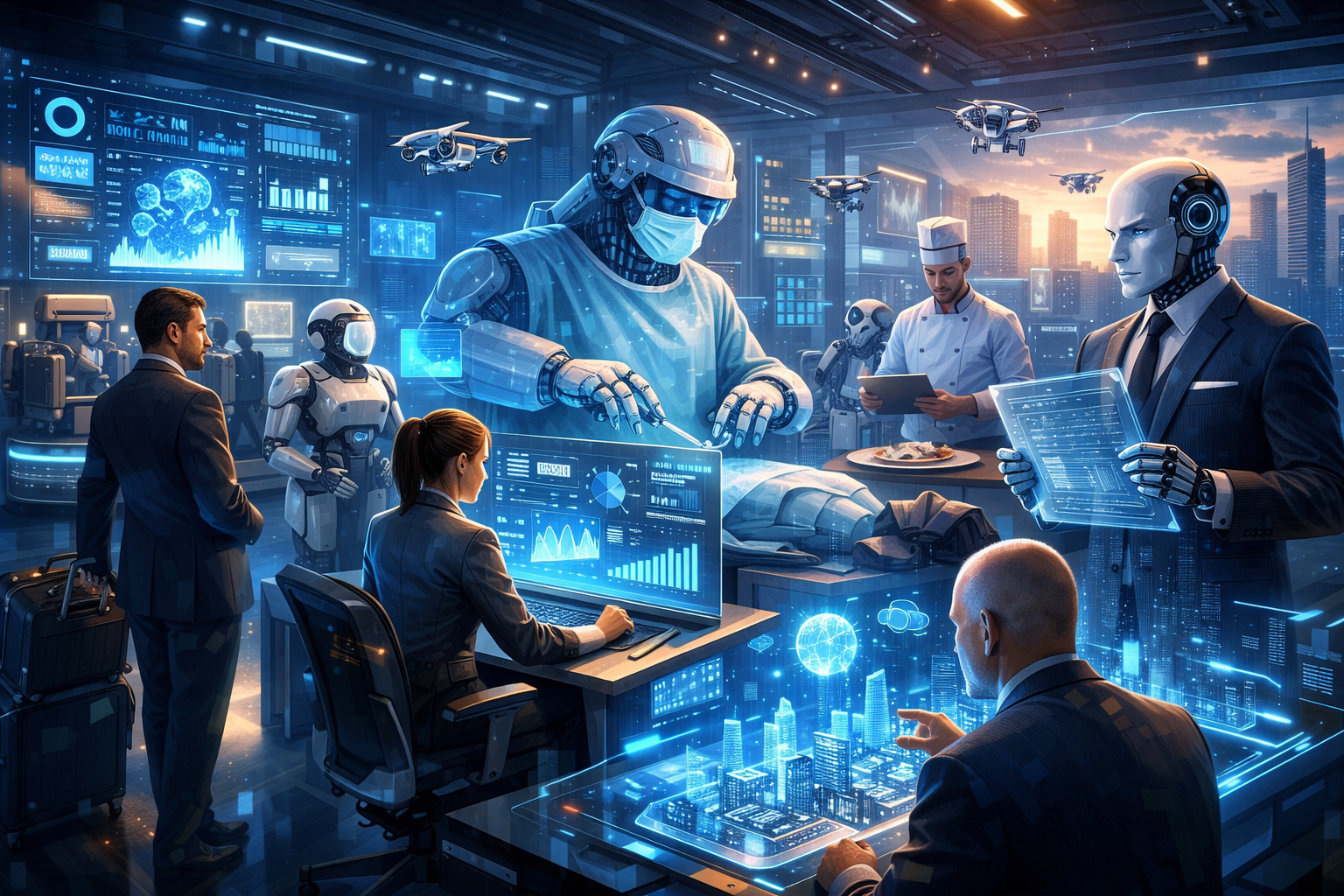

A chart is circulating that should make any professional who earns a living through their judgement uncomfortable. It is titled “Timeline to Technical Capability” and assigns—not-so-distant—dates to AI’s technical ability to replace entire professions.
Software developers in 2028. Drivers in 2029. Teachers in 2029. Doctors in 2030. Lawyers in 2031. Surgeons in 2032.
The most unsettling part is not the dates. It is the fine print: “Real-world adoption may be delayed by regulatory and cultural frictions”. That phrase is what reassures us… and what deceives us.
Because the real message is not about when technology can do it. It is about what happens when some professionals use it to multiply their productivity by 10, 50 or 100, while others continue working exactly as they did five years ago.
In hospitality, many believe this is a distant debate. “We are a people business,” we say. And that is true. But we are also a business of judgement, analysis, experience design, pricing, leadership and decision-making. And that is where stratification begins.
The question is no longer whether AI will replace your role.
The question is whether you will become an augmented professional or the average professional who is no longer needed.
Professional Stratification: The Market Does Not Eliminate Jobs, It Eliminates Mediocrity
There is a pattern repeated across every industry: when a technology radically increases productivity, the market does not need more people doing the same thing. It needs fewer people doing more.
This is already happening in hospitality, even if we are not calling it that.
Let us look at how this translates in our industry.
1. The Revenue Manager
The traditional revenue manager adjusts prices by looking at daily pick-up.
The augmented revenue manager integrates predictive analytics, scenario simulations and demand elasticity.
The average revenue manager competes on ADR.
The augmented revenue manager designs profitability architectures.
The difference is not the tool. It is the judgement used to apply it.
2. The Hotel General Manager
The average general manager runs the operation.
The augmented general manager designs the asset’s economic model.
The former controls.
The latter anticipates.
In an environment where tools can automate reporting, forecasting, segmentation and analysis, what remains is strategic judgement.
And that judgement is scarce.
3. The Sales Professional
The traditional sales professional sells rooms.
The augmented sales professional understands data, positioning and profitability by segment.
The former negotiates rates.
The latter negotiates margin.
Technology does not eliminate the role. It eliminates superficiality.
4. The Chef
Many say manual trades are safe. The technical gesture may indeed be difficult to replace. But the market stratifies there too.
The chef who executes recipes.
The chef who designs a concept, experience and culinary narrative.
One competes on cost. The other competes on identity.
An Applicable Framework: The 10X Hospitality Professional Model
If you genuinely want to know which side you will be on, you need a clear framework.
I propose the 10X Model for Hospitality Professionals. It is not theoretical. It is practical.
Pillar 1. Command of the Economic Model
Questions you should be able to answer without hesitation:
Which segments genuinely generate margin?
Which pricing decisions affect profit, rather than ADR alone?
Which fixed costs constrain you strategically?
An augmented professional commands the P&L with strategic judgement, not merely technical knowledge.
Pillar 2. Integration Capability
Knowing your own area is not enough.
Do you understand how marketing affects operations?
How does the employee experience affect profitability?
How does positioning influence price elasticity?
The average professional is vertical.
The augmented professional is cross-functional.
Pillar 3. Judgement Under Uncertainty
AI can offer scenarios.
It cannot assume the risk for you.
In hospitality, we make decisions with imperfect information:
Openings.
Repositionings.
CAPEX investments.
Changes to the operating model.
The real value lies in the ability to decide when the data is inconclusive.
My published books
Pillar 4. Designing Competitive Advantage
This is where most fail.
Many hotels still compete on:
Location.
Price.
A recent refurbishment.
That is not competitive advantage. It is circumstance.
The augmented professional designs:
Strategic barriers.
Distinctive brand territory.
Non-replicable experiences.
A differentiating internal culture.
And no algorithm can automate that.
The Great Trap: Confusing Security with Relevance
Another viral list features “20 jobs AI cannot replace”: plumbers, nurses, chefs, mechanics.
It creates a false sense of security.
The plumber who merely follows instructions will compete with AI-assisted apprentices who diagnose problems faster.
The average doctor will compete with systems that detect invisible patterns.
The average executive will compete with leaner structures that operate with fewer middle-management layers.
The market does not eliminate the profession.
It eliminates the average version of that profession.
Practical Application for Hotel Leaders
If you are reading this as an owner or general manager, you need to act now.
Here is an uncomfortable but necessary checklist:
Audit your structure: how many roles genuinely contribute strategic judgement?
Redefine roles: fewer administrative tasks, more analysis and decision-making.
Develop judgement, not just tool proficiency.
Eliminate useless reporting that nobody turns into decisions.
Reward the ability to improve the economic model, not merely operational execution.
And something even more difficult:
Honestly assess whether you are an augmented professional or simply a competent manager.
Because competent competence will be the first to be left behind when the market can do more with less.
Hospitality in the Next Decade: What Will Really Change
It will not be the disappearance of hotels.
It will be the disappearance of mediocre hotels.
It will not be the replacement of the general manager.
It will be the replacement of the general manager who brings no distinctive judgement.
It will not be the elimination of the revenue manager.
It will be the concentration of talent in fewer people with greater impact.
Hospitality will remain human.
But it will be augmented human.
And that is where the opportunity lies.
If you choose to learn, integrate technology with strategic intelligence and elevate your decision-making capacity, your value will multiply.
If you choose to continue operating as you always have, the market will decide for you.
You do not need to compete against artificial intelligence.
You need to stop competing as if it did not exist.
This article ends here. The archive does not.
Lead Hospitality brings together 1200 English articles published since 2018: years of experiences, decisions and lessons you can keep exploring.
What would you like to explore next?
Choose a direction and keep reading around what you want to solve, learn or challenge.