
Hospitality Does Not Need Its Aura Read

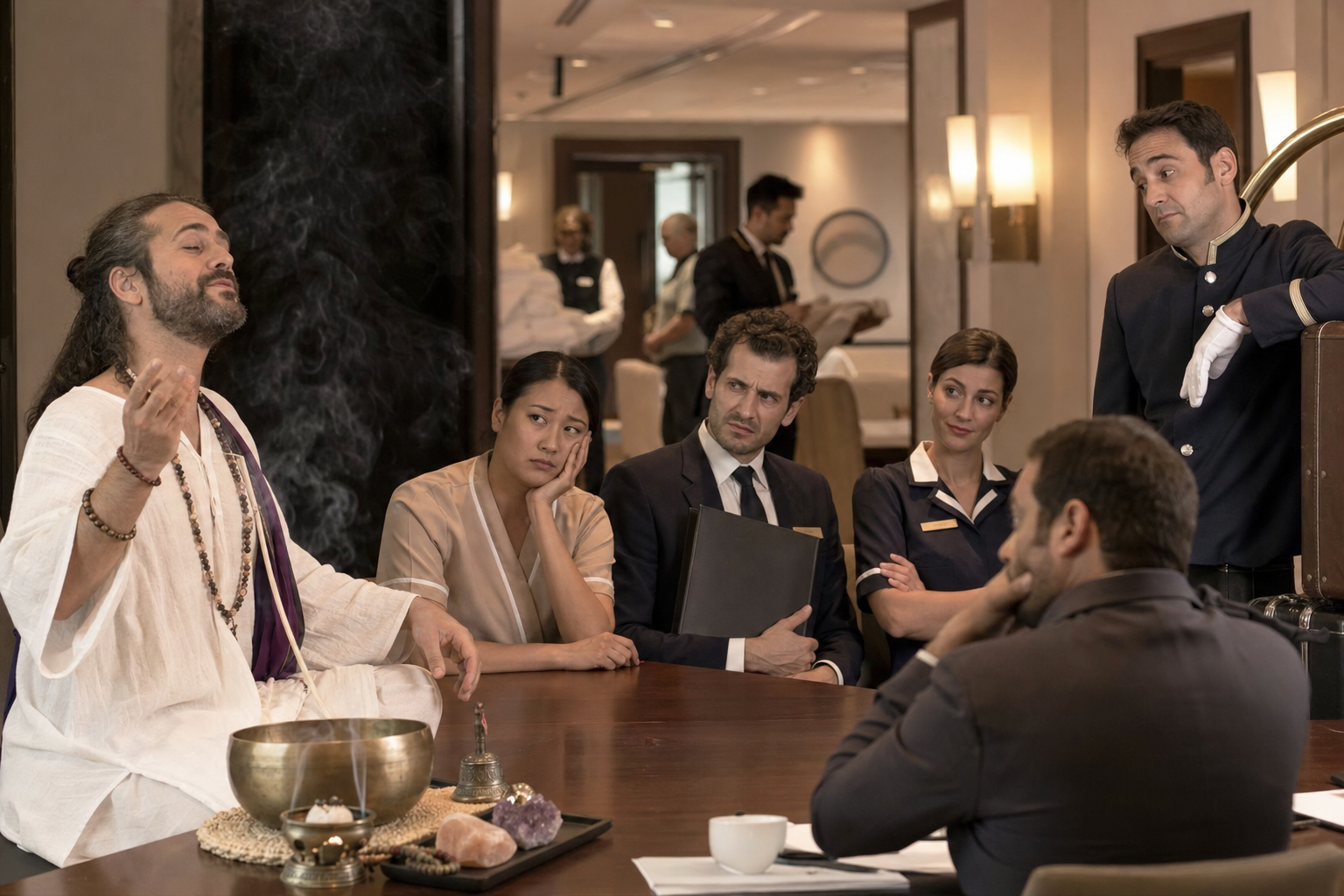

Some time ago, I attended a session organised to help a hotel team going through a difficult period. There was fatigue, unfilled vacancies, demanding commercial targets, conflict between departments and an operation that had been absorbing more pressure than was reasonable for months. I expected a serious conversation about priorities, resources, coordination and leadership. Instead, the guest speaker asked us to close our eyes, breathe deeply and visualise the hotel’s energy as a sphere of light. I must admit that, for a few seconds, I considered the possibility that this sphere, as well as being luminous, might help release the outstanding rooms.
The scene would have been merely quaint if it had been presented as an optional pause to reduce tension. The problem emerged later, when rather specific operational issues began to be interpreted as emotional blockages. Staff shortages became inner scarcity, disagreements between departments were attributed to incompatible energies, and exhaustion came to be described as resistance to change. No one asked about shifts, workloads, duplicated processes or contradictory decisions. Apparently, the rota was not poorly designed; the team simply had not yet found its frequency.
I am not writing this to ridicule spirituality, meditation, personal reflection or practices that help some people live and work with greater balance. I have met sensible professionals who use mindfulness, coaching or personal development tools with respect, preparation and positive results. The boundary that concerns me appears when this language becomes a source of unearned professional authority, is used to explain every problem, and allows someone with only a fleeting connection to hotels to dispense lessons on leadership, service, culture or operational excellence.
These characters do not arrive alone. Hotels also open the door to them because, in times of uncertainty, they offer something tempting: a simple, emotionally appealing explanation that is almost always free of conflict. It is more comfortable to talk about shared purpose than to review an incorrectly sized structure. It is less uncomfortable to look for limiting beliefs than to admit to a poor appointment. It is cheaper to organise a talk on abundance than to correct salaries, tools, shifts or supervisory styles. The charlatan brings the incense, but we had often already prepared the altar.
My intention is to examine a specific variant of the hotel industry peddler of empty promises, distinct from the generic consultant or the corridor expert. I am referring to the Hospitality spiritual guru who turns legitimate emotions into merchandise, mistakes depth for solemn vocabulary, and talks about transforming hotels without having had to endure many of their contradictions. The useful question for you is not whether you believe in certain personal practices. It is to learn how to distinguish between an intervention that strengthens the team’s judgement and one that seeks to replace it.
Spiritualising problems is also a form of avoidance
Hospitality is particularly vulnerable to this kind of discourse. Our work combines emotions, human relationships, expectations, economic pressure and a promise of hospitality that goes far beyond producing a product. We use words such as vocation, purpose, empathy, care, belonging and service. They are necessary words, but they also provide fertile ground for anyone who knows how to wrap vagueness in a soft voice and a linen shirt.
The false guru understands something important: many hotel problems have an emotional dimension. An angry guest affects the professional serving them. Poor management erodes trust. Unpredictable shifts disrupt personal lives. Pressure to deliver results can generate fear, rivalry and burnout. All of that is true. The trap lies in taking that emotional dimension and presenting it as the complete cause of the problem, removing organisation, resources, incentives and accountability from the analysis.

Stop managing isolated systems. Start managing the whole hotel.
HotelGEX connects guests, operations, Revenue, F&B, Groups & Events and Management into one intelligent hotel context — so every decision starts with a clearer picture.
Thus, an exhausted person ceases to be someone who has spent too many days covering absences and becomes someone who does not know how to manage their energy. A department receiving impossible commercial promises no longer suffers from a coordination failure and instead displays resistance. A manager asking for clear objectives is accused of needing too much control. Someone who disagrees with the facilitator may not be making a valid argument; they simply have not yet opened themselves to the process.
This shift is dangerous because it turns organisational failures into personal shortcomings. The hotel stops asking what it should change in its management and begins to suggest that the employee needs to transform themselves. Responsibility moves from those who design the work to those who have to endure it. Everything is wrapped in kind rhetoric, but beneath that kindness there may be a sophisticated form of blame.
I have seen sessions in which employees were invited to share fears, intimate experiences and personal conflicts in front of colleagues with whom they would have to continue working the following day. The facilitator created emotionally intense moments that were interpreted as profound progress. Yet no one had explained how that information would be protected, what clinical training the person leading the exercise had, or what would happen if someone left more vulnerable than they had arrived. A silent room and two people crying make for a compelling photograph, but they do not in themselves constitute an improvement in culture.
It is worth remembering that a hotel is not a therapeutic community. It can and should care for its people, foster healthy relationships, prevent psychosocial risks and provide professional support where appropriate. It must also respect the boundaries of privacy. An employment contract does not include an obligation to reveal personal wounds in order to demonstrate commitment to the company. Trust is not built by forcing confessions, and authenticity should not become another performance indicator.
The spiritual charlatan tends to use a recognisable combination of tactics. None of them individually proves a lack of competence, but several together should trigger considerable caution:
-
Vague hotel background. They claim to have worked with the industry, supported brands or transformed teams, but it is difficult to establish what responsibilities they held, how long they were exposed to operations and what concrete results they produced. Giving a talk in a hotel is not the same as working in Hospitality, just as sleeping on an aeroplane does not make anyone a pilot.
-
Language immune to verification. They speak of raising vibrations, unlocking abundance, activating consciousness or aligning the essence of service without defining observable behaviours. If results improve, the intervention worked. If they do not, the team was not ready. It is a business model admirably protected from any possibility of being wrong.
-
Disproportionate promises of transformation. One session, retreat or conference is meant to change culture, improve leadership, restore motivation and elevate the guest experience in hotels. Those of us who have spent time in this profession know that changing a routine between two shifts can take weeks. Instant transformation usually lasts until the next group arrives early.
-
Elegant contempt for complexity. When someone raises budgetary, legal or operational constraints, they are presented as excuses born of fear. This manoeuvre allows the discourse to retain its purity because any contact with reality is interpreted as negativity. The problem is not that the idea is impractical; the problem is you, still thinking from a place of scarcity.
-
Authority based on emotional intensity. The quality of the intervention is measured by applause, tears, hugs or enthusiastic posts, rather than sustained change. An emotional experience can open a valuable conversation, but it can also be mere spectacle. In Hospitality, we should be wary of any initiative whose main indicator of success is the number of people photographed hugging at the end.
-
Claiming credit and externalising failure. If the hotel improves, the methodology was transformative. If the conflict continues, the organisation lacked sufficient courage to complete the journey. The facilitator is never exposed to the consequences of their recommendations and, curiously, the solution usually consists of hiring another phase of the programme.
-
Turning disagreement into a diagnosis. Anyone who questions a claim is rigid, blocked or afraid of losing power. In this way, criticism ceases to be information and becomes a pathology. This tactic is particularly harmful in hierarchical cultures because it discredits anyone raising a legitimate objection and rewards emotional compliance.
A lack of hotel experience does not automatically invalidate someone. Some of the best ideas I have adopted came from professionals in other industries, academic disciplines and creative fields. An external perspective can identify habits that we no longer see. I have also met veterans with decades of hotel experience behind them who repeated exhausted formulas and confused longevity with wisdom. Experience does not confer infallibility, but inexperience requires humility.
What makes me uncomfortable is the imbalance between exposure and authority. Someone with very limited operational experience can ask excellent questions, contribute a tool or facilitate a conversation. What they can scarcely do rigorously is present a total explanation of hotel culture, judge the attitude of professionals subjected to pressures they do not understand, and prescribe changes without assuming their consequences.
Some knowledge is acquired through study, and other knowledge only emerges when a reasonable decision collides with the reality of the working day. It is easy to talk about mindfulness without a queue at Reception, a technical alarm and several rooms still to be released. It is simple to recommend making every interaction memorable when job design requires attending to three demands simultaneously. Operations do not hold every truth, but they introduce an essential quality: consequence.
Anyone who has had to correct their own decision in front of a team develops a different relationship with certainty. They know that a recommendation can increase another department’s workload, that a commercial promise can become an incident, and that a motivational exercise can leave middle management handling impossible expectations. That experience does not always produce better answers, but it usually produces more responsible questions.
We must also recognise why these discourses find an audience. Many professionals are tired of cold presentations, metrics without context and managers who speak only about productivity. When someone appears mentioning emotions, humanity and purpose, the contrast is seductive. The false guru’s success often points to a genuine absence: the hotel was not offering serious spaces to discuss the human dimension.
That is why the response is not to mock every reflective practice or replace spiritual excess with operational cynicism. A hotel managed exclusively through metrics can also dehumanise its teams. The challenge is to integrate care and high standards, listening and accountability, purpose and profit and loss. Professional maturity begins when we are able to hold these tensions without taking refuge in a single explanation.
Professional authority must pass a landing test
After several experiences of this kind, I began using a simple question before hiring an external intervention or adopting a new internal discourse: where does this land on Monday morning? I am not interested only in whether the proposal inspires, moves people or sounds good. I want to know which decision it changes, which behaviour it seeks to develop, which obstacle it recognises and who will be accountable if it does not work.
I have called this filter the Hotel Landing Test. It is not intended to determine which personal philosophy each person should follow. Its purpose is to protect the team and the business from recommendations that acquire authority without demonstrating usefulness, limits or accountability. It can be applied to a conference, leadership programme, consultancy, corporate retreat or any intervention promising to transform hotel culture.
-
Sufficient proximity to the problem. I ask that those intervening observe the real work, listen to different levels of the organisation and understand the basic constraints. An opinion about Reception that never goes near Reception is intellectual decoration. Immersion does not require months, but it does require direct contact with the hotel’s people, rhythms, exceptions and dependencies.
-
Definition of the expected behaviour. Words such as purpose, consciousness, trust and empowerment must be translated into actions. What will a manager do differently? What conversation will they need to have? What decision will the team be able to make without asking permission? What practice will we stop tolerating? If no one can describe the change without returning to abstract vocabulary, there is not yet an operational proposal.
-
Recognition of organisational causes. A serious intervention distinguishes between what needs to be developed in people and what must be corrected in the structure. It will not ask for resilience to endure poor planning indefinitely. Nor will it recommend a positive attitude as a substitute for tools, training, breaks, clear priorities or sufficient resources.
Lead Hospitality LibrarySee the booksBooks to run a hotel with judgement
Written from the general manager’s chair: technology, guest experience, leadership and management.
 Directing HotelsWhat Nobody Tells You Before You Sit in the General Manager’s Chair
 The Intelligent HotelData, Artificial Intelligence and a New Way to Run Hotels
 The Guest JourneyDesigning Customer Experience Across the Entire Hotel Journey
 Leadership and High-Performance Team ManagementPeople, Experiences and Results in Today\\\'s HospitalityDigital edition · Personal licence · Free or discounted for subscribersSee all books →
-
A real possibility of being wrong. I ask what evidence would lead the facilitator to revise their diagnosis. If no answer can refute it, we are dealing with a closed belief, not a professional method. Humility is demonstrated by defining limits, acknowledging uncertainty and explaining in which situations a tool should not be used.
-
Protection of privacy. Any exercise exploring emotions or personal experiences must establish voluntary participation, confidentiality, clear boundaries and avenues of support. No one should feel obliged to disclose sensitive information in front of colleagues or superiors. The hotel is purchasing a professional intervention, not a temporary licence to invade its employees’ inner lives.
-
Accountability for subsequent effects. I am interested in knowing who will support managers when the session ends, how expectations will be managed and what will happen to the commitments made. A talk can open issues that subsequently require follow-up. Leaving after the final photograph and allowing the team to clear up the emotional debris is a rather peculiar version of hospitality.
-
Evaluation beyond immediate satisfaction. Final applause tells us about the experience in the moment, but it does not demonstrate transfer. It is worth reviewing later whether conversations, coordination, confidence in disagreeing, the quality of decisions or the ability to resolve conflicts have changed. Measurement should be proportionate, but there should always be some observable signal.
-
Economic and operational coherence. Even an initiative focused on wellbeing consumes budget, time and attention. We must compare it with other alternatives and ask which priority problem we are choosing not to solve. The purpose may be lofty, but the invoice still reaches Finance with its chakras perfectly aligned.
This test also requires us to review our own motivations. Sometimes we hire a guru because we hope they will tell the team what we have not managed to explain ourselves. On other occasions, we seek someone to legitimise a decision already made or to boost morale without changing the conditions that undermine it. We use the facilitator as a messenger, entertainer or source of external absolution. Then we are surprised when the intervention produces superficial enthusiasm and little change.
A responsible hotel training policy should begin with a utility contract. Before approving an activity, the hotel should define the problem it wishes to address, the population affected, the behaviours it expects to improve and the internal decisions it is willing to review. If the organisation is not going to change anything, it is unethical to ask the team to transform itself in order to adapt better to what is harming it.
It is also worth examining credentials without becoming fascinated by titles. I do not look only for certificates, followers or enthusiastic testimonials. I ask what work that person has carried out, which part they executed directly, what they learned from their failures and what they can demonstrate without violating client confidentiality. A professional answer includes nuance. Grandiosity, by contrast, tends to produce accounts in which every hotel was lost before the consultant arrived and reached enlightenment shortly after paying the invoice.
When someone has barely worked in hotels, I expect them to acknowledge it naturally. That transparency does not necessarily diminish their value. They may contribute expertise in organisational psychology, communication, strategy, education, occupational health or facilitation. The honest approach is to define their field, collaborate with hotel professionals and avoid turning a specific competence into a licence to comment on the whole management of hotels.
Interdisciplinary collaboration works best when each party retains respect for the other’s experience. The external specialist brings frameworks, questions and methods. The hotel team brings context, consequences and operational memory. Neither should use their knowledge to silence the other. Innovation emerges from that productive friction, not from submission to a charismatic figure.
Hotel leaders must also protect middle managers. An inspirational intervention often makes promises about autonomy, communication or wellbeing that later collide with procedures, budgets and decision rights that no one has changed. The manager is left trapped between the message from the stage and the rules of the operation. If the hotel announces empowerment in the morning and requires authorisation for every exception in the afternoon, the problem is not energetic. It is organisational and quite visible.
With teams, I recommend practising a form of respectful scepticism. Listening to an idea does not oblige us to accept it in full. We can salvage a useful question from a mediocre session, test a specific tool and discard the exaggerated wrapping. Nor is there any need to humiliate someone who found personal value in the experience. Critical thinking loses strength when it becomes superiority.
In my conversations after these activities, I use questions that bring reflection back to professional ground. I ask which idea deserves a trial, which part created discomfort, which claim needs evidence, which problem was left out of the analysis and what responsibility belongs to the hotel. In this way, we avoid two equally poor extremes: reverential acceptance and automatic rejection.
For owners and those responsible for hotel strategic planning, there is also a reputational dimension. Associating the employer brand with pseudoscientific promises, invasive exercises or discourses that blame workers can erode internal trust. Culture does not improve because a hotel declares itself conscious, human or transformative. It improves when people observe consistency between those words and the way shifts are allocated, objections are heard, abuses are corrected and difficult decisions are made.
The guest experience in hotels does not benefit from turning staff into performers of a corporate doctrine either. Guests need attentiveness, judgement, empathy and responsiveness, not employees forced to enact a prefabricated version of happiness. Genuine hospitality allows for different personalities. A professional team does not have to smile spiritually; it needs the conditions to serve well without betraying itself.
Even from the perspective of hotel profitability, the distinction matters. A healthy culture reduces errors, encourages cooperation, protects knowledge and improves adaptability. Yet these results come from coherent work systems, everyday leadership and sustained learning. No ceremony can replace process review, management development, clarity of objectives or responsible allocation of resources.
I have learned to distrust transformations that depend too heavily on the presence of the transformer. If the method generates devotion to a person rather than capability within the hotel, we are buying dependency. A good intervention leaves better questions, usable tools and more autonomous professionals. A bad intervention leaves social media quotes, a degree of confusion and the commercial proposal for the next level of consciousness.
Before hiring someone who promises to elevate hotel culture, I advise you to first examine which internal conversation you are avoiding. Perhaps the team does not need to discover its purpose, but to receive clear priorities. Perhaps conflict between departments does not require healing relationships, but defining decision rights. Perhaps the lack of commitment does not come from low energy, but from the repeated experience that speaking up changes nothing.
Make room for inspiration, wellbeing and personal growth, but protect them with the same rigour you would apply to any other professional decision. Ask about limits, evidence, experience, transfer and accountability. The more extraordinary the promise, the more ordinary and specific your questions should be. That discipline does not impoverish the human dimension; it prevents someone from using it as a sales argument.
Hospitality needs people able to care, listen and imagine a better future, but it also needs craft, modesty and contact with consequences. Welcome ideas from outside, question those from within, and do not mistake calm on stage for operational wisdom. When someone claims they can transform your hotel without understanding how it works, remember something simple: before raising the building’s vibration, it may be worth checking why the lift is still not working.
This article ends here. The archive does not.
Lead Hospitality brings together 1200 English articles published since 2018: years of experiences, decisions and lessons you can keep exploring.
What would you like to explore next?
Choose a direction and keep reading around what you want to solve, learn or challenge.