
AI Does Not Need More Prompt Gurus. It Needs to Know Your Hotel



Two hotels can use exactly the same artificial intelligence and achieve completely different results. The difference is not necessarily in how they phrase their questions, but in what the technology actually knows about their business.
Artificial intelligence has triggered a genuine boom in training programmes, conferences, consultancy services and new experts.
Suddenly, everyone seems to be an AI specialist.
Social media has filled with gurus promising to revolutionise businesses by teaching us how to write the perfect prompt. Courses featuring hundreds of instructions, magic formulas for talking to ChatGPT and prompt libraries supposedly capable of transforming our productivity.
I do not question that learning to communicate properly with artificial intelligence is useful. It is.
But I believe we are confusing something fundamental.
Knowing how to write a good prompt does not mean knowing how to transform a business through artificial intelligence.
And in the hotel sector, this distinction is especially important.
The prompt industry: plenty of spectacle, little business knowledge
Today, we can find countless posts explaining how to ask ChatGPT to act as the world's best hotel manager, the best revenue manager or the most prestigious strategic consultant.
All it takes is writing:
Act as a revenue management expert with 25 years of experience and design a strategy to maximise my hotel's profitability.
Impressive.
But there is one small problem.
Artificial intelligence does not know which hotel we manage.
It does not know our occupancy, booking pace, operating costs, room categories, commercial restrictions, staffing structure or profitability targets.
It can produce a perfectly written strategy, complete with professional terminology and seemingly sophisticated recommendations.
But it will not be managing our hotel. It will be working from assumptions.
And this is one of the greatest risks in the current popularisation of artificial intelligence: confusing a convincing response with a well-founded one.
An exceptional prompt with insufficient information can produce an exceptionally wrong answer.
It is something I already reflected on in The opportunist of the moment: AI expert today, something else yesterday.
Two hotels, the same AI and completely different results
Let us take as an example a case I know firsthand: a four-star superior boutique hotel with 53 rooms, a restaurant, spa and several accommodation categories.
Its manager wants to improve RevPAR over the next 30 days.
In the first scenario, they use conventional artificial intelligence. They provide it with a carefully crafted prompt, following all the experts' recommendations.
The AI suggests analysing pickup, reviewing ADR, studying the competition, applying dynamic pricing and segmenting demand.
Nothing to object to. But nothing an experienced hotel manager did not already know.
In the second scenario, the manager uses exactly the same artificial intelligence model, but connected through controlled access to the property's real information.
The AI can now consult availability, bookings, rates, demand trends, commercial history and restrictions.
It can identify specific opportunities, propose price adjustments for particular dates and categories, estimate their effects and prepare amendments for approval.
It can even subsequently verify whether the authorised changes have been correctly applied.
The artificial intelligence model has not changed. Nor does the prompt need to be especially brilliant.
What has changed is the context.
And with it, the usefulness of the response.
As I noted in AI knows a great deal about hotels and almost nothing about your hotel, property-specific knowledge is decisive.
A hotel's real knowledge is not in a prompt
There is something those of us who work in hotel management know perfectly well.
A hotel is not a collection of indicators. It is a complex organisation in which every decision affects different departments.
An occupancy level of 80% can be excellent commercial news and, at the same time, create an operational problem if there are numerous departures, early arrivals and reduced staffing.
A rate increase can improve ADR, but it can also alter booking pace.
A food and beverage promotion can increase revenue while creating additional staffing needs.
That is why the true value of artificial intelligence emerges when it can connect information.
Let us return to the hotel in our example. Its manager could ask:
Prepare tomorrow's housekeeping schedule, taking into account departure rooms, expected arrivals, staff rosters and outstanding tasks.
To respond correctly, the AI needs to know far more than the meaning of housekeeping.
It needs to know who is working, which rooms are occupied, which have departures, which arrivals are expected and what the operational priorities are.
And it needs that information to be reliable and up to date.
No prompting technique can legitimately invent that knowledge.
From artificial intelligence that talks to artificial intelligence that helps manage
For years, we have used technology tools to consult information.
We log into the PMS, generate reports, review spreadsheets, check emails and draw conclusions.
Artificial intelligence can change that dynamic.
Instead of searching for data across different systems, we can directly pose the problem we need to solve.
Identify the dates over the next two months with the greatest potential for rate increases.
Calculate tomorrow's staffing requirements based on expected activity.
Detect commercial opportunities that have not been followed up.
Compare revenue performance with the previous year and explain the main variances.
Analyse booking engine searches that did not convert into sales and determine the possible causes.
Identify recurring operational issues affecting our guests' satisfaction.
But for these questions to produce useful answers, AI needs access to relevant information and an understanding of the property's particularities.
And if we also want it to execute actions, we will need integrations, permissions, approval mechanisms and traceability.
This is the real leap forward.
It is not about getting AI to write better answers. It is about enabling it to participate usefully and in a controlled manner in our management processes.
This is also the approach I develop in Thirty days managing a hotel without opening the PMS.
The problem with selling tools without understanding operations
Another aspect of this new industry of experts that concerns me is the gap that sometimes exists between technological knowledge and operational reality.
It is relatively easy to showcase a spectacular artificial intelligence demonstration.
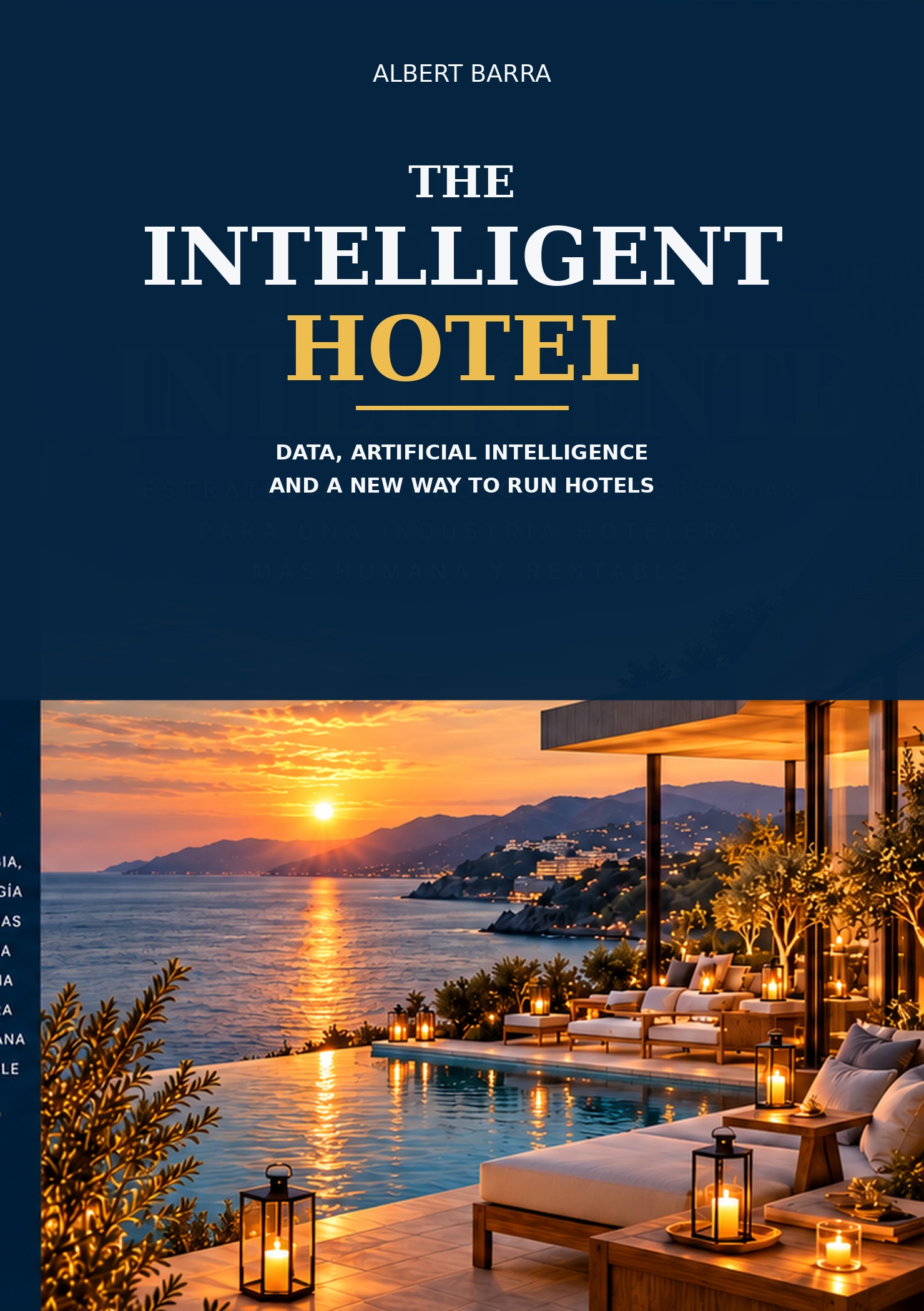
The Intelligent Hotel
Data, Artificial Intelligence and a New Way to Run Hotels
Go deeper into how AI, data and automation are transforming hotel management, commercial performance and the guest journey.
Read a free sample
It is far more difficult to integrate that technology into a hotel operating 24 hours a day, with interdependent departments, changing information, legal obligations and decisions that directly affect guests and employees.
Real transformation requires understanding processes.
You need to know how the front desk works, how housekeeping is planned, how rates are managed, what information food and beverage needs and how the different areas are coordinated.
Without that knowledge, we may end up digitising inefficiencies or automating poor decisions.
And that is not innovation.
It is simply doing faster something we may already have been doing badly.
I am surprised by the ease with which some professionals present themselves as experts in applying artificial intelligence to business sectors whose processes they barely understand.
Knowing how to use ChatGPT does not automatically make anyone a hotel strategy consultant. Just as knowing how to use Excel does not make anyone a finance director.
That is why, what matters is not having technology, but knowing what to do with it.
Nor is it about handing over all our data to AI
Defending the value of context does not mean indiscriminately opening up our systems.
Security, data protection and access control must be part of the design from the outset.
An AI does not need to know all our guests' personal data to analyse occupancy.
Nor does it need unlimited access to employment information to help organise shifts.
And a rate-change recommendation should not automatically become a commercial amendment without appropriate controls.
The aim is to provide the necessary context, not all the context available.
The quality of connections, data governance and human oversight are as important as the model's capabilities.
The great opportunity for independent hotels
This change opens up a particularly interesting opportunity for independent properties.
For years, large hotel chains have enjoyed technological advantages arising from their scale, budgets and specialist teams.
Artificial intelligence can narrow some of those gaps.
A 50-room hotel, with properly connected systems and well-defined processes, can develop analytical and coordination capabilities that previously required a much larger structure.
Not because artificial intelligence replaces the experience of its manager.
Precisely because it can amplify it.
Professional experience will remain essential for interpreting recommendations, setting priorities and making decisions.
But it will now be supported by technology capable of connecting large volumes of information in far less time.
And this applies to virtually every area of the business, from revenue management to sales management, operations or marketing, as I explained in AI will not deliver better hotel marketing if it does not know what the hotel needs to sell.
Fewer miracle prompts. More business knowledge
I have nothing against those who teach others how to use artificial intelligence.
Training is necessary and will continue to be so.
But I believe we should demand more than collections of prompts and eye-catching demonstrations.
We need professionals capable of understanding business processes, integrating systems, assessing data quality, establishing controls and measuring results.
In hospitality, that means truly understanding how a property operates.
Because we can spend hours perfecting an instruction for ChatGPT to act like an extraordinary general manager.
But if it does not know our hotel, it will remain an imaginary general manager.
Artificial intelligence does not need us to explain how to appear to know our business. It needs the right context to understand it.
A final reflection
Over the coming years, we will continue to see new artificial intelligence models, more powerful tools and a growing number of experts promising extraordinary transformations.
But I suspect the real difference between businesses will not lie in who uses the most advanced model or who knows the most prompt-writing tricks.
It will lie in who has managed to organise their knowledge, connect their systems and turn information into decisions.
Because technology will become increasingly accessible.
Prompts will be copied in seconds.
Models will evolve continuously.
But the deep knowledge of each business, its processes, its guests and its particularities cannot be downloaded from the internet.
It is built.
And that will probably be one of the great competitive advantages of the next stage of hospitality.
The question we should ask ourselves is not whether our employees know how to write good prompts.
It is whether our artificial intelligence really knows how our hotel works.
What if your AI really knew your hotel?
With HotelGEX you run your property from ChatGPT and Claude, using your hotel’s real data: occupancy, bookings, guests and operations.
- 30-minute demo built around your hotel
- Works with your current PMS, or without one
- No commitment
This article ends here. The archive does not.
Lead Hospitality brings together 1200 English articles published since 2018: years of experiences, decisions and lessons you can keep exploring.
What would you like to explore next?
Choose a direction and keep reading around what you want to solve, learn or challenge.