
The Human Tower That Defines a Hotel

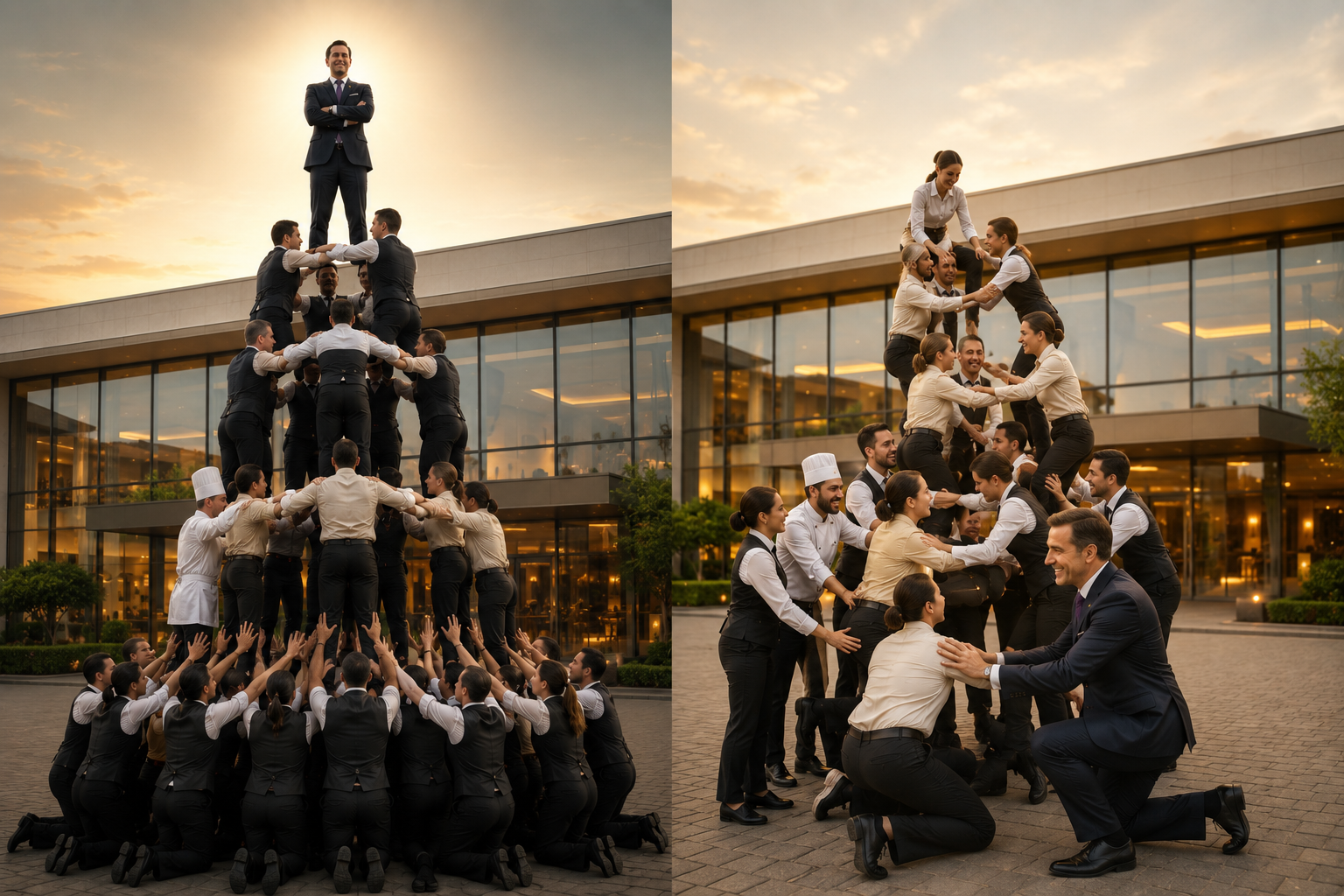

There are images that explain hospitality better than any leadership manual. And few are as powerful as a castell.
Perhaps it is because I am Catalan, but I have always seen the Castellers as one of the most accurate representations of how a hotel truly works. Not merely because of coordination. Not merely because of collective effort. But because of something far deeper: the relationship between leadership, structure, trust and silent sacrifice.
Let us imagine two human towers built by hotel employees.
In the first, the general manager is right at the top. At the summit. Visible. Giving orders from above. Shining in their own light while everyone else carries the weight from below. They are the leading figure. The visual centre. The symbol of power.
In the second, the general manager is at the bottom. Supporting. Coordinating. Listening. Relieving tension. Helping every part find its balance. Most likely, no one can see them from afar. They may not even appear in the final photograph. But without them, the tower would not stand for twenty seconds.
And that is where one of the great questions in modern hospitality emerges:
What kind of tower are we building within our hotels?
Because many hotels still operate under a deeply outdated idea of leadership: vertical authority. The general manager as a distant figure. The office as a symbol of power. Hierarchy understood as separation. The organisational chart understood as emotional distance.
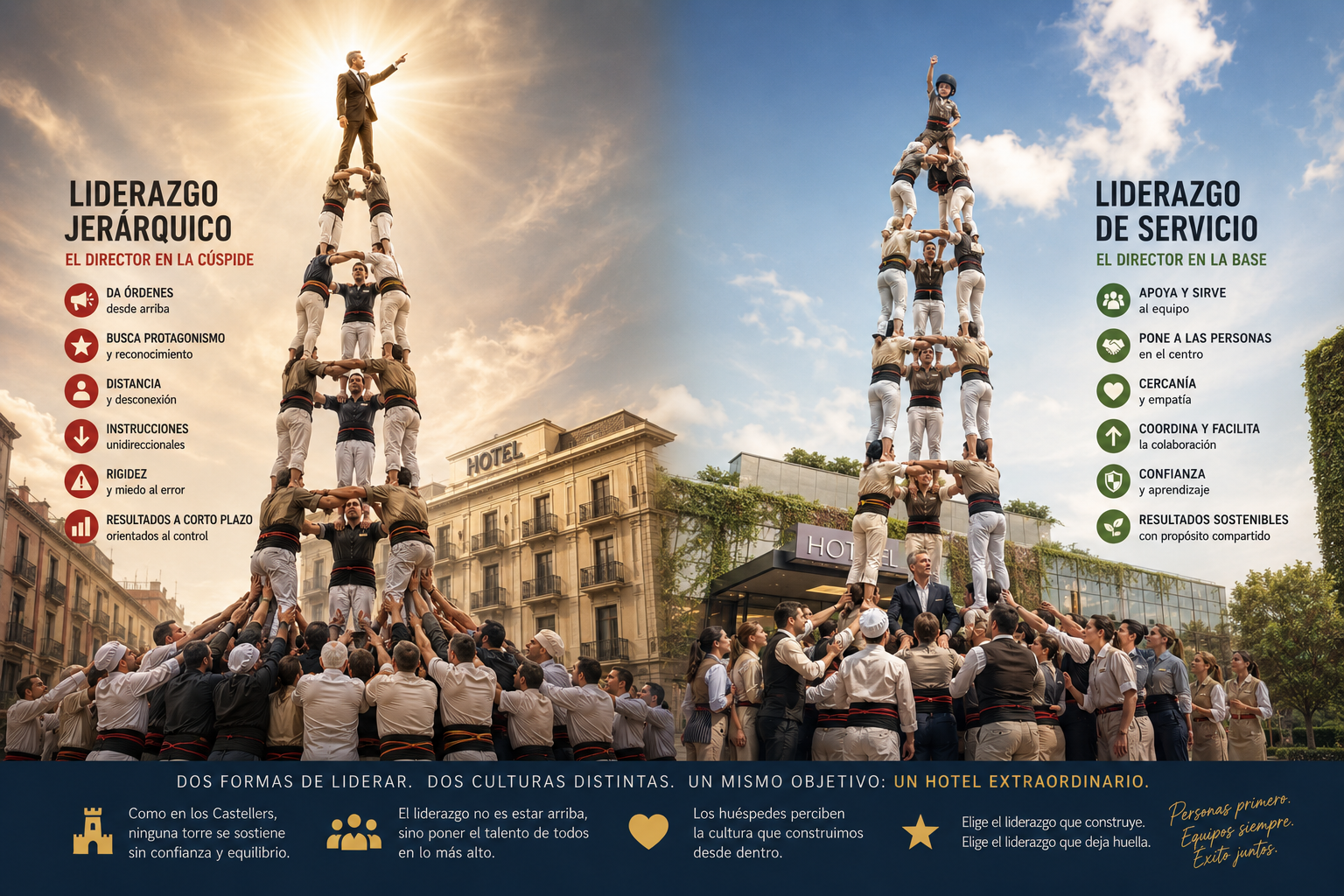
Ironically, the more complex the hotel environment becomes, the less efficient that model proves to be.
Today’s hospitality industry operates under constant pressure:
- exhausted teams,
- ever more demanding guests,
- tight margins,
- staff turnover,
- constant public scrutiny,
- daily operational issues,
- and a brutal pace of change.
In that context, leading from the top does not always work.
Because from above, you can see the horizon. But from below, you feel the weight.
And hotels are not sustained by rhetoric. They are sustained by structure.
What is fascinating about the Castellers is not the person who crowns the tower. What is truly impressive is the pinya.
The base.
That tightly packed group of people who absorbs the pressure, stabilises movement and prevents the system from collapsing. Hardly anyone there receives recognition. There is no glamour. There is invisible effort.
Exactly as in a hotel.
Because real hospitality does not happen on LinkedIn. It happens:
- when there are 180 breakfasts in 45 minutes,
- when there is a queue at reception,
- when the kitchen comes under pressure,
- when maintenance receives three simultaneous service requests,
- when a room attendant is running behind on rooms,
- when a guest loses their patience,
- or when the PMS decides to rebel at 7:30 p.m. on a Saturday, which, curiously, always chooses peak occupancy periods to commit suicide.
That is where authentic leadership emerges.
And that is where the general manager who merely “holds a position” is distinguished from the one who truly supports an operation.
I have known hotels where the general manager needed to be constantly visible. Everything had to revolve around them:
- decisions,
- meetings,
- successes,
- even problems.
They were organisations in which the team eventually developed operational fear:
- no one made decisions,
- no one took responsibility,
- no one acted without senior approval.
The consequence is devastating: the hotel appears large, but operationally it is fragile.
Like a very tall tower… built on an unstable base.
And the most dangerous thing is that this kind of leadership is often mistaken for authority.
But real authority does not need to be constantly displayed.
In hospitality, deep respect rarely comes from a job title. It comes from other things:
- consistency,
- calm under pressure,
- the ability to help,
- fairness,
- operational credibility,
- a genuine understanding of the business,
- and the willingness to get their hands dirty when necessary.
The team quickly recognises who is building the tower… and who simply wants to be in the photograph.
Because in a hotel, everyone is watching:
- how you respond in a crisis,
- how you treat people,
- how you speak when something goes wrong,
- whether you help or disappear,
- whether you protect the team or look for someone to blame,
- and, above all, whether you genuinely understand the day-to-day operational effort.
Hospitality has something very interesting about it: false leadership does not last long.
You can impress people for weeks. Perhaps months.
But when real pressure arrives—and it always does—the operational truth emerges.
And then teams know perfectly well who is holding up the tower and who is simply enjoying the view from the top.
There is another wonderful element to the Castellers: no one builds alone.
That, too, is a powerful lesson for hospitality.
Many hotels remain trapped in cultures where:
- departments compete,
- information is withheld,
- egos dominate,
- and hierarchies create silos.
But a competitive hotel needs precisely the opposite: operational interdependence.
Front office depends on housekeeping. Housekeeping depends on maintenance. Maintenance depends on procurement. Procurement depends on finance. Food and beverage depends on operations. And everyone depends on everyone else.
Hospitality is probably one of the most collective industries in existence, even if it is sometimes still managed through deeply individualistic models.
And this is where something I consider fundamental emerges:
Books to run a hotel with judgement
Written from the general manager’s chair: technology, guest experience, leadership and management.
 Directing HotelsWhat Nobody Tells You Before You Sit in the General Manager’s Chair
 The Intelligent HotelData, Artificial Intelligence and a New Way to Run Hotels
 Leadership and High-Performance Team ManagementPeople, Experiences and Results in Today\\\'s Hospitality
 The Guest JourneyDesigning Customer Experience Across the Entire Hotel Journey
A general manager should not aspire to be the most important part of the hotel.
They should aspire to build a system that works even when they are not present.
That is organisational maturity.
Because if everything constantly depends on one person, the hotel does not have leadership. It has structural dependency.
And that ends up exhausting everyone:
- the team,
- middle management,
- and the general manager themselves.
The best hotel operations I have seen had one thing in common: an almost invisible sense of stability.
They were not necessarily the most luxurious. Nor the largest. Nor the most modern.
But there was:
- clarity,
- coordination,
- respect,
- shared responsibility,
- and a strong culture of mutual support.
Like in a well-built human tower.
Every person knew:
- where they needed to be,
- when they needed to act,
- how much weight they could bear,
- and who was supporting them.
That reduces operational chaos far more than many procedure manuals ever could.
Because the guest experience does not arise from service alone. It arises from the team’s emotional and operational stability.
And that connects directly with the symbolism of the general manager at the base of the tower.
The most powerful leadership in hospitality is often the least theatrical.
It is the kind that:
- listens more than it speaks,
- observes more than it boasts,
- corrects without humiliating,
- demands without destroying,
- protects without infantilising,
- and helps without needing to turn it into a spectacle.
That kind of leadership does not always generate immediate applause. But it creates something far more valuable: trust.
And trust is the true cement of any hotel.
Because when a team trusts:
- it communicates better,
- helps one another more,
- spots problems sooner,
- resolves them faster,
- and withstands pressure far more effectively.
Exactly like a strong pinya.
Sometimes I think that many hospitality problems are not really operational problems. They are problems of human construction.
Towers that are too vertical. Too rigid. Too ego-driven. Too far removed from the daily reality of the hotel.
And towers like that tend to fall for the same reason: from above, the small cracks in the base cannot be seen.
That is why I increasingly admire general managers who:
- show up in difficult moments,
- help without making noise,
- know people by name,
- understand operational fatigue,
- and know that leading is not about occupying the summit.
It is about ensuring that the entire structure remains standing.
Because ultimately, in hospitality, as with the Castellers, what is truly extraordinary is never the person at the top.
What is extraordinary is getting dozens of people to trust one another enough to hold up something that once seemed impossible.
This article ends here. The archive does not.
Lead Hospitality brings together 1200 English articles published since 2018: years of experiences, decisions and lessons you can keep exploring.
What would you like to explore next?
Choose a direction and keep reading around what you want to solve, learn or challenge.