
Is Your Hotel Team Burning Out?

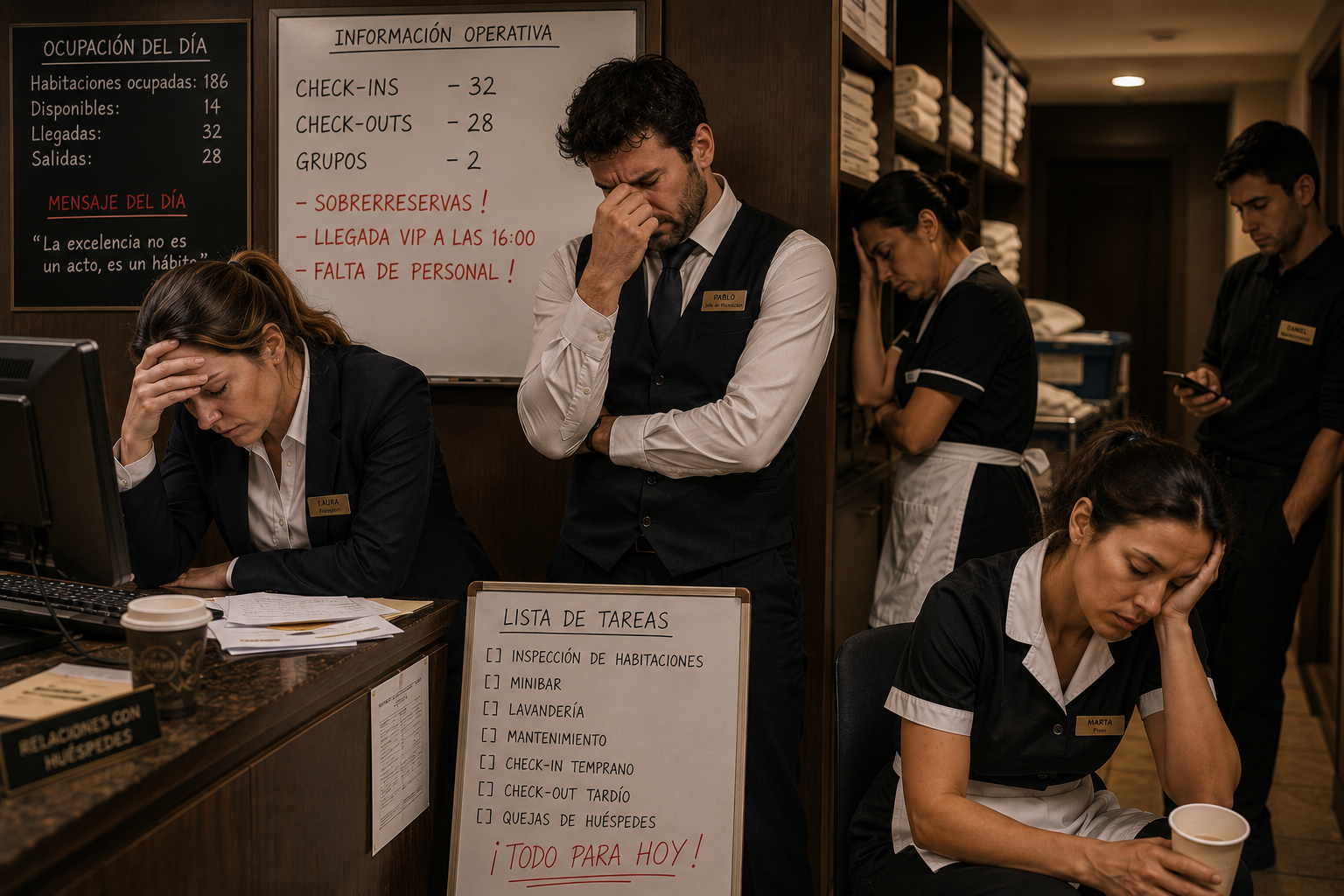

There is something I have been seeing in many hotels for some time and that, honestly, is beginning to concern me more than many financial indicators.
Hotels that appear to be full. Hotels with growing ADR. Hotels with reasonable occupancy. Hotels where, on paper, “everything works”.
But where the team is completely exhausted.
And the worst part is that, many times, no one acknowledges it because burnout in hospitality rarely manifests itself as an immediate collapse. It does not appear overnight. It slowly seeps into day-to-day operations until it becomes part of the landscape.
It starts with small details that an experienced hotelier spots straight away: more tense front desks, fewer spontaneous smiles, emotionally drained middle managers, housekeeping operating in survival mode, kitchens working under constant pressure, irritable restaurant teams, overwhelmed maintenance teams, and a constant sense that the hotel is always putting out fires.
Then something even more dangerous appears: emotional disconnection from the guest. And that is where the real deterioration begins.
Because hospitality can automate processes, optimise distribution or make revenue management as sophisticated as it wishes, but it still depends deeply on something profoundly human: the emotional energy of the people who deliver the guest experience every day.
And an exhausted team can keep operating. But it can hardly continue to inspire guests.
Hospitality Has Spent Decades Normalising Exhaustion
There is an uncomfortable reality that the sector has romanticised for far too long.
In hospitality, we have turned exhaustion into a kind of badge of commitment.
Sleeping little. Never switching off. Resolving issues at any hour. Stringing together weeks of pressure. Constantly working with lean staffing levels. Sustaining complex operations with insufficient resources.
And we often even take pride in it.
As if being permanently at the limit were a natural part of hospitality’s DNA.
But operational intensity—which will always exist in this industry—is one thing; building organisations that are structurally exhausted is something entirely different.
Because burnout does not arise simply from working long hours.
It arises when effort ceases to have meaning.
And this happens especially when the team feels that:
- They never get through everything.
- Everything is always urgent.
- Priorities are constantly changing.
- Resources are never sufficient.
- Mistakes carry more weight than successes.
- There is no genuine recognition.
- Pressure always flows downwards.
- Management is in constant reaction mode.
And this is where one of the sector’s biggest current problems emerges.
Many hotels are still trying to address burnout with cosmetic initiatives: motivational talks, fruit in the office, team-building activities, or inspirational quotes in the staff area.
But hospitality burnout is rarely a motivation problem.
It is an operational structure problem.
Because no wellbeing programme can compensate for a poorly designed operation.
The Symptoms of Hospitality Burnout Are Extremely Visible
The most dangerous aspect of organisational burnout is that it leaves very clear signs long before the financial consequences emerge.
And almost all of them are visible in the hotel’s day-to-day operations.
For example:
- The front desk loses its capacity for empathy. Check-in stops being a welcome and becomes a formality.
- Housekeeping slips into emotional autopilot. The room may be clean, but the invisible care that distinguishes an excellent hotel from a merely adequate one disappears.
- Restaurant and kitchen teams begin operating under tension. More mistakes, less coordination, more internal friction.
- Middle managers stop leading and simply begin surviving. And this is particularly serious because they are the ones who truly sustain day-to-day operations.
- Initiative disappears. No one suggests improvements because they feel nothing will change.
- The guest begins to perceive the fatigue. And this happens long before poor reviews start appearing.
I have seen hotels where the team was still technically fulfilling its duties… but where, emotionally, the product had already deteriorated enormously.
Because genuine hospitality requires emotional energy.
And that does not appear in any KPI.
There is no dashboard that measures: enthusiasm, engagement, human connection, or the emotional capacity to sustain excellent service for months under continuous pressure.
But the guest perceives it immediately. Always.
Burnout Also Destroys Profitability (Even If Many Are Slow to Understand It)
This is where something particularly important emerges.
Many owners and financial structures still see team wellbeing as an indirect cost, or even as something “soft”.
But burnout has extremely real economic consequences:
- Higher turnover.
- Higher absenteeism.
- More operational errors.
- More guest incidents.
- More compensation.
- Less upselling capacity.
- A poorer guest experience.
- Loss of key talent.
- Greater dependence on management.
- A gradual decline in reputation.
And perhaps most dangerously: exhausted hotels lose their ability to evolve.
They become reactive. Defensive. Slow. Operationally rigid.
Books to run a hotel with judgement
Written from the general manager’s chair: technology, guest experience, leadership and management.
 Directing HotelsWhat Nobody Tells You Before You Sit in the General Manager’s Chair
 The Intelligent HotelData, Artificial Intelligence and a New Way to Run Hotels
 The Guest JourneyDesigning Customer Experience Across the Entire Hotel Journey
 Leadership and High-Performance Team ManagementPeople, Experiences and Results in Today\\\'s Hospitality
All their energy is consumed simply trying to survive the next day.
And an organisation that lives in a permanent state of fatigue stops innovating, stops building culture and stops creating competitive advantage.
This is precisely why the strongest hotel organisations I have known were not necessarily the largest or the most luxurious.
They were those with: clarity, structure, stable leadership, consistent processes, functional hierarchies, and an operational culture that was emotionally sustainable.
Hotels where the team could work intensely… without feeling destroyed by the system.
Because having difficult days is one thing. Hospitality will always have them.
Turning exhaustion into a permanent operating model is something entirely different.
The Question Many Hotels Avoid Asking Themselves
There is an uncomfortable question that many hotels should ask themselves honestly:
Are we building a sustainable operation for the people who deliver the guest experience?
Because if the only way for the hotel to function is to have permanently exhausted teams… then the problem is not the people.
The problem is the operating model.
And this connects directly with something that will become increasingly critical in modern hospitality: the ability to attract and retain talent.
The most valuable professionals no longer choose hotels based on salary alone.
They choose cultures. They choose emotional stability. They choose consistent leaders. They choose environments where they can grow without burning themselves out.
Especially younger generations.
And honestly, I believe many hotels still have not understood the scale of this shift.
Because talent does not shy away from effort.
Hospitality will always demand effort.
What talent avoids are chaotic, exhausting and emotionally unpredictable organisations.
And an increasing number of excellent professionals simply leave those environments.
Quietly. Without conflict. Without drama.
They simply no longer want to work that way.
And perhaps that is one of the major strategic questions facing hospitality today.
Not how to operate ever closer to the limit.
But how to build hotels capable of sustaining operational excellence without systematically destroying the energy of the people who make it possible.
Because no hotel can sustain genuine hospitality on permanent burnout.
This article ends here. The archive does not.
Lead Hospitality brings together 1200 English articles published since 2018: years of experiences, decisions and lessons you can keep exploring.
What would you like to explore next?
Choose a direction and keep reading around what you want to solve, learn or challenge.