Lead Hospitality

Hotel Strategy Is Dead as We Knew It: From Planning to Real-Time Adaptation

THE IDEA

Hotel strategy is no longer a static annual plan. In a fast-changing market, the most successful hotels are those that read demand, execute with agility and adjust decisions in real time. This article explores how to turn strategy into a living competitive advantage.

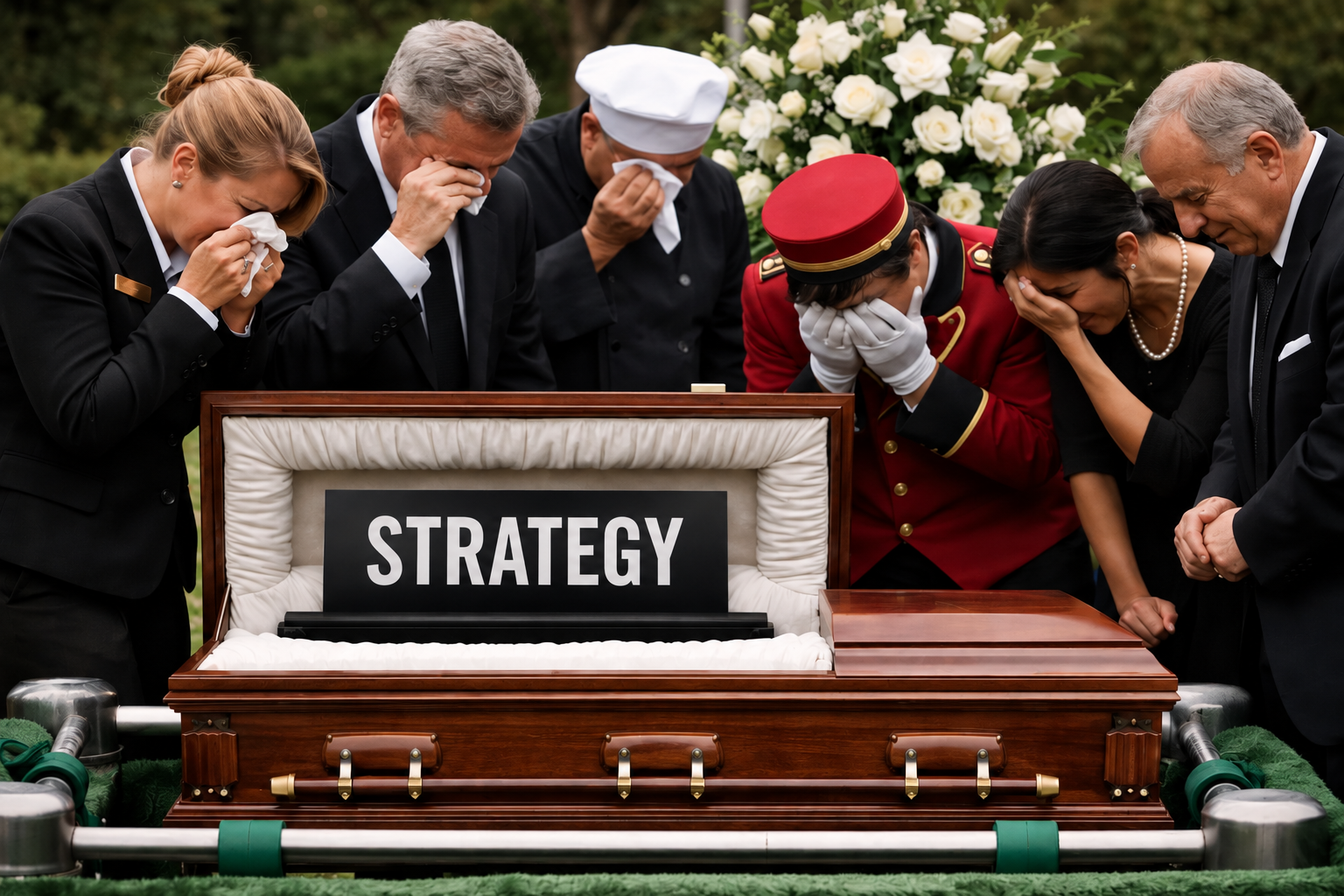
For years, in Hospitality, we have treated strategy as though it were a sacred document. An annual plan, reviewed by committee, approved by ownership and executed with discipline for months. We printed it, presented it… and, in many cases, forgot about it. But a hotel’s operational reality has never been static. Demand changes, guests evolve, channels transform, and the economic environment fluctuates. And yet, we continue trying to manage dynamic businesses with rigid plans. I have seen hotels with perfectly designed strategies… fail within weeks. And others, with less formal structure but a great capacity to adapt, clearly outperform their results. Hospitality Strategy Is Dead This is no coincidence. It is a symptom of something deeper: strategy in Hospitality cannot be a plan. It has to be a living system. The difference is critical. A plan gives you direction. But a system enables you to survive—and grow—when that direction changes. Today, the question is no longer, “Do we have a strategy?” The real question is: do we know how to adjust our strategy while the market is moving?

Strategy as a living system: the new model in Hospitality

In practice, managing a hotel today means accepting an uncomfortable reality: strategic assumptions expire faster than ever. That completely changes the approach. It is no longer about designing the best possible plan, but about building the strongest possible capacity to adapt. Strategy therefore ceases to be an annual exercise and becomes a continuous discipline. It is not written once and filed away. It is observed, tested, challenged and corrected. It becomes a way of thinking, prioritising and making decisions. In Hospitality, moreover, this transformation is particularly important because we work with a perishable product, volatile demand, high fixed costs and people-intensive operations. Put differently: almost everything changes, and it changes quickly. That is why, whenever I hear people speak about strategy as though it were a closed document, I always think the same thing: perhaps that worked in more predictable environments. Not today. Today, useful strategy is strategy that breathes. In my view, these are the five keys to new strategic thinking in hotels:
  • Strategy as a continuous search. You do not define a single path and follow it blindly. You explore options, test signals and correct course based on what the market is actually telling you.
  • Decisions based on gaps, not wishes. The question is not simply what we want to become, but what we lack today in order to compete better tomorrow. Mature strategy begins with diagnosis, not PowerPoint.
  • Execution integrated into strategy. In Hospitality, strategy does not live solely in the executive office. It lives at reception, in the restaurant, in housekeeping, maintenance and reservations. Every operational decision has a strategic impact.
  • Constant iteration. Strategy is no longer reviewed once a year. It is reviewed every week, at every period close, at every demand peak and with every change in guest behaviour.
  • The ability to say no. An essential part of good strategy is deciding what to stop doing. Not all growth adds value, not all demand is desirable, and not every channel delivers genuine value.
I have seen it many times: the hotels that progress most consistently are not necessarily those with the most attractive plan, but those that have developed a greater ability to read their environment. They know how to interpret. They know how to filter out the noise. They know how to distinguish what is urgent from what is important. And, above all, they know how to move without breaking. That requires humility. Because it means recognising that strategy is not an absolute truth, but a working hypothesis. And as soon as reality proves it wrong, it must be adjusted—without drama, without misplaced pride and without that dangerous temptation to persist simply because we had already chosen that path. Ultimately, what changes is the role of strategic thinking. Before, it served to establish a stable direction. Today, it serves to maintain dynamic coherence amid change.

From planning to operations: where strategy is truly won

There is something that is often overlooked: strategy in Hospitality is not won in Excel. It is won in operations. We can spend hours designing positioning strategies, defining segments, reviewing budgets or projecting scenarios. All of that is necessary. But real competitive advantage emerges when that vision is translated into concrete, repeatable and consistent behaviours. That is where many hotels fail. Not because they do not think. But because they do not turn thinking into a system. They have intent, but no practical translation. They have ambition, but no structure. They have a narrative, but no execution. And in our sector, execution is everything. Because the guest does not buy a strategy. They buy an experience. They do not perceive the annual plan. They perceive the check-in, the cleanliness of the room, the coordination at breakfast, the speed of response, the atmosphere, the team’s attitude and the consistency between what was promised and what was delivered. That is why I like to insist on this idea: there is no valid strategy unless it becomes an operational habit. When a hotel decides to position itself within a particular segment, that decision should be evident in its commercial tone, the composition of its offer, its service, the pace of its operation, its pricing policy and even the smallest details. If it is not evident, there is no strategy. There is only intent. Hotels that execute well tend to share several characteristics:
  1. Absolute clarity on priorities. They do not try to pursue ten objectives at once. They know what truly matters at each stage and align the team around it.
  2. A fast decision-making pace. They understand that deciding late is also a decision. They would rather adjust as they go than become paralysed by endless analysis.
  3. Consistency between pricing, product and service. They do not sell one thing and operate another. They do not attempt to capture premium value with a commodity experience, nor compete on price with a cost structure unable to sustain it.
  4. A culture of learning. Every mistake becomes information. Every deviation is analysed. Every point of friction is a clue. Honest mistakes are not punished; failing to learn from them is.
This requires highly present leadership. Not controlling in the negative sense, but involved. Because when strategy reaches operations, it needs dialogue, follow-up, judgement and guidance. Communicating an objective is not enough. It must be translated into daily decisions. I have seen, for example, hotels talk about personalisation while operating with processes designed for volume. Or defend an experiential positioning while systematically reducing the time spent interacting with guests. Or boast of profitability while accepting channels, segments or promotions that erode margins and damage brand perception. All of this happens when strategy is separated from operations. And that separation is costly in Hospitality. The good news is that the opposite also happens. When a hotel gets its team to understand not only what they need to do, but why they do it, execution improves dramatically. Judgement emerges. Autonomy emerges. The ability to make sound decisions emerges, even when leadership is not standing in front of them. And that is probably one of the greatest signs of strategic maturity: when the organisation stops depending solely on instructions and begins to operate with understanding. If I had to summarise it in one sentence, it would be this: strategy begins with vision, but only becomes an advantage when it enters the routine. At that point, there is no longer any need to repeat it so often. It shows. Because ultimately, for a long time we have confused stability with control. But in Hospitality, control does not come from having anticipated everything. It comes from knowing how to read the market better, adjust before others do and execute with a consistency the guest can feel. Strategy, therefore, is not what you write in a document. It is what you do when reality does not match what you expected. And that, in our sector, happens every day. That is why I believe the time has come to leave behind the idea of strategy as a file and start treating it as what it really is: a continuous search for opportunity, fit and advantage. Not to live in a state of improvisation. But to build hotels that are more aware, more agile and better prepared. Because in a long-term business like this, true strength does not lie in getting it right once. It lies in knowing how to recalibrate, always.
FREE READING LIMIT

You have reached your free article limit

Subscribe to continue reading without limits, or unlock this article individually when available.