
The New Hotel Guest Journey: When Travellers Ask AI First



For many years, we have represented the hotel customer journey as a relatively orderly process. Inspiration, search, comparison, booking, stay, review and, hopefully, repeat business. We could debate the exact number of stages, but we all understood reasonably well where the guest’s commercial journey began and which tools to use to influence each moment.
That map no longer fully describes what is happening. Not because guests no longer need inspiration, trust, information or reassurance before booking. Those needs remain deeply human. What is changing, and much faster than some hotels appear to realise, is who intervenes between the traveller’s need and the hotel choice. For years, that intermediary was primarily Google, an OTA, an agency, a personal recommendation, or a combination of all of them. Now a new influencer has emerged: Artificial Intelligence.
And there is a fundamental difference. When someone searched Google for “romantic hotel near the beach in Valencia”, they received a page of alternatives and had to do much of the work themselves: open results, consult maps, compare photographs, read reviews, check facilities and rates. When they ask an AI, “recommend three peaceful hotels by the Mediterranean for a four-night romantic break, with a good restaurant, spa and excellent reviews”, they are delegating a substantial part of that analysis process. They are no longer asking for information; they are asking for judgement.
This could profoundly alter hotel marketing strategy, because the real battleground may gradually shift from winning the click to becoming part of the answer. A hotel may have an excellent website, invest appropriately in SEO and maintain a perfectly structured distribution strategy, yet discover that a potential guest never gets to see it because an AI has already narrowed fifty options down to three recommendations. To me, this is one of the most relevant transformations we need to watch in Hospitality over the coming years.
But it would be a mistake to interpret this phenomenon solely as a technology issue. What is truly interesting is that it forces us back to some extraordinarily traditional questions: for whom are we genuinely relevant? What do we do particularly well? What do our guests say when we are not present? What evidence exists to prove our promises? What experience do we deliver after securing the booking? Artificial Intelligence may change the route, but it does not eliminate the fundamentals of Hospitality. On the contrary: it will probably make both our strengths and our inconsistencies far more visible.
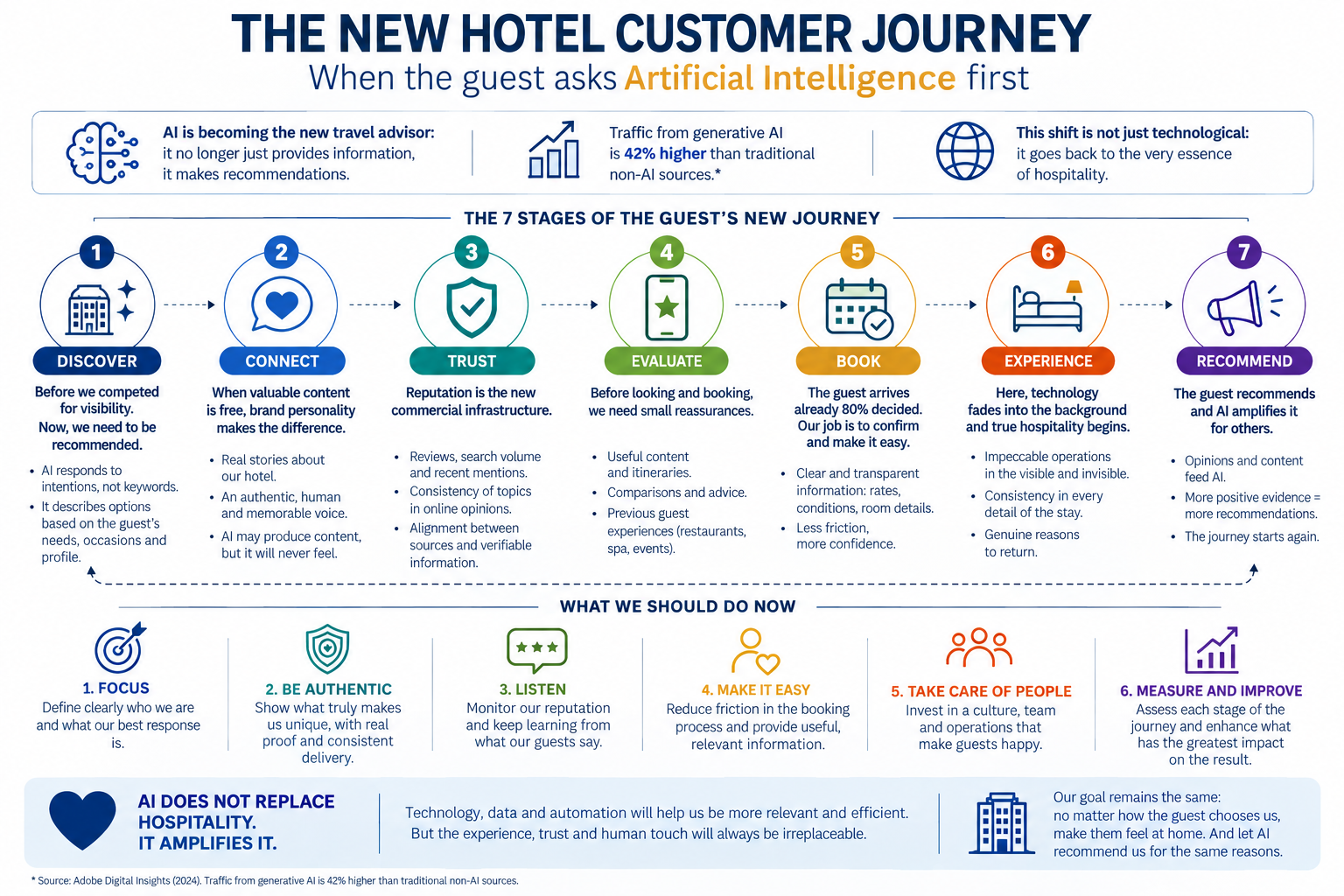
From searching for hotels to asking which hotel to choose: the seven stages of the new guest journey
There is an idea in John Jantsch’s Marketing Hourglass model that I find particularly useful for applying to our sector. Rather than understanding the commercial relationship as a funnel that ends once we make a sale, it proposes seven stages: Know, Like, Trust, Try, Buy, Repeat and Refer. In Hospitality, we could translate them as Discover, Connect, Trust, Try, Book, Repeat and Recommend.
I find the logic extraordinarily relevant because one of our historical mistakes has been to devote too much energy to securing bookings and considerably less to understanding everything that happens before and after them.
Moreover, the evidence is beginning to suggest that this shift is not anecdotal. Adobe Digital Insights reported in 2026 that traffic from generative AI platforms was converting up to 42% better than traffic from non-AI-related sources. The figure should be interpreted cautiously—it comes from general digital commerce, not hotels alone—but its meaning is difficult to ignore: users who arrive after interacting with an AI may be much further advanced in their decision-making process.
That changes the entire architecture of the customer journey.
1. DISCOVER — We used to fight to appear. Now we must become recommendable
Until very recently, an important part of our strategy consisted of appearing wherever the guest searched: Google, metasearch engines, OTAs, maps, social media and specialist portals.
Now we need to add a far more uncomfortable question:
What does an Artificial Intelligence system answer when someone asks about hotels like ours?
Not when they type our name. That would be too easy.
I am much more interested in seeing what happens when the traveller describes a need:
“I am looking for a peaceful hotel for couples near the Mediterranean.”
“I want a small hotel with a good restaurant and spa for a three-night break.”
“Where should I stay near the beach if I want to avoid family hotels and large resorts?”
“Recommend an elegant but informal hotel for an anniversary celebration.”
That is where the new positioning begins.
Even major hotel operators are beginning to introduce conversational search capabilities that can take travellers from a natural-language description of their wishes to a specific selection of accommodation. We are moving from searching through filters to conversing through intent.
And that completely changes the language.
A traditional listing says:
Swimming pool | Spa | Restaurant | Parking | Wi-Fi.
A traveller may ask:
“Where can I spend four days without using the car, close to the sea, eating well and relaxing?”
The difference may seem small, but conceptually it is enormous.
The first is an inventory.
The second is a travel intent.
This is why I believe hotels will have to learn to describe themselves less through features and much more through situations, needs, occasions and guest profiles.
2. CONNECT — When everyone can produce content, having personality becomes an advantage again
We are entering a paradoxical era.
Never has it been so easy to produce reasonably good photographs, articles, newsletters, videos, social posts or commercial descriptions. Precisely for that reason, being reasonably good is beginning to have less value.
If twenty hotels publish impeccable but interchangeable content, none of them builds a genuine personality.
And here Hospitality has an extraordinary advantage: our product is full of real stories.
We have receptionists who remember guests.
Chefs who know their suppliers.
Housekeepers who spot needs before anyone else.
Guests who return for years.
Local products.
Anecdotes.
Mistakes.
Celebrations.
Traditions.
People.
A machine can help us organise and communicate all of that. But it should not invent it.
I am increasingly convinced that Artificial Intelligence will increase the commercial value of authenticity precisely because it will make artificial content infinitely abundant.
We will not necessarily need to produce more content.
We will need to produce content that could only have been born in our hotel.
3. TRUST — Reputation becomes commercial infrastructure
This is probably one of the most important changes.
For years, we have treated online reputation as a quality indicator. Now we must also begin to view it as a source of data used by systems that may play a role in recommendations.
When an AI attempts to determine which hotel to recommend, it needs signals.
These may include:
- Guest ratings. A high, consistent score is a signal far more difficult to manufacture than any marketing copy.
- Review volume. An excellent rating based on fifteen guests does not convey the same thing as one supported by hundreds.
- Recency. Reputation should not be understood solely as a historical average. What is happening now matters.
- Thematic consistency. If numerous independent guests repeatedly mention cleanliness, tranquillity, breakfast, location or service, those patterns build an extraordinarily powerful picture.
- Consistency across sources. Websites, directories, maps, OTAs, press, external content and reviews should all describe broadly the same hotel.
- Verifiable information. Opening hours, facilities, policies, location, real photographs, rooms and terms must be clear.
An experimental study published in 2026 on hotel recommendations made by different language models found precisely that certain reputation signals carry considerable weight in selection. In its experiments, a high rating significantly increased the likelihood of recommendation.
The lesson I take from this is not that we should “trick the algorithm”.
It is exactly the opposite.
We must provide enough evidence for it to understand accurately what we truly are.
Here I also see a connection with something far older than AI. In hotel strategy, we have always spoken about building competitive advantage through resources and capabilities that are difficult to replicate. A strong reputation, a robust culture, consistent service and a clear proposition are precisely that kind of asset. AI does not replace strategy; it simply introduces a new observer attempting to interpret it.
4. TRY — Between looking and booking, we need small commitments
This is probably one of the least developed stages in Hospitality.
We normally offer visitors two options:
look or book.
There is very little space in between.
But a traveller may be interested without yet being ready to commit several hundred or several thousand euros.
We can create small experiences that reduce uncertainty:
- Personalised itineraries. “What to do over three days if you are looking for gastronomy and tranquillity”.
- Genuinely useful room comparison tools. Not just square metres and photographs, but an explanation of which room category is best suited to different needs.
- Pre-stay experiences. The restaurant, spa, rooftop, events or gastronomy can become first points of contact with the brand.
- Direct advice. Being able to ask the hotel which room to choose may seem unsophisticated, but it remains extraordinarily effective.
- Content focused on real decisions. When to visit, which room has the best aspect, how to get there, where to park, what to do when it rains, or which activities are available nearby.
The purpose of this stage is simple:
reduce risk before asking for commitment.
5. BOOK — By the time guests reach our website, they may already have made 80% of the decision
This is another important consequence.
For years, we designed websites on the assumption that they had to persuade visitors.
Increasingly, we will have visitors arriving already partly convinced.
They have asked an AI.
They have compared.
They have read reviews.
They have checked our location.
They may even know our strengths and weaknesses.
Our role therefore ceases to be exclusively about persuading and also becomes one of confirming.
Confirming availability.
Confirming the price.
Confirming the terms.
Confirming that the room is genuinely as they expected.
Confirming that they can cancel.
Confirming that they will be able to park.
Confirming that the spa operates as they imagined.
Confirming that they are making a good decision.
This is why a website full of phrases such as “an unforgettable experience in an unrivalled setting” contributes far less than we believe.
Guests need answers.
Who is this hotel for?
What will I find?
What does it really cost?
What is included?
Which room is right for me?
What restrictions are there?
Why should I choose it over another alternative?
The further advanced the guest is, the less tolerant they are of ambiguity.
6. REPEAT — This is where the technology narrative ends and real Hospitality begins
We can appear in ChatGPT.
We can dominate Google.
We can have magnificent photographs.
We can build an impeccable website.
We can secure the booking.
And then the guest arrives.
At that point, almost every excuse disappears.
The room is clean or it is not.
The mattress is comfortable or it is not.
Breakfast works or it does not.
Staff look at guests when they speak or they do not.
Maintenance is up to standard or it is not.
The shower has pressure or it does not.
The restaurant delivers or it does not.
The room is ready when it should be or it is not.
That is where I still see the essence of the business.
A classic hotel operations manual expresses it from another perspective: front-of-house activities have an immediate impact on guest experience and satisfaction, while countless back-of-house processes quietly determine the quality ultimately perceived.
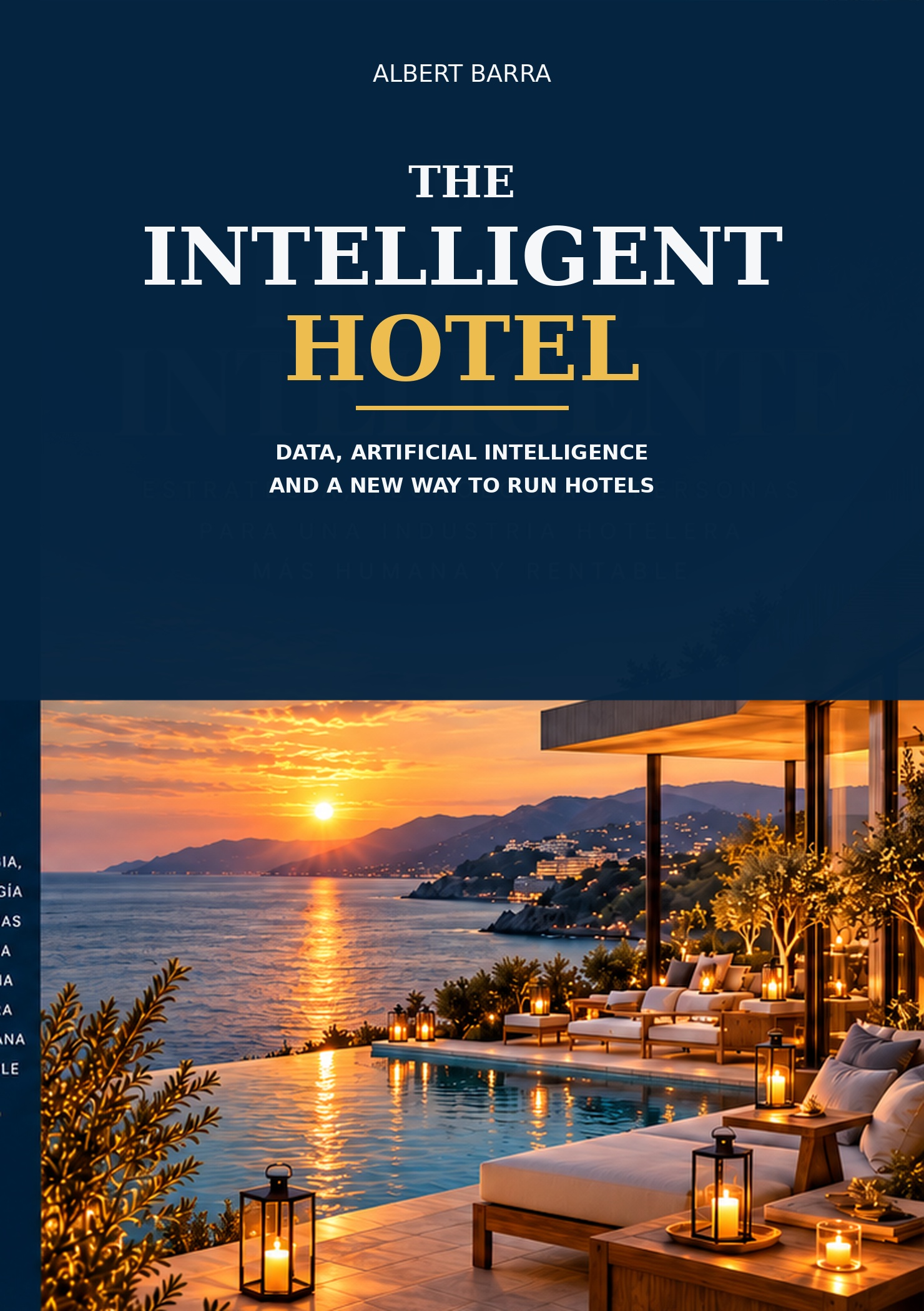

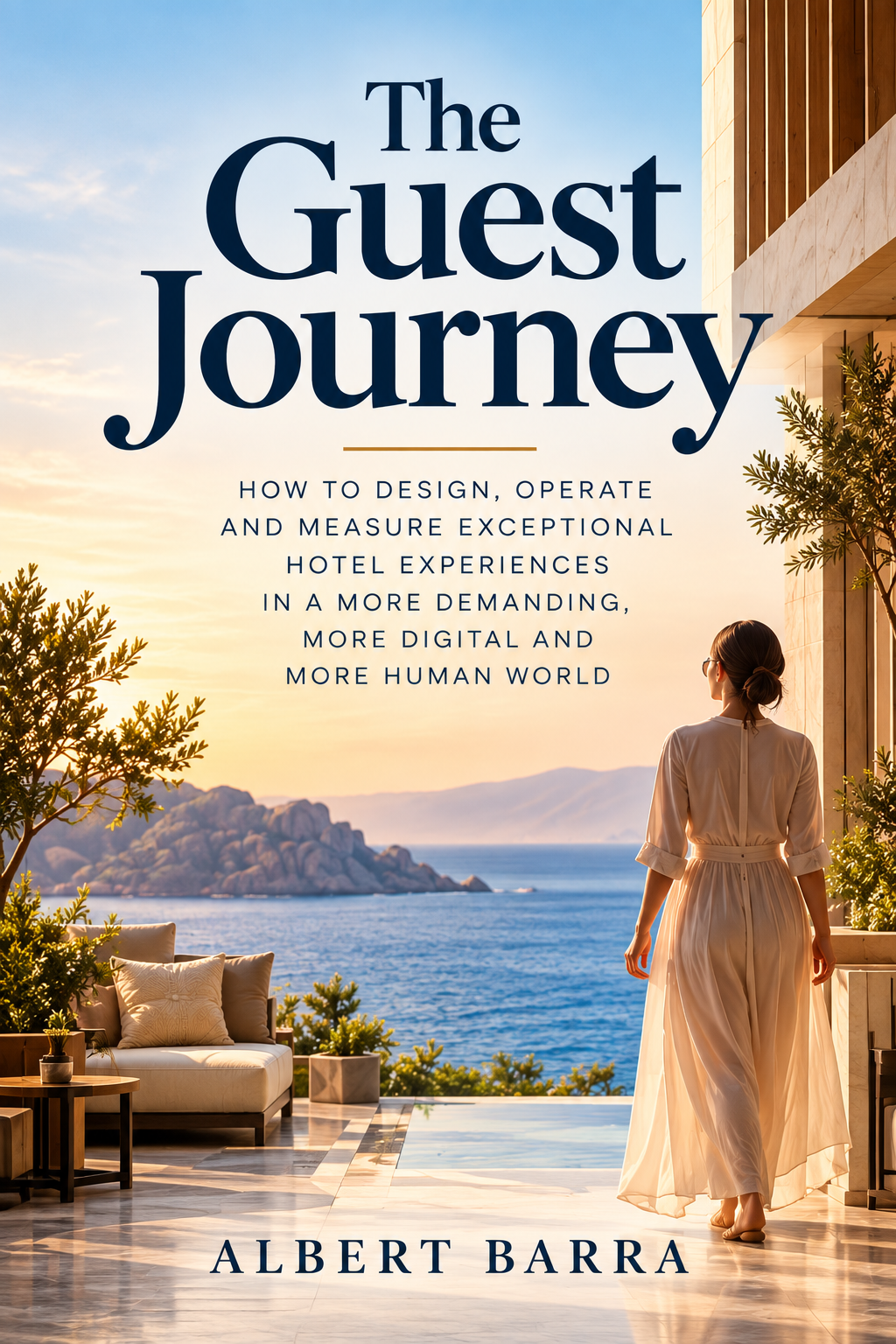
My published books
And that is excellent news.
Because it means that the ultimate competitive advantage remains inside the hotel.
AI can help us secure the first booking.
The experience determines whether we secure the second.
7. RECOMMEND — Guests who recommend us are no longer speaking only to other guests
This is perhaps where the most fascinating part of this new ecosystem emerges.
Traditionally, we imagined word of mouth like this:
Guest → friend.
Then the platforms arrived:
Guest → review → thousands of travellers.
Now we need to add:
Guest → review/content → AI → future travellers.
A review written today may ultimately influence, indirectly, a recommendation made months later to someone who will never read that review.
This multiplies the strategic value of every experience.
Hospitality literature has long indicated that satisfaction and word-of-mouth are decisive to a property’s long-term prosperity, precisely because one guest’s experience shapes the future decisions of other travellers.
What changes now is the scale.
The satisfied guest leaves evidence.
The evidence feeds reputation.
Reputation increases trust.
Trust supports recommendation.
Recommendation generates discovery.
And the customer journey begins again.
AI does not eliminate the Customer Journey: it compresses it, connects it and makes it far less controllable
If I had to summarise the change in a simple diagram, I would use this one:
BEFORE
Need → Google/OTA → Comparison → Website → Reviews → Booking → Stay → Review
NOW
Need → AI → Shortlist → Verification → Booking → Stay → Evidence → Future AI
And this has an enormous strategic consequence.
For years, hotels have tried to control the message.
Now we will have to learn to build evidence.
Because an AI can compare what we say with what others say about us.
We can claim to provide extraordinary service.
But there may be 800 reviews that allow this to be verified.
We can claim that we are peaceful.
But comments may confirm or contradict it.
We can sell gastronomy.
But guests will describe whether it is genuinely worthwhile.
We can position ourselves as a romantic hotel.
But photographs, content, reviews and features will ultimately build—or dismantle—that narrative.
This leads me to an idea I consider especially important:
hotel marketing will increasingly be less a discipline devoted to manufacturing perceptions and more a discipline devoted to making excellent operational reality visible.
Kotler has long advocated an evolution of marketing towards a more human vision, in which people are not merely consumers but whole individuals seeking values, meaning and authentic relationships with organisations. The paradox is remarkable: we may need precisely that philosophy in the age of machines.
That is why, before buying the next AI tool, I would conduct an audit that is far less spectacular and considerably more uncomfortable.
I would score these seven questions from 1 to 10:
- DISCOVER — Can an AI clearly understand what kind of hotel we are and for which type of guest we are particularly well suited? If our proposition requires twenty minutes of internal explanation, it is unlikely to be understandable externally.
- CONNECT — Do we have a recognisable personality? If we could replace our name with that of the hotel next door without changing our copy, we have a problem.
- TRUST — Is there sufficient independent evidence to support our promises? Reputation, recent reviews, real photographs, mentions, consistent information and transparency.
- TRY — Can a guest get closer to our experience before booking? Useful content, gastronomy, spa, events, advice, tours, proposals or small commitments.
- BOOK — Have we removed friction and uncertainty? Price, terms, availability, room, policies and the next step must all be obvious.
- REPEAT — Do we have genuine reasons for someone to return? Not discounts. Reasons. Recognition, consistency, trust, memories and a sense of belonging.
- RECOMMEND — Does something happen that is good enough for someone to want to tell others about it? This may be the most important question of all.
Then I would look at the lowest score.
And I would start there.
Because strategy is not about implementing one hundred initiatives simultaneously. It is about understanding which decisions best connect our resources with a changing competitive environment. In Hospitality, strategic management serves precisely to integrate functional decisions within a shared direction and prevent marketing, operations, revenue and service from each moving in a different direction.
AI is extraordinarily powerful, but it has one characteristic worth remembering: it amplifies whatever it works with.
An excellent hotel proposition can become more visible.
An outstanding reputation can turn into recommendation.
Useful content can reach new audiences.
A well-developed relationship can be personalised.
But it can also amplify our contradictions.
If we say one thing and do another, there is data.
If our photographs promise more than our rooms deliver, there are reviews.
If our value proposition is unclear, AI will struggle to understand it.
If we are indistinguishable from our competitors, it will probably treat us as interchangeable.
That is why I would not begin by asking:
“How do we incorporate AI into the customer journey?”
I would begin by asking:
“Do we have a customer journey that is good enough to be worth amplifying?”
And I would add another question that I have long considered essential in Hospitality: do we really know who we want to choose us?
Not every hotel should appear in every search.
That would even be counterproductive.
The aim should not be to make an Artificial Intelligence system recommend us all the time.
It should be to ensure that it recommends us when we genuinely are one of the best possible answers for that particular guest.
That requires positioning.
It requires making choices.
It requires knowing the guest deeply.
It requires consistency between product, price, distribution, communication and operations.
And it requires something that no tool can buy for us:
an authentic value proposition.
My practical advice would be to begin this very week by asking ten questions of different AI tools, as though you were a guest who does not yet know your hotel. Do not type the property’s name. Describe only the real needs of your priority segments and observe which hotels appear, why they appear and what arguments the AI uses to recommend them. You will probably learn more about your competitive positioning in one hour through that exercise than by reading certain marketing reports for an entire afternoon.
Then compare those answers with your own proposition. Pay particular attention to the differences between what you believe you are, what you communicate, what your guests say and what an AI is able to understand about you. This is where some of the most interesting gaps to work on over the coming years will emerge. Not all of them will require technology; some will be resolved by improving information, others by modifying processes, and a few simply by doing hospitality better.
And finally, I would not forget something fundamental. Behind every prompt, there is still a person who has probably been looking forward to a holiday for months, is celebrating an anniversary, needs to rest, is travelling for work, wants to surprise someone or is simply looking for a few happy days. We can become obsessed with algorithms, language models, GEO, SEO and automation, but our business still begins and ends in exactly the same place: a person entrusts a part of their life to our hotel for a few days. If we live up to that trust, there will be guests who return, guests who speak about us and, increasingly, machines that end up recommending us precisely because people first had good reasons to do so.
This article ends here. The archive does not.
Lead Hospitality brings together 1200 English articles published since 2018: years of experiences, decisions and lessons you can keep exploring.
What would you like to explore next?
Choose a direction and keep reading around what you want to solve, learn or challenge.