
The Tyranny of Perfection in Hospitality: When High Standards Start Hurting Your Hotel

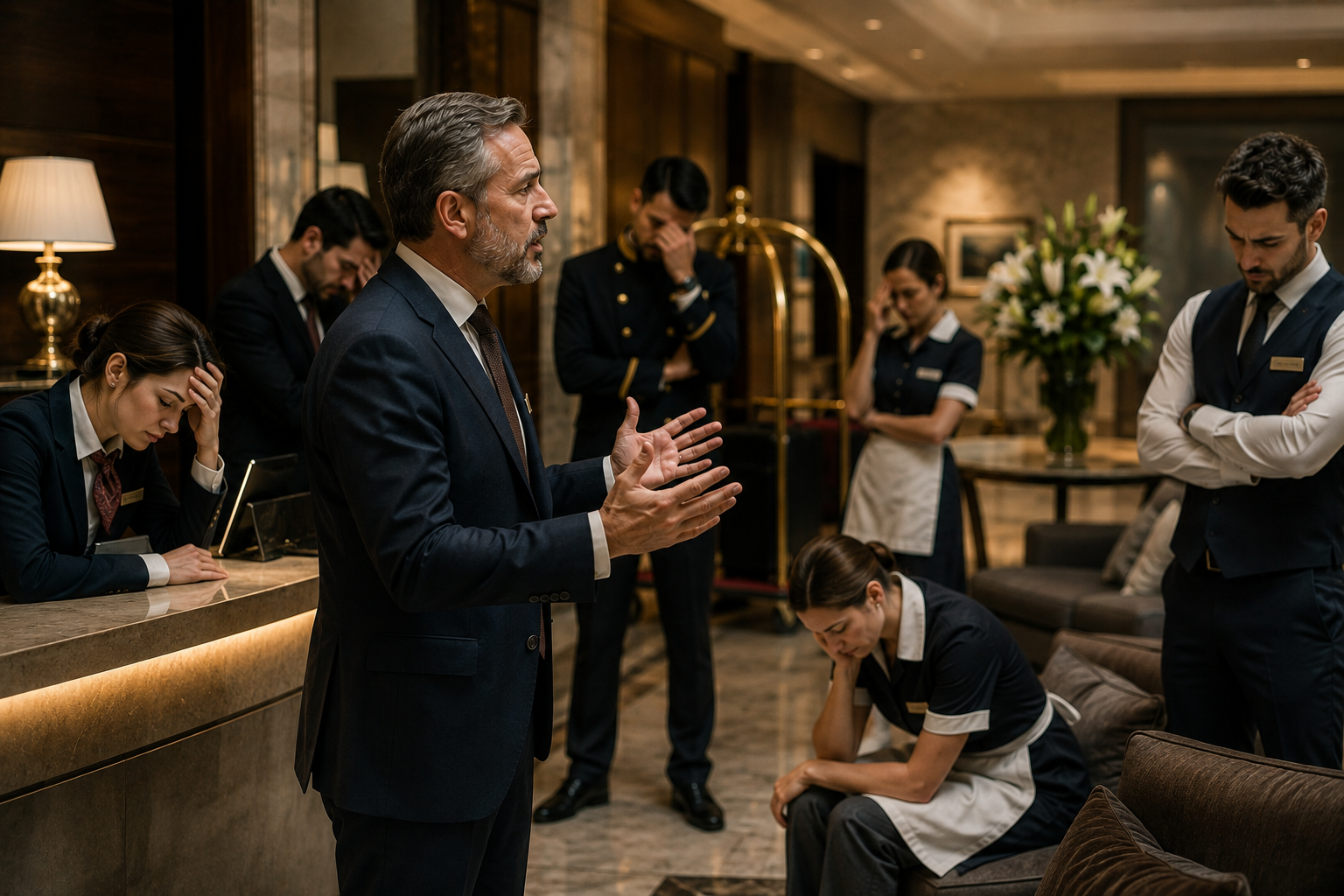

For much of my professional career, I believed that being highly demanding was almost always a virtue. In Hospitality, it is difficult not to reach that conclusion. We live focused on details, standards, schedules, costs, guest reviews, inspections, budgets and results. We know that an apparently perfect room can be undermined by a hair in the bathroom, that ten minutes of waiting can shape an arrival, and that an excellent breakfast may ultimately be remembered for a cup that took too long to clear. We learn very early that details matter and, precisely because of that, develop a certain obsession with controlling them.
I still believe deeply in high standards. A hotel that gives them up inevitably begins to decline. Standards loosen, small deviations become normalised, and what was initially an exception ends up becoming routine. But over the years, I have also learned something that seems far more difficult to accept: there is a point beyond which demanding more no longer improves results. It can even begin to make them worse. When we obsessively pursue perfection, we can end up creating organisations that are more tense, less autonomous, less creative and, paradoxically, less excellent.
The boundary is extraordinarily fine because, from the outside, both behaviours can look identical. A demanding professional inspects a room; so does a perfectionist. A demanding professional corrects a procedure; so does a perfectionist. Both identify mistakes, challenge results and want to improve. The difference lies in what they do after the mistake. One seeks to understand it, correct it and prevent it from happening again. The other needs to find someone to blame, exert more control and ensure that something which, in an organisation made up of human beings, will probably happen again at some point never happens again.
Brad Stulberg’s reflection on excellence in The Way of Excellence strikes me as particularly useful for understanding this difference. Excellence and perfectionism are not synonymous. Excellence involves growth, progressive mastery, commitment and consistency; perfectionism easily turns the outcome into a permanent test of our own worth. One asks: “How can we do this better?” The other asks: “How could this have happened?” It may seem like a semantic difference, but within a hotel’s culture it separates two entirely different worlds.
Because a hotel does not need people who are terrified of making mistakes. It needs professionals who strive not to make mistakes, but who know how to respond exceptionally well when they inevitably do. That difference determines the speed of learning, initiative, internal communication and, ultimately, the guest experience.
When excellence turns into fear
There is a contradiction I have observed many times in Hospitality. We want employees with initiative, but then challenge every decision they make. We want autonomous managers, but we want to approve everything. We want problems to be reported quickly, but we react so intensely when someone reports one that next time they may prefer to try to hide it.

Stop managing isolated systems. Start managing the whole hotel.
HotelGEX connects guests, operations, Revenue, F&B, Groups & Events and Management into one intelligent hotel context — so every decision starts with a clearer picture.
Then we wonder why nobody makes decisions.
The answer may be uncomfortable: because we have taught them that making decisions is dangerous.
Micromanagement rarely begins with bad intentions. It usually arises precisely from a sense of responsibility. We know the business, we know how we want things done, and we have learned—often through our own mistakes—that certain details matter. So we check.
Then we check again.
And finally, we check that someone has checked.
Without realising it, we can end up building an organisation in which many people work but very few think without asking permission.
Hospitality literature has reminded us for decades that guest satisfaction depends to a great extent on the attitudes, capabilities and behaviours of frontline employees. Service excellence cannot be created exclusively from an office: it requires recruitment, training, feedback, assessment and a culture that enables learning to be transferred into daily operations.
If every interaction requires senior approval, we have confused control with quality.
And we have also created an operational problem.
The bottleneck may be the person who works the hardest
There is a particularly paradoxical situation in some organisations: the hardest-working person ends up becoming the hotel’s main bottleneck.
Everything goes through them.
Rates.
Purchasing.
Complaints.
Rota schedules.
Recruitment.
Room moves.
Compensation.
Events.
Maintenance.
Menus.
Communications.
Commercial decisions.
Even matters that someone else could perfectly well resolve.
From the outside, it looks like extraordinary commitment. And it probably is.
But organisationally, it can be a disaster.
If an organisation permanently needs one specific person to function properly, we do not have a robust system. We have dependency.
A mature organisation should be able to maintain its standards even when its leaders are not present. That requires procedures, accountability, training, information, and clear relationships between roles and people. The classic principles of organisation already identified the need for objectives, people, systems, procedures, authority and responsibility in order to provide stability and continuity.
Delegating, however, means accepting something uncomfortable:
they will probably not do certain things exactly as we would do them.
This is one of the hardest lessons to learn.
We can teach what the expected outcome is, set boundaries, define standards and review results. What we cannot expect is for every person to replicate our exact way of thinking.
If there is only one correct way—the way we do it—we are not developing professionals.
We are producing executors.
And those responsible for execution are waiting for instructions.
The hidden cost of not allowing mistakes
Let us imagine that a receptionist makes a reasonable decision in response to a complaint and grants €25 in compensation.
Later, we decide that perhaps €15 would have been enough.
We have two options.
We can use those ten euros as an opportunity to explain service recovery criteria.
Or we can turn them into an investigation.
Why did you do it?
Who authorised you?
Why did you not ask?
What exactly happened?
The message that person will probably receive will not be, “We need to refine our judgement.”
It will be:
“Next time, do not make a decision.”
Then the next complaint arrives.
And they ask.
The manager is busy.
The guest waits.
Reception calls again.
The guest becomes impatient.
Eventually, we authorise exactly what the employee could have resolved ten minutes earlier.
And then we complain that the team lacks autonomy.
Some mistakes cost money.
But there is also a cost to not allowing people to make mistakes.
It is harder to quantify: slowness, bureaucracy, dependency, loss of initiative, fear, duplicated work and management burnout.
Lean Hospitality is fundamentally concerned with identifying activities that consume resources without creating value for the guest. If we were to analyse some organisations from this perspective, we would discover a considerable amount of time invested in validations, authorisations, checks and rework created solely by our inability to trust.
Not all mistakes carry the same weight
Here, I believe it is essential to introduce a distinction.
We cannot relativise everything.
There are mistakes relating to safety, hygiene, legal compliance, guest protection, financial integrity or reputation that require an exceptionally low tolerance level.
But there are also minor operational mistakes.
And then there are things that simply are not mistakes, even if they were not done exactly as we would have preferred.
I find it useful to classify deviations into three levels:
- Critical errors. They may affect safety, health, legality, data protection, financial integrity, or cause significant harm to the guest. Here we need strict procedures, clear controls and the ability to respond immediately.
- Operational errors. They create inconvenience, cost or service deterioration, but are part of the normal risk of a human operation. We should analyse them, correct them and use them to improve processes and training.
- Differences in judgement. The outcome is correct, even though another person arrived at it by a different route from the one we would have taken. Here, we probably should not intervene.
Confusing these three categories creates enormous amounts of unnecessary tension.
A hygiene deficiency cannot carry the same importance as a napkin placed two centimetres differently.
Although at nine in the morning, after three coffees and before an inspection, it may sometimes seem that way.
When everything is important, nothing is important
This is probably one of the most common illnesses in highly demanding organisations.
Everything is a priority.
Everything is urgent.
Everything must be perfect.
And everything must be done today.
The result is predictable: the team stops distinguishing.
If we react with the same intensity to a serious problem and a minor deviation, people learn that everything triggers the same storm. And when everything triggers the same storm, they stop using judgement and simply begin protecting themselves.
Excellence requires prioritisation.
What directly affects the guest?
What affects safety?
What significantly affects financial performance?
What could become a recurring problem?
What truly deserves our intervention?
And above all:
what can we let go?
This final question is surprisingly difficult for highly demanding people.
But leading also means consciously deciding what does not deserve our energy.
Perfectionism also damages the guest experience
We may think this problem only affects the team.
It does not.
Guests can clearly sense a hotel’s internal culture.
They sense the waiter who is more focused on not making a mistake than on engaging naturally.
They sense the receptionist who checks three times before responding.
They sense the employee who uses rigid phrases because departing from the script carries a risk.
They sense the tension between departments.
They sense the manager who appears immediately because nobody dares to resolve an issue.
Technically perfect service can be emotionally mediocre.
Hospitality was born around a human relationship between the person who receives and the person who arrives. Even historical definitions of hospitality revolve around protection, attention, welcome and care for the stranger.
That requires procedures.
But it also requires naturalness.
If we turn every interaction into a protocol, we may end up eliminating precisely what made the experience memorable.
Perfection can also destroy innovation
Innovation means trying something whose outcome we do not yet know.
If we demand absolute certainty before acting, we simply will not innovate.
Real innovation inevitably produces some initiatives that work and others that do not.
A new food and beverage concept may fail.
A promotion may not sell.
An event may perform less well than expected.
An operational reorganisation may need adjustments.
A new experience may not appeal to the guest.
The problem is not making mistakes.
The problem is making costly mistakes, making them for too long, or learning nothing from them.
That is why I prefer to speak of responsible experimentation: test on a small scale, measure, learn and scale what works.
The perfectionist alternative is to analyse indefinitely until finding the supposedly perfect solution.
Meanwhile, someone less perfectionist has already tried it five times.
The tyranny of detail
In Hospitality, we constantly say that detail makes the difference.
It is true.
But something should be added.
Not all details make the same difference.
We can invest an extraordinary amount of energy perfecting aspects that the guest barely notices while more important structural problems remain unresolved.
I have seen organisations spend hours discussing small aesthetic elements while maintenance issues persisted.
They have analysed a menu design for weeks while service times were excessive.
They have pursued small budget variances while certain commercial decisions had far greater impacts.
Excellence needs attention to detail.
But it needs even more judgement in choosing the right detail.
There is an interesting connection here with Revenue Management. Its very philosophy requires decisions to be made using knowledge of guests, pricing, events, history, competition and distribution, and explicitly raises the need to say no to certain business when it does not contribute to the hotel’s objectives.
The same judgement should be applied to our time.
We must also learn to say no to certain tasks.
Because management attention is also a limited resource.


My published books
The problem with managing by exception
Another behaviour associated with perfectionism is changing processes every time something goes wrong.
A guest complains.
We create a rule.
Another finds an exception.
We create another one.
An incident occurs.
We add a form.
Someone forgets to complete it.
We add a signature.
Then we need to verify the signature.
After a few years, we have built an extraordinarily complex system designed around everything that has ever gone wrong.
The result may be a hotel perfectly prepared to avoid the mistakes of the past and completely unable to operate with agility in the present.
Exceptions should teach us.
But not all of them deserve to become a procedure.
Before changing a process, I try to ask myself:
Are we facing a systemic problem or an anomaly?
If it happens repeatedly, we must intervene.
If it happened once in ten thousand operations, perhaps the solution is not to add bureaucracy to the other 9,999.
Perfection can conceal insecurity
This may be the most uncomfortable reflection of all.
Sometimes our perfectionism does not arise solely from wanting to do things well.
It can also arise from our fear of losing control.
If someone else makes a decision, they may make a mistake.
But they may also get it right.
And they may discover a better way than ours.
Truly delegating means accepting both possibilities.
Professional confidence and humility should progress together. The more we know, the more aware we should be of the complexity of the business and of our own limitations.
When a team begins to function without needing our constant intervention, we may feel a strange loss of relevance.
In reality, exactly the opposite should happen.
The success of a leader should not be measured by how much they are needed, but by how much they have enabled the organisation to do well without needing them.
That does not mean disappearing.
It means raising the level of our contribution.
Less time checking tasks that others can check.
More time spent thinking about strategy, guests, talent, profitability, positioning and the future.
From controlling people to designing systems
I believe this evolution is essential.
When something fails, we can ask:
“Who made the mistake?”
Or we can ask:
“What allowed this mistake to get this far?”
The first question quickly finds someone to blame.
The second may find a solution.
It does not eliminate individual accountability. There are negligent behaviours and failures to comply that must be managed.
But many mistakes are the consequence of deficient processes, insufficient training, ambiguous responsibilities, poorly designed workloads or information that does not arrive in time.
The hotel organisation needs clear relationships between roles, responsibilities and objectives in order to achieve stability and coordination.
When we correct only the person but leave the system untouched, we will probably encounter the same problem again, involving someone else.
Perfectionism also exhausts those who practise it
There is another victim of this culture that we rarely discuss:
ourselves.
Trying to control every detail of a hotel is exhausting.
There will always be something to review.
There will always be a room.
An invoice.
A review.
A purchase.
An incident.
A forecast.
A dish.
A conversation.
A shift.
A light left on where it should not be.
If our peace of mind depends on absolutely everything being exactly as we believe it should be, we have chosen a profession that is extraordinarily ill-suited to finding peace of mind.
A hotel is alive.
And precisely for that reason, it will never be completely finished.
Sustainable excellence requires accepting that reality.
It does not mean complacency.
It means managing our energy with the same intelligence with which we manage our financial resources.
Because an organisation permanently operating at maximum intensity eventually becomes exhausted.
And so is a person.
From a culture of fear to a culture of accountability
I do not want a hotel where mistakes do not matter.
I want exactly the opposite.
I want them to matter enough that we can talk about them.
That someone can say:
“I made a mistake.”
Without immediately adding:
“But it was because…”
I want teams capable of taking responsibility, explaining what happened, proposing a solution and learning.
That requires reciprocity.
If we ask for transparency, we must be able to receive bad news without destroying the messenger.
If we ask for autonomy, we must accept different decisions.
If we ask for initiative, we must tolerate certain mistakes.
If we ask for accountability, we must provide authority.
And if we demand excellence, we must provide training, resources, clarity and time to learn.
Service culture is built around the people who deliver the experience and around how we recruit, train, assess, incentivise and learn from guest feedback.
We cannot demand excellence through fear.
We can obtain obedience.
Perhaps even for quite some time.
But obedience and excellence are different things.
My first piece of advice would be to review regularly where you are truly adding value and where you are simply controlling. For one week, observe how many decisions reach you that someone else could perfectly well have made. Do not blame the team for bringing them to you. Ask yourself what you have done to make them feel they need to consult you. Perhaps training, clear criteria, financial limits or simply trust are missing. Every decision we successfully move to the place where it should be made frees up capacity for matters of greater impact.
My second would be always to distinguish between a standard and a personal preference. A standard protects the experience, safety, brand or results. A preference means that we simply prefer things to be done in a certain way. Confusing the two generates an enormous amount of frustration. If the outcome meets the standard, perhaps we need to learn something that some demanding people find surprisingly difficult: leave it alone.
And my third would be to remember that our job is not to build a hotel where nobody ever makes a mistake, but a hotel that makes fewer mistakes over time, detects them earlier, resolves them better and learns from them faster. That seemingly small shift transforms the culture completely. Perfection pursues an impossible destination. Excellence accepts that we will never arrive and, precisely because of that, keeps moving forward.
This article ends here. The archive does not.
Lead Hospitality brings together 1200 English articles published since 2018: years of experiences, decisions and lessons you can keep exploring.
What would you like to explore next?
Choose a direction and keep reading around what you want to solve, learn or challenge.