
The AI Bubble in Hospitality: An Industry Déjà Vu from the Social Media Era

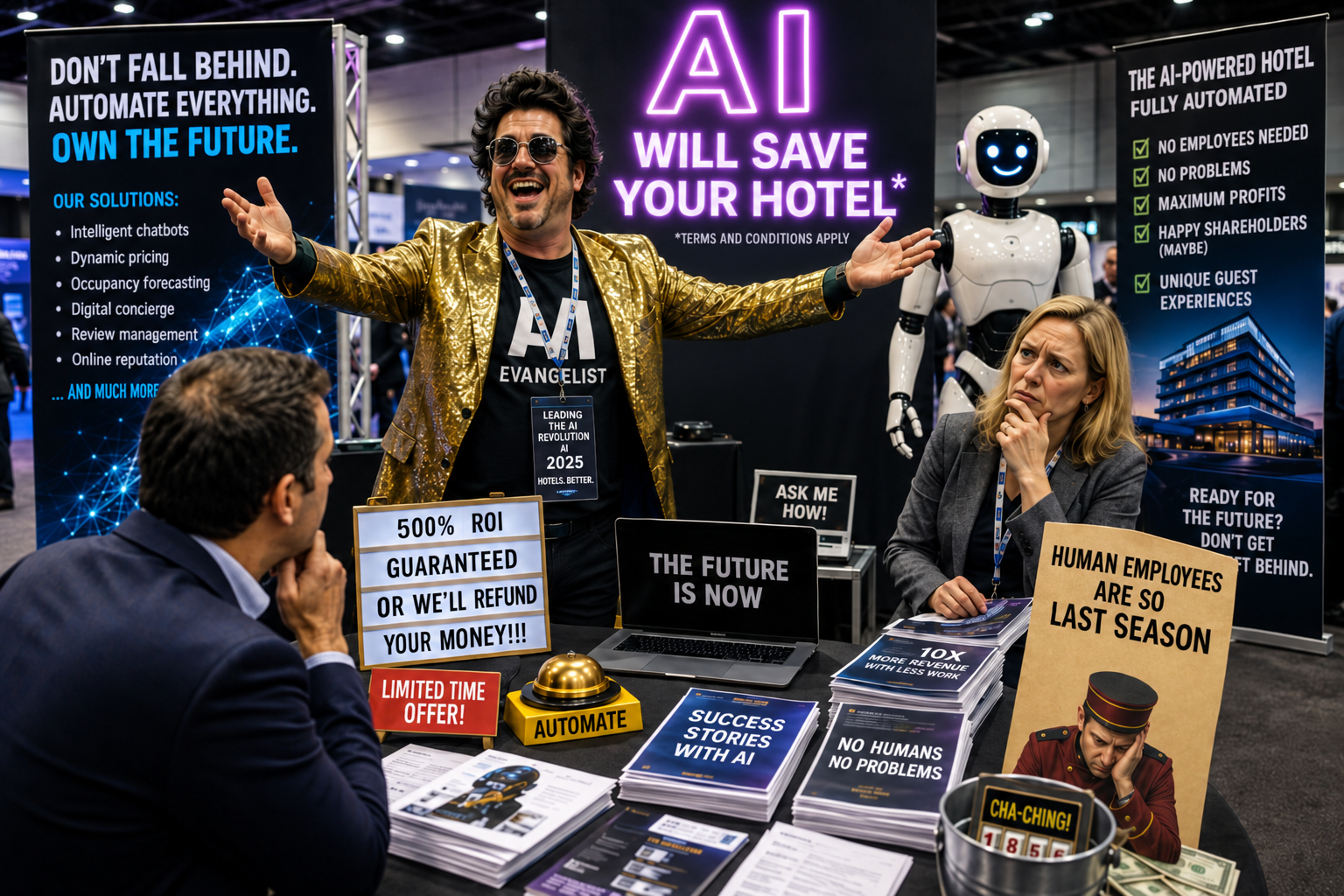
 Every week, new “experts” in artificial intelligence applied to hotels emerge. Many of them have never managed a hotel operation, dealt with an overbooking on an August Saturday, had to contain a reputation crisis at eleven at night, or managed an unmotivated team in the middle of peak season. Yet they speak with overwhelming confidence about how AI will revolutionise the guest experience.
I have even seen something on social media that I find, frankly, as fascinating as it is worrying: the profiles of supposed “experts” delivering masterclasses on how to redesign a check-in, eliminate reception queues or reorganise a hotel’s operational layout… without ever having worked in one. People who have never experienced an overbooking at eleven at night, never had to manage the simultaneous arrival of a group of 80 people while the PMS goes down, or never felt the real pressure of a guest waiting for an immediate solution in front of other customers. And yet they speak with almost surgical certainty, as though hospitality could be solved through a LinkedIn thread, a thirty-second video or a Canva template with coloured arrows.
What is truly dangerous is not only the superficiality of the discourse, but also its patronising tone. Simplistic ideas are put forward for extraordinarily complex operations, ignoring the human, architectural, cultural, financial and emotional factors that shape every decision in a hotel. They reduce decades of operational experience to phrases such as “automate this”, “remove that desk” or “do check-in on mobile”, as if the guest were an algorithm rather than a tired, emotional, unpredictable person who is different every day. It is pathetic to watch some people turn practical ignorance into digital authority, while professionals who have spent years keeping real hotels running barely have time to record themselves offering advice because they are, quite simply, working in the real world.
And this is where the real problem begins: when an industry historically obsessed with chasing trends starts confusing innovation with collective anxiety.AI Is Being Sold More as a Symbol Than as a Solution
Hospitality has a certain structural weakness for management fads. We find it hard to admit, but historically we have been a highly impressionable sector. We have chased concepts, certifications, marketing trends and operating models many times before truly understanding their economic or operational impact. Something similar is happening with AI, but on a larger scale. Today, many hotels feel the need to “do something with AI” simply to avoid appearing outdated. And when technology is implemented due to reputational pressure rather than strategic need, the risk of disappointment is enormous. The pattern is almost identical to the one we experienced with social media:- First, an apocalyptic narrative emerges.
- Then comes the sense of urgency.
- Then the gurus arrive.
- Later, there is a mass offering of courses.
- Then miracle solutions proliferate.
- Finally, the market discovers that reality was far more complex.
- Mass loyalty.
- Hyperactive communities.
- Ongoing conversations with customers.
- Direct conversion into sales.
- Automatic brand humanisation.
- Generating irrelevant content.
- Posting out of obligation.
- Hiring community managers without a strategy.
- Chasing empty metrics.
- Measuring success in likes instead of profitability.
- “AI will completely change hospitality.”
- “Anyone who does not adopt AI will disappear.”
- “AI will replace entire departments.”
- “AI will revolutionise the customer experience.”
Much Talk, Few Genuine Success Stories
This is probably the most striking aspect of this entire frenzy. There is an enormous amount of content about artificial intelligence… and surprisingly few solid, in-depth and sustainable cases of genuine success in hospitality. I am not talking about:- using ChatGPT to write descriptions,
- automating emails,
- generating review responses,
- creating images for social media,
- or summarising reports.
- radically changes profitability,
- alters the cost structure,
- substantially improves the experience,
- creates sustainable competitive advantages,
- or redefines a business model.
The New Industry of the “AI Expert”
There is another fascinating parallel with the social media era: the mass emergence of instant experts. Suddenly:- everyone gives talks,
- everyone sells training,
- everyone has frameworks,
- everyone talks about prompts,
- everyone has “the definitive method”.
- more profitability,
- more productivity,
- less operational friction,
- better decisions,
- better leadership,
- better processes,
- and more efficient teams.
- A spectacular chatbot that does not improve conversion.
- A virtual assistant that creates frustration.
- An automated system that forces the guest to do more work.
- An AI-filled dashboard that nobody consults.
- A hyper-automated hotel that loses its humanity.
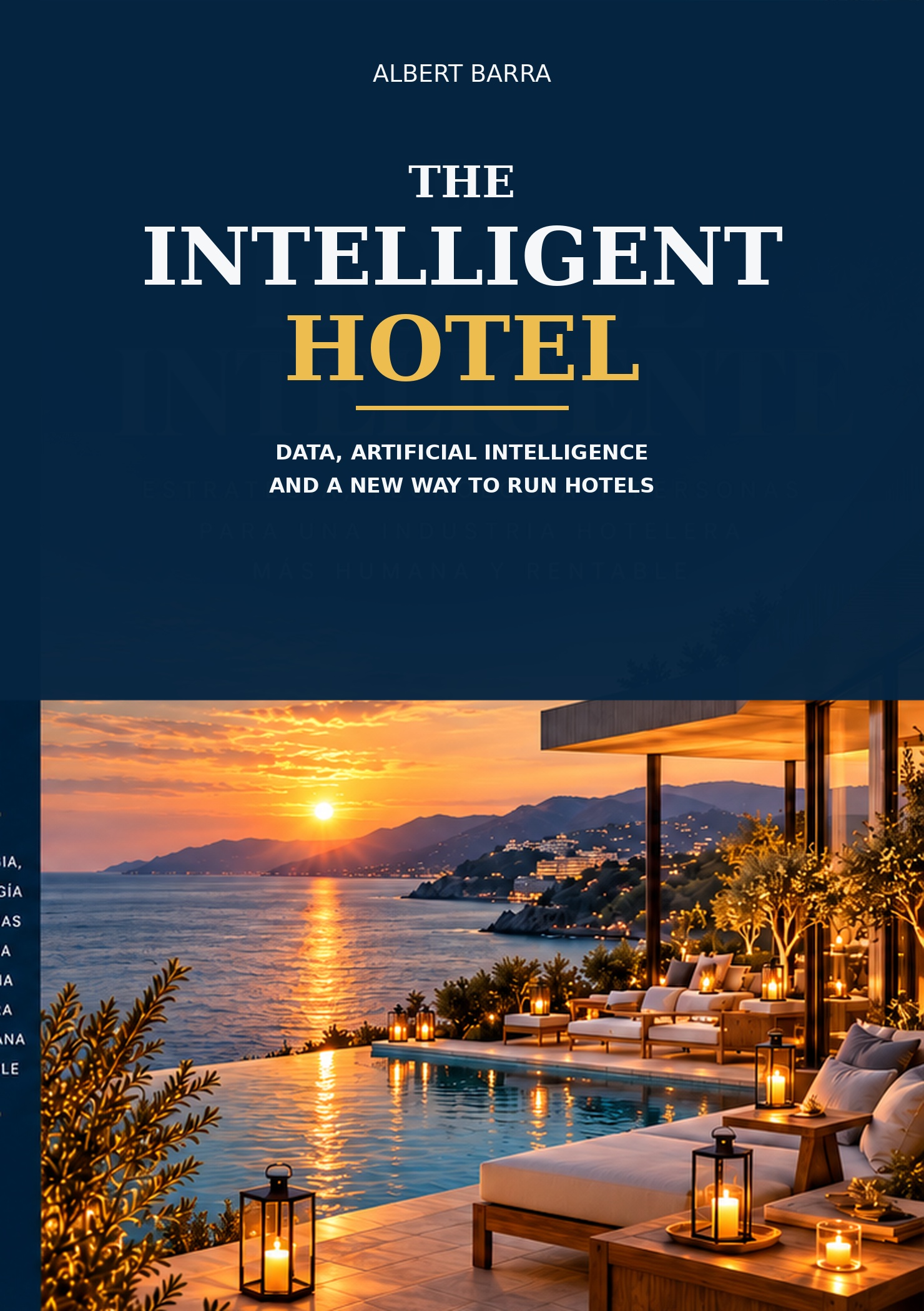
The Intelligent Hotel
Data, Artificial Intelligence and a New Way to Run Hotels
Go deeper into how AI, data and automation are transforming hotel management, commercial performance and the guest journey.
Hospitality Has a Fundamental Problem: It Confuses Tools with Strategy
This is nothing new. For years, many hotels confused:- having social media with having marketing,
- having a CRM with having loyalty,
- having a channel manager with having strategic distribution,
- having a PMS with having operational control.
- What specific problem are we solving?
- What operating cost are we reducing?
- What experience are we genuinely improving?
- What KPI is changing?
- What financial return do we expect?
- Which human tasks are worth preserving?
- Are we automating for efficiency or because it is fashionable?
The Great Irony: The More AI There Is, the More Important Humanity Will Become
There is something deeply paradoxical about all this. The more automated the sector becomes, the more valuable what cannot be automated will become. In an environment saturated with:- automated responses,
- generated messages,
- robotised processes,
- virtual assistants,
- and standardised experiences…
- a brilliant automation,
- an efficient chatbot,
- or a flawless digital process.
- how you made them feel,
- how you solved a problem,
- how your team reacted,
- or the emotional impression they took away from the hotel.
We Are Entering the Market Maturity Phase
I believe AI will survive this bubble. Unlike other passing fads, it has genuine transformative potential. But I also believe we are approaching an inevitable stage: the filtering stage. Soon, the market will begin to distinguish:- utility from spectacle,
- efficiency from marketing,
- genuine innovation from performative posturing,
- and strategy from opportunism.
- where to use it,
- where not to use it,
- and when the human experience remains infinitely superior.
This article ends here. The archive does not.
Lead Hospitality brings together 1200 English articles published since 2018: years of experiences, decisions and lessons you can keep exploring.
What would you like to explore next?
Choose a direction and keep reading around what you want to solve, learn or challenge.