
Leading from Afar: Deferred Micromanagement

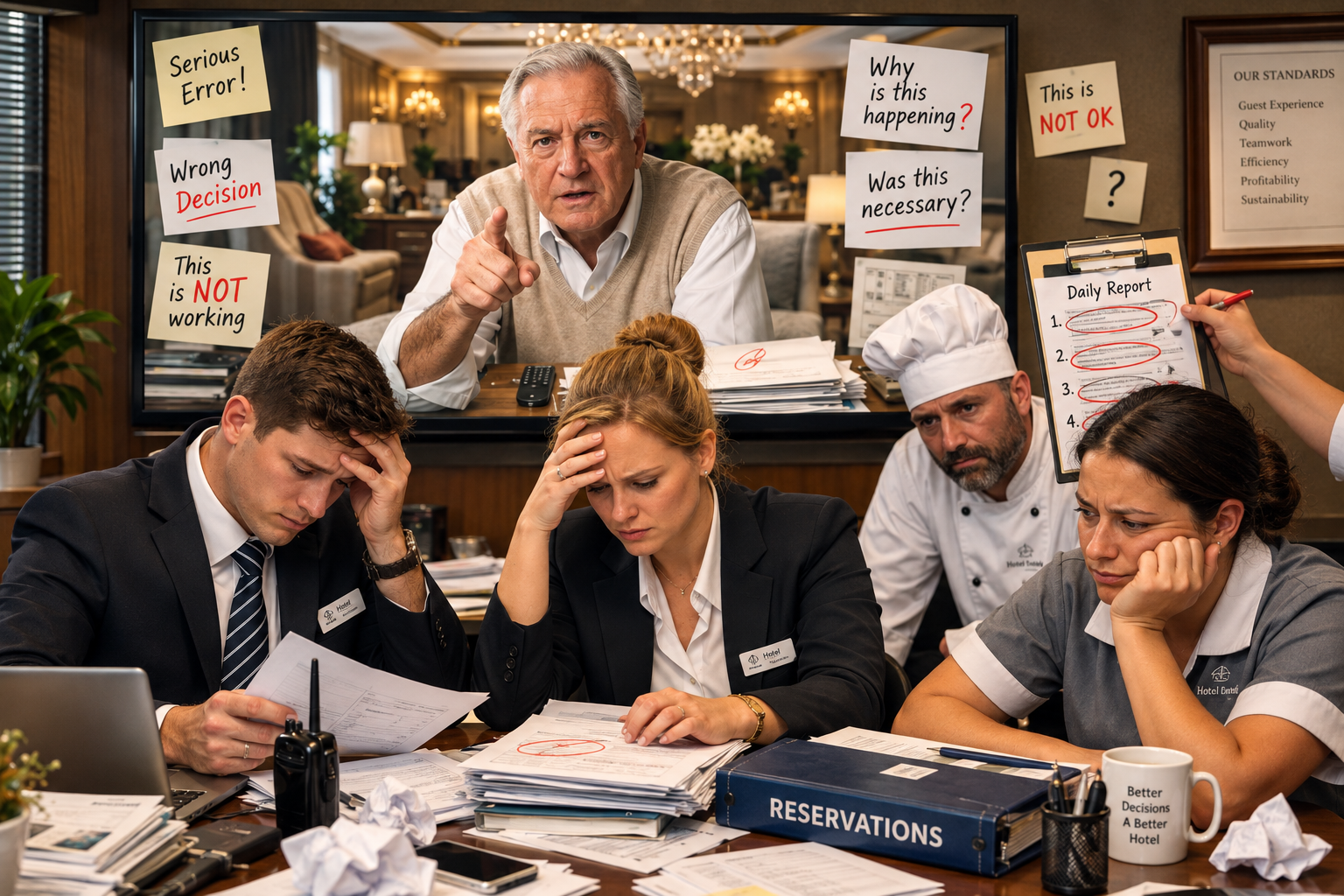

There is a kind of control that goes unnoticed at first, yet ends up weighing more heavily than any direct supervision. It does not interrupt meetings, walk through the hotel, enter the kitchen or step into reception. In fact, it is hardly ever there. And yet, it always appears afterwards. Once the decision has already been made, the guest has already reacted, and the problem has already had consequences.
I call it deferred micromanagement. And in Hospitality, when it is exercised by ownership, it becomes one of the most demoralising ways to run a hotel.
Because there is something profoundly unfair about reviewing decisions without having been there when they had to be made. About offering an opinion without having felt the pressure of the moment. About correcting without having had to answer to an angry guest, a disappointed couple or a supplier demanding immediate answers. Ownership watches from afar, with time, calm and perspective… and judges decisions made without any of those privileges.
Meanwhile, the hotel operates in real time. Or it does not operate at all.
Those leading the operation do not make decisions with an Excel spreadsheet open or a meeting scheduled. They decide with the guest standing in front of them, the restaurant full, an overbooking that cannot wait, and a team looking to them for support. They decide knowing that every option has a cost, and that not deciding is also a decision. And yet, afterwards, comes the comment: “I would have done it differently”. Always in hindsight. Always without risk.
Deferred micromanagement is comfortable. It does not wear you down. It does not expose you. It does not require you to take a stand. It allows authority to be exercised without assuming the discomfort that genuine leadership entails. And perhaps that is why it is so tempting for some owners: it offers a sense of control without having to live with the consequences of day-to-day operations.
The problem is that this kind of control does not improve the hotel. It diminishes it.

Gradually, those running the operation stop making decisions based on judgement and start making them out of fear. Fear that, whatever happens, someone will review the play from outside, with different information, a different context and a different tolerance for risk. Then come constant consultations, unnecessary hesitation and slowness. Not because capability is lacking, but because support is lacking.
And when a hotel starts operating this way, it stops thinking about the guest and starts thinking about avoiding mistakes. It stops asking, “What is best right now?” and starts asking, “What will they say to me later?” That is the prelude to operational mediocrity, even if everything looks orderly and under control from the outside.
There is also an underlying inconsistency that is hard to admit: professional judgement is demanded, but it is not accepted that two professionals may make different decisions in the same situation. Leadership is requested, but every move is corrected with the benefit of hindsight. People speak of trust, but practise deferred suspicion.
Ownership that acts this way usually justifies it in the name of the business, the brand or the money. But the reality is simpler: you cannot ask others to take risks you are unwilling to take yourself. And running a hotel means taking them. Every day.
A hotel needs neither an omnipresent nor an absent owner. It needs a mature owner. One that understands its role is not to review decisions one by one, but to build a solid framework for sound judgement, trust it, and accept that, within that framework, there will be imperfect decisions. Because perfection only exists when no guests are waiting for an answer.
In the end, the question is not whether a decision was exactly the one ownership would have made. The real question is whether the hotel responded with consistency, dignity and speed when it was needed. Everything else is boardroom rhetoric.
Deferred micromanagement reassures those who practise it. But it strips the hotel of its soul, agility and character. And in Hospitality, that comes at a price. Always.



My published books
Yes. And saying it out loud is uncomfortable, but necessary.
Very often, deferred micromanagement does not stem from a desire for control or some supposed obsession with detail. It stems from something much more basic and far less readily admitted: a lack of trust in the people on the team. And when that mistrust comes from ownership, the problem is not operational; it is structural.
When there is no genuine trust in the people who lead the hotel every day, something curious happens: they are allowed to act… but are not granted the moral authority of having made the right decision. Action is tolerated, but judgement is not validated. It is a kind of half-delegation, profoundly damaging because it conveys an ambiguous message: “You do it, but do not forget that the final judgement is not yours”.
A lack of trust is rarely expressed directly. No one says, “I do not trust you”. It manifests itself in far subtler and more corrosive ways: constant after-the-fact reviews, questions intended not to understand but to confirm suspicions, comments that dismiss complex decisions with a “this was simple”. Always afterwards. Always from the outside.
In Hospitality, this mistrust is especially serious because the business is, above all, a business of people managing people. No manual, standard or protocol can cover every real-life situation experienced in a hotel each day. If there is no trust in the human judgement of those on the frontline, all that remains is control… and control never replaces judgement.
There is also a paradox that is hard to ignore: many owners mistrust the team they themselves have chosen or allowed to become established. They do not invest enough in selecting, training and supporting people, but they do invest time and energy in reviewing, correcting and questioning them. It is like mistrusting the mirror instead of examining the image it reflects.
This lack of trust ultimately has very tangible effects. The team stops engaging emotionally. Operational management stops feeling that the hotel is their own. People do only what is required, make only the minimum decisions, and avoid any initiative that might cause friction afterwards. The hotel keeps operating, yes, but it operates without a pulse.
And perhaps the most perverse aspect of all is that deferred micromanagement reinforces the mistrust that gave rise to it. If every decision is questioned, the team ends up making poorer decisions, not because of incapacity but because of insecurity. And then ownership confirms its initial prejudice: “See? That is why everything has to be reviewed”. The circle is complete.
Trusting is not the same as disengaging. Trusting means accepting that people can make mistakes within a clear framework, and that those mistakes are part of the hotel’s learning and maturity. Trust is not demonstrated by reviewing past decisions, but by supporting present decisions.
In the end, a hotel can survive with thin margins, limited facilities or difficult markets. What it cannot withstand for long is a relationship based on suspicion. Because where there is no trust, there is no shared judgement. And without shared judgement, Hospitality becomes a succession of stopgaps… always reviewed far too late.
This article ends here. The archive does not.
Lead Hospitality brings together 1200 English articles published since 2018: years of experiences, decisions and lessons you can keep exploring.
What would you like to explore next?
Choose a direction and keep reading around what you want to solve, learn or challenge.