
The Front Desk Is No Longer a Department: How to Turn It into a High-Value Decision Hub

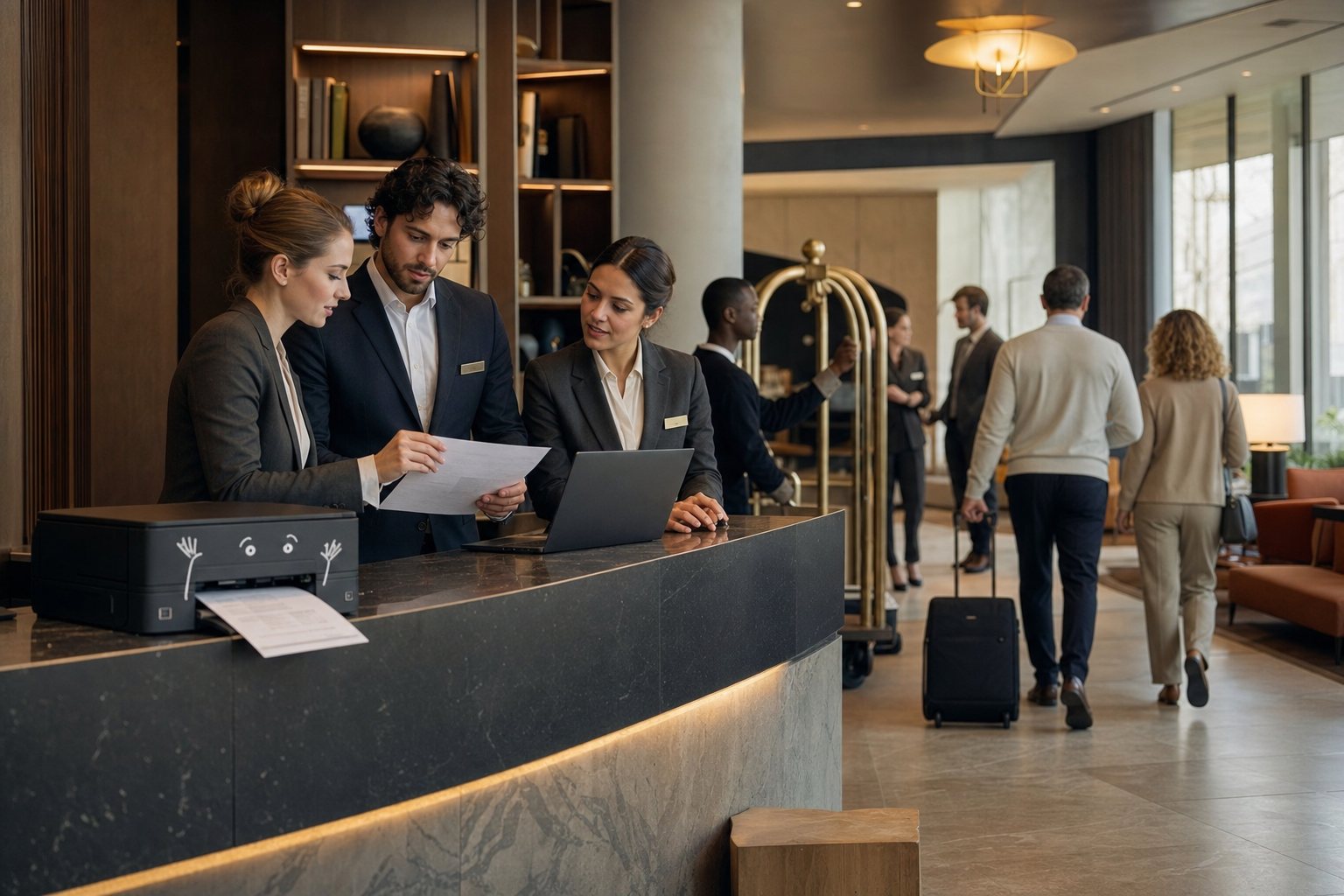

I am tired of walking into hotels where Reception is still treated as a combination of administrative counter, incident switchboard and document-printing station. Capable teams, close to the guest and exposed to a vast amount of relevant information, end up spending much of their day checking data, repeating explanations, chasing authorisations or relaying messages between departments. Then we are surprised when the experience feels slow, impersonal or ineffective. The problem is rarely the attitude of those working behind the desk. It lies in the limited role the organisation has assigned to them.
Fortunately, that is not how we understand Reception at my hotel. I am not claiming that we do everything perfectly or that every decision always turns out well. That would hardly be credible in an operation dealing with early arrivals, rooms still pending, last-minute changes, special requests and the occasional printer that retains a mysterious right of veto over the pace of the shift. What we have learned is that Reception cannot be limited to processing the stay. It must interpret what is happening, assess what may happen next and act before a small deviation becomes a costly problem.
The transformation of the front desk is often explained through digitalisation: online check-in, mobile keys, kiosks, automated payments or pre-arrival communication. All of this can be useful, but I believe the debate is incomplete when it focuses solely on removing tasks. If we automate registration while leaving authority levels, coordination habits and service standards untouched, we will simply have created a reception desk with less paperwork. Freeing up time does not create value in itself. Value emerges when that time translates into better decisions.
Reception occupies a unique place in the hotel’s architecture. It sees guests when they arrive with their expectations still intact, detects signs of fatigue or unease, knows the state of inventory, receives the consequences of commercial promises, perceives operational tensions and hears comments that will never make it into a survey. No other point in the property so regularly brings together guest context, operational information and time sensitivity. Failing to make use of that position is one of Hospitality’s most costly and, at the same time, least visible organisational decisions.
My proposal is to redesign Reception as a high-value decision centre throughout the stay. This does not mean turning it into the owner of every problem or transferring responsibilities that belong to Housekeeping, Maintenance, Food & Beverage, Revenue or Sales. It means equipping it with the judgement, authority and coordination channels needed to protect the hotel’s promise, recover service, identify relevant opportunities and reduce the effort we impose on the guest. The change may seem semantic, but it affects hotel management, hospitality leadership, the hotel guest experience and, ultimately, hotel profitability.
The administrative counter is disappearing; the need for judgement is not
When I observe the activity of a traditional reception desk, I find a contradiction that is difficult to justify. We place professionals who see and hear virtually everything on the frontline, yet allow them to decide very little. They know a guest is dissatisfied, but must wait for authorisation to offer a solution. They identify that a family needs a different room configuration, yet lack the latitude to reorganise the allocation. They spot a clear sales opportunity, yet the process requires them to recite a generic offer. They sense that an early arrival may end badly, yet nobody has explained which alternatives they can activate.
Under these conditions, Reception does not manage the experience. It administers the consequences of decisions made elsewhere. Marketing makes promises, Revenue sets the configuration, Reservations enters the conditions, Housekeeping prepares rooms, Maintenance resolves faults and Food & Beverage manages its capacity. Yet when one piece does not fit, the guest does not turn to the organisation chart. They turn to the desk.

Stop managing isolated systems. Start managing the whole hotel.
HotelGEX connects guests, operations, Revenue, F&B, Groups & Events and Management into one intelligent hotel context — so every decision starts with a clearer picture.
This detail should make us reflect. Guests attribute an authority to Reception that many hotels deny it internally. To the guest, the person standing in front of them represents the entire property. To the organisation, however, that same person may be merely the final link in a chain of approvals. The gap between those two perceptions creates a particularly harmful form of friction: the appearance of capability without the real ability to respond.
I have seen a simple incident drag on because the team had to consult a manager, who in turn consulted another manager, who finally asked what had happened in the first place. By the time the authorisation came back, the original problem had already changed. The guest was more upset, the team more tense and the required compensation greater. The service intention did not fail. Decision-making speed did.
This is why I believe the first role of a redesigned Reception function is to protect the value of the stay while it can still be protected. In Hospitality, many losses occur not because the hotel ignores the problem, but because it acts too late. A room that is not yet available, recurring noise, an unmet preference or a misunderstood reservation can be resolved reasonably at the outset. After two calls, an uncertain wait and several explanations, the same issue takes on an entirely different emotional meaning.
The front desk should intervene in at least five families of high-value decisions:
- Protecting the commercial promise. Reception needs to understand what the guest has actually purchased, which expectations pre-arrival communication has created and which elements of the value proposition are particularly sensitive for each segment. It is not enough to verify a room category. We must recognise the outcome the guest expected and identify as early as possible whether the hotel is able to deliver it.
- Immediate service recovery. An issue managed well during the stay preserves more value than a later apology. The team must be able to assess its severity, decide on a proportionate response, mobilise other departments and verify that the solution has worked. Resolving an issue does not simply mean offering compensation; it means restoring the guest’s confidence that the hotel is in control.
- Contextual, relevant selling. Reception is in a privileged position to generate additional revenue, provided it stops acting as a display stand for promotions. Good contextual selling begins with a genuine signal: a family needing greater comfort, a couple celebrating something special, a traveller requiring more time, a guest asking about dining options or someone who particularly values quiet. The opportunity arises from context, not from a script.
- Coordinating operational capacity. Decisions about early check-in, late check-out, room moves, cleaning priorities, room assignments and additional services simultaneously affect guest experience, workload and revenue. Reception must understand those interdependencies in order to avoid solutions that satisfy one guest while unnecessarily shifting a problem elsewhere in the hotel.
- Reading guest signals. The team observes behaviours that no report captures quickly enough: hesitation, silence, impatience, relief, disappointment, resistance to a price or spontaneous interest in a service. Turning these signals into decisions requires professional sensitivity, but also a system for communicating what has been learned and preventing that information from disappearing at the end of the shift.
These responsibilities require more than friendliness and PMS knowledge. They demand commercial judgement, product understanding, emotional intelligence, operational awareness and influence skills. We still select many Reception professionals for their language skills, presentation and administrative ability, while the role increasingly calls for the capacity to resolve ambiguous situations.
A receptionist may execute twenty procedures correctly and still make a poor decision if they do not understand how the hotel makes money, which segments it seeks to retain, which promises are non-negotiable or which operating costs each alternative triggers. Equally, they may fail to follow a minor procedure and make an excellent decision for the business. Maturity emerges when we stop assessing only whether they followed the steps and begin to analyse whether they understood the situation and protected the right value.
This requires us to reconsider an expression we use far too lightly: empowering the team. I have found that some organisations understand empowerment as giving people a compensation budget and wishing them good luck. Others announce autonomy, then retrospectively challenge every decision made. In both cases, the outcome is predictable. People become conservative, ask for approval on everything and learn that making a decision carries more personal risk than doing nothing.
Professional autonomy needs understandable boundaries. The team must know what it can decide, up to what amount, in which circumstances, according to which criteria and when it must escalate. It also needs the assurance that a reasonable decision will not be judged using information that only became available later. Reviewing decisions in order to learn is essential. Reviewing them from the comfort of the following day as if uncertainty had never existed destroys initiative.
In my experience, a simple decision architecture is more useful than an endless manual. For every recurring situation, it is worth defining four elements: the signal that triggers intervention, the outcome we want to protect, Reception’s authority perimeter and the point at which another level must become involved.
| Situation | Value to protect | Decision Reception can make | When to escalate |
|---|---|---|---|
| Room unavailable on arrival | Trust, time and sense of control | Offer an immediate alternative, store luggage, activate a useful service and set a specific update time | When the wait exceeds the agreed threshold or the alternative affects category, critical inventory or a material cost |
| Recurring issue in the room | Continuity of the stay and credibility | Move the guest, coordinate the transfer and remove the affected room from allocation until it has been verified | When there is a safety risk, multiple guests are affected or there is significant reputational impact |
| Late check-out request | Incremental revenue without damaging operational capacity | Offer options according to occupancy, room category, Housekeeping workload and guest value | When it compromises priority arrivals, groups, special rooms or critical planning |
| Sign of dissatisfaction without an explicit complaint | Preventing a silent loss | Start a conversation, confirm expectations and activate a proportionate preventive action | When the cause depends on a structural promise the hotel cannot fulfil |
| Upgrade or additional service opportunity | Margin, satisfaction and price consistency | Present a contextual offer with a clear guest benefit | When it requires changes to protected inventory, commercial terms or channel agreements |
This approach changes the daily conversation. The question is no longer “which procedure applies?” but rather “what value is at risk, and what decision can we make now?”. Procedures remain necessary, but they become support for judgement rather than a substitute for thinking.
It is also worth avoiding the opposite extreme. Turning Reception into a decision centre does not mean placing every coordination failure in the property on the team’s shoulders. If every incident ends up there, every department sends its unfinished business to the desk and nobody owns the next action, we will merely have renamed overload. Centrality does not mean accumulation. Reception can interpret, prioritise and activate a response, but every commitment must have a clear operational owner.
The distinction matters. Reception does not have to repair the air conditioning, prepare the room or cook an alternative meal. It does need to know who is responsible, when it will be resolved, what to tell the guest and which option to offer if the deadline is missed. Its primary responsibility is not to execute every solution, but to preserve the continuity of the experience.
Redesigning Reception requires changing the system, not moving the desk
I have seen renovations that removed the traditional counter, introduced informal tables and designed visually appealing lobbies. Some improved proximity. Others simply ensured that guests did not know where the queue began. The physical layout matters, but it does not replace the operating model. A front desk can look modern while continuing to function with the same hierarchy, permissions and administrative obsession of twenty years ago.
The redesign must begin by defining Reception’s mission precisely. In our case, I try to ensure that the team understands its work through four verbs: read, decide, coordinate and capitalise. Read what is happening beyond the words. Decide within an agreed perimeter. Coordinate the complete response, even when several departments are involved. Capitalise on every interaction to protect revenue, create value or learn something useful.
From that mission, I recommend working on eight organisational design decisions:
- Remove work that does not require human judgement. It is worth reviewing, one by one, the administrative steps involved in arrival, the stay and departure. Some are mandatory; others survive because nobody has asked why they exist. The objective is not to automate because it is fashionable, but to remove duplication, purposeless checks and tasks that consume attention without improving control, service or compliance.
- Define a real authority map. The team needs to know what it can decide regarding room moves, compensation, upgrades, timings, services, charges, exceptions and recovery. Financial amounts matter, but they are not enough. There must also be boundaries related to safety, positioning, fairness between guests and operational capacity.
- Design alternatives before they are needed. Under pressure, we think less clearly and tend to repeat familiar solutions. Preparing several responses in advance for common incidents reduces improvisation. If a room is not ready, for example, the alternative cannot be limited to asking for patience. It may include luggage storage, access to facilities, a space to change, a dining suggestion, a temporary room or an update at a specific time.
- Connect Reception to the hotel’s operational pulse. The team must know about sensitive arrivals, late departures, Food & Beverage capacity, blocked rooms, technical incidents, Housekeeping priorities, groups, events and inventory restrictions. It does not need to be flooded with reports. It needs the information that changes a decision during the shift.
- Train conversations, not speeches. Scripts can provide reassurance at the beginning, but they often fail when a situation departs from what was expected. I prefer to work on questions, listening, reframing, explaining alternatives and closing commitments. Guests do not expect a perfect phrase; they want to feel that the person understands what they need and can guide the situation.
- Teach the basic economics of the stay. Reception should understand the effect of a commission, the value of an upgrade, the cost of compensation, the impact of blocking a room, the margin on a service and the difference between revenue and contribution. This training improves both selling and service recovery because it enables people to decide with intelligent generosity rather than acting out of fear or giving things away without judgement.
- Create continuity between shifts. A commitment cannot disappear when the person at the desk changes. Every active promise should include an owner, deadline, status and next action. The handover should not be a rushed account of anecdotes, but a structured transfer of outstanding decisions and experience risks.
- Review decisions to learn, not to find fault. Each week, it is worth selecting several cases and analysing them calmly. What information did the team have? Which option did it choose? What value did it protect? What consequences did it create? What would we change next time? This is how shared judgement is built. When review becomes a personal trial, the team learns to conceal and escalate.
This last point has been especially important to me. Judgement is not transmitted through training alone. It develops by exposing the team to real decisions, listening to their reasoning and showing how guest experience, brand, operations and profitability connect. A person learns more from honestly analysing five complex cases than from memorising fifty standard responses.



My published books
The redesign also requires changing recruitment and development profiles. The hotel reception function of the future needs professionals capable of remaining calm, interpreting nuance, explaining boundaries, negotiating alternatives and understanding conflicting priorities. They will not always be the most extroverted people. Some of the best decisions I have seen have been made by understated professionals who observed closely, asked good questions and did not need to prove they were right.
We must also offer them a career path that recognises this complexity. If we present Reception as a stepping stone to another role, we will end up losing accumulated knowledge and relational maturity. A professional can grow by expanding their authority or specialising in recovery, guest experience, sales, training or coordination, without necessarily leaving the frontline. Development should not depend solely on hierarchical promotion.
Selling deserves specific reflection. In many hotels, upselling is still treated as a campaign separate from hospitality. Targets are set, incentives are published and the team is asked to offer certain room categories or services. When the offer does not respond to the guest’s context, the conversation sounds forced and the professional eventually avoids having it.
Contextual selling works differently. First, a need or an opportunity to improve the outcome of the stay emerges. Then, an alternative is presented whose value can be clearly explained. Finally, the guest’s freedom to decide is protected. An upgrade makes sense when it provides space, quiet, views, privacy or comfort that matter to that person. A late check-out has value when it solves a scheduling need. A restaurant reservation is useful when it removes uncertainty or completes a special occasion.
This way of selling connects directly with hotel marketing and hotel revenue management. Price no longer appears as an isolated figure; it is linked to a specific outcome. Reception thus becomes the place where the hotel’s value proposition is translated into the individual guest’s situation. It does not dilute positioning; it makes it understandable.
We must also review how we measure performance. If we assess the front desk solely on check-in times, cash variances, procedural compliance and overall scores, we will continue to produce an administrative reception function. Metrics communicate what the organisation considers important. If we want high-value decisions, we must observe their impact.
I recommend creating a focused dashboard that combines efficiency, experience, coordination and revenue:
- First-contact resolution. This measures how many requests or incidents are genuinely resolved without requiring guests to repeat themselves, chase the matter or ask again. It is important to distinguish between saying that something will be done and confirming that it has been done.
- Time to a useful decision. The relevant speed is not how long the team takes to respond, but how long the hotel takes to offer an answer that allows progress. A polite phrase without a decision may be quick and still resolve nothing.
- Avoidable escalations. This identifies matters that reach senior managers due to a lack of authority, information or confidence. The aim is not to eliminate escalations, but to reserve them for situations that genuinely require a different level of judgement.
- Commitments delivered on time. This records whether what was promised to the guest happened when it was said it would. This metric reveals the quality of coordination between Reception and the rest of the operation.
- Contextual revenue and margin generated. This tracks upgrades, extensions, additional services and reservations, but avoids rewarding sales volume alone. A sale should improve contribution without creating disproportionate operational complexity or undermining trust.
- Effective recoveries. This analyses how many incidents were resolved during the stay and what outcome they achieved. Simply providing a gesture of goodwill does not demonstrate recovery. The right question is whether the guest regained confidence and was able to continue their experience normally.
- Guest repetition of information. Every time someone must explain their problem or preference again, the hotel transfers the cost of its lack of coordination to the guest. Measuring this phenomenon helps identify failures between shifts and departments.
- Decision quality. A regular review of cases makes it possible to assess whether the team understood the context, used its authority appropriately and protected experience, brand and profitability. Not everything fits into an automated indicator; some important matters require professional conversation.
These metrics must be interpreted together. If we reward speed alone, the team may close interactions without resolving them. If we incentivise sales alone, inappropriate offers will emerge. If we seek to reduce compensation at all costs, we will conceal incidents. An isolated metric always ends up encouraging defensive behaviour. Hotel strategic planning requires observing the whole system.
Implementation can be approached over ninety days without turning the project into a major corporate transformation. During the first month, I recommend observing the real work, categorising enquiries, identifying recurring approvals and detecting unnecessary administrative tasks. In the second, I would define the authority map, operational alternatives and interdepartmental commitments. In the third, I would introduce weekly case reviews, practical training and a simple dashboard.
It is important for other departments to participate from the outset. If Housekeeping interprets the new autonomy as a source of last-minute changes, if Revenue fears inventory will be altered without control or if Maintenance receives conflicting priorities, the model will generate resistance. The shared objective must be clear: make the best overall decision for the stay sooner, not grant Reception privileges over the rest of the operation.
Coordination works better when visible rules are agreed. Which rooms can be reassigned, when a late check-out is accepted, how a breakdown is prioritised, what information Food & Beverage needs, who validates a room after an incident and how quickly the guest must be updated. These rules reduce internal negotiation precisely when pressure is greatest.
We must also accept that there will be imperfect decisions. Giving autonomy means tolerating a reasonable margin of error. If we expect every professional to decide as we would, with our experience and hindsight, we are not delegating judgement; we are looking for imitators. The aim is for the team to make decisions consistent with shared principles, learn from the results and improve progressively.
When this model matures, Reception stops being the place where problems end up and becomes the point where many of them stop growing. Guests find clearer answers, departments receive better-prioritised requests and management no longer needs to intervene in exceptions that should be resolved on the frontline. The experience gains continuity and the organisation recovers a considerable amount of attention.
My first recommendation is that you observe what really happens behind the desk over several shifts. Do not ask only what tasks the team performs. Note what it knows, what it detects, what it could decide and what forces it to stop. There you will find a meaningful part of your hotel’s underused capability. Before investing in a new physical design or another tool, examine whether you have created a role in which people are able to think.
Then choose five frequent decisions and redesign their entire journey. Define the signal, the value at risk, the available alternatives, the authority required, the owner of each action and the moment to update the guest. Start with real situations, not an ideal manual. When those five decisions work, expand the perimeter patiently and learn from the cases that did not turn out as you expected.
Reception will continue to welcome, check in, charge and bid farewell to guests, but its most valuable contribution will lie elsewhere: interpreting earlier, deciding better and keeping the hotel connected around the stay. If you ensure that the team closest to the guest also has the judgement and authority needed to help them, the front desk will cease to be a department. It will become one of your hotel’s most important strategic capabilities.
This article ends here. The archive does not.
Lead Hospitality brings together 1200 English articles published since 2018: years of experiences, decisions and lessons you can keep exploring.
What would you like to explore next?
Choose a direction and keep reading around what you want to solve, learn or challenge.