
Every Hour of a Hotel Room Has a Price—and a Cost

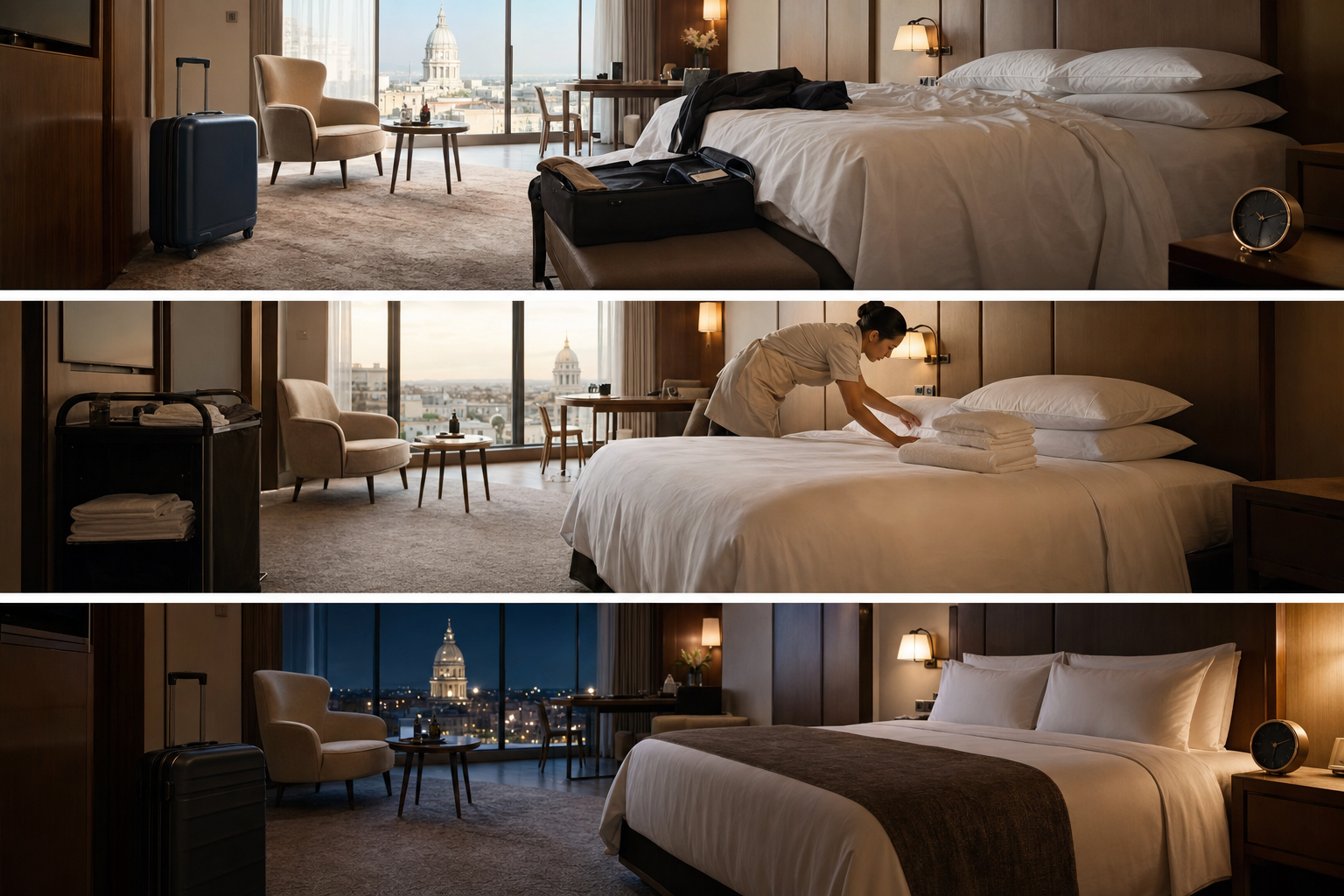

At half past eleven in the morning, one room can belong to three different guests without any of them knowing it yet. The first is still inside because they requested a late check-out. The second will arrive earlier than planned and expects an early check-in. The third will not even sleep at the hotel, but has booked a few hours of day use to rest, shower or work. Between them appears a fourth protagonist, far less visible and much more decisive: the person who must clean, inspect and release the room on time.
I have lived through many days when an apparently excellent sale ended up becoming a small operational crisis. Revenue celebrated the additional income, Front Office tried to keep several promises at once and Housekeeping discovered that the planned work sequence no longer worked. The hotel had sold more, yes, but it had also sold part of the time it needed to produce the next stay. That difference rarely appears in the day’s commercial report.
A room is usually managed as an overnight unit. We sell it from arrival date to departure date, calculate its rate, analyse its channel and measure its contribution. Yet guests consume much more than nights. They consume hours, priorities, access, flexibility and response capacity. They may ask to enter early, leave late, store luggage, use a shower, remain at the pool, work in a common area or return a few hours after check-out. Each possibility uses a different part of the hotel and carries a different cost.
The mistake is to treat these requests as isolated incidents that Front Office resolves through goodwill. When demand is occasional, improvisation may seem sufficient. When it repeats, it stops being spontaneous hospitality and becomes an unmanaged business line. Contradictory exceptions, prices determined by whoever is on shift, difficult commercial promises and uncomfortable negotiation in front of the guest then damage the hotel guest experience.
I therefore propose recognising an economic category we still manage in fragments: Stay Inventory. It consists of all the temporal and operational rights that can be sold before, during and after the night. Managed well, it increases revenue, improves perceived flexibility and differentiates the hotel. Managed badly, it can block rooms, strain Housekeeping, delay arrivals and turn a forty-euro supplement into two hundred euros of compensation.
A room is not a night; it is a sequence of capacity
The traditional unit of hotel Revenue Management has been the room-night. It is useful, comparable and deeply embedded in our control systems. The problem appears when we try to use it to explain everything that happens between two consecutive nights. A room occupied until noon and available again at three does not contain only a departure and an arrival. It contains a three-hour turnaround window in which cleaning, replenishment, inspection and, when necessary, Maintenance work must all be completed.
If we authorise a late check-out until two o’clock, we have not merely given two hours to the departing guest. We have consumed two thirds of the window available to prepare the room for the next stay. The economic value of those two hours depends on what happens afterwards. If the room remains empty that night, the marginal cost may be low. If there is a guaranteed arrival at three, the category is sold out and Housekeeping is operating at its limit, the same two hours can be extraordinarily expensive.
This is one of the most interesting contradictions in hotel management. The same product can be profitable or harmful without changing its duration or price. The result depends on the capacity context. A late check-out sold for fifty euros may generate excellent contribution on a quiet Sunday and destroy margin on a fully occupied Friday with many departures, numerous arrivals and several rooms out of service.
Early check-in works in a similar way, although we tend to perceive it as a more innocent request. If the room is already clean and inspected, handing over the key early can create considerable value for the guest at very little cost. When it forces Housekeeping to alter its sequence, change assignments, displace a priority room or interrupt an inspection, its cost rises. The difficulty is that this cost does not arrive as an invoice. It is silently distributed across minutes of coordination, movement, calls, pressure and reordered work.
We must also distinguish between physical capacity and time capacity. A hotel may have one hundred rooms physically available, but not one hundred rooms capable of simultaneously absorbing late departures, early arrivals and day-use stays. The constraint may be the number of room attendants, laundry, inspection, internal linen transport, service lifts or the concentration of arrivals. Selling time without identifying that bottleneck is equivalent to selling imaginary capacity.
Day use adds another layer of complexity. Commercially it is attractive because it allows a room to generate a second income within the same day. In certain urban, airport or hospital- and business-district hotels, it can respond to real and recurring demand. However, a room used from ten in the morning until five in the afternoon may require two cleans, block a category throughout the turnaround window and compromise the evening arrival. The room has been sold twice, but it has also been produced twice.
To assess these operations correctly, I use a logic of net time contribution. The calculation can be expressed simply:
Net time contribution = additional revenue − direct costs − priority cost − expected collision cost − displaced demand − probable compensation.
Direct costs include additional cleaning, amenities, laundry, consumption and commissions. The priority cost represents the work generated by altering the planned sequence. Expected collision cost incorporates the probability that the time concession interferes with another stay. Displacement measures the revenue we forgo by blocking the room or one of its alternative uses. Finally, it is sensible to consider compensation risk when a promise cannot be fulfilled.
I am not suggesting that Front Office solve a financial formula while the guest waits at the desk. That would be a rather creative way of making check-in worse. The calculation should be done beforehand using operating patterns and defined scenarios. The aim is to turn hundreds of small negotiations into a few economic rules that the team can understand and apply safely.
Five variables are particularly useful when building those rules:
- Probability of immediate room reuse. A late departure has a very different cost when the unit remains empty than when there is a confirmed arrival. The forecast should be made by category and, in some cases, by specific room, because a unique suite does not have the same substitutability as a standard room.
- Pressure on the turnaround window. The number of departures alone does not explain the difficulty of the day. We need to know how many rooms must be cleaned within a particular period, how many early arrivals are committed and what real resources will be available to complete the work.
- Production complexity. Not every room requires the same amount of time. A long stay, a family unit, a suite with several areas or a room requiring technical intervention may consume much more capacity than a simple departure. Selling an extra hour without considering that complexity can transfer a disproportionate burden to Housekeeping.
- The value of flexibility to the guest. An early arrival after an overnight flight may have a perceived value far greater than entering one hour early for convenience. Price should not depend solely on the time granted, but also on the utility we create, the segment and the alternative the hotel can offer.
- Decision reversibility. Some concessions can be changed if the operational situation changes; others immediately become firm promises. The lower the reversibility, the greater the certainty required before selling. Confirming a late check-out several days in advance requires different protection from offering it on the morning of departure.
This last variable receives too little attention. Many hotels sell future flexibility as though they already knew what the operation will look like that day. They accept a guaranteed early check-in weeks in advance without reserving any specific capacity to fulfil it. In reality, they sell a conditional promise using the language of certainty. When the date arrives, Front Office discovers that the commercial promise depends on Housekeeping performing a small miracle before noon.
The solution is not to stop selling in advance. It is to distinguish between a registered request, an operational priority and a contractual guarantee. They are three different commitments and should be communicated as such. A request means the hotel will try. A priority means the hotel will organise the operation to favour it. A guarantee means protecting the necessary capacity, even when that protection has a cost.
This distinction also improves hotel marketing. Promising flexibility can be a powerful commercial advantage, especially for segments with inconvenient schedules. But the value of the promise depends on its credibility. If the hotel sells guaranteed early check-in and then explains that it is subject to availability, it is not offering flexibility. It is selling hope with a surcharge.
Stay Inventory does not end at the bedroom door either. Luggage storage, changing rooms, showers, work areas, F&B outlets, pools and other spaces can absorb part of the guest’s need without consuming the scarcest resource. A family arriving early may not need the room immediately if they can leave their luggage, change comfortably and access the facilities. A corporate traveller may value a quiet place to work more than entering the bedroom three hours early.
These alternatives turn a binary response into an options design. Instead of deciding only whether or not to hand over the room, we can manage different levels of access. The objective is to preserve critical capacity while meeting the need behind the request. This perspective improves the experience and expands the strategies available to hotels that want to monetise ancillary services without saturating their core inventory.
I have learned that guests usually accept a limitation more readily when they receive a concrete, useful and well-presented alternative. “The room is not ready yet” closes a door. “We can store your luggage, offer you somewhere to change and give you immediate access to the pool while we prioritise your room” begins to build an arrival experience. The difference is not only in the words. It lies in having designed alternative capacity to respond.
A shared architecture for selling time without selling problems
Stay Inventory forces Revenue, Front Office and Housekeeping to work with shared criteria. If each department optimises only its own result, the hotel can win a sale and lose the operation. Revenue sees incremental income, Front Office sees an opportunity to satisfy the guest and Housekeeping receives a last-minute disruption. All three are right from their own perspective and, precisely for that reason, the system fails.
The first decision is to define which time-based products the hotel wants to offer. Not every property needs to commercialise every possibility. The choice should respond to segment, location, seasonality, value proposition and operating capacity. A resort may find considerable value in access to facilities after check-out. An urban hotel may develop day use and workspaces. A property near an airport may focus on short rests, showers and flexible schedules.
I would create a limited, understandable catalogue that includes, at a minimum, duration, guarantee level, included services, booking cut-off time, cancellation policy and operating conditions. Flexibility should not become ambiguity. The more exceptional each case appears, the more time it will consume in explanation, authorisation and coordination.
That catalogue can be organised around four decision levels:
- Automatic sale. Low-risk products that can be confirmed without consultation when predefined conditions are met. For example, a short extension in a room with no subsequent arrival, within a maximum quota and with sufficient Housekeeping capacity.
- Conditional sale. Occupancy, category, next arrival time or operating workload must be checked before confirmation. The response should be fast and there should be a clear owner, so the guest is not left waiting while the request travels through half the organisation chart.
- Protected sale. Products guaranteed in advance. The hotel reserves specific capacity, limits units and applies a price that compensates for the risk. Protection may require blocking a room, adjusting assignments or retaining a small inventory buffer.
- Suspended sale. Activated when operational pressure exceeds defined limits. On those dates, the hotel stops offering certain extensions, reduces time windows or redirects demand towards alternatives that do not use bedrooms. Forgoing marginal revenue may be the most profitable decision of the day.
Commercial suspension often meets resistance because it looks like a visible loss. Yet the cost of accepting every request remains hidden until operations collide. Then it appears as late room deliveries, last-minute changes, complaints, compensation, stress and loss of trust. Hotel profitability improves when we learn to compare the revenue we can see with the risk we are creating.
We should also abandon the habit of pricing late check-out as a fixed percentage of ADR. The rule is convenient but economically incomplete. ADR reflects the value of a night, whereas an extension consumes a very specific fraction of operating capacity. One extra hour may cost very little at low occupancy and a great deal during a critical turnaround.
Late check-out pricing should consider duration, operating pressure, category, resale possibility, lead time and guarantee level. A tiered scale can be used, but the tiers should reflect the hotel’s real economics. An extension until one o’clock does not consume the same capacity as staying until five. Beyond a certain time, it may make more sense to sell a day-use rate or charge a substantial fraction of the night, because the room has already lost much of its next commercial opportunity.
Early check-in is similar. Charging simply for entering earlier can be difficult to justify if the guest sees that the room has been ready for hours. It is better to present the product as a guarantee of early availability, not the arbitrary rental of a key. The price pays for protected capacity, advance planning and the certainty offered. When it is granted free because the room is already available, that should also be recorded. Complimentary flexibility has value and forms part of a recognition, loyalty or recovery strategy.
Recording complimentary concessions prevents a common distortion. Some hotels measure only charged revenue and conclude that these services have little demand. Meanwhile, Front Office may be granting dozens of extensions, access rights and early arrivals that consume capacity without appearing in any account. Before designing a new product, it is worth auditing for several weeks everything the hotel already gives away without a price.
Books to run a hotel with judgement
Written from the general manager’s chair: technology, guest experience, leadership and management.
 The Intelligent HotelData, Artificial Intelligence and a New Way to Run Hotels
 Directing HotelsWhat Nobody Tells You Before You Sit in the General Manager’s Chair
 Leadership and High-Performance Team ManagementPeople, Experiences and Results in Today\\\'s Hospitality
 The Guest JourneyDesigning Customer Experience Across the Entire Hotel Journey
That audit should record the requested time, the granted time, category, forecast occupancy, reason for the request, whether there was a charge, who authorised it, how much additional work it generated and whether any collision occurred. There is no need to start with a major platform. Simple recording discipline can reveal more than a sophisticated dashboard fed by incomplete data.
Useful patterns usually emerge. A particular segment may repeatedly request early check-in because its flights arrive first thing in the morning. There may be an opportunity to design a specific rate, adjust pre-arrival communication or reserve a small amount of protected inventory. Late check-outs may concentrate on Sundays, when arrival pressure is lower. In that case, the hotel can market them more proactively and with a different policy from Friday.
Hotel strategic planning begins precisely there: turning repeated observations into structural decisions. If the same exception appears every day, it is probably no longer an exception. It is a poorly defined product, an unmet need or a capacity we have not yet learned to value.
A particularly useful tool is the Time Collision Matrix. Its purpose is to determine what happens when several uses compete for the same room. It can be built around four simple questions:
- Who holds the firmest promise? A paid guarantee should take priority over a request subject to availability. If the hotel does not distinguish between the two commitments, it will end up deciding according to pressure, customer hierarchy or negotiating skill—hardly consistent criteria.
- Which use generates the greatest net contribution? The price charged is not enough. Production, displacement and risk must be deducted. An attractive day-use fee may contribute less margin than protecting the arrival of a four-night stay in a sold-out category.
- Which alternative causes the least loss of value? Sometimes it is possible to change the assigned room, offer access to facilities or move the extension to another space. The most profitable solution may be to satisfy the need without providing exactly the resource requested.
- How much recovery margin remains? A decision made at nine in the morning has more options than one made twenty minutes before arrival. The smaller the recovery window, the greater the authority required and the more conservative the criterion should be.
This matrix must translate into operational authority. Front Office needs to know what it can sell, give away or refuse without seeking permission. Housekeeping must know which priorities are firm and which can change. Revenue needs information about real capacity before opening time-based products. Coordination cannot depend on a chain of improvised messages every time someone asks whether they can stay one more hour.
Leadership in Hospitality becomes visible when criteria survive the change of shift. If a decision depends on who is at Front Office, which housekeeper is present or whether someone manages to locate a manager, the hotel does not yet have a policy. It has a collection of opinions wearing uniforms.
To avoid this, I recommend a brief operational huddle focused on the turnaround period. There is no need to create another ceremonial meeting. A few minutes are enough to review late departures, early arrivals, priority rooms, sold-out categories, technical incidents and time-based products sold. The purpose is for everyone to work from the same map of the day.
In high-pressure hotels, it is also useful to define a freeze time. After that point, certain assignments and priorities may change only for a justified reason. The freeze protects Housekeeping from a continuous flow of modifications that makes any plan meaningless. Commercial flexibility needs time boundaries if it is not to become operational instability.
Another important principle is to reserve a recovery window. Between one use and the next there must be enough time to absorb delays, inspect the room and correct incidents. Chaining a day use, minimal cleaning and an evening arrival with no margin may look efficient. In practice, one late departure, breakdown or deep-cleaning requirement is enough to collapse the whole sequence.
This margin should not be interpreted as wasted time. It is protective capacity. An operation without recovery can produce more revenue under perfect conditions, but Hospitality rarely offers perfect conditions for many consecutive hours. There will always be a forgotten suitcase, a shower used five minutes after the agreed time or a coffee machine that decides to retire precisely when the room is in a hurry.
The model must also incorporate the experience of the guest arriving afterwards. There is a tendency to evaluate the time-based service only from the perspective of the person buying it. But a room sold twice affects two experiences. The customer who pays to leave late receives value. The customer waiting to enter may receive the emotional bill for that decision. The first guest’s contribution should never be analysed while ignoring the second.
For that reason, I consider it essential to measure indicators that connect revenue, operations and experience:
- Net revenue per hour granted. Measures contribution after associated costs. It allows early check-in, late check-out, day use and other extensions to be compared without confusing billing with profitability.
- Time fulfilment rate. Shows what percentage of guaranteed services are delivered at exactly the promised time. Selling more products while fulfilment falls is not healthy growth; it is accumulated operational debt.
- Collision rate. Records how many time-based sales interfere with another stay, cause a forced change, delay a room delivery or require extraordinary intervention. This helps identify capacity limits.
- Housekeeping reordering minutes. Estimates the time spent changing sequences, reassigning rooms, moving around or rebuilding priorities. It is real work even if it does not appear as an additional clean.
- Time-related compensation cost. Groups discounts, amenities, upgrades and other costs arising from failures linked to timing. Its trend reveals whether incremental revenue is financing later problems.
- Conversion to alternatives. Measures how many requests can be resolved through luggage storage, changing rooms, F&B, work areas or facility access. Good conversion protects bedrooms and demonstrates that the hotel understands the need beyond the literal request.
- Demand deliberately declined. Recording what we choose not to sell allows us to estimate future opportunities and determine whether capacity should be expanded. Consciously rejecting demand is very different from not knowing how much demand exists.
These indicators also help review staffing and process design. If day use has demand and margin but the second clean prevents its development, there may be an opportunity to create a dedicated shift, cell or sequence. If early check-ins concentrate in certain categories, capacity can be reserved or part of production brought forward. Commercial information should lead to operational decisions, not merely prove that guests want flexibility.
There is also a positioning dimension. A hotel may decide that time flexibility is central to its value proposition. That choice requires investment, rules and protected capacity. Another property may offer it selectively and at high prices. Both strategies are valid if they are coherent. The danger lies in communicating broad flexibility while the operation depends on internal favours and people running down corridors.
The policy should also explain what happens with repeat guests, loyalty programmes, direct bookings and high-value segments. Giving priority may be a good strategy, but priority consumes inventory. If every tier promises late check-out, every package includes early check-in and every service failure is recovered by giving away hours, we will soon discover that we have distributed more flexibility than the hotel can produce.
That is why I would assign a time-capacity budget to each strategic use. One portion can be reserved for sale, another for loyalty, another for service recovery and another as operational protection. This approach forces us to recognise that giving away an hour and selling it use the same resource, even though they pursue different objectives. The decision can remain free for the guest, but it should never be invisible to the hotel.
Final communication deserves the same rigour. The guest must understand what has been purchased, until what time they may stay, which spaces are included and what will happen with luggage or access to facilities. Ambiguity creates arguments precisely at departure, when the team has the least room to resolve them. A well-explained policy protects the relationship and prevents an experience of flexibility ending with someone knocking on the door to remind the guest that the purchased time ended twenty minutes ago.
If I had to start tomorrow, I would not immediately launch new supplements. For two or three weeks I would observe what time we are giving away, selling, refusing and promising. I would review the periods in which collisions occur and listen especially to Front Office and Housekeeping, because that is where the cost omitted by other reports becomes visible. That first snapshot would allow us to design a policy based on the real hotel rather than a generic idea of what should work.
Then I would choose a small number of products, set limits by day and category, calculate their net time contribution and give the team clear authority. I prefer to start with a limited offer the hotel can always fulfil, learn from its behaviour and expand gradually. In this area, selling fewer units reliably usually builds more profitability than opening all capacity and hoping the morning will be kind.
A room sold twice on the same day can represent an excellent business opportunity. It can also reveal that we are still measuring nights while the guest buys time. When Revenue, Front Office and Housekeeping share the same economics, flexibility stops being a dangerous exception and becomes a designed capability. My advice is simple: before putting a price on an hour, understand which part of the next stay you are using to produce it.
This article ends here. The archive does not.
Lead Hospitality brings together 1200 English articles published since 2018: years of experiences, decisions and lessons you can keep exploring.
What would you like to explore next?
Choose a direction and keep reading around what you want to solve, learn or challenge.