Hotel StrategyCustomer-Centric Revenue ManagementHotel Repositioning
The Door, the Rate, and the Red Line of Hotel Positioning
Hotel positioning becomes real when it defines the demand you want to attract, the price that protects your proposition, and the business you are willing to turn away. This guide offers a clear, practical framework for turning those choices into consistent commercial, operational, and financial decisions.
Albert BarraSeptember 8, 2026 · 21 min read
I remember a commercial meeting in which the booking pace for the following weeks was clearly below forecast. The conversation began with a degree of calm, but within minutes the usual proposals emerged: open an additional channel, launch a promotion, accept a group that had not previously been a fit, relax conditions and lower the entry rate. Each measure could be defended individually. Together, however, they were about to turn the hotel into something different from what we had decided to build.
That day confirmed a suspicion that has accompanied me through many hotel strategic planning processes. Most hotels can explain what they want to sell, but few have precisely defined which demand they want to admit, what price they need to sustain and which business they are willing to turn away. Positioning is often presented through photographs, brand attributes, guest profiles and carefully crafted phrases. All of that matters, although it is insufficient when a low-occupancy Tuesday arrives and the P&L starts looking at the committee rather unfavourably.
I prefer to approach hotel positioning with considerably more detachment. To me, positioning means allocating scarce resources. A room, a table, an hour of team time, a pool time slot, a parking space or Front Desk attention cannot be given simultaneously to every possible source of demand. Every accepted guest consumes capacity, shapes the atmosphere, creates expectations, displaces other opportunities and leaves an economic and operational footprint that rarely ends with room revenue.
That is why I use three simple images to examine a hotel’s strategy. The first is the door, representing the demand to which we make access easier. The second is the rate, which selects, orders and monetises that demand. The third is the red line, indicating what we will not do, even if it produces occupancy, visibility or short-term revenue. If one of the three disappears, positioning becomes incomplete. If all three disappear, all that remains is inventory trying to find a buyer.
In the following pages, I propose a guide to turn these images into a decision-making system. I do not intend to offer a universal formula, because a leisure resort, an urban hotel, a luxury property and a roadside hotel have different economics and obligations. My aim is to help you build your own admissibility boundary, linking demand, price, capacity, experience and profitability. The ultimate objective is not to appear different, but to know exactly which decisions allow your hotel to remain recognisable and profitable when the market stops cooperating.
Positioning begins at the boundary of what is admissible
A hotel is not positioned by what it declares on its website, but by the set of transactions it repeatedly accepts. If it communicates tranquillity but admits volumes that overcrowd common areas, the market will believe the overcrowding. If it promises exclusivity but keeps promotions permanently open, guests will believe the discount. If it presents itself as a family specialist while designing schedules incompatible with families, the experience will quickly correct the message.
This gap between declared identity and economic behaviour explains why some hotels seem to change personality according to occupancy levels. When demand is strong, they are disciplined, protect rates and select business. When pace weakens, they discover a surprising universal vocation. The problem is not making tactical adjustments. A strategy unable to adapt would be of little use. The problem arises when adaptation changes the nature of the hotel and attracts demand that damages its margin, operation or the experience of priority guests.
I have learned to think of positioning as the hotel’s economic constitution. It does not describe every possible decision, but it sets the limits within which those decisions remain coherent. That constitution must answer three uncomfortable questions:
Which demand deserves our capacity. It is not enough to check whether someone is willing to pay. We must estimate the contribution it delivers, the resources it consumes, the expectations it arrives with, how it coexists with other guests and how likely it is to strengthen reputation, repeat business or recommendation within the market we intend to occupy.
Which price protects the model. The rate must cover more than the incremental cost of accommodating a booking. It must also protect perceived value, fund the promised experience, remunerate invested capital, absorb acquisition cost and compensate for the potential displacement of better demand.
Which revenue we prefer to lose. Every serious strategy contains a list of business the hotel will not pursue, conditions it will not grant and capacity it will not sacrifice. That list does not express rigidity or superiority. It shows that we have calculated the consequences of saying yes too many times.
These three answers form the positioning boundary. Within it, there is freedom to manage prices, channels, campaigns, packages and segments. Outside it, any exception requires an explicit justification, an owner and an expiry date. Otherwise, the exception becomes precedent, and precedent eventually turns into policy through administrative fatigue.
The demand door. Traditional segmentation classifies guests according to origin, travel purpose, channel, booking window, length of stay, price sensitivity and other variables. It is useful for describing what happens, but positioning requires an additional decision: determining the role we want each type of demand to play. I usually divide it into four zones.
Core demand. This is the demand that justifies the hotel’s design and best recognises its proposition. It does not need to represent all volume, but it should guide product, communication, standards, investment and culture. Its value does not come solely from rate; it may also bring repeat business, advocacy, stability, ancillary spend or less operational friction.
Compatible demand. It is not at the centre of the strategy, although it coexists well with it. It allows the hotel to fill capacity without materially changing the atmosphere, promise or cost to serve. It can be particularly valuable in periods when core demand does not cover available inventory.
Opportunistic demand. It is acceptable under certain dates, allocations, prices or conditions. Its suitability depends on context. It may be profitable one week and destructive the next. This is where many groups, promotions, wholesalers, crews, events or corporate agreements sit, as their value changes once displacement and operational pressure are included.
Destructive demand. This is demand whose apparent contribution does not offset its economic, reputational, cultural or operational damage. It may pay a reasonable rate and still be unsuitable. A segment that monopolises facilities, generates recurring conflicts, demands disproportionate concessions or alters the priority guest experience may fill rooms while reducing the hotel’s total value.
The value of this map lies in forcing us to abandon a dangerous simplification: demand and profitable guests are not synonymous. Two bookings at the same rate can produce opposite outcomes. One arrives through an efficient channel, stays several nights, uses high-margin services and fits the operation. The other comes with high commission, costly requests, cancellation risk, a short stay, concessions and an arrival concentrated during the busiest hour. Looking only at average rate is like comparing two icebergs by the portion above water.
To make more rigorous decisions, I use an approximation of net positioning contribution. It is not intended to replace a full P&L, but it considerably improves the conversation:
Net positioning contribution = expected net revenue − acquisition − incremental cost − concessions − displacement − operational friction − inconsistency risk
The first components can be estimated with reasonable precision. The final two require judgement. Operational friction captures additional hours, planning changes, pressure on departments, incidents and service complexity. Inconsistency risk estimates how much that demand may affect atmosphere, perception, reputation or loyalty among priority guests. Not having a perfect figure does not justify assigning them a value of zero.
The rate as a selection mechanism. Price does not merely capture value; it also regulates who buys, when they buy, what they expect and what capacity remains available. This selective function is often overlooked in parts of hotel revenue management. We lower rates in search of more demand without asking what kind of demand will respond, what expectations it will bring and whether the increase in volume will compensate for the change in mix.
Rather than working with a single minimum price, I find it more useful to distinguish three rate floors:
Economic floor. This is the minimum rate that delivers contribution after acquisition, variable costs, concessions and foreseeable risks are considered. Selling below it may make sense in exceptional circumstances, but it should be recognised as an investment or defensive decision, never as profitable business.
Positioning floor. This is the level below which the rate begins to send a signal incompatible with the proposition, attracts demand that is difficult to serve coherently or trains the market to expect future discounts. It may sit substantially above the economic floor.
Opportunity floor. This incorporates the demand we could displace. On dates with limited capacity, the acceptable price must reflect the expected value of holding inventory. This floor changes over time, with booking pace, length of stay, arrival patterns and the probability of selling better.
In general terms, the minimum admissible price should be the highest of these three floors. This rule prevents us from accepting a booking because it covers variable costs when, in reality, it erodes positioning or displaces a better opportunity. It also forces Revenue, Sales, Marketing and Operations to speak the same language. An apparently attractive rate may not be so attractive if it requires changes to the product, grants additional benefits or concentrates workload at a critical moment.
There is also a rarely discussed issue: price determines perceived entitlement. As the rate increases, expectations of space, flexibility, recognition, speed and control tend to rise. Yet a very low rate can also generate demands if the communication has overstated the experience. The challenge is to align price, promise and actual capacity. Charging more without improving reliability disappoints; charging less permanently can devalue an experience that genuinely deserves a different price.
The red line of trade-offs. Few tools reveal a hotel’s strategic maturity better than an updated list of what it has decided not to do. Trade-offs turn positioning into a verifiable choice. Without them, all value propositions eventually begin to look alike because none has borne the cost of specialising.
It is worth recording at least six types of trade-off:
Demand trade-offs. Segments, behaviours or stay formats that do not fit the property’s experience, capacity or culture, even if they may provide occasional occupancy.
Price trade-offs. Rates, cumulative discounts and concessions the hotel will not accept because they destroy contribution or contradict the value signal it needs to sustain.
Channel trade-offs. Distributors or agreements whose production does not offset their cost, loss of control, exposure conditions or the quality of demand obtained.
Product trade-offs. Services added solely because competitors offer them, but which scatter investment, increase complexity or lack relevance for priority demand.
Operational trade-offs. Volumes, schedules, configurations or promises that exceed the team’s sustainable capacity and turn every additional sale into a risk to the entire experience.
Capital trade-offs. Attractive refurbishments, equipment and projects that do not strengthen the selected position. The budget also needs a red line; otherwise, it ends up funding bright ideas with surprising ease.
These trade-offs have a visible cost. A room may remain empty, a group may be lost, market share may temporarily decline or immediate revenue may disappear. That is why they are so difficult to defend. The benefits of positioning usually accumulate slowly, while the rejected booking appears on today’s report. Inconsistency has an unfair accounting advantage: it collects now and sends the full bill months later.
I have seen apparently clear strategies collapse as soon as occupancy falls below a certain level. I call this phenomenon elasticity of conviction. Everyone defends the brand when the hotel is full; the test begins when inventory is available. If nobody knows what will be maintained, what will be relaxed and what will remain prohibited in an adverse scenario, there is no strategy prepared for reality. There is only a preference conditional on fair weather.
That is why I apply three tests before considering a positioning credible:
The empty Tuesday test. Which limits would we maintain at occupancy far below forecast? It identifies genuine trade-offs and separates convictions from situational luxuries.
The full Saturday test. Which demand would we displace first when capacity becomes scarce? It reveals which segments are truly priorities and which were present only because there was room.
The uncomfortable money test. Which business would we reject even if it generated significant revenue? This question forces us to acknowledge risks to reputation, the team, the guest experience, safety or hotel identity that do not appear in ADR.
A positioning passes these tests when it produces specific answers. Phrases such as “it depends on the moment” or “we would need to study it” are reasonable to a point, although they sometimes conceal the absence of criteria. Strategy should not anticipate every situation, but it should provide sufficient principles to make decisions under pressure without reinventing the hotel in every meeting.
A system for choosing demand, price and trade-offs without improvising
Turning this reflection into hotel management requires more than inspiration. We need concise documents, clear owners, indicators and regular conversations. My proposal is to build a Positioning Contract, understood as the internal agreement that defines priority demand, economic limits and the trade-offs that should govern the hotel’s decisions.
The contract should not be a lengthy manual. If it takes fifty pages to explain whom we serve and by which rules, we probably have not yet made enough decisions. It can be structured around seven blocks that force us to move from intentions to observable criteria.
1. Define the hotel’s economic role. Before discussing guests, it is useful to clarify the function the asset must fulfil. Maximising short-term cash flow is not the same as building a premium position, stabilising annual revenue, increasing real estate value, reducing seasonality or preparing for repositioning. Two physically similar properties may need opposing strategies because their economic objectives differ.
This point requires a candid conversation with ownership. I have participated in plans that simultaneously sought to increase rates, raise occupancy, reduce costs, attract new segments, refurbish facilities and keep the year’s profit entirely intact. All of these may be desirable, but not all can come first. Positioning requires a hierarchy of objectives and a time horizon. Without them, every result disappoints because there will always be another metric that did not improve.
2. Identify the advantage we can deliver. A valuable proposition must be relevant to a demand segment, defensible against alternatives and consistently executable. The third condition is the one that eliminates the most strategies. We can imagine an extraordinary experience, but if it requires staffing, coordination or investment that the hotel cannot sustain, the promise will become a liability.
I recommend stating the advantage in a deliberately unadvertising-like sentence:
For a specific demand segment, our hotel solves a priority need better than its alternatives because of capabilities we can sustain profitably.
Each word should then be tested against evidence. Is the demand sufficiently specific? Does the need truly influence purchase? Are we better, or merely different? Does the capability depend on one exceptional person? Does the margin allow us to maintain it? This discipline prevents positioning from being built around generic attributes such as location, personalised service, refined gastronomy or excellent service—virtues almost every hotel claims to possess.
3. Write the Demand Charter. This document establishes the four demand zones and describes, for each, its value, admission conditions, capacity limits and risk signals. It should not be limited to demographic profiles. It must include behaviours, needs, stay economics and compatibility with other guests.
A useful Demand Charter can answer these questions:
Which problem the guest comes to solve. Resting, celebrating, working, reconnecting, accessing a destination, simplifying a family trip or receiving recognition are different needs that shape the design of the stay.
What the guest values and why they are willing to pay. Identifying true value drivers helps avoid eye-catching investments that guests appreciate in a photograph but do not reward when booking.
What capacity the guest consumes beyond the room. Food and beverage, parking, activities, spa, pools, service attention, housekeeping time, schedule flexibility and concentration of use should all be considered.
Which other demand segments it coexists well with. Guest mix influences atmosphere. Two individually profitable segments may be incompatible when they share spaces, schedules or expectations.
Which behaviours anticipate friction. Extreme price pressure, ambiguous requests, a history of concessions, disproportionate expectations or resistance to conditions may signal a booking that is economically more complex than it appears.
4. Build the Price Corridor. A coherent pricing strategy needs more than a minimum and a maximum. It must define a range within which price maintains a credible relationship with the product, demand and context. The corridor can shift according to season, booking window, occupancy, events, length of stay and conditions, but it should not lose its logic.
For each relevant segment, it is useful to set four reference points:
Entry price. This is the lowest visible or accessible rate under normal conditions. Its function is to provide a route in without devaluing the rest of the architecture.
Core price. It represents the level that best balances conversion, perceived value and contribution under normal circumstances.
Scarcity price. It monetises limited capacity when the probability of selling is high. It must be defensible through demand, product and conditions, not merely through the absence of inventory.
Break point price. It marks the point at which a rate that is too low or too high begins to harm positioning. The upper limit matters too; charging an amount the experience cannot justify generates revenue today and disappointment tomorrow.
This corridor does not prevent dynamism. It disciplines it. It allows hotel revenue management to respond to demand without turning every fluctuation into an identity crisis. It also helps hotel marketing communicate value more precisely and prevents Sales from negotiating conditions that Operations must later fund silently.
5. Create the Trade-off Register. I recommend turning every trade-off into a documented decision with five elements: rationale, risk avoided, accepted cost, owner and review conditions. In this way, “no” stops depending on the temperament of whoever is in the meeting and becomes a reasoned policy.
A register may include decisions such as limiting certain group formats on critical dates, not stacking discounts above a threshold, protecting specific room types, excluding services incompatible with operations, avoiding channels that prevent control of the promise or reserving capacity for priority demand. Every hotel will have different trade-offs. What matters is that they can be explained in economic and experiential terms.
It is also useful to calculate the accepted cost of coherence. If we reject business, we should estimate the revenue and contribution we forgo. This practice prevents us from romanticising trade-offs. Saying no may be strategic, but it can also be an elegant way to preserve prejudice, inefficiency or old decisions that nobody dares revisit. A trade-off must protect superior value, not simply make us feel selective.
6. Budget for exceptions. No framework survives contact with operations entirely intact. Singular opportunities, commercial relationships, reputational situations and unusual periods will arise that justify temporarily crossing a boundary. The solution is not to prohibit every exception, but to govern it.
I propose assigning a controlled inconsistency budget. It may be expressed as a number of rooms, a percentage of inventory, an amount of concessions or contribution sacrificed. Every exception consumes part of that budget and must include a hypothesis: what we expect to learn, protect or gain. When the limit is exhausted, new exceptions require a higher-level decision.
This mechanism prevents the exceptional from multiplying without visibility. In many hotels, nobody formally approves abandoning positioning; small flexibilities are simply granted by different departments until the aggregate result contradicts the strategy. Revenue adjusts a price, Sales adds a concession, Marketing launches an incentive and Front Desk compensates for a poorly configured expectation. Each gesture seems minor. Their sum can be considerable.
7. Translate strategy into departmental decisions. Positioning only acquires value when it changes concrete priorities. Every department should be able to identify what changes in its work because of the chosen position.
Revenue must govern not only rate, but also acquisition cost, demand quality, displaced capacity and strategic price floors.
Marketing needs to attract priority demand, reduce incompatible expectations and avoid campaigns that generate high traffic with weak conversion or poor fit.
Sales must have criteria to accept, renegotiate or reject business without measuring success solely by gross production.
Operations needs to adapt standards, schedules, flows and staffing to the moments most valued by selected guests, rather than distributing resources uniformly.
Finance must incorporate the cost of complexity, displacement, concessions and future deterioration, even when several of these items require estimates.
People and Culture must recruit and develop capabilities consistent with the promised experience. Positioning based on judgement, anticipation or personalisation requires different profiles, autonomy and training from a model focused on standardisation and volume.
This translation reveals important contradictions. A hotel may want higher-value demand while maintaining hiring processes focused exclusively on reducing payroll. It may promise serenity while maximising capacity. It may seek longer stays while internally rewarding the number of bookings. It may champion direct bookings while designing a website that forces the guest to overcome a small obstacle course. Positioning acts as a rather undiplomatic, but highly necessary, mirror.
Govern with indicators that measure coherence. ADR, occupancy, RevPAR and GOP remain indispensable, although they do not by themselves explain whether the hotel is strengthening its position. I recommend adding a focused scorecard of metrics able to show the quality of acquired business.
Net contribution per priority stay. This shows how much economic value core demand delivers after acquisition, spend and relevant costs.
Demand purity index. This measures the proportion of capacity occupied by core and compatible demand. Its purpose is not to reach one hundred per cent, but to monitor whether the mix is evolving in the chosen direction.
Leakage below the strategic floor. This records rooms sold below the positioning price, together with their causes, approvals and outcomes.
Cost of exceptions. This aggregates discounts, concessions, upgrades, operational hours and contribution sacrificed by decisions that crossed established rules.
Friction by segment. This compares incidents, compensation, repeated requests, pressure on facilities and service workload in order to identify apparently profitable demand that consumes invisible capacity.
Retention of priority demand. This analyses repeat business, recommendation and guest recovery within the selected territory, preventing overall loyalty from concealing the loss of guests who matter most to the strategy.
Return on trade-offs. This reviews what happened after business was rejected or limited. Some trade-offs will have protected capacity for a better sale; others will have left inventory empty and should be reconsidered.
I find the final metric particularly important. There is a certain tendency to celebrate rejected business as automatic proof of strategic courage. I prefer to verify the outcome. If a trade-off does not protect margin, experience, capacity, reputation or learning, it deserves review. Strategy requires conviction, but also the humility to recognise that a boundary was placed in the wrong location.
Stress-test before you need the answers. The Positioning Contract should be rehearsed under different scenarios. I suggest working with at least three demand levels: low occupancy, balance and sell-out conditions. In each, decide which prices may be relaxed, which channels may be opened, which segments gain priority, which trade-offs remain intact and who may authorise exceptions.
This exercise reduces emotional improvisation. It is much easier to defend a red line when it has been agreed before a specific opportunity appears with a name, volume and revenue attached to it. Once the business is on the table, we all develop an astonishing ability to find reasons proving that this particular exception was exactly what the strategy had been waiting for.
A practical 90-day implementation. The model can be launched without waiting for the next budgeting cycle. During the first thirty days, I would reconstruct actual demand over the previous twelve months: its contribution, friction, channel, use of capacity and compatibility. I would not look for definitive answers yet; I would seek to discover which business we are accepting and what it truly costs.
Between days thirty and sixty, I would define the Demand Charter, the three rate floors, the Price Corridor and the Trade-off Register. This phase must include commercial, operational and financial voices. If positioning is confined to Marketing or Revenue, it will inherit their blind spots. Operations knows costs that do not appear in reports, while the Sales team perceives objections that rarely reach dashboards.
In the final thirty days, I would turn the criteria into decision rules, owners, indicators and exception scenarios. I would then test the model against real bookings, groups, promotions and dates. The question would not be whether the document appears complete, but whether it helps resolve disagreements more quickly and effectively. A useful strategy reduces ambiguity; an ornamental strategy adds vocabulary to the same old discussions.
My advice is to begin with a small but economically real decision. Choose a segment, a date or an agreement that currently creates uncertainty and run it through the three boundaries. Check whether it belongs to the desired demand, whether it enters at a price capable of protecting the model and whether it requires breaching any trade-off. The value of the framework will emerge when you discover that a booking attractive for its volume ceases to be so when you examine its contribution, friction and impact on other opportunities.
I also advise reviewing trade-offs with the same discipline used to review rates. A red line is not a monument. It can move when the product, demand, capacity or asset objective changes. What should not happen is for it to shift silently under commercial pressure. If you are going to change it, document what evidence has changed and what outcome you expect. That is how you distinguish strategic evolution from a simple retreat.
Hotel positioning reaches its most honest form when it allows you to say three things without resorting to brand phrases: whom we want to serve, how much we need to charge and what we are willing to lose in order to remain coherent. If you and your team can answer precisely, the hotel will have a recognisable door, a defensible rate and a shared red line. If you cannot yet do so, that conversation deserves greater priority than the next promotion.



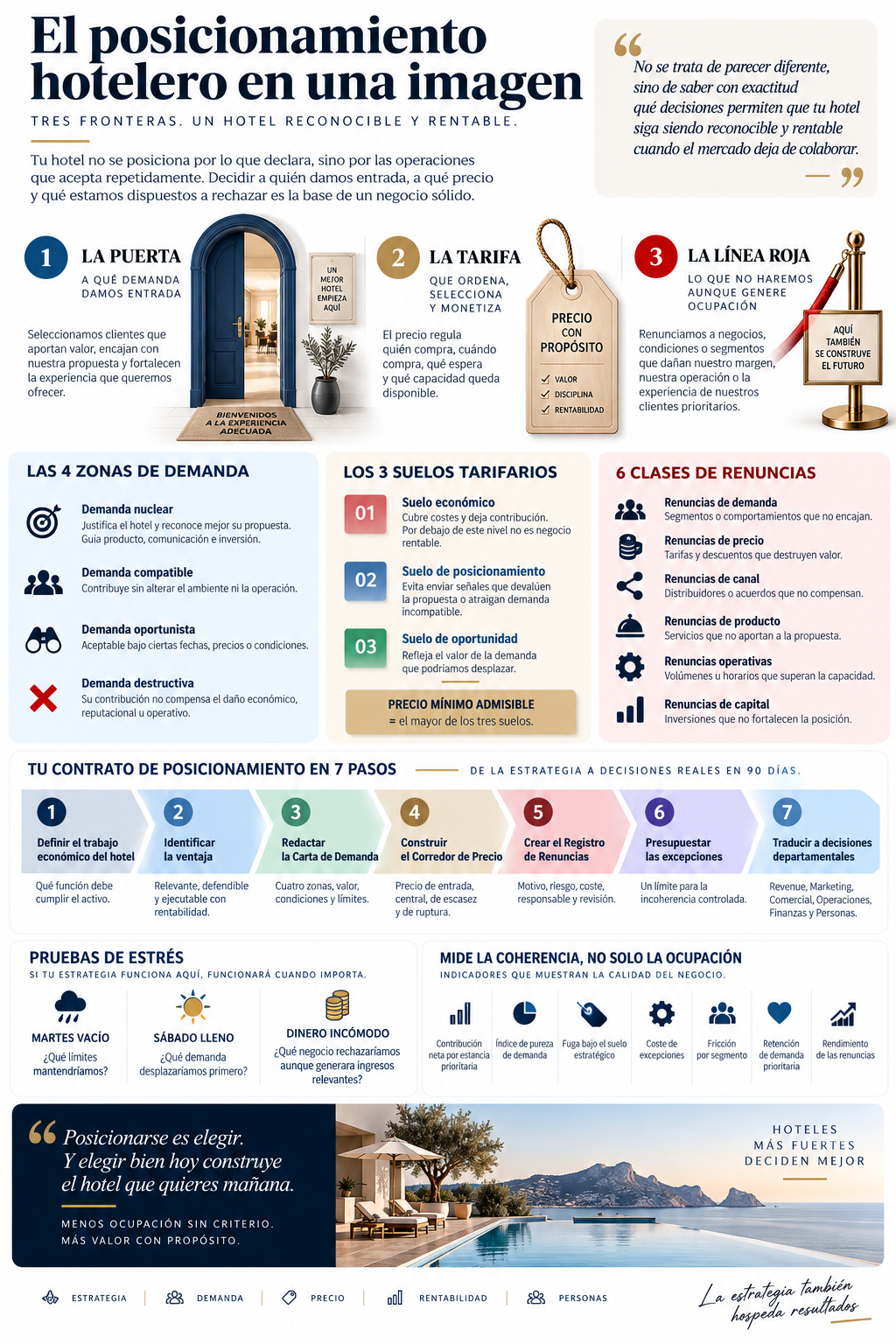 In the following pages, I propose a guide to turn these images into a decision-making system. I do not intend to offer a universal formula, because a leisure resort, an urban hotel, a luxury property and a roadside hotel have different economics and obligations. My aim is to help you build your own admissibility boundary, linking demand, price, capacity, experience and profitability. The ultimate objective is not to appear different, but to know exactly which decisions allow your hotel to remain recognisable and profitable when the market stops cooperating.